
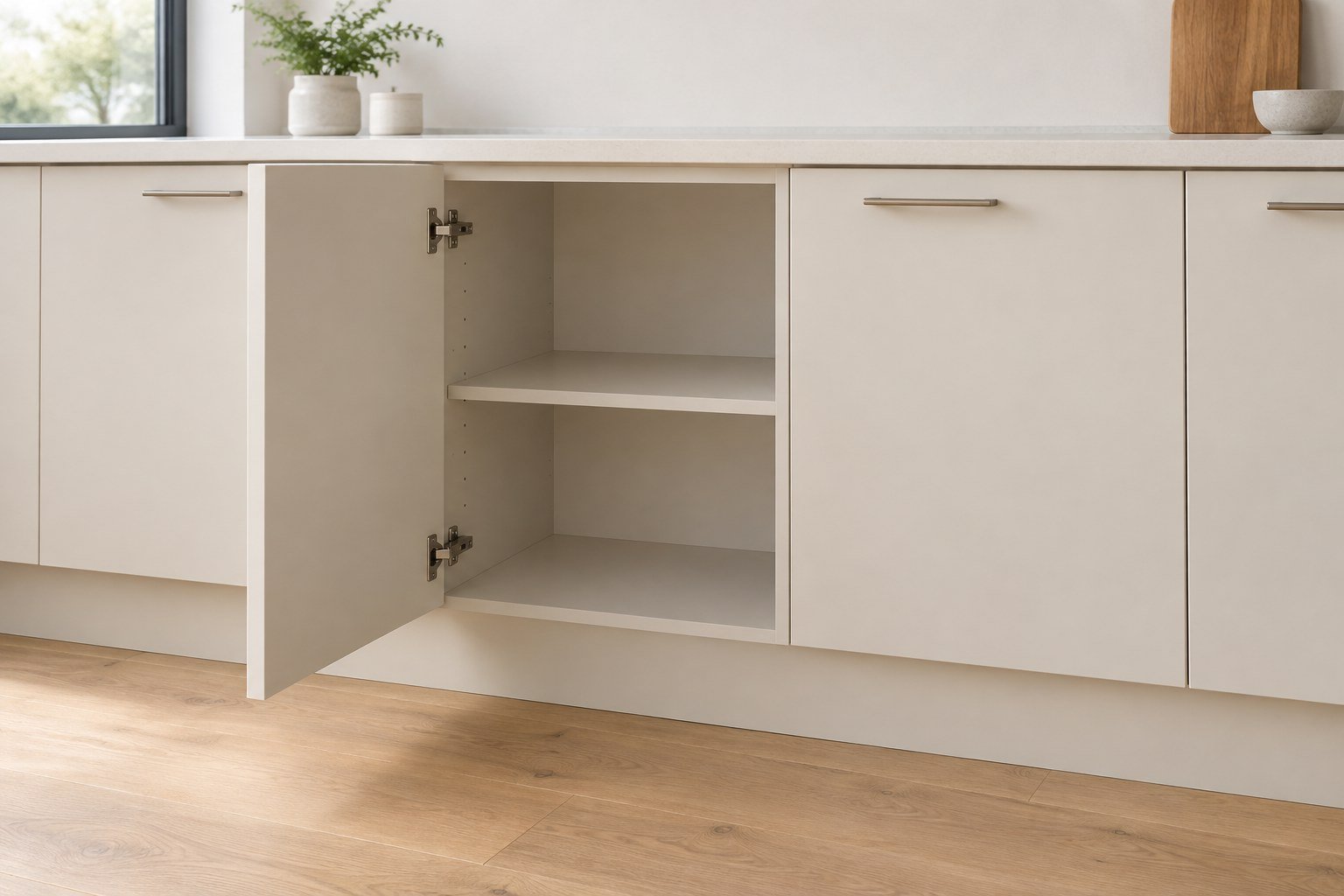
Kitchen cabinet refacing is worth investigating when the layout works, the cabinet boxes are sound and suitable replacement fronts can be fitted. Cabinet replacement deserves a closer look when you need different storage openings, a changed layout or a solution to problems within the boxes themselves.
The distinction starts behind the doors. A cabinet’s carcass is its box: the sides, base and other structural panels that remain when you open it. New doors can change the kitchen’s appearance while leaving that box—and its limitations—in place.
Before choosing either route, separate what you dislike looking at from what you need the kitchen to do differently.
Table of Contents
What changes with each option?
“Refresh”, “reface” and “replace” can describe different scopes. Establish which parts would stay, rather than relying on the label alone.
| Route | What changes | What stays or needs checking |
|---|---|---|
| Refinish existing fronts | The finish on the existing doors or drawer fronts, where the material and proposed finish are suitable. | The fronts, cabinet boxes and existing arrangement remain. Surface preparation and finish suitability need assessment. |
| Replace fronts or reface cabinetry | New doors and drawer fronts; refacing may also include a new surface on retained visible cabinet parts. | The existing boxes remain. Exposed panels, plinths, hinges, handles and drawer internals are included only if specified. |
| Replace cabinets | New cabinet boxes and the fronts and fittings selected for them. | The design can reconsider cabinet sizes and arrangement. Benchtops, appliances, removal and other trades still need their own defined scope. |
A front replacement is therefore different from a new kitchen inside and out. A new drawer front does not, by itself, mean a new drawer box or runner.
Decide whether the existing layout still works
Imagine the doors in the colour and profile you want. Would the kitchen then work well, or would the same daily frustrations remain?
Perhaps you like the preparation area and appliance positions but want a lighter colour and simpler door profile. Retaining suitable cabinets may meet that goal. If you need a wider opening, a different cabinet run or room for an appliance that does not fit, new fronts alone will not create that space.
Internal fittings can sometimes improve a retained cupboard, but their suitability depends on the actual opening and hardware. Do not assume an organiser will solve a layout problem before its fit has been checked.
Replacement also needs a considered design. New boxes in the same arrangement could reproduce a problem you hoped to remove.
Look at the boxes before choosing the fronts
A kitchen can look dated while its boxes remain suitable for retention. Equally, a tidy door can conceal a cabinet that needs attention.
Swelling, distorted panels, damaged edges or loose hinge fixings are reasons to have the affected cabinet assessed. Signs of a leak also need investigation; covering a visible surface does not establish that the underlying issue has been resolved.
Ask the responsible supplier or installer which units can be retained and what would need repair or replacement. A problem in one cabinet does not automatically establish that every cabinet must go. Conversely, liking the existing layout does not make damaged boxes suitable for refacing.
Check whether new fronts and hardware will fit
Matching a door’s width and colour is only part of the decision. The cabinet system, door dimensions and hardware arrangement need to work together.
A useful example comes from IKEA Australia’s guidance on FAKTUM and METOD doors. IKEA states that the two kitchen ranges are not compatible in sizing. Buying from the same brand is therefore insufficient evidence that a current door will fit an older cabinet.
Hinges have their own requirements. Blum’s hinge planning information considers door thickness, drilling position, mounting plates and the clearance between fronts. These are details for the proposed door and hinge combination, rather than a universal fit rule.
Have the actual combination checked before ordering fronts. That assessment should also consider whether the doors can open as intended beside adjoining cabinets, walls and appliances.
Consider the whole visible finish
Doors are not the only surfaces you see. An exposed cabinet end, the panel below the cabinets—the plinth—or a retained benchtop may remain prominent after the fronts change.
A pale flat door beside a dark profiled end panel will create a different result from a coordinated change across both. Neither approach is automatically wrong; decide whether the contrast is intentional. Look at proposed samples alongside the surfaces you plan to keep, and identify any visible parts that need their own treatment.
For example, consider a kitchen with dark raised-panel doors. If the boxes and layout remain suitable, simpler fronts and a considered treatment of the exposed ends could address the main concern. If the real goal is to relocate appliances and change the cabinet arrangement, the same new fronts would leave that goal unresolved.
Choose the route around what needs to change
Investigate retaining the cabinets when you are satisfied with their arrangement and an assessment supports both their condition and the proposed fronts. Explore replacement where the required change reaches into cabinet size, configuration or unsuitable boxes. If condition or compatibility is still uncertain, resolve that question before committing to the visible finish.
If you are considering replacement cabinetry, explore Silk Touch Joinery’s custom kitchen cabinetry, including design, manufacture, supply and installation to an agreed project scope. Benchtops, appliances and other trades are separate unless your individual agreement expressly includes or coordinates them.
Discuss your kitchen cabinetry project. Share your Melbourne suburb, what you want to change and any useful photos or plans so the appropriate project scope can be considered.