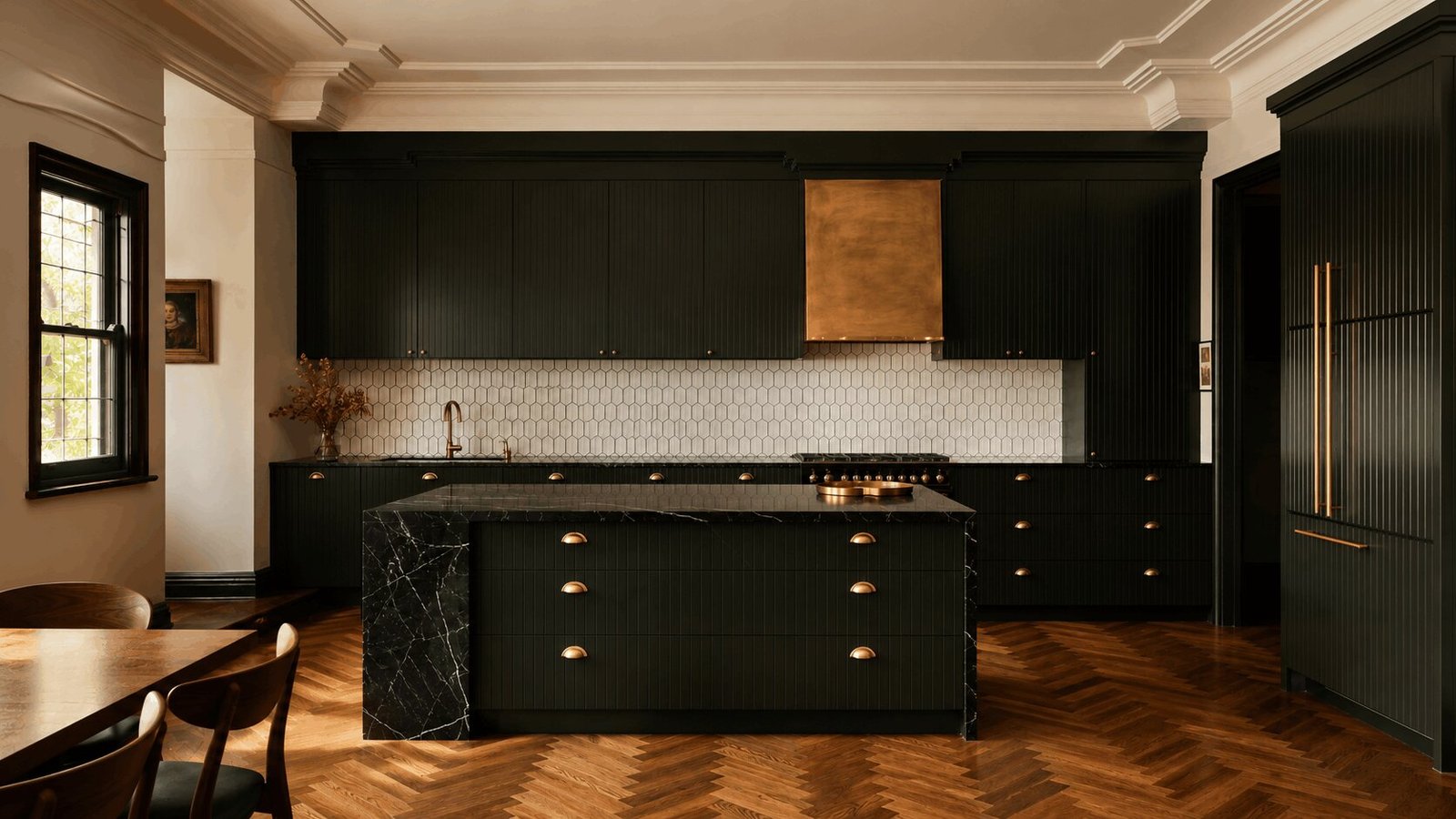
Art Deco is the most significant aesthetic revival in Melbourne’s 2026 kitchen design conversation — and it is happening in precisely the suburbs where it makes the most sense. Not in new apartments or contemporary builds where it would be applied without context. In Surrey Hills, where the stepped cornice above the kitchen zone, the herringbone parquetry in the adjacent hallway, and the geometric leadlight window at the end of the dining room have been waiting for a kitchen renovation that speaks the same design language for eighty years.
This is not nostalgia. The Art Deco revival in 2026 Australian kitchen design is a considered design choice — one that draws on the period’s geometry, material warmth, and commitment to craft without recreating a literal 1930s interior. The result, when executed correctly, is a kitchen that feels completely of 2026 and completely of its building at the same time.
For the period architecture context that Surrey Hills shares with other Boroondara suburbs, the kitchen joinery Balwyn post covers the interwar renovation brief in detail. This post focuses specifically on the Art Deco aesthetic — what it means in 2026, what it requires in joinery specification, and why Surrey Hills is the right place for it. For the full design philosophy behind how Silk Touch approaches heritage kitchen joinery across Melbourne, the kitchen renovations Camberwell page covers our approach.
What the Art Deco Revival Actually Means in 2026 — Defining the Aesthetic
“Art Deco” is a label that gets misapplied. Before specifying a single material or profile, it is worth establishing exactly what the 2026 revival is and — critically — what it is not.
Art Deco (short for Arts Décoratifs — the 1925 Paris Exposition that named the movement) was the dominant design language of the late 1920s through the 1940s. Its defining characteristics in architecture and interiors: geometric forms over organic ones, strong bilateral symmetry, bold material contrasts — dark against light, matte against reflective, heavy against fine — warm metallic accents in brass, bronze, and gilt, and a commitment to craftsmanship in every detail. Art Deco was not modest. It was confident and deliberate in every surface decision.
The 2026 Australian kitchen interpretation of Art Deco is not reproduction. It is contemporary joinery that applies Art Deco’s geometric discipline, material richness, and metallic warmth to a functional 2026 kitchen. The result should feel like a kitchen designed in 2026 by someone who understands what 1935 got right — not a museum recreation or a themed interior.
Three non-negotiable principles underpin every successful Art Deco kitchen design:
1. Geometry over organicism. Every surface decision should lean geometric. Cabinet profiles with a stepped or reeded detail rather than a plain face. Tile splashbacks in hexagonal, chevron, or large-format geometric patterns. Hardware with a strong geometric form — a bar handle’s clean line, or a cup pull’s perfect circle. Where there is a choice between a curved edge and a hard one, the hard edge is almost always correct.
2. Material contrast. Art Deco design is defined by bold contrasts — dark against light, warm against cool, heavy against fine. In a kitchen: dark cabinetry against a light stone or plaster wall. A dark benchtop against a lighter cabinet face. Warm brass hardware against a cool dark stone. The contrast is the composition. Remove it, and the room loses its architecture.
3. Committed warmth. Art Deco is never cold. Even in its darkest expressions, there is warmth in the material selection — unlacquered brass deepens and develops over time, dark stone has grain and variation, handmade ceramic tiles carry the irregularity of human making. This warmth is what separates a genuine Art Deco kitchen from a dark contemporary kitchen with geometric props applied. It is a quality of intention, not just palette.
Why Surrey Hills Is the Right Suburb for the Art Deco Kitchen Revival
Many Melbourne suburbs have interwar housing stock. Surrey Hills has something more specific: a genuinely high concentration of Art Deco homes — not Georgian Revival, not Californian Bungalow, but the stepped cornices, geometric leadlight, and horizontal rendered facades of the 1920s and 1930s at their most intact. Three reasons make Surrey Hills the most authentically suited suburb in Melbourne’s inner east for this revival.
The original architecture provides the vocabulary. Surrey Hills’ interwar homes already speak Art Deco — the stepped cornice in the living room, the herringbone parquetry in the entrance hall, the geometric leadlight in the dining room window, the original built-in buffet unit with geometric door panels in the dining room. A kitchen renovation that references this vocabulary is not applying a trend from outside — it is completing a design intention that was always in the building. The Art Deco kitchen in a Surrey Hills interwar home feels native. The same kitchen in a 1970s Mitcham brick veneer would feel applied, because there is nothing in the building to anchor it.
The spatial character supports the aesthetic. Art Deco design requires a certain spatial confidence to work — it does not suit small, cramped kitchens where bold material choices become oppressive rather than rich. Surrey Hills’ double-fronted interwar homes typically have kitchen zones of 4m × 5m or larger — room enough for dark cabinetry, a generous island, and a geometric splashback to breathe without overwhelming the space. The ceiling heights, typically 2.9–3.2m in original interwar rooms, allow overhead cabinetry to reach proportions that a lower ceiling could not support. Space is not incidental to Art Deco design. It is structural to it.
The demographic has the design literacy to commit. The Art Deco revival requires conviction. A half-committed Art Deco kitchen — one or two geometric tiles, a single brass handle, dark lower cabinets but white uppers — reads as indecision rather than design. Surrey Hills homeowners, many of whom have engaged architects and interior designers on other parts of their homes, typically have the design literacy and the confidence to commit fully. The result is a kitchen that succeeds precisely because it is not hedged.
The Art Deco Material Palette — Specific Selections for 2026 Surrey Hills Kitchens
This section exists to be useful. The following recommendations are specific enough to brief a designer, a builder, or a joiner directly.
Cabinetry — Tone and Profile
Art Deco cabinetry in 2026 is not white or off-white. The defining tones are:
Deep charcoal (near-black, warm undertone — not blue-grey): the most versatile and the most consistently successful. Works with brass, with dark stone, and with warm timber accents. The neutral of the Art Deco palette in the sense that it carries the other elements without competing.
Forest or hunter green (deep, saturated, warm): the most popular single choice in Melbourne’s 2026 Art Deco revival. References both the period’s love of botanical colour and the contemporary sustainability-aware palette. In a Surrey Hills home with warm parquetry floors, deep green cabinetry reads as entirely resolved.
Deep navy (warm-undertoned, not bright): more restrained than green, pairs strongly with unlacquered brass. Works particularly well in kitchen zones that receive strong morning or midday light — the blue reads warm rather than cold when lit correctly.
Warm black (2-pack, satin sheen): the most dramatically Art Deco choice. Requires the most commitment and the most design confidence. Pairs with aged brass only — not matte black hardware, which disappears against the cabinet face and contributes nothing.
All of the above should be specified in 2-pack polyurethane at a satin sheen. Matte on dark colours absorbs fingerprints acutely — every handprint is visible. Gloss on dark colours is too reflective and reads as a bathroom vanity rather than a kitchen. Satin sits correctly between the two.
Three cabinet profiles work in an Art Deco Surrey Hills kitchen:
Stepped profile (a routed stepped reveal on the door face, echoing the period’s architectural stepped detail): the most explicitly Art Deco cabinet profile. Requires CNC routing for precision — hand-routed stepped profiles produce visible inconsistencies that undermine the geometric discipline the profile is trying to achieve.
Reeded profile (vertical parallel grooves routed into the door face): appearing strongly in 2026 as the Art Deco-adjacent cabinet detail. Less literally period than a stepped profile but equally geometric and equally appropriate in a Surrey Hills interwar home. The reeded detail echoes the fluted columns and pilasters of Art Deco public architecture at a domestic scale.
Flat-slab (completely flat, no profile): acceptable in Art Deco kitchens in a rear extension zone where the building’s original architectural detail is less present. The material richness does the Art Deco work; the profile does not need to add further. Not recommended in original interwar rooms where a profile-less cabinet face looks insufficiently considered against the room’s geometric cornice.
Hardware — Unlacquered Brass
Hardware is where the Art Deco signal is clearest and most immediately visible. It is also where the most common mistakes are made.
Unlacquered brass is brass without a protective lacquer coating. Over time, unlacquered brass oxidises and develops a patina — darker at wear points, warmer and richer overall. This patina is the Art Deco material quality at its most authentic. It requires occasional polishing if the homeowner wants to maintain original brightness; if left, the patina deepens to a beautiful antique quality that no factory finish can replicate.
Aged brass is brass with a factory-applied antique finish. More consistent in appearance than unlacquered brass and lower maintenance. Less authentic, but entirely appropriate for homeowners who want the warmth of brass without the commitment of ongoing patina management.
Bronze — darker and redder than brass, more architectural in character — is appearing in Surrey Hills’ more committed Art Deco renovations in 2026. It reads as serious and considered rather than decorative.
For hardware forms: the cup pull is the most period-specific — a D-shaped pull mounted on a back-plate, the dominant hardware form in 1930s joinery. The bar handle is contemporary-appropriate with a clean geometric line. The reeded bar handle — a bar handle with a fluted surface detail — is Art Deco and contemporary simultaneously, and one of the strongest hardware specifications available in 2026.
No matte black in an Art Deco kitchen. Matte black is a contemporary minimalist hardware choice. It belongs in a Japandi or flat-slab contemporary brief, not in an Art Deco interwar home. The two design languages are not compatible in the same room.
Benchtop — Dark Stone
The Art Deco benchtop is dark. The three defining options:
Honed Nero Marquina marble: warm black with fine white veining. The most authentically Art Deco stone — the period’s love of bold material contrasts finds its clearest expression in black marble against brass hardware. Accepts patina and requires sealing. Price: $700–$1,400/lm installed.
Honed black granite or Absolute Black: no veining, pure black. More formal and uniform than Nero Marquina. Works in the most architecturally committed Art Deco kitchens where material variation would compete with the geometric rigour of the cabinet and tile specification. Price: $500–$900/lm installed.
Dark engineered stone (Caesarstone Empira Black, Silestone Eternal Noir): the practical alternative to natural dark stone. Non-porous, no sealing required, consistent appearance across the full run. Less character than Nero Marquina but significantly lower maintenance. For kitchens with heavy daily use, this is a legitimate and frequently correct choice. Price: $400–$750/lm installed.
Avoid white or light stone benchtops in an Art Deco kitchen. A dark cabinet with a white benchtop is a contemporary contrast palette — it works well in its own right, but it loses the material commitment that makes Art Deco design coherent. The benchtop decision should reinforce the palette, not pivot from it.
Splashback — Geometric Tile
The splashback is the most overt Art Deco signal in the kitchen and the place where the period vocabulary is most explicitly stated. Four options in order of period authenticity:
Hexagonal handmade ceramic tile in warm off-white or cream body with strong contrasting grout (charcoal or warm grey): the most popular Art Deco splashback choice in 2026 Melbourne. The hexagonal form is geometric; the handmade variation introduces warmth. Laid at full height — bench surface to underside of overhead cabinet — for maximum impact.
Chevron or herringbone tile in a neutral tone: references the parquetry floor patterns common in Surrey Hills interwar homes. A direct material echo of the building’s existing detail — the floor pattern rises to the wall and the composition becomes coherent across the room.
Large-format geometric tile with bold grout joint: a 200mm × 400mm tile in warm cream or grey with a 5mm contrasting grout joint creates a strong geometric grid that reads as Art Deco without the smaller-format complexity. Easier to maintain than hexagonal tile and faster to install.
Fluted glass panel: an increasingly popular 2026 alternative to tile — a full-height fluted glass panel behind the bench zone, backlit with warm LED strip. Elegant, reflective, geometric. Requires a recessed electrical chase for the LED strip — plan this in the electrical rough-in. A contemporary interpretation of the Art Deco mirror and glass vocabulary that appears extensively in the period’s public interiors.
Flooring Continuation
In Surrey Hills kitchens where original herringbone or chevron parquetry runs through from the hallway or dining room, extend it into the kitchen zone or match it with a new engineered timber in the same pattern and a comparable warm tone. The parquetry floor and the Art Deco kitchen are compositionally inseparable. This is the detail that makes the room feel resolved rather than renovated — the sense that the kitchen has always belonged to the house.
The Art Deco Kitchen in a Heritage Surrey Hills Home — Navigating Boroondara
Surrey Hills sits under Boroondara City Council’s planning jurisdiction — the same framework that governs Camberwell, Hawthorn, and Balwyn. Heritage overlays are active on most pre-war streets. The practical implications for a kitchen renovation are straightforward:
Internal joinery replacement — cabinets, benchtops, splashback — is permit-free in Surrey Hills. The Art Deco revival in the kitchen is achievable without any council engagement. A complete kitchen transformation, including a new island, can proceed under a standard building permit.
Structural changes — wall removal, rear extensions — are subject to Boroondara planning assessment. Any structural works visible from the street require a planning permit under the Heritage Overlay schedule. Internal structural works not visible from the street — a load-bearing wall removal between kitchen and dining room, for example — typically require a building permit only.
For further detail on the Boroondara heritage planning framework and its specific implications for kitchen renovation sequencing, the why custom joinery Melbourne east south post covers the planning context in depth.
There is also a design argument worth making for any heritage-adjacent discussion that arises: an Art Deco kitchen renovation in a Surrey Hills interwar home is arguably the most heritage-appropriate renovation a homeowner can undertake. It works with the building’s original design language rather than against it. A joinery specification that references the period’s geometry, materials, and warmth reinforces the building’s heritage character rather than compromising it. That argument, made clearly, tends to resolve any questions about design appropriateness before they require formal engagement. Book a free in-home consultation and we can walk through what applies to your specific property.
The kitchen renovation Blackburn post covers comparable interwar renovation considerations in the neighbouring Whitehorse LGA for those working across council boundaries.
What Art Deco Gets Wrong — The Five Mistakes That Produce Pastiche
Most failed Art Deco kitchens do not fail for lack of budget. They fail because one or two decisions break the internal logic of the design, and the result reads as a collection of period-adjacent choices rather than a coherent design intention. These are the five mistakes that produce pastiche.
Mistake 1 — Gold, not brass. Gold-finished hardware — bright, uniform, synthetic-looking — is not Art Deco. Unlacquered or aged brass — warm, developing, with variation — is Art Deco. The difference is immediately observable to anyone who has seen both in person. Specify “unlacquered brass” or “aged brass” explicitly in your hardware brief. Accept no substitution with “gold finish,” “champagne finish,” or “warm gold.” These are not the same material and they do not read the same way.
Mistake 2 — Geometric pattern without material commitment. A hexagonal tile splashback in front of white flat-slab cabinets and a white stone benchtop is a geometric tile in a white kitchen. The tile alone does not make it Art Deco. The full material palette — dark cabinetry, warm brass, dark stone, geometric tile — is required for the period language to be coherent. Remove any of those elements and the others lose their context.
Mistake 3 — Mixing Art Deco hardware with contemporary profiles. Art Deco cup pulls or bar handles on flat-slab handleless-profile cabinetry creates a conflict between two design vocabularies that undermines both. The hardware and the cabinet profile must work from the same design language. Either commit to a period-informed profile — stepped, reeded — with period hardware, or use a flat-slab profile with integrated handles and no exposed hardware. Mixing the two produces a result that looks unresolved because it is.
Mistake 4 — Polished or gloss finishes. Art Deco interiors were not shiny in the domestic kitchen context. Polished stone benchtops, high-gloss cabinet finishes, and mirror-polished hardware belong in Art Deco hotel lobbies and public buildings — not in residential kitchens. The residential Art Deco kitchen is matte and honed throughout — satin paint finish, honed stone, aged metal. The warmth comes from material richness, not surface reflectivity. Gloss reads as effort; satin reads as confidence.
Mistake 5 — Applying Art Deco to the wrong building. An Art Deco kitchen in a 1970s brick veneer or a contemporary townhouse requires the palette to do all the work without the building providing any architectural context. It can be done — but it is significantly harder to execute convincingly, and the result is more likely to read as themed than as designed. Surrey Hills’ original interwar homes provide the architectural context that makes Art Deco feel inevitable rather than applied. That is the advantage this suburb offers, and it is worth preserving.
2026 Cost Guide — Art Deco Kitchen Joinery in Surrey Hills
All figures are supply-only joinery unless noted. Trade and installation costs are additional.
| Kitchen Scope | Joinery Supply-Only Range (AUD) |
|---|---|
| Compact galley or in-place renovation (under 4m total run) | $8,000 – $12,000 |
| Standard L-shape or single-wall (4–7m total run) | $12,000 – $20,000 |
| Open-plan kitchen with island (7m+ total run) | $18,000 – $30,000+ |
| Whole-home joinery package | $30,000 – $70,000+ |
The Art Deco palette typically sits at the upper end of the bespoke range for each scope. The following uplifts apply relative to a standard white 2-pack Slim-Shaker kitchen of equivalent size:
| Item | Cost Uplift |
|---|---|
| Dark 2-pack finish (charcoal, green, navy) vs standard white | +10–18% on door costs — dark colours require more substrate preparation and higher-quality primer for a uniform finish |
| Stepped or reeded cabinet profile (CNC routed) vs standard Shaker | +8–15% on door costs |
| Unlacquered brass hardware vs standard brushed nickel | +15–30% on hardware |
| Dark natural stone benchtop (Nero Marquina) vs white engineered stone | +40–80% on stone costs |
| Geometric handmade tile splashback vs standard subway tile | +60–120% on splashback |
For a complete all-trades Art Deco kitchen renovation in Surrey Hills with no structural works:
| Trade / Item | Budget Range (AUD) |
|---|---|
| Bespoke joinery (supply only) | $12,000 – $30,000+ |
| Dark stone benchtop | $4,500 – $16,000 |
| Geometric handmade tile splashback | $1,800 – $5,500 |
| Appliances | $4,000 – $25,000 |
| Plumbing | $1,000 – $3,500 |
| Electrical | $800 – $3,000 |
| Painting | $1,000 – $4,500 |
| Flooring (parquetry extension or matching) | $4,000 – $12,000 |
Frequently Asked Questions
What is Art Deco kitchen design?
Art Deco kitchen design draws on the aesthetic principles of the 1920s–1940s Art Deco movement: geometric forms, symmetry, bold material contrasts, and warm metallic accents. In a 2026 kitchen context, this translates to stepped or reeded cabinet profiles (not plain Shaker), unlacquered or aged brass hardware, dark stone benchtops (Nero Marquina, honed black granite, or dark engineered stone), geometric tile splashbacks (hexagonal, chevron, or large-format with a strong grout line), and warm dark cabinetry tones (deep charcoal, forest green, or navy in 2-pack). Art Deco design is not reproduction — it is a contemporary kitchen that references the period’s geometry and material warmth without recreating a 1930s literal interior.
Does Art Deco kitchen design work in a Surrey Hills interwar home?
Surrey Hills is one of the best suburbs in Melbourne for an Art Deco kitchen renovation — the suburb’s 1920s–1940s interwar homes have original stepped cornices, geometric joinery details in living rooms and hallways, and parquetry or Baltic Pine floors that are entirely compatible with an Art Deco kitchen palette. The original architecture provides the context that makes Art Deco design feel authentic rather than applied. A kitchen in Surrey Hills that references the building’s own period character — through geometry, brass, and rich materials — reads as a restoration of intent, not a trend application.
What materials define an Art Deco kitchen in 2026?
The 2026 Art Deco kitchen palette centres on five material decisions: (1) cabinet finish in a deep warm tone — charcoal, forest green, or navy in 2-pack polyurethane; (2) unlacquered or aged brass hardware — cup pulls, bar handles, or integrated reeded profiles; (3) dark stone benchtop — honed Nero Marquina marble, honed black granite, or a dark engineered stone equivalent; (4) geometric tile splashback — hexagonal handmade tile in a contrasting grout, or a large-format tile with a strong geometric pattern; (5) warm metallic accents in the rangehood and tap specification. All surfaces matte or honed — no gloss or polished finishes in an Art Deco kitchen.
How much does an Art Deco kitchen renovation cost in Surrey Hills in 2026?
An Art Deco-influenced bespoke kitchen in Surrey Hills typically costs $12,000–$20,000 supply-only for a standard 4–7m L-shaped kitchen, and $18,000–$30,000+ for an open-plan kitchen with island. The Art Deco palette tends toward the upper end of the bespoke range because dark 2-pack finishes require a higher-quality substrate and more precision in finishing than lighter colours, and dark stone benchtops cost more than standard white engineered stone. These are supply-only joinery figures — stone benchtop ($2,500–$12,000), appliances, plumbing, and electrical are additional.
Do you do Art Deco kitchen renovations in Surrey Hills and surrounding Melbourne East suburbs?
Yes. Silk Touch Joinery works across Melbourne’s inner east including Surrey Hills, Mont Albert, Box Hill, Balwyn, Blackburn, Nunawading, and surrounding Boroondara and Whitehorse suburbs. Contact us to book a free in-home consultation at your Surrey Hills property.
The Art Deco Kitchen That Belongs to the House
The Art Deco revival is not a trend that will pass when the next aesthetic cycle arrives. It is a design philosophy that was present in Surrey Hills’ buildings before any of the current homeowners arrived and will outlast any contemporary alternative. The geometric cornice above the kitchen zone, the parquetry in the hall, the leadlight in the dining room window — these details have been waiting for a kitchen renovation that speaks the same language for eighty years.
A custom kitchen Surrey Hills 2026 renovation that works with the building’s period character, rather than ignoring or erasing it, produces a result that belongs to the house in a way no imported aesthetic can. The geometry is coherent. The materials are warm. The hardware develops over time rather than dating. And the kitchen, when it is done correctly, feels less like a renovation and more like a restoration of something that should always have been there.
If your Surrey Hills home has the original architecture — the cornice, the parquetry, the leadlight — and the kitchen has not yet caught up, this is the brief worth pursuing.
Book a free in-home consultation →
We visit your Surrey Hills home, assess the joinery scope, and provide a detailed written brief and indicative pricing. No obligation. We’d love to see what your building is working with.