IKEA Kitchens Australia 2026: Costs, Pros, Cons and Installation
IKEA kitchens remain a practical option for many Australian homeowners because the METOD system combines modular cabinets, a broad choice of fronts and internal fittings, and a planning process that lets you develop an itemised product list before ordering.
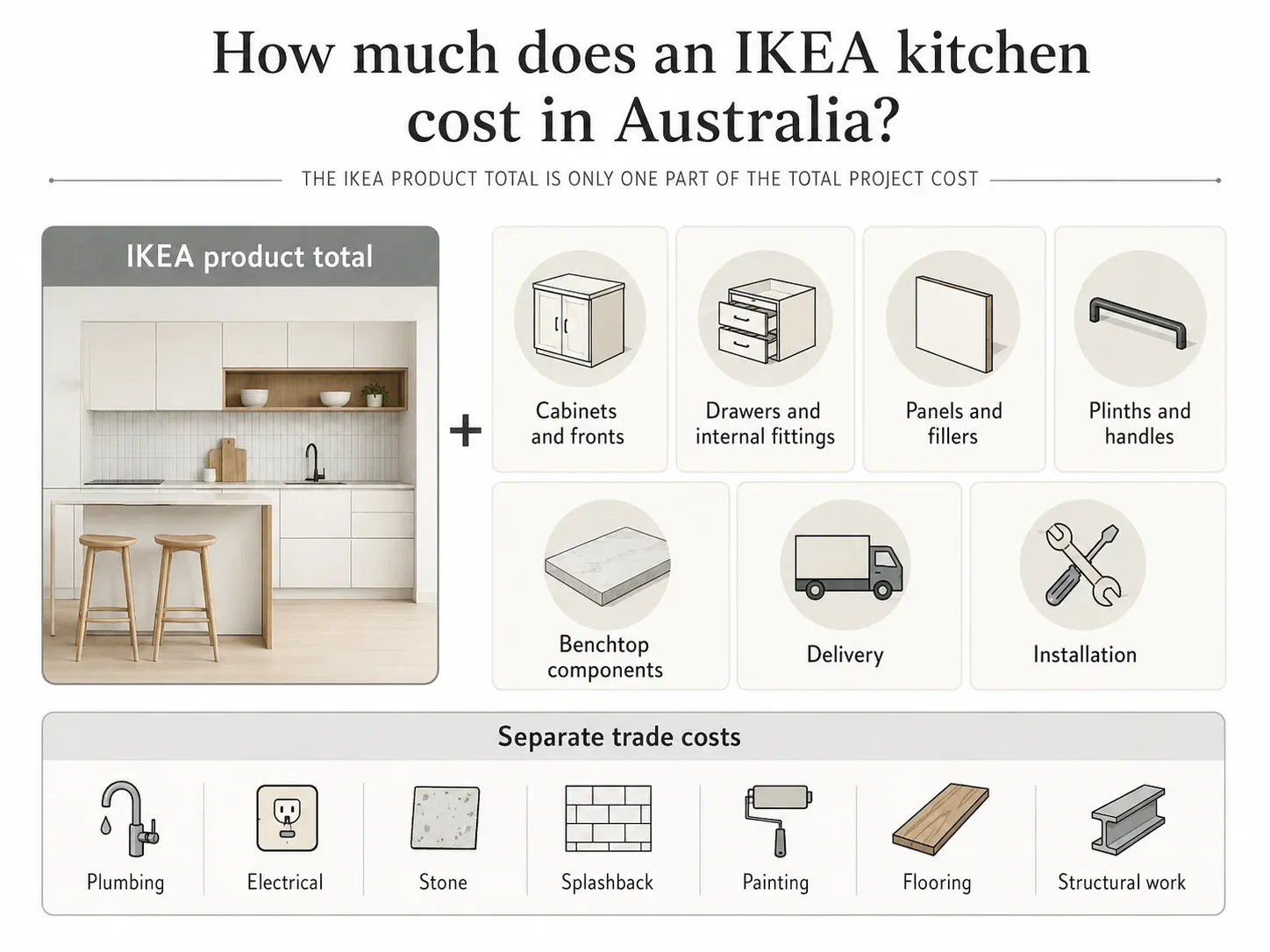
The IKEA product total is only one part of the project. Your total project cost can also include delivery, removal of the existing kitchen, professional installation, benchtop work and any plumbing, electrical, splashback, flooring, painting or structural work required at the property.
Silk Touch Joinery is an independent Melbourne joinery and kitchen-installation business. We are not affiliated with or endorsed by IKEA. We provide complete IKEA METOD kitchen installation within the scope explained below, and we also design and manufacture custom joinery for projects that require a different approach.
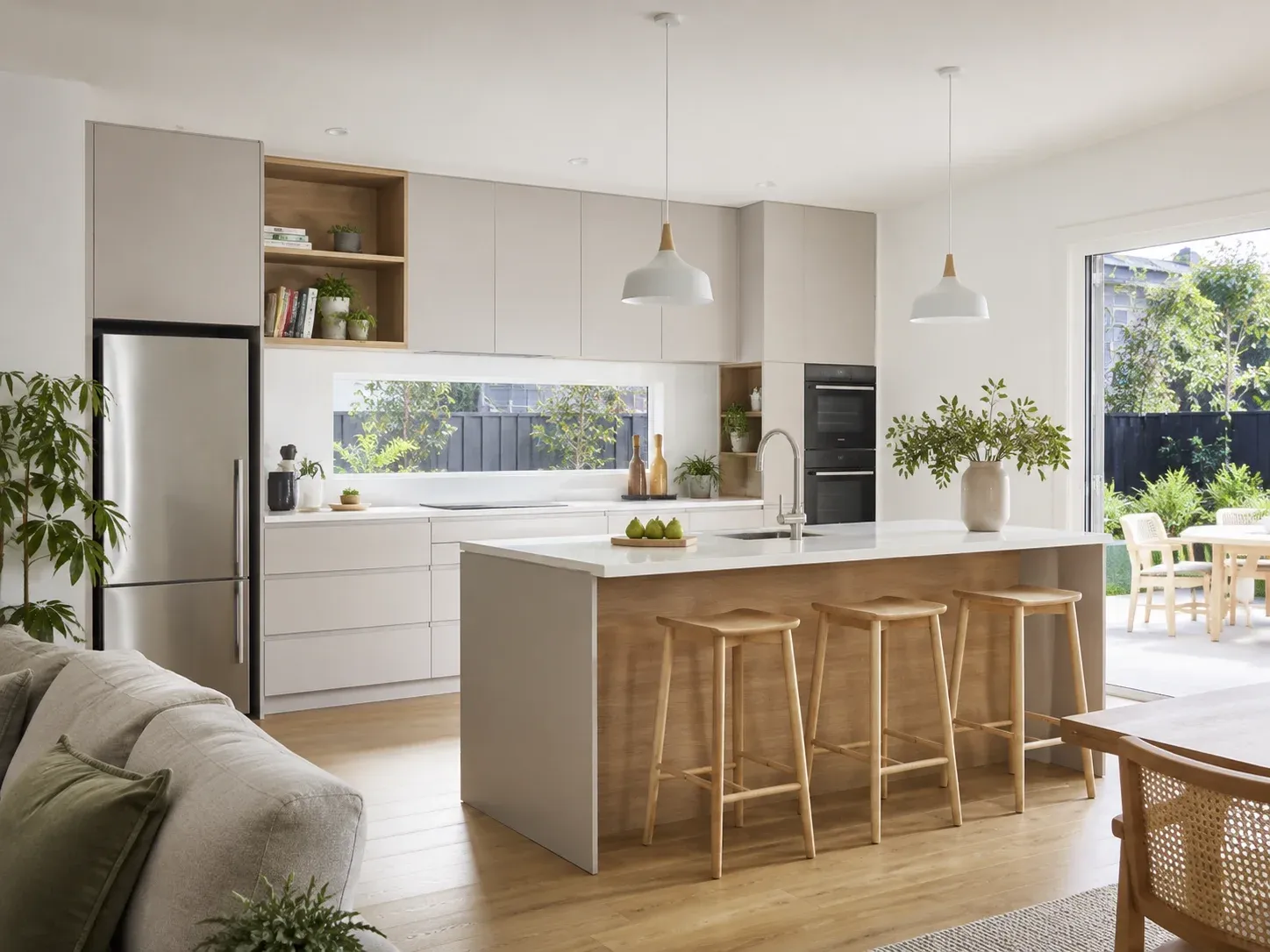
Plan the product, installation and total project scope
Use the contents below to compare current IKEA product costs, understand METOD planning requirements and choose the appropriate installation or custom-joinery pathway.
How much does an IKEA kitchen cost in Australia?
There is no single average price that accurately represents every IKEA kitchen project. The total changes with the room, cabinet count, front selection, drawers and internal fittings, panels, handles, benchtop choice, delivery, installation requirements and work by other trades.
The best project-specific starting point is your current IKEA kitchen plan or order summary. It shows the selected product cost at that time. A separate installation quote can then be based on the actual plan, agreed scope and site conditions.
Start with your current IKEA product total
An IKEA kitchen order can contain more than the visible cabinet boxes and doors. Depending on the design, the itemised product list may include:
- base, wall, high and appliance cabinets;
- doors, drawer fronts and drawers;
- hinges, shelves and internal organisers;
- suspension rails, legs and fixing components;
- cover panels and decorative panels;
- fillers needed to finish gaps;
- plinths;
- handles;
- benchtop components;
- lighting or accessories.
Check delivery separately in the current order summary because it is an additional project cost rather than a cabinet component.
Review the itemised plan rather than a display-kitchen price or old estimate because products, availability, promotions and pricing can change.
What changes the installation quote?
The installation quote reflects the work required at the property. Relevant assessment factors include:
- the number and type of cabinets;
- the kitchen layout;
- whether the existing kitchen must be removed;
- the condition of the walls and floor;
- cabinet levelling, alignment and fixing requirements;
- filler panels and scribing;
- cover-panel and plinth work;
- appliance cabinet panels;
- handle installation;
- compatible IKEA benchtop fitting;
- access, parking and material handling;
- whether the IKEA order is complete and ready for installation.
Two kitchens with a similar visible layout can require different installation work because their rooms, walls, floors and finishing details differ.
Costs outside the Silk Touch installation scope
Silk Touch’s IKEA installation quote excludes other trades. Separate quotes may be required for:
- plumbing;
- electrical work;
- stone fabrication and installation;
- splashback installation;
- painting;
- flooring;
- structural work;
- other building or renovation trades.
A useful project budget combines the current IKEA product total, the Silk Touch installation quote and any separate trade costs required.
How IKEA joinery works: the METOD kitchen system
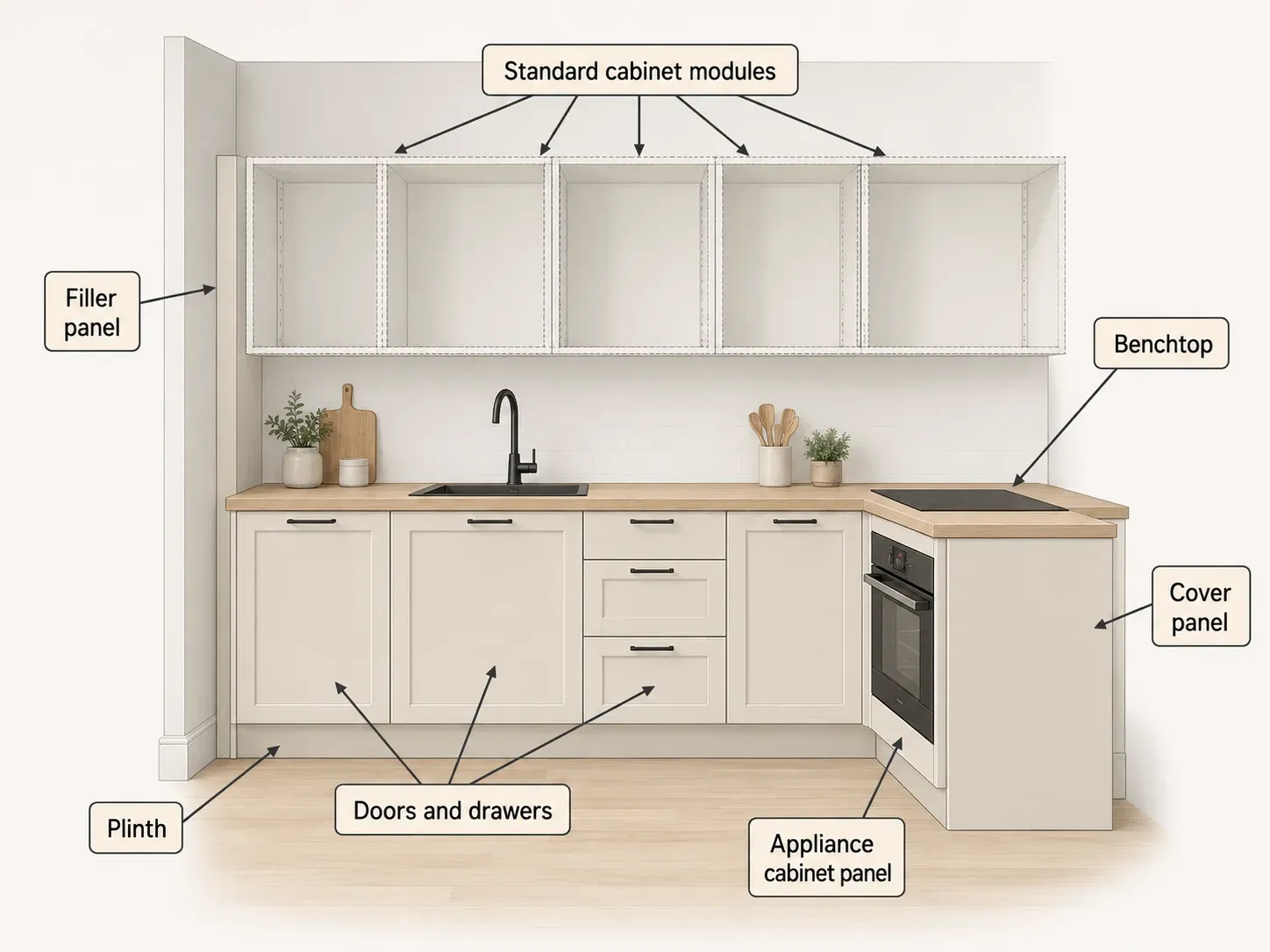
METOD is IKEA’s modular kitchen system. A kitchen is developed by combining standard cabinet frames with selected fronts, drawers, shelves, internal fittings, panels, handles and benchtops.
Planning depends on matching the available modular cabinet sizes to the measured room and allowing for finishing components around walls, appliances and exposed ends.
Cabinet frames, module sizes and filler panels
IKEA Australia’s current product information describes the referenced METOD base-cabinet frame as an 18mm-thick particleboard construction with melamine foil, plastic edging and a fibreboard back. Specifications can vary by component, so the current Australian product pages and order summary should be checked before purchase.
Common base-cabinet widths currently listed include 20, 30, 40, 60 and 80cm. The exact dimensions and available cabinet types should be confirmed from the current Australian range and the project order summary.
Because METOD uses fixed cabinet sizes, fillers may be required beside walls, around appliances or openings, where the remaining dimension does not match an available cabinet width, or to provide door and drawer clearance. Their position, width and final finish should be resolved during planning.
Door fronts, drawers and internal fittings
The final specification depends on the fronts, hardware, drawers and internal fittings selected for the order.
When reviewing the plan, check:
- selected fronts and drawer configurations;
- shelves, hinges and internal organisers;
- appliance cabinet requirements;
- exposed ends and cover panels;
- handles, plinths and finishing pieces.
The product list should be reviewed as a complete system. A missing panel, hinge, rail or filler can delay completion even when the main cabinet frames have arrived.
Planning, measuring and the METOD guarantee
IKEA Australia provides a kitchen planner and planning and measuring pathways. Accurate site measurement and a complete order remain essential.
IKEA Australia states that the METOD kitchen system has a 25-year guarantee covering defects in materials and workmanship, subject to the applicable guarantee terms and exclusions. The guarantee does not replace correct planning, site preparation or installation.
Official references:
IKEA kitchen pros and cons
An IKEA kitchen is not automatically the best or worst option. It may work well when the modular system suits the room, the selected products meet the brief and the project is planned as a complete installation rather than only a cabinet purchase.
IKEA states that METOD has a 25-year guarantee, subject to the applicable terms and exclusions. The guarantee is one product consideration; planning, component selection, site preparation and installation quality still affect the completed project.
| Potential advantage | Planning consideration |
|---|---|
| Standard modular system with defined cabinet and component choices | Fixed dimensions may require fillers, cover panels or layout compromises |
| Broad selection of fronts and internal fittings | Selected components and current availability must be checked before ordering |
| Planning tools and an itemised product list | Accurate room measurements and a complete order remain essential |
| DIY is possible for suitably experienced homeowners | Assembly, fixing, levelling and finishing require time, tools and practical capability |
| Can work efficiently in regular room layouts | Irregular walls, floors and room dimensions may require additional finishing work |
| Product selection and installer selection are separate decisions | The product total does not include every installation, trade or renovation cost |
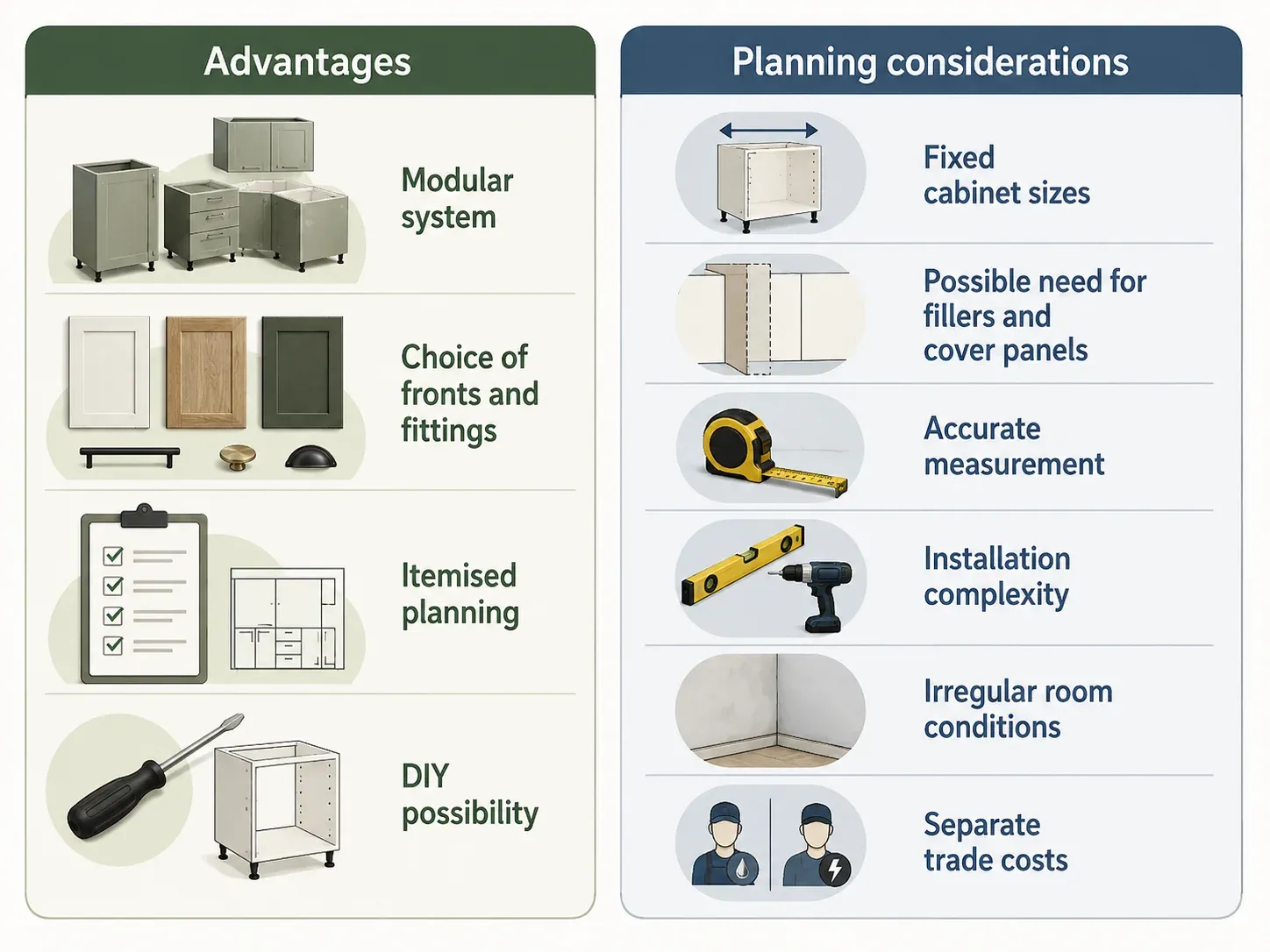
Separate arrangements may be required for plumbing, electrical work, stone, splashbacks and other work outside the installer’s agreed scope.
The practical question is not whether modular cabinetry is universally good or bad. It is whether the METOD system fits your room, design priorities, storage needs and project process.
IKEA kitchen installation options in Australia
Product selection and installation are separate decisions. This guide considers DIY, IKEA’s current referral pathway and an independent kitchen installer.
DIY assembly and installation
DIY may suit someone with the tools, experience and time to assemble, level, fix and finish the cabinetry correctly.
The work extends beyond assembling cabinet frames. It may include suspension-rail installation, cabinet levelling and fixing, appliance-panel alignment, filler and cover-panel cutting, plinths, handles and compatible benchtop fitting.
Plumbing and electrical work remain separate and must be completed by the appropriate trades where required.
IKEA planning and installation referral pathways
IKEA Australia currently offers planning and measuring pathways and an installation-referral service for seeking local quotes using an IKEA plan and project details. Check current availability, terms and processes before proceeding.
Using an independent kitchen installer
An independent installer can review the IKEA plan and quote the proposed installation scope.
Before accepting a quote, confirm:
- exactly what is included;
- whether removal and disposal are included;
- which panels, fillers and finishing pieces will be fitted;
- whether compatible benchtop fitting is included;
- whether the complete IKEA plan or order summary has been reviewed;
- which other trades remain separate;
- required site preparation and information.
Silk Touch provides the complete IKEA installation scope described below.
Complete IKEA METOD kitchen installation in Melbourne
Silk Touch Joinery provides complete IKEA METOD kitchen installation for Melbourne projects. “Complete installation” refers to the IKEA kitchen assembly, fitting and finishing work included in the individual quote. It does not include the separate trades or building work listed below.
What the Silk Touch installation includes
Silk Touch’s complete IKEA METOD installation scope includes the following work, as applicable to the approved plan and confirmed in the individual quote:
- removal and disposal of the existing kitchen;
- METOD cabinet assembly;
- suspension-rail installation;
- cabinet levelling, alignment and fixing;
- door and drawer fitting;
- fitting internal IKEA fittings included in the quote;
- appliance cabinet panels;
- fillers and scribed finishing pieces;
- cover panels;
- plinths;
- handles;
- fitting compatible IKEA benchtops.
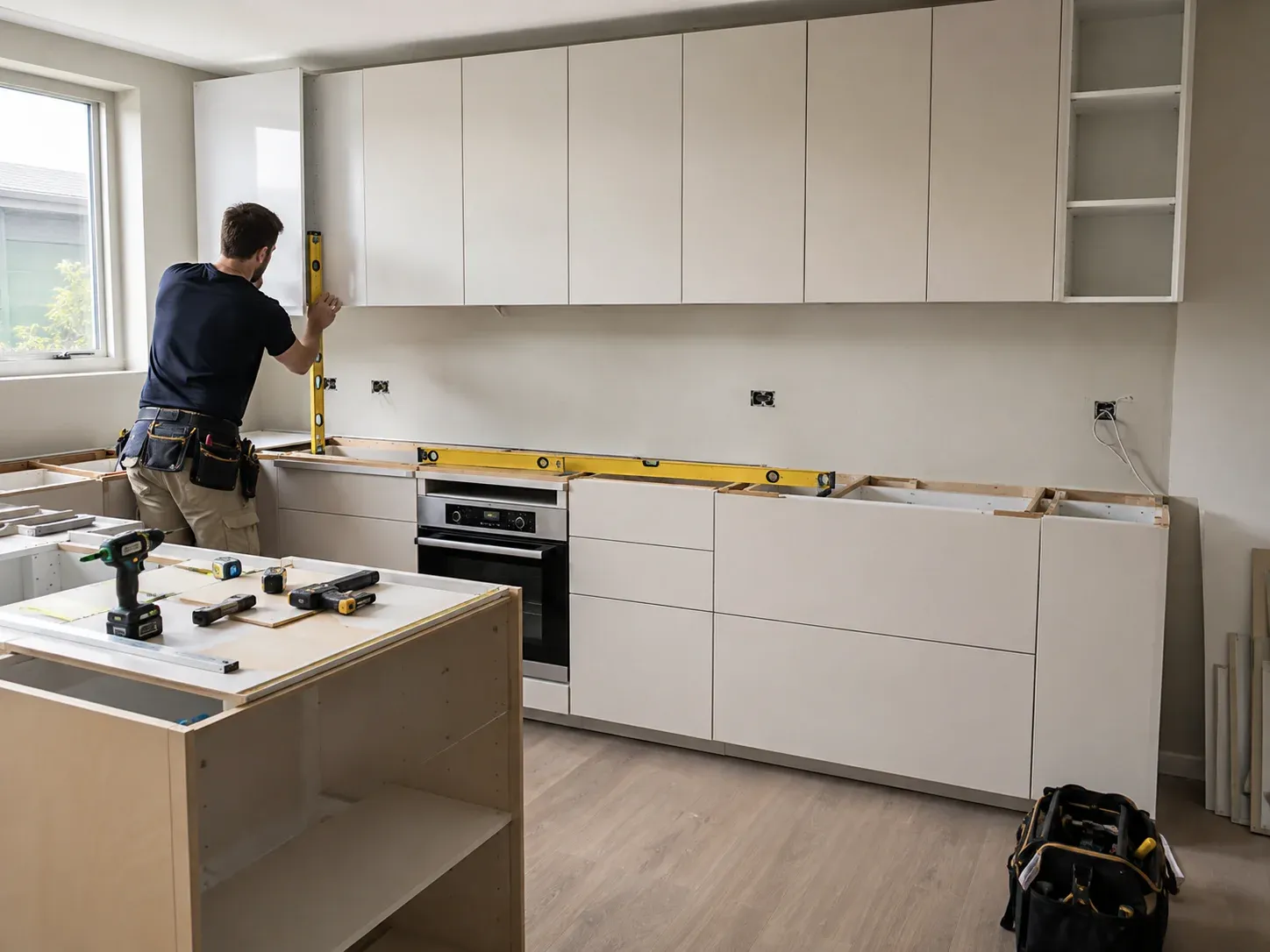
The quote remains the governing record. It identifies the plan reviewed, installation inclusions, assumptions, exclusions and any site requirements. The installation image below is illustrative and is not a completed Silk Touch IKEA project.
Which other trades are excluded?
The IKEA installation service excludes:
- plumbing;
- electrical work;
- stone fabrication and stone-benchtop installation;
- splashback installation;
- painting;
- flooring;
- structural work;
- other building or renovation trades.
These services must be arranged separately where required. Any benchtop requiring specialist fabrication or installation is outside the compatible IKEA benchtop-fitting scope unless expressly included in the individual quote.
What to send for an installation quote
To help Silk Touch assess the project, send:
- the IKEA plan or order summary;
- the project suburb;
- cabinet schedule or cabinet count, if available;
- photographs of the current room;
- whether the existing kitchen needs removal;
- the expected or confirmed IKEA delivery date, if known;
- the selected benchtop type;
- known access or site constraints;
- the preferred installation timeframe.
A complete order summary helps identify the cabinets, panels, fillers, plinths, handles and internal components selected.
For related planning guidance, see:
What Silk Touch customers say
The reviews below are Google reviews for Silk Touch Joinery generally. They should not be interpreted as reviews of the IKEA installation service unless an individual review explicitly describes that service.
Request a free measurement and consultation
A free measurement and consultation session is available and can be requested as the next step.
This can help when the room or modular plan needs checking, filler and panel requirements need review, or you are comparing IKEA with custom joinery.
Request an IKEA Installation Quote
Use the form to request a project-specific installation quote or a free measurement and consultation.
IKEA kitchen vs custom joinery: which suits your project?
METOD uses a predefined modular system. Custom joinery is designed and manufactured for the individual room and approved brief. Neither is automatically correct for every project.
When a modular IKEA kitchen may suit
IKEA may suit when:
- the room works with standard cabinet dimensions;
- you prefer an available METOD front and internal system;
- the layout does not depend on non-standard cabinet sizes;
- fillers are acceptable where needed;
- you are prepared to review a complete IKEA plan and itemised order;
- installation and separate trade scopes can be coordinated.
A galley kitchen, for example, can work well with modular cabinetry when the wall lengths, appliance positions and clearances align with available sizes.
When exact-fit custom joinery may suit
Custom joinery may be more appropriate when:
- the room has irregular dimensions;
- exact wall-to-wall fit is a priority;
- the design requires non-standard sizes or highly specific storage;
- ceiling height or architectural details affect the layout;
- a particular profile, finish or detail is central to the brief;
- the cabinetry must be designed from measured dimensions rather than standard modules.
Custom materials and hardware are confirmed per project
Depending on the project, Silk Touch may specify options such as HMR cabinetry, two-pack polyurethane finishes and Blum hardware. Final materials, hardware and lead times are confirmed in the individual quote. A free measurement and consultation session is available and can be requested as the next step.
| Decision factor | IKEA METOD | Custom joinery |
|---|---|---|
| Dimensional approach | Fixed modular cabinet sizes | Designed to the measured project |
| Layout flexibility | Works within available modules | Non-standard sizes can be developed for the approved brief |
| Fronts and internal fittings | Selected from the current IKEA range | Specified for the individual brief |
| Quote method | Current IKEA plan and order summary, plus a separate installation quote | Individual custom-joinery quote |
| Installation scope | Product selection and installation are separate decisions | Cabinetry scope is confirmed in the individual custom-joinery quote |
| Other trades | Excluded from the Silk Touch IKEA installation scope | Must be confirmed in the individual custom-joinery quote |
| May suit | Rooms and briefs compatible with available modular dimensions and products | Rooms and briefs requiring exact-fit or project-specific cabinetry |
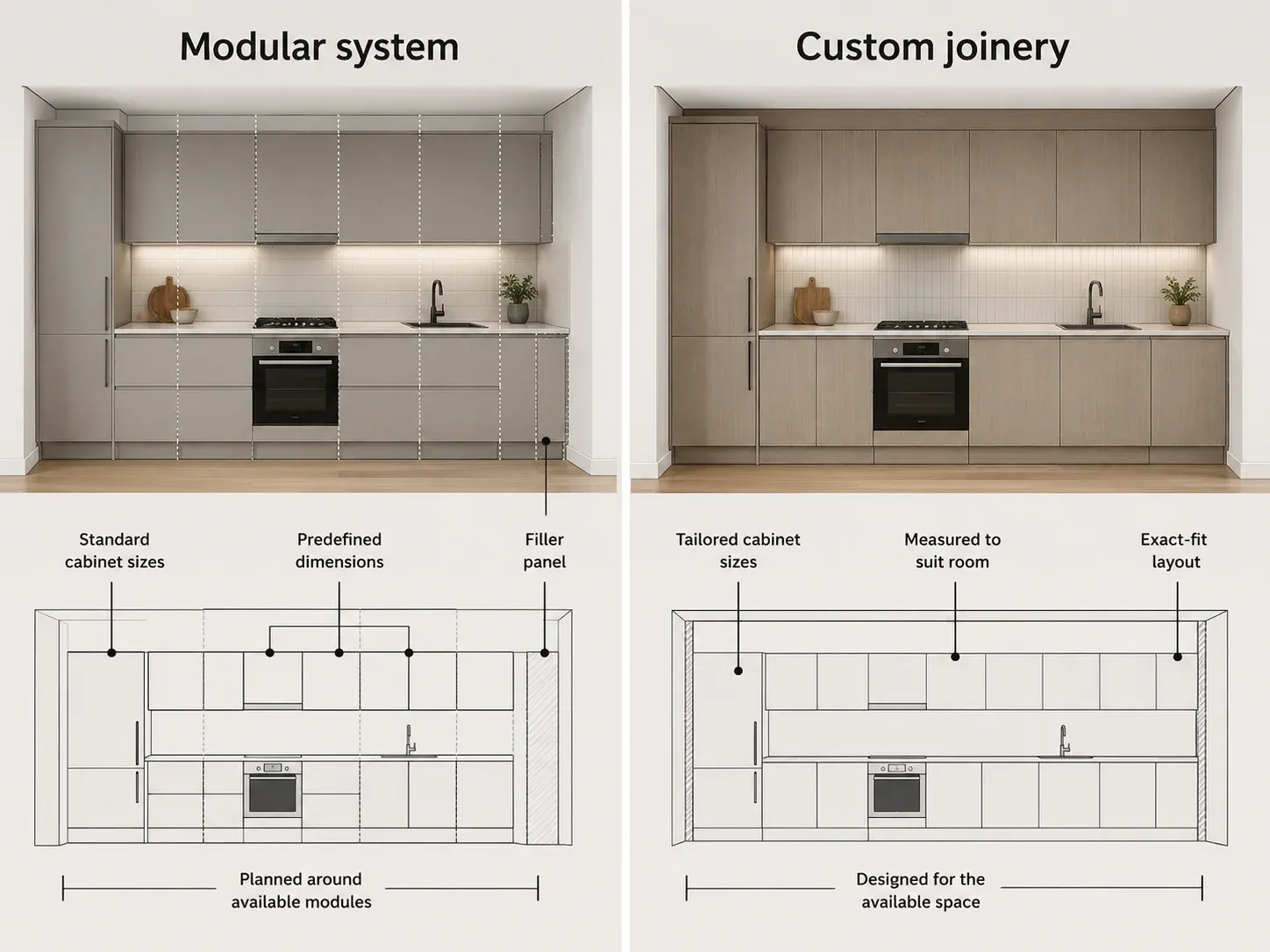
Related guidance: Custom vs modular kitchen cabinets and Custom kitchen cabinets in Melbourne.
Is an IKEA kitchen worth it in Australia in 2026?
An IKEA kitchen can be worth considering when the METOD system suits the room, the selected products meet your expectations and the full project—not only the cabinet order—is planned properly.
Questions to answer before deciding
- Does the measured room work with available modular dimensions?
- Have all panels, fillers and finishing components been included?
- Is the IKEA product total current and complete?
- Who will assemble and install the cabinetry?
- Which benchtop and separate trades are still required?
- Does the design brief require exact-fit cabinetry or storage that METOD cannot provide?
Which homes may suit modular cabinetry?
The age or suburb of a home does not decide whether IKEA will work. The more useful considerations are the measured room dimensions, wall and floor conditions, appliance positions, openings and design priorities.
A galley layout may work efficiently with modular cabinetry when the wall lengths, appliance positions and clearances align with available cabinet sizes.
Regular rooms may be easier to resolve with standard modules. Older, altered or irregular rooms may still suit IKEA but can require additional fillers, scribing and site adjustment. Exact wall-to-wall designs may be better assessed as custom joinery.
The decision should come from the measured project, not a general rule that one system is always better.
The IKEA plan suits the project: Request a complete IKEA installation quote.
The options still need comparison: Request a free measurement and consultation.
Frequently asked questions about IKEA kitchens in Australia
Are IKEA kitchens good quality?
IKEA METOD is a defined modular kitchen system. IKEA Australia describes the referenced standard base-cabinet frame as an 18mm particleboard construction and states that METOD has a 25-year guarantee, subject to the applicable terms and exclusions.
The result also depends on component selection, measurement, order completeness, site preparation and installation quality. Assess the individual plan and product list rather than treating every IKEA kitchen as identical.
How much does an IKEA kitchen cost in Australia?
There is no universal price that represents every IKEA kitchen project. Start with the current IKEA plan and product total, then account for delivery, installation and any separate trade or renovation work required.
Silk Touch does not publish a fixed range because product selections, site conditions and installation requirements vary.
How much does IKEA kitchen installation cost in Melbourne?
Silk Touch prepares a project-specific quote after reviewing the IKEA plan or order summary, room information, requested inclusions and site conditions.
Send the plan, room photographs, project suburb, removal requirements, selected benchtop, known site constraints and expected or confirmed delivery date, if known.
What is included in Silk Touch’s complete IKEA kitchen installation?
Silk Touch’s complete IKEA METOD installation scope includes, as applicable to the approved plan and confirmed in the individual quote:
removal and disposal of the existing kitchen; METOD cabinet assembly; suspension-rail installation; cabinet levelling, alignment and fixing; door and drawer fitting; internal IKEA fittings included in the quote; appliance cabinet panels; fillers and scribed finishing pieces; cover panels; plinths; handles; and fitting compatible IKEA benchtops.
The individual quote remains the governing record for the project.
Does IKEA kitchen installation include plumbing, electrical or stone?
No. Silk Touch’s IKEA installation scope excludes plumbing, electrical work, stone fabrication and stone-benchtop installation, splashback installation, painting, flooring, structural work and other building or renovation trades.
Can Silk Touch fit IKEA benchtops and appliance cabinet panels?
Yes. Fitting compatible IKEA benchtops and appliance cabinet panels forms part of the complete installation scope where applicable to the approved plan and confirmed in the individual quote.
Stone fabrication and stone-benchtop installation are excluded. Any benchtop requiring specialist fabrication or installation also remains outside the compatible IKEA benchtop-fitting scope unless expressly included in the quote.
Can I request a free measurement and consultation?
Yes. A free measurement and consultation can be requested before finalising the plan or quote, or while comparing IKEA with custom joinery.
Send the available plan, room photographs and project suburb so Silk Touch can determine the appropriate next step.
Ready to plan your kitchen?
Choose the pathway that matches the stage of your project.
I have selected IKEA and need complete installation
Send your IKEA plan or order summary, room photographs, project suburb and expected or confirmed delivery date, if known. Silk Touch will review the project information and determine the next step for a project-specific installation quote.
Request an IKEA Installation QuoteI am still comparing IKEA with custom joinery
Request a free measurement and consultation to review the room, modular plan and whether exact-fit custom cabinetry should also be considered for the project.
Request a Free Measurement and Consultation