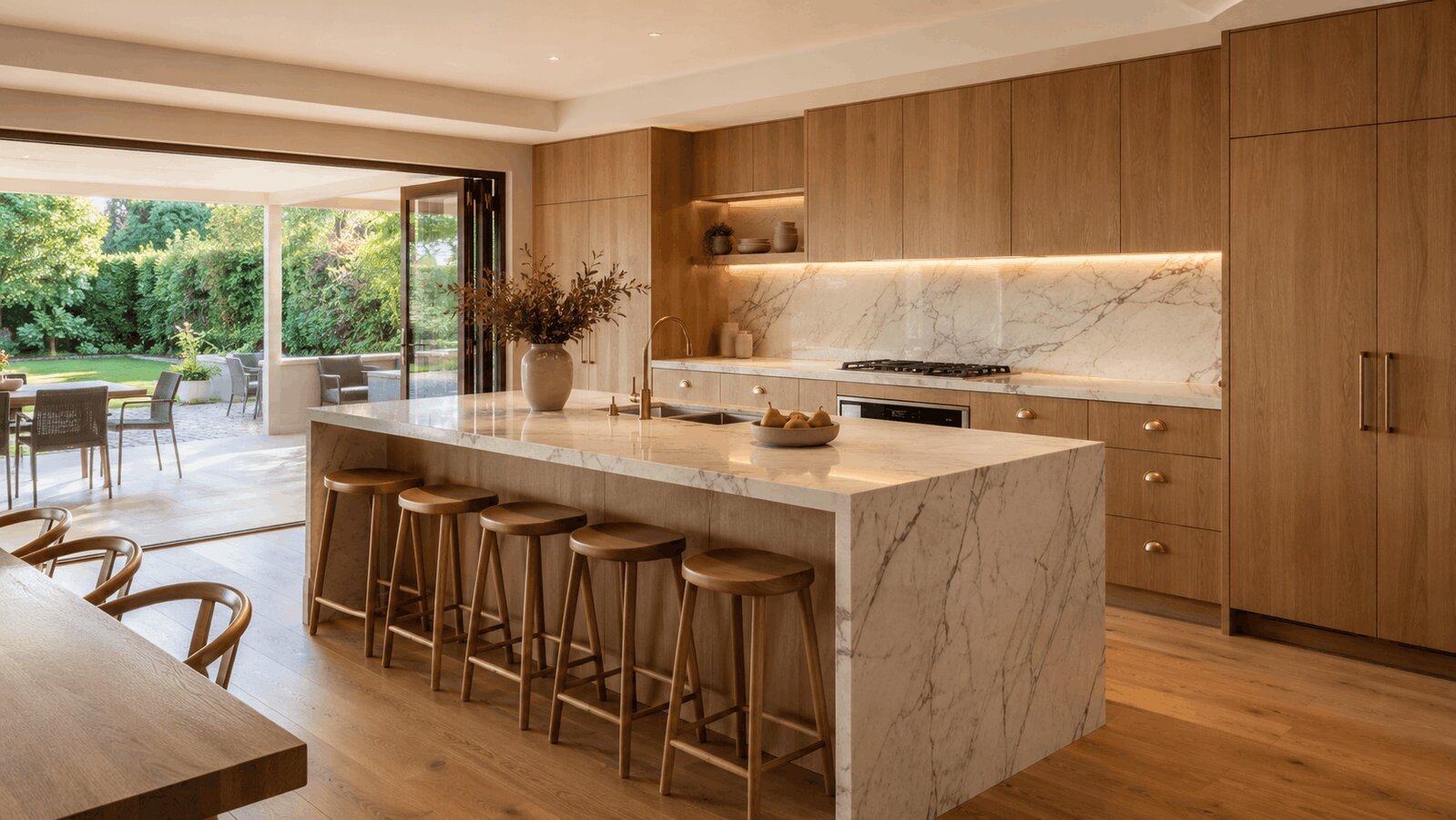
There is a particular home in Wheelers Hill that defines the dominant renovation brief of 2026: a 1980s double-storey on generous blocks of 800–900 sqm, well-presented throughout, with a kitchen that has not been touched since the original build. For homeowners considering custom joinery in Wheelers Hill, this is the most common starting point — a house that has been maintained and progressively updated in every room except one. The bathrooms have been retiled and refitted. The living zones have been repainted and refurnished. The covered outdoor entertaining area is maintained to a high standard. The kitchen is the last room from the original build, and it shows: chipboard carcasses faced in a laminate that was considered quality in 1994, a benchtop that has delaminated at the sink junction, and hardware that belongs to a different era entirely.
Wheelers Hill’s block sizes and home footprints produce joinery outcomes that rival — and in some cases exceed — what is achievable in Melbourne’s inner eastern suburbs, because the available floor area is greater. The material quality can be identical. The spatial generosity is not. A 1900mm island with 1050mm clear aisles on all working sides is standard brief territory in Wheelers Hill. In Camberwell or Hawthorn on a 400 sqm lot, that configuration is exceptional. In Wheelers Hill, it is routine.
The material and specification philosophy that underpins premium bespoke joinery across Melbourne is covered in detail on the bespoke joinery Toorak page — the same approach applies to Wheelers Hill, where the blocks provide even more room to work with. For the entertainer kitchen brief that is common to both Wheelers Hill and neighbouring Wantirna, the custom kitchen joinery Wantirna post covers that scope in depth.
What “Luxury” Actually Means in a Wheelers Hill Kitchen Brief
Luxury, as a kitchen specification term, is often deployed to mean expensive-looking rather than to describe any specific material or fabrication decision. In a Wheelers Hill brief, it has a more precise meaning: five specific decisions that distinguish a premium joinery outcome from a quality-but-standard one. Wheelers Hill homeowners are sophisticated enough to recognise vague quality claims. The five specifications below are the material and fabrication decisions that define the premium tier in this suburb in 2026 — and what Silk Touch works to deliver on every project at this level.
1. Natural Stone Benchtops Over Engineered Stone
Engineered stone — Caesarstone, Silestone, Quantum Quartz — is non-porous, dimensionally consistent, and low-maintenance. It is the correct specification for a family kitchen that prioritises practicality over material character. Natural stone is the specification that communicates something engineered stone cannot replicate: variation, depth, and a character that develops context over time.
In Wheelers Hill premium kitchens, the 2026 natural stone shortlist runs as follows. Honed Calacatta marble or Bianco Carrara for lighter palettes — warm white base with grey veining, matte surface texture that absorbs rather than reflects ambient light. Statuario for a higher-contrast white and grey vein. Nero Marquina for darker palette kitchens — dense black marble with fine white veining that reads as precise and architectural. Each slab is unique. The veining composition on a specific slab pulled from a specific block cannot be replicated anywhere else. For a Wheelers Hill homeowner who has seen enough quality joinery to know the difference, natural stone is the benchtop that reads as genuinely premium. Cost premium over equivalent engineered stone: 40–80% per lineal metre installed.
2. Timber Veneer Cabinetry Over 2-Pack Painted
Two-pack polyurethane in warm white, greige, or sage is the correct specification for a durable, family-functional kitchen. It is also the most widely specified cabinet finish in Melbourne’s outer south-east, which means it does not communicate material distinction — it communicates competent execution of a standard brief.
Timber veneer — American Oak, Blackbutt, or Victorian Ash — is the specification that communicates craftsmanship in a way painted cabinetry does not. The grain is visible. The warmth is material rather than tonal. The quality of a press-bonded veneer door — the precision of the grain match at adjacent door panels so that the grain sequence reads as continuous, the edge treatment, the finishing process that brings out the natural grain without obscuring it — is immediately apparent to a design-aware homeowner. It is also immediately apparent when it has been done incorrectly: mismatched grain at adjacent panels, veneer edge lifting at corners, or a finishing coat that flattens rather than enhances the natural character. A competent bespoke workshop produces a visibly different result from a flat-pack Oak laminate equivalent. The quality difference is apparent on inspection and persists for the life of the kitchen. Cost premium over equivalent 2-pack: 20–35% on door costs.
3. 30mm Stone Island Benchtop With Waterfall End Panel
A 20mm engineered stone island benchtop is functional and widely specified. A 30mm natural stone island benchtop — with a full waterfall end panel continuing the stone down the visible end face to floor level — reads as a different calibre of material entirely. The mass of 30mm stone at island scale changes the proportion of the piece: it reads as furniture rather than a benchtop on a cabinet. The waterfall end panel eliminates any visible substrate at the entertaining-facing end, presenting the stone as a continuous element from countertop surface to floor.
At a Wheelers Hill island of 1900mm × 1100mm, the visual presence of a 30mm Calacatta marble top with a full-height waterfall end panel is the single most visible quality signal in the kitchen for a guest who does not know joinery. It is also the element that photographs as unambiguously premium — the reason island kitchen photography is the highest-performing Google Business Profile format for this suburb’s demographic. Typical cost for a 30mm natural stone island benchtop with full waterfall end panel, supply and install: $4,500–$8,000 depending on slab selection.
4. Integrated Appliances Throughout
Integrated appliances — a panel-fronted fridge matching the cabinet doors, a panel-fronted dishwasher, a rangehood concealed within a custom joinery column — produce a kitchen where no appliance interrupts the cabinet facade. The kitchen reads as a single unbroken composition: a designed object rather than an assembly of components that happen to be co-located. In a 2-pack kitchen, appliance integration reads as contemporary premium. In a timber veneer kitchen, it reads as considered luxury.
Each integration adds $600–$1,500 in joinery cost for the housing cabinet: the fridge surround with custom panel door, the dishwasher cabinet with matching panel front and soft-close hinge, the rangehood housing built to conceal the extraction unit within the overhead cabinet run. For three integrations — fridge, dishwasher, rangehood — the joinery premium over a freestanding-appliance equivalent is $1,800–$4,500. The result is a kitchen that holds its design integrity in photographs, in person, and over time as appliances are eventually replaced with newer models that retain the same panel specification.
5. Blum Legrabox With Full-Extension Runners at 40kg Rating
The premium drawer specification. Legrabox is Blum’s highest-tier drawer system — a slimline, full-height drawer box in a satin nickel finish that remains visible inside the open drawer. Every Legrabox drawer extends to 100% of its depth, closes with Blumotion self-close damping in the last 70mm of travel, and is rated at 40kg for its functional lifetime. The full-height Legrabox side profile — rather than the reduced-profile Tandembox alternative — allows the drawer interior to function as an organised storage zone rather than simply a cavity behind a door.
The difference between a Legrabox kitchen and a standard Tandembox Antaro kitchen is visible to a homeowner who opens one drawer and felt with every subsequent use for the life of the kitchen. Cost premium over standard Blum Tandembox Antaro equivalent: $400–$1,200 on hardware per kitchen, depending on drawer count. For a Wheelers Hill kitchen with a full island and perimeter cabinetry — typically 18–24 drawers — the Legrabox premium is $600–$1,200 over standard Blum hardware. It is the specification that Wheelers Hill homeowners consistently notice and comment on at handover.
Wheelers Hill Kitchen Layouts — The Generous Block Advantage
The kitchen renovation in Wheelers Hill is structurally different from the inner-city Melbourne brief, and the reason is the block. Wheelers Hill’s 1970s–1990s housing stock — predominantly 700–1,000+ sqm lots along the Jells Road and Ferntree Gully Road corridors, and in the streets surrounding Jells Park — was designed with rear open-plan zones of a generosity that is no longer achievable on Melbourne’s subdivided outer-suburban lots. Four layout types define the Wheelers Hill brief in 2026, each enabled by floor areas that inner-city homeowners aspire to and cannot achieve.
The Open-Plan Kitchen With Full-Scale Island
In a Wheelers Hill home with a rear open-plan zone of 6m × 7m or larger — typical of 1980s–1990s double-storey homes and rear-extended single-storey homes — a full-scale island of 1800–2000mm × 1050–1100mm is achievable with 1050mm clear aisles on all working sides. No wall removal is required. No structural engagement beyond confirming the floor structure. The island sits within the available footprint with room to move around it comfortably.
At 1900mm × 1100mm, the island function divides cleanly: the kitchen-facing side provides 750mm prep depth, comfortable for two cooks working simultaneously on separate tasks without occupying each other’s zone. The living-facing overhang — 300mm clear of the cabinet run — seats five adults at the entertaining side with proper stool clearance. The island’s visual proportion at this scale commands the room rather than filling it. This is the island that inner-city homeowners on constrained lots want and cannot have. In Wheelers Hill, it is standard brief. The inclusion of a preparation sink in the island, a second tap, and a concealed pull-out for waste management — all standard Wheelers Hill island specifications — adds $1,800–$3,200 to the joinery scope but produces a fully independent prep and entertaining station.
The Kitchen-Scullery-Butler’s Pantry Suite
For Wheelers Hill’s most comprehensive renovation briefs — common in homes that have undertaken a rear addition or have an existing service zone immediately behind the main kitchen — the three-zone layout is the outer south-east equivalent of what Toorak and Camberwell homes achieve in renovated period houses. The main kitchen functions as the social and cooking centrepiece: the island, the cooking station, the integrated fridge and dishwasher, the premium material palette visible from the living and dining zones. The scullery immediately behind handles cleanup, the secondary sink, the overflow dishwasher, and appliance storage — it conceals the functional mess that the main kitchen should never show. The butler’s pantry alcove on the approach from the dining room provides dry goods storage, wine storage, and a bar or prep sink for the entertaining sequence.
Each zone has a distinct function. All three share the same material palette — the same cabinet door profile, the same stone tone, the same hardware specification — so the full suite reads as a single designed environment rather than three rooms fitted out at different times by different joiners. The material consistency is the work. Combined joinery supply across all three zones: $35,000–$55,000+.
The Double-Storey Kitchen Renovation
Many Wheelers Hill double-storey homes from the 1980s have a ground-floor kitchen that was designed with the original floor plan: a partially open plan that was considered contemporary at the time but is now undersized relative to the family’s entertaining expectations and the living zone standard they have maintained elsewhere in the house. Ceiling heights in these kitchens — typically 2.6–2.85m downstairs, occasionally 3.0m in architecturally designed homes — allow floor-to-ceiling cabinetry runs that substantially change the storage capacity and vertical presence of the room without any structural intervention.
The renovation path in this configuration typically requires no structural works: the existing opening between kitchen and living is already generous by inner-city standards. The joinery scope covers full carcass and door replacement, a larger island replacing the original breakfast bar or undersized island, a preparation sink integrated into the island top, and a full floor-to-ceiling cabinetry wall on the previously blank wall opposite the original cabinet run. The blank wall — fitted with pantry columns, an integrated fridge housing, and display shelving above the bench height — transforms the room’s proportion and brings the kitchen’s storage capacity into alignment with the home’s overall living standard. Joinery supply for a 7m+ total run with island: $18,000–$30,000+.
The Whole-Home Joinery Brief
Wheelers Hill’s demographic produces whole-home joinery briefs at a higher rate than any other outer south-east suburb in this series. The reason is structural: larger homes have more rooms to fit out, and homeowners who are investing at the premium specification level in the kitchen — American Oak veneer, natural stone, Blum Legrabox — tend to extend that brief to the master suite and laundry rather than accepting a material discontinuity between rooms. A kitchen in American Oak veneer with natural Calacatta benchtops and aged brass hardware adjacent to a master suite fitted with white melamine wardrobes and chrome hardware reads as a missed opportunity to a design-aware Wheelers Hill homeowner.
As covered in the custom wardrobes Templestowe post — where a similar outer-east premium demographic produces equivalent whole-home briefs — the whole-home package achieves material palette consistency across the house that staged, separate projects with different joiners cannot. The kitchen’s American Oak veneer tone is repeated in the walk-in wardrobe lining. The cabinet door profile matches across kitchen, wardrobe, and laundry. The hardware specification — aged brass, satin nickel, or matte black — runs through every room. The home reads as designed from the inside out. Combined whole-home joinery supply: $45,000–$70,000+ depending on scope.
Premium Material Palettes for Wheelers Hill Kitchens
Three material palettes define the 2026 luxury kitchen standard for Melbourne’s south-east outer suburbs, led by Wheelers Hill’s premium tier in the Monash corridor. Each sits at the premium specification level — natural stone or premium engineered stone, considered hardware, and either timber veneer or a high-quality 2-pack with material accents. The correct palette for a specific home depends on the architectural character of the space, the existing finishes in adjacent rooms, and the natural light direction of the rear-facing kitchen zone.
The Natural Stone and Oak Palette
The signature Wheelers Hill premium palette in 2026 and the most requested in this suburb across the entire outer south-east series. American Oak veneer flat-slab cabinet doors throughout — natural Oak finish, open American Oak floating shelves on one or two sections of the overhead cabinet run, American Oak veneer island base. Honed Calacatta marble benchtop — 30mm thick on the island with a full waterfall end panel, 20mm on the perimeter bench. Aged brass cup-pull hardware on all doors and drawers. Handmade ceramic subway tile splashback in warm off-white with warm grey grout. Warm engineered timber floor in a matching Oak tone extending through the open-plan zone to create a continuous material plane from kitchen threshold to living zone edge.
This palette is the most materially coherent of the three: the Oak cabinetry, the marble benchtop, and the ceramic tile all share a warm, natural, slightly imperfect character that reads as deliberate rather than templated. The warmth of the Calacatta marble veining against the natural Oak grain produces a kitchen that ages well — the materials develop character rather than becoming dated. It is also the most demanding to fabricate correctly. American Oak veneer requires press-bonded production, precision grain matching at adjacent door panels so the grain sequence reads as continuous, and a finishing process that enhances rather than obscures the natural grain character. A competent bespoke workshop produces a visibly different result from a flat-pack Oak laminate equivalent. That quality difference is apparent on inspection and holds for the life of the kitchen.
The Dark Contrast Palette
For Wheelers Hill’s more architecturally confident renovation briefs — homes where the rear open-plan zone has significant north or west-facing natural light that can absorb a dark lower cabinet palette without making the kitchen feel compressed. Deep charcoal or forest green 2-pack flat-slab base cabinets, warm white overhead cabinets, creating a strong tonal contrast between the lower working zone and the upper storage zone. Honed Nero Marquina marble benchtop — dense black marble with fine white veining — 30mm on the island, 20mm on the perimeter bench. Unlacquered brass hardware: bar handles on the drawers, cup pulls on the upper cabinets. The unlacquered brass will patinate over time to a darker, richer tone — a material decision, not a maintenance oversight.
This is the Art Deco-adjacent palette covered in the Art Deco kitchen Surrey Hills post, adapted for Wheelers Hill’s contemporary double-storey architecture rather than the ornate period details of a Surrey Hills home. The architectural confidence required to commit to a dark lower cabinet palette is more common in Wheelers Hill — where the rear open-plan zones are large enough to absorb the palette’s visual weight — than in lower-price-point outer suburbs where the kitchen zone is more constrained. The palette’s power is directly proportional to the available floor area. In a 6m × 7m Wheelers Hill open plan, it anchors the room. In a smaller kitchen, it can dominate it.
The Warm Contemporary Premium
For homeowners who want a premium result without the maintenance commitment of natural stone or the fabrication premium of timber veneer. Warm greige 2-pack in a Slim-Shaker profile throughout — a warmer, more complex tone than the standard warm white that reads as more considered at this price tier. The Slim-Shaker profile adds a subtle shadow-line detail without the dated connotations of a full traditional Shaker rail. 30mm honed engineered stone island — Caesarstone Calacatta Nuvo or similar — the one category where a premium engineered stone matches natural stone’s visual quality convincingly enough that the distinction requires close inspection. Aged brass bar handles throughout. American Oak open shelving on one or two overhead cabinet sections as the material accent element that elevates the palette from competent to considered.
The result is a kitchen that reads as premium through proportion, tone, and hardware quality without the natural stone benchtop’s sealing requirement or the timber veneer’s fabrication complexity. For a Wheelers Hill family with young children — where the kitchen surfaces absorb daily use rather than receiving careful maintenance — this palette achieves a premium visual result at a specification that is genuinely compatible with a functional family kitchen. It is also the most durable of the three over a ten-year period of daily use. The Oak shelving provides a material warmth reference without the full commitment and cost of an all-veneer kitchen.
The material philosophy that underpins Silk Touch’s premium joinery approach — across both inner-city and outer south-east Melbourne — is covered in detail on the bespoke joinery Toorak page.
Walk-In Wardrobes and Whole-Home Joinery in Wheelers Hill
Wheelers Hill’s master suite renovation brief is the most comprehensive in the outer south-east series. The suburb’s larger homes — 1980s and 1990s double-storey configurations with four or five bedrooms and generous floor plans on both levels — regularly produce briefs that extend the kitchen investment into the master suite and, in many cases, every bedroom and the laundry. Whole home joinery in Wheelers Hill at the premium specification tier is the norm, not the exception.
The Master Suite Package
A Wheelers Hill master suite renovation typically covers three elements: the walk-in wardrobe, the bedhead joinery wall, and a laundry joinery update. The walk-in wardrobe in a Wheelers Hill home benefits from the same spatial generosity as the kitchen. A 3.0m × 4.0m dressing room is achievable in a converted fourth bedroom — common in Wheelers Hill’s five-bedroom double-storey stock — producing an island dressing room configuration with three-sided fit-out, a full-length mirror panel on the island end face, LED strip lighting at every shelf level and hanging zone, and an American Oak or timber-lined interior that carries the kitchen’s material palette into the bedroom suite.
The island dressing table configuration — a freestanding joinery island in the centre of the walk-in, fitted with soft-close drawers, a stone or timber top surface, and an upholstered stool recess at one end — is the walk-in wardrobe equivalent of the kitchen island. It is the specification that signals an investment in the master suite that matches the investment in the kitchen, and it is the element that distinguishes a considered whole-home brief from a room-by-room renovation. Supply cost for a full island dressing room configuration: $9,000–$12,000.
Wardrobe Material Palette — Matching the Kitchen
The whole-home package principle is material continuity across rooms. If the kitchen uses American Oak veneer flat-slab cabinetry with a natural Oak finish and open Oak shelving, the walk-in wardrobe interior uses American Oak veneer lining — the same species, the same grain character, the same finish specification. The home transitions from kitchen to bedroom suite with a consistent material register rather than the discontinuity produced by separate joiners working from separate briefs at different times.
If the kitchen uses a warm greige 2-pack Slim-Shaker profile, the wardrobe door fronts in the master suite and secondary bedrooms use the same tone and the same profile. Hardware matches: if the kitchen uses aged brass cup pulls, the wardrobe door hardware is aged brass. The home reads as designed from the inside out — a single material intelligence applied to every joinery element across all rooms. This is the outcome that a Wheelers Hill homeowner investing at the premium specification level is paying for, and it is the outcome that a whole-home brief with a single joinery supplier can guarantee.
Wardrobe Cost Reference — Supply Only
Walk-in wardrobe joinery pricing in Wheelers Hill at the premium specification tier — American Oak veneer or matching 2-pack door fronts, Blum soft-close hardware throughout, LED lighting at every zone:
- Walk-in robe 2.0m × 2.4m, three-sided fit-out, no island: $4,000–$8,000
- Walk-in robe 2.4m × 3.0m+ with island dressing table: $9,000–$12,000
- Full master suite package (walk-in + bedhead joinery wall + laundry): $18,000–$30,000+
Secondary bedroom built-in wardrobes in a whole-home brief — single built-in basic: $1,200–$3,500; full three-sided fit-out: $2,500–$6,000 — are scoped as part of the whole-home package to achieve material consistency across all bedrooms. The laundry joinery, fitted to match the kitchen’s door profile and hardware, is typically an additional $3,500–$8,000 supply-only depending on the configuration, and rounds out the whole-home brief as the final joinery room in the package.
Monash City Council — Planning Context for Wheelers Hill
Every kitchen renovation in Monash City Council’s jurisdiction follows the same residential planning framework. Understanding the permit requirements before committing to a renovation scope — particularly where wall removal or rear extensions are involved — prevents project delays and cost revisions downstream. The following is a practical guide to the permit landscape for a Wheelers Hill kitchen renovation in 2026.
Internal Joinery: Permit-Free
For internal joinery replacement in Wheelers Hill — cabinets, benchtops, splashback, island installation — no planning permit and no building permit is required. This applies to like-for-like kitchen replacements regardless of specification: whether the project is a standard flat-pack replacement or a premium American Oak veneer and natural stone commission, the permit status is identical. Council engagement is not required. The joinery process can proceed directly from design approval to fabrication and installation without any council interaction.
Wall Removal: Building Permit Required
Removal of any internal wall in a Wheelers Hill home requires a building permit from Monash City Council. The permit application requires a structural engineer’s assessment confirming the structural implications of the proposed removal and specifying the lintel or beam required to span the new opening. Monash building permit timeline for standard residential applications: typically 4–8 weeks. The most efficient project sequence is for the builder to obtain the permit before joinery fabrication commences, so the two timelines run in parallel rather than sequentially — saving 4–8 weeks on the overall project programme.
Rear Extensions: Building Permit and Possible Planning Permit
A rear extension — adding a new room, extending the kitchen zone into a new footprint, adding an alfresco connection — requires a building permit and, if the extension exceeds Monash’s setback or site coverage thresholds, a planning permit from Monash City Council. Monash applies ResCode standards to residential extensions. For larger rear extensions of 5m+ depth, engaging a building designer or architect to prepare permit documentation before approaching joiners is the most efficient sequence: the joinery brief is designed to fit the approved structural outcome rather than the other way around. Attempting to design joinery for a rear extension before the structure is approved risks significant rework if the permitted outcome differs from the originally intended footprint.
Heritage Overlay: Check the Specific Property Address
Monash City Council has heritage overlays in parts of Wheelers Hill and adjoining suburbs. Coverage is moderate — less comprehensive than Boroondara (Camberwell, Hawthorn, Kew) but more active than Whitehorse or Knox. Most Wheelers Hill residential streets are not individually heritage-listed, but the specific property address should be confirmed against the Monash Planning Scheme before committing to any external works. Internal joinery is unaffected by heritage overlay regardless of the property’s overlay status. External modifications — new windows, alterations to the facade, rear extensions visible from public space — require council assessment if a heritage overlay applies to the property.
The practical outcome for most Wheelers Hill kitchen renovations: the joinery component is entirely permit-free. If the brief includes wall removal, the builder’s permit process runs in parallel with joinery design and fabrication. If the brief includes a rear extension, council engagement is required before joinery briefing. Silk Touch coordinates with the builder and any required consultants during the permit phase — our joinery is designed to the approved structural outcome.
2026 Cost Guide — Custom Joinery in Wheelers Hill
The following pricing reflects Silk Touch Joinery’s confirmed 2026 figures for bespoke joinery supply in Wheelers Hill. All figures are supply-only unless noted — installation, trade works, and structural items are additional. For the full pricing framework and a breakdown of what drives cost variation across Melbourne’s outer suburbs, see the kitchen cabinet costs guide. Wheelers Hill projects consistently sit toward the upper end of each range due to the premium material specifications — natural stone benchtops, timber veneer cabinetry, Blum Legrabox hardware — that the suburb’s demographic routinely specifies.
Kitchen Joinery — Supply Only
| Kitchen scope | Supply-only range (AUD) |
|---|---|
| Compact in-place renovation (under 4m total run) | $8,000 – $12,000 |
| Standard L-shape or single-wall (4–7m total run) | $12,000 – $20,000 |
| Open-plan with island (7m+ total run) | $18,000 – $30,000+ |
| Premium natural stone and Oak veneer specification (same scope) | Add 20–35% to above ranges |
Whole-Home Joinery — Supply Only
| Package scope | Supply-only range (AUD) |
|---|---|
| Kitchen + scullery + butler’s pantry zone | $35,000 – $55,000+ |
| Kitchen + master walk-in robe (island dressing room configuration) | $30,000 – $45,000+ |
| Full whole-home (kitchen + scullery + wardrobes + laundry) | $45,000 – $70,000+ |
Premium Specification Uplifts
| Upgrade | Typical cost uplift |
|---|---|
| Natural stone benchtop vs engineered stone | +40–80% on stone cost |
| 30mm benchtop thickness vs 20mm | +15–25% on stone cost |
| Full waterfall end panel | +$800–$2,500 on stone cost |
| Timber veneer cabinetry vs 2-pack painted | +20–35% on door costs |
| Blum Legrabox vs Tandembox Antaro | +$400–$1,200 on hardware |
| Integrated appliance housing (per appliance) | +$600–$1,500 per cabinet |
All-Trades Add-Ons
| Trade / item | Budget range (AUD) |
|---|---|
| Natural stone benchtop — 30mm, supply and install | $4,500 – $16,000 |
| Appliances — premium Miele or Gaggenau suite | $8,000 – $25,000+ |
| Splashback | $800 – $5,500 |
| Plumbing | $1,000 – $4,000 |
| Electrical | $1,200 – $4,000 |
| Painting | $1,000 – $4,500 |
| Flooring — engineered timber or natural stone tile | $4,000 – $12,000 |
The Silk Touch Process for Wheelers Hill Projects
A premium joinery brief in Wheelers Hill requires a process that matches the specification level of the outcome. Seven steps define how Silk Touch manages a Wheelers Hill kitchen and whole-home joinery project from initial brief through to final commissioning.
- Free in-home consultation. We visit the Wheelers Hill property, assess the full scope — kitchen, wardrobes, laundry, any structural implications — understand the design aspirations in the context of the specific space and its natural light conditions, and scope both the joinery brief and any structural requirements. This is a site visit, not a showroom appointment: the conversation happens in the room being renovated, which changes the brief in ways that a showroom conversation cannot anticipate.
- 3D design development with material samples. Full 3D renders of every room in the brief — kitchen, walk-in wardrobe, laundry — with material samples physically presented in the room’s natural light. Warm north-facing afternoon light reads differently from a south-facing ambient kitchen or the intense west-facing light common in Wheelers Hill’s rear kitchen zones. Sample approval happens in the space, not from a showroom board under artificial lighting.
- Natural stone slab selection. For natural stone benchtops, we accompany clients to the stone yard to select the specific slab from the available block stock. No two Calacatta marble slabs are identical: the vein composition, the density of the grey, the warmth or coolness of the white base — all vary slab to slab within the same quarry run. Selecting the specific slab before fabrication commences is non-negotiable for a premium natural stone result. It is also one of the aspects of the Silk Touch process that clients most value in retrospect.
- Builder and consultant coordination. Where the brief includes wall removal, rear extension, or any structural work, Silk Touch coordinates directly with the builder and any structural engineer or building designer engaged for the project. The joinery design is confirmed against the approved structural outcome — not designed speculatively before permits are in place.
- Workshop fabrication. 6–8 weeks from signed design approval. Bespoke production — press-bonded veneer, custom carcass sizing to the approved floor plan dimensions, stone templating after cabinetry installation, and stone fabrication to the confirmed template — runs on a dedicated production schedule confirmed at sign-off.
- Staged installation. Kitchen, wardrobes, laundry, and any additional rooms installed in the correct sequence relative to the builder’s construction programme. Joinery does not arrive on site before the space is ready for it. Installation timing is coordinated directly with the builder throughout the construction phase.
- Final commissioning. Full hardware adjustment — door alignment, soft-close calibration, Legrabox drawer runner adjustment to the 40kg setting. Stone and joinery junction inspection. Client walkthrough and handover with a briefing on material care for natural stone benchtops and timber veneer cabinetry — the information that ensures the premium specification performs as intended for its full service life.
Book a free in-home consultation →
Frequently Asked Questions
How much does custom joinery cost in Wheelers Hill in 2026?
Bespoke kitchen joinery in Wheelers Hill starts at $8,000–$12,000 supply-only for a compact galley under 4m. A standard kitchen (4–7m) runs $12,000–$20,000. An open-plan kitchen with island (7m+) starts at $18,000–$30,000+. A whole-home joinery package covering kitchen, wardrobes, and laundry runs $30,000–$70,000+. Wheelers Hill projects typically sit toward the upper end of each range due to the premium material specifications — natural stone benchtops ($2,500–$12,000+), timber veneer cabinetry, and Blum hardware throughout — that the suburb’s demographic consistently requests.
What premium kitchen specifications are popular in Wheelers Hill in 2026?
The 2026 premium kitchen specifications most requested in Wheelers Hill are: natural stone benchtops (honed Calacatta marble or Bianco Carrara rather than engineered stone), American Oak veneer cabinetry or timber veneer island bases, 30mm thick island benchtops with a waterfall end panel, integrated appliances throughout (fridge, dishwasher, rangehood), Blum Legrabox drawer systems, and a scullery addition behind the main kitchen for cleanup concealment. Many Wheelers Hill clients also commission matching wardrobe joinery in American Oak veneer as part of a whole-home package.
What is the typical island size for a Wheelers Hill kitchen renovation?
In Wheelers Hill’s larger open-plan zones (typically 5.5m × 7m or more in double-storey or rear-extension homes), a 1700mm × 1050mm island is a strong functional target — generous enough to seat four at the entertaining side, with a full prep zone on the kitchen side and 1050mm clear aisles throughout. On very generous footprints, a 1900mm × 1100mm island with a waterfall stone end panel, an integrated preparation sink, and a drinks fridge on the entertaining end is achievable and increasingly specified in this suburb.
Does Wheelers Hill require planning permits for kitchen renovation?
For internal joinery replacement in Wheelers Hill — cabinets, benchtops, splashback — no planning permit is required. Wheelers Hill falls under Monash City Council, which has a moderate heritage overlay footprint. If your project involves wall removal, a rear extension, or changes to the external envelope, a building permit (and in some cases a planning permit from Monash Council) will be required. Silk Touch works alongside your builder and any required consultants — our joinery is designed to the approved structural outcome.
Do you service Wheelers Hill and surrounding Melbourne south-east suburbs?
Yes. Silk Touch Joinery is actively working across Melbourne’s outer south-east including Wheelers Hill, Rowville, Glen Waverley, Mulgrave, Wantirna South, Scoresby, and surrounding Monash and Knox suburbs. Contact us to book a free in-home consultation at your Wheelers Hill property.
Wheelers Hill homes have the blocks to match the brief. The spatial constraints that limit inner-city premium joinery projects — the 250 sqm lot, the 2.8m ceiling height in a period terrace, the galley that cannot be widened because the adjacent room is structural — do not apply here. A 1980s Wheelers Hill double-storey on 850 sqm has the floor area for a full-scale island, a scullery, and a butler’s pantry alcove without compromising the open-plan zone’s living function. The master suite has a converted bedroom available for a proper island dressing room. The laundry is large enough for a complete joinery fit-out that matches the kitchen standard. For a bespoke kitchen in Wheelers Hill — or a whole-home joinery package that extends from the kitchen to the master suite and laundry — the only limiting factor is the brief itself.
A free in-home consultation is the starting point. Silk Touch Joinery visits the Wheelers Hill property, assesses the full scope in the actual space, and develops the brief from there. Book a free in-home consultation with Silk Touch Joinery →