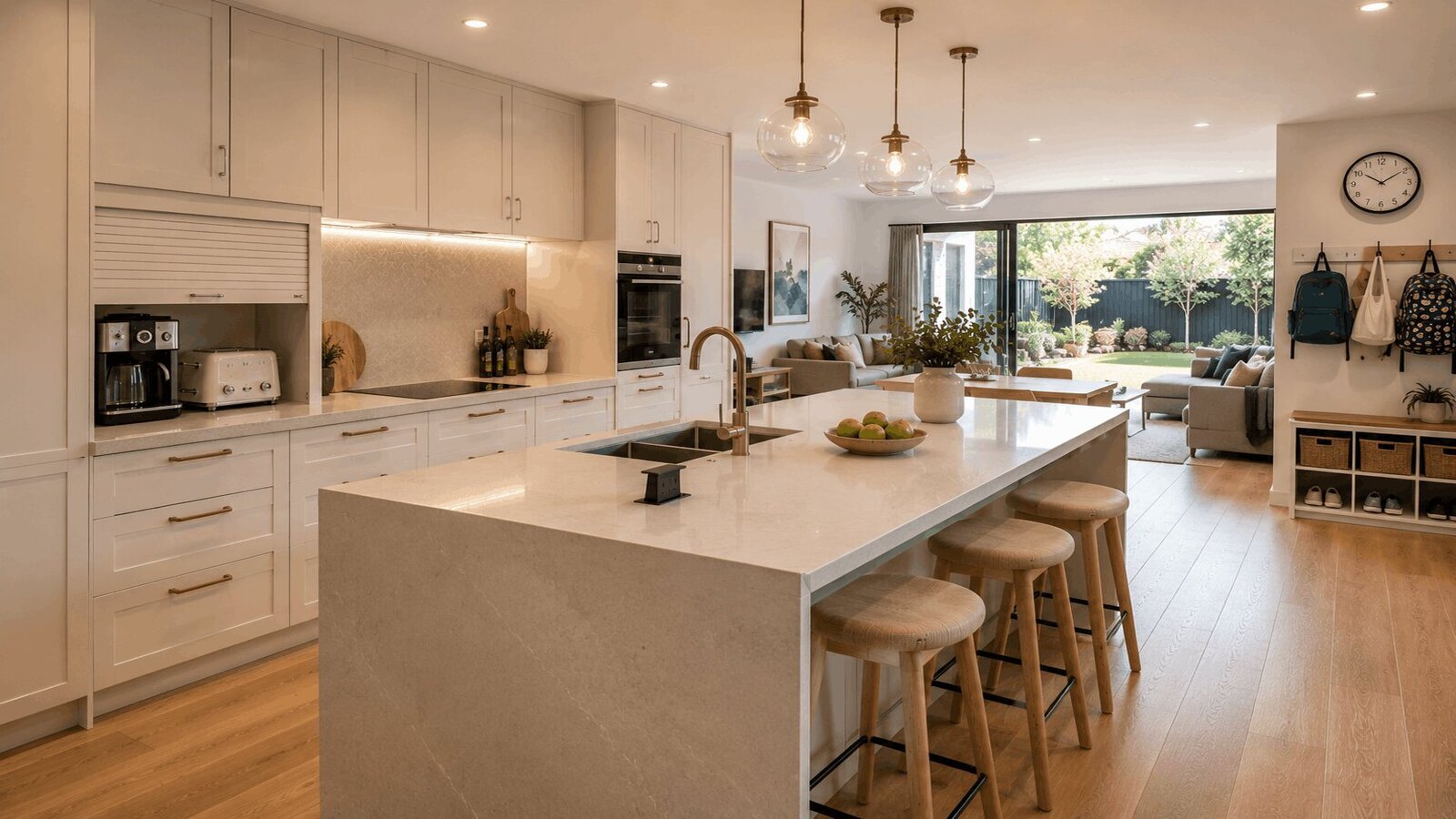
Tuesday, 7:30am in a Forest Hill kitchen. Three children are moving on three different school schedules. One parent is trying to find a pen for a permission slip. The toaster, kettle, and coffee machine are all sitting on the same cramped stretch of bench. The lunchbox drawer does not close properly. The bin is already full, but nobody wants to deal with it before school. There are bowls in the dishwasher, but the dishwasher has not been unpacked. Someone has left homework on the island. The school bags are drifting toward the kitchen floor again.
This is not a kitchen that looks wrong. It is a kitchen that works wrong.
That is the point of a family kitchen renovation in Forest Hill. The job is not to make the room photograph well when it is empty and spotless. The job is to make the kitchen hold up when four people are trying to use it at once during the most intense 75 minutes of the day. At Silk Touch Joinery, that is how we think about kitchen design in Forest Hill: not as decoration, but as daily infrastructure.
We covered the six storage failure zones in family kitchens in depth in the kitchen renovations Doncaster post, worth reading alongside this one. This post applies that framework specifically to Forest Hill’s 1960s to 1980s brick veneer homes and the school-morning workflow that defines the family kitchen brief in this suburb.
Forest Hill’s housing stock – what the family kitchen is working with
Forest Hill is a classic outer-east Whitehorse suburb. The housing stock is largely made up of post-war brick veneer homes, with most kitchens sitting inside homes built in the 1960s, 1970s, and 1980s. There are some older weatherboard homes in established pockets and some 1990s infill properties, but the dominant renovation opportunity is still the same: a family home with a tired original kitchen that was never designed for modern household demand.
The key local fact is simple. Most Forest Hill kitchens were built for a different kind of family life. They were not designed for lunchboxes, devices, homework at the island, all-day snack traffic, or two adults trying to prepare breakfast while children move through the room. That is why so many of them are now being rebuilt in 2026. The original joinery is near the end of its life, and the old layout is usually the real problem.
The 1960s single-storey brick veneer
This is the most common Forest Hill home type. The block is usually generous enough to allow for a meaningful kitchen upgrade, and the home itself is often long and low, with the kitchen at the rear. The original kitchen is commonly a closed galley or an L-shape. The room itself might be around 3.2m by 3.8m, which is enough space for basic cooking, but not enough space for a modern family workflow without changes.
The typical renovation path in this home type is wall removal, often to the adjacent living area, followed by an open-plan conversion and the addition of an island bench. In some cases, the rear opening is extended with bifold or sliding doors so the kitchen connects better to the garden. This kind of renovation is especially effective when the family wants a kitchen that feels more connected to the rest of the home without losing function.
There is a structural reality here. Many 1960s Forest Hill homes use internal brick walls, and those walls may be load-bearing. Never assume a wall is safe to remove just because it looks like a partition. A structural engineer needs to confirm that in writing before a builder takes it out.
The 1970s to 1980s updated brick veneer
This is the most common Forest Hill renovation scenario in 2026. These are the homes that were already improved once, usually in the 1990s, with semi-custom or builder-grade joinery that has now reached the end of its useful life. Often the wall layout is already open enough. The real issue is that the cabinet carcasses, drawers, hinges, and benchtops are worn out.
In these homes, the renovation is usually a full joinery replacement inside the existing footprint. That is the most cost-efficient and least disruptive outcome for many families. The layout is already close to right. The storage just needs to be rebuilt properly.
For a standard 4m to 7m total cabinet run, joinery supply usually sits in the $12,000 to $20,000 range. The timeline is usually 14 to 18 weeks from design sign-off to installation, depending on finishes, lead times, and trades coordination.
The larger 1980s to 1990s double-storey or ranch-style home
These homes are less common, but they do exist in Forest Hill. They usually offer more room to work with, and the kitchen footprint can be noticeably more generous than the average 1960s brick veneer. In some cases, a genuine open-plan kitchen zone of 5m by 6m or more is possible without a rear extension.
That changes the brief. In a larger Forest Hill home, the kitchen can do more than just cook. It can become the social centre of the family home, with a larger island, a proper pantry column, and even a small scullery alcove if the block and floor plan support it.
The school-morning workflow – designing the kitchen for peak demand
Forest Hill is a family suburb, and that matters. The kitchen brief here is usually not driven by entertaining or showpiece design. It is driven by how the household functions at the most difficult time of day: 7:00am to 8:15am.
That is the moment when the kitchen is under maximum stress. Two adults may be making breakfast at the same time. Children are finding bags, shoes, lunchboxes, and notes. One child is asking where their water bottle is. Another child is looking for a charger. The dishwasher from the night before may still be full. The bin may need emptying. And somehow everyone is supposed to leave the house on time.
A Forest Hill family kitchen renovation has to solve for that exact scenario.
The bench surface – keeping 600mm clear at all times
A family kitchen cannot function if the bench is already occupied before breakfast starts. The minimum viable standard in a school-morning kitchen is 600mm of clear bench space that stays clear.
That means the toaster, kettle, and coffee machine should not be sitting permanently on the main prep zone. It means the fruit bowl should have a fixed place that does not consume the most useful surface. It means charging cables should not be draped across the bench. And it means the kitchen design should include an appliance garage or another concealed storage solution for the small appliances that are used daily but do not need to live in the open.
An appliance garage can reclaim 600mm to 900mm of usable bench space. That is not a nice-to-have. In a family kitchen, it is the difference between a bench that works and a bench that constantly gets in the way.
The lunchbox zone
This is one of the most important storage decisions in the entire kitchen. A family with school-age children has a constant cycle of lunchboxes, drink bottles, snack containers, and reusable food items. These objects need a specific home.
The best solution is a dedicated base cabinet near the fridge and prep zone, with full-extension drawers at a low enough height that children can access them. One drawer can hold lunchboxes. Another can hold drink bottles. Another can hold snack containers or lunch-packing items. The point is not simply storage. The point is repeatability.
If the lunchbox system is not fixed, everything falls back into the same morning scramble. The child asks where the bottle is. The parent searches the wrong cupboard. The kitchen loses time. A dedicated lunchbox zone solves a daily friction point that most families have simply accepted for years.
The bag drop zone
School bags are part of the kitchen traffic pattern whether the design accounts for them or not. If there is no designated place for them, they end up on the floor, usually in the one spot where they can interrupt circulation between the island, the back door, and the fridge.
The fix is simple and effective. Add a hook panel or integrated bag zone to the joinery design. It can be a wall-mounted set of hooks at the end of a cabinet run or on the living-facing side of an island. It should allow one hook per family member, with a small shelf above for hats, keys, and other items that always seem to migrate toward the kitchen.
This is not a decoration detail. It is a traffic management decision. Once it is built in, the floor stays clearer, and the morning flow improves immediately.
The homework island
The island is rarely just an island in a family kitchen. During the afternoon, it becomes the homework station. It is where children sit while a parent finishes dinner prep. It is where a laptop is opened, a charger is plugged in, and a school task gets done while the household keeps moving around them.
For that reason, the island has to serve both cooking and family life. It needs enough prep depth on the kitchen side, and enough overhang on the living side for seating. It also needs power. If the island has no power point, it is already underperforming for a modern family.
An island that is designed only as a work surface is not enough. In Forest Hill, the island must be a prep zone, breakfast zone, and homework zone in one piece of joinery.
Smart storage decisions for the Forest Hill family kitchen
Storage is not just about capacity. It is about access, visibility, and speed. In a family kitchen, the best storage makes the whole house easier to run.
All-drawer base cabinets
This is the highest-impact storage upgrade in a family kitchen. Standard door-fronted base cabinets force people to crouch, reach, and rummage. That might be acceptable in a low-use kitchen, but it is inefficient in a family home.
All-drawer base cabinets are better because the full depth of the cabinet becomes visible and accessible. Full-extension runners let you see everything inside without kneeling on the floor and digging through stacked items. That matters when the kitchen is opened and closed dozens of times a day by multiple people, including children.
The one exception is where plumbing or appliance access requires a door. Under-sink and dishwasher-adjacent positions often need doors, but everywhere else, drawers are the smarter answer.
The pantry column
A full-height pantry column is one of the most effective additions in a family kitchen. It creates order out of the daily chaos of dry goods, breakfast items, snack foods, and lunch supplies. Instead of having cereal in one cupboard, baking items in another, and snack packs in a third, the household has one clear food storage zone.
For a family kitchen, the pantry should not just be tall. It should be well planned. Internal pull-out shelving at different heights makes the contents visible and accessible. Larger items need more vertical clearance. Smaller items can sit on tighter shelves. Lighting matters too. A simple internal LED strip can dramatically improve usability.
When the pantry is done properly, the whole kitchen feels calmer because the groceries are in one intelligible place.
The integrated pull-out bin
A freestanding bin on the kitchen floor is one of the most common and most unnecessary sources of clutter in a family kitchen. It occupies floor space in a traffic zone and becomes another thing people step around.
An integrated pull-out bin fixes that problem. Waste and recycling are stored inside a dedicated cabinet, usually around 400mm wide, and the entire system moves out on a full-extension runner. That means the floor stays clear and the bin remains easy to use.
This is a small detail with a big daily effect. In a crowded morning kitchen, every square metre matters.
Kickboard LED lighting
Kickboard lighting is one of those details that families do not always think of at the beginning, but they appreciate immediately after moving in. It creates enough low-level light for late-night kitchen use without turning on the full room lighting. That is useful for a middle-of-the-night glass of water, a quick snack, or early morning movement without waking everyone else.
It also makes the room feel more refined and practical. The cost is modest during the build, but it should be included in the electrical brief from the start. Retrofitting it later is always more expensive.
The appliance garage
The appliance garage is one of the best ways to protect bench space. In many homes, the coffee machine and toaster are permanently parked on the bench because there is nowhere else for them. The result is predictable: the bench stays crowded, and breakfast prep becomes harder than it needs to be.
A concealed appliance garage solves that. It keeps the appliances close at hand but off the open surface. In a family kitchen, that can return a meaningful amount of usable work area every single morning.
If the bench is the frontline of the kitchen, the appliance garage is one of the best ways to keep that frontline clear.
Layout options for Forest Hill family kitchens
The right layout depends on the house, the existing walls, and the way the family uses the room. In Forest Hill, four layout strategies keep showing up.
The L-shape with family island
This is the most effective overall layout for many Forest Hill homes. The cabinetry runs along two walls, and the island sits in the open space. The result is a room that can separate cooking from family movement without fully isolating the cook.
The island becomes the main point of connection. The cook has a clear prep zone. The children get a place to sit or work. The living area feels connected to the kitchen without being inside the work zone.
For many outer-east family homes, this is the sweet spot. It creates enough openness without making the room feel unstructured.
The galley-to-open-plan conversion
This is common in older 1960s Forest Hill brick veneer homes. A closed galley kitchen is opened up by removing the wall to the living zone, then reworking the room around an island or peninsula.
This kind of change requires more than joinery. It needs structural assessment, permit planning, and proper trade coordination. But when it is done well, the impact is significant. The room goes from narrow and isolated to open, practical, and family-friendly.
The structural logic is similar to the kind of work discussed in the kitchen renovation Blackburn guide, because the same post-war brick veneer patterns often apply across Whitehorse suburbs.
The in-place renovation with full storage rebuild
This is the best fit for homes that already have an open kitchen zone but whose cabinetry is failing. The walls stay in place. The footprint stays in place. The structure stays in place. The joinery gets completely rebuilt.
This approach is often the fastest and least disruptive way to transform a Forest Hill kitchen. It is also the most cost-efficient where the layout is basically right but the storage is poor.
A full storage rebuild might include all drawers, a proper pantry column, an appliance garage, an integrated bin, and a new island profile. The room can feel completely different without the cost of demolition or structural work.
The larger family kitchen with scullery
Some Forest Hill homes have the block size and internal space to support a larger kitchen and a small scullery. That is a powerful combination in the right home.
The main kitchen handles cooking, family traffic, and social use. The scullery can take the messier functions out of sight. It can store the pantry, hide extra appliances, and provide a secondary sink if needed. This can dramatically improve the usability of a larger family home.
It is especially valuable where the family wants the main kitchen to stay clean and visually calm while still handling high day-to-day use. For some households, this is the best possible outcome.
The difference between a family kitchen and an entertainer kitchen matters here. The kitchen renovation Wantirna post is useful for that comparison because it reflects a more entertainer-focused brief. Forest Hill is generally different. The priority here is not event hosting. It is household efficiency.
2026 material palettes for Forest Hill family kitchens
Forest Hill families are usually looking for something durable, cleanable, and timeless. The materials need to handle daily use, not just look good on day one.
The warm white family classic
This is the most common palette for a reason. Warm white 2-pack cabinetry, a warm grey-white engineered stone benchtop, subtle handles, and a simple white or off-white splashback create a kitchen that is easy to live with and easy to maintain.
White cabinetry can still work well in a family home when the finish is specified properly. Satin 2-pack is practical because it is easier to wipe down than matte and less reflective than gloss. It keeps the room bright without becoming overly shiny.
This palette is popular because it is calm, flexible, and resale-safe. It also suits the outer-east family home character very well.
The warm greige plus timber accent
This option adds warmth without becoming overly dark or heavy. Warm greige cabinetry, a small amount of American oak shelving, and a soft stone benchtop create a kitchen that feels grounded and welcoming.
This palette works well in homes that receive good natural light and where the family wants a little more visual depth without losing practicality. It is still easy to clean, but it has a softer residential feel than a full white kitchen.
It is a good fit for Forest Hill homes that want warmth without losing clarity.
The two-tone family kitchen
The two-tone kitchen is increasingly popular in 2026. It usually combines a lighter upper cabinet run with a darker or warmer island base. That contrast helps define the room visually while also being practical, because darker lower surfaces tend to disguise everyday marks better than white.
This is especially useful in a family home where the island becomes a homework zone, snack zone, and breakfast zone all at once. The darker island base is more forgiving, and the lighter perimeter keeps the room open.
The design thinking behind family-oriented joinery across Melbourne’s inner and outer east is covered on the kitchen renovation Hawthorn page, and the same logic applies here: the room has to function beautifully before it can look beautiful.
Joinery specifications for Forest Hill family kitchens
Joinery specification is where the quality difference is felt over time. In a family kitchen, the wrong hardware or finish can start to annoy people within months. The right specification can perform well for years.
Carcass
Use 18mm HMR board throughout. Moisture resistance matters, especially in under-sink and dishwasher-adjacent zones. This is one of those choices that should never be compromised.
Door finish
Use 2-pack polyurethane in satin sheen. This gives the right balance between durability and everyday practicality. Satin is usually the best option for family kitchens because it does not highlight fingerprints as badly as gloss and does not absorb marks as readily as matte.
Hardware
Specify Blum Legrabox or Tandembox Antaro full-extension soft-close drawers, together with Blum Clip Top Blumotion hinges. In a family kitchen, the hardware is not an accessory. It is the operating system of the room.
If drawers and doors are opened constantly by adults and children alike, the difference between premium hardware and generic hardware becomes obvious very quickly. Good hardware keeps its feel and function over time.
Hinges with 170 degree opening
Where the cabinet arrangement allows, use hinges that open to 170 degrees. That helps doors sit flatter against adjacent cabinetry and reduces obstruction in high-traffic areas. In a family kitchen, especially during school-morning rush, that matters more than people expect.
Benchtop
For most Forest Hill family kitchens, 20mm engineered stone is the right specification. It is durable, non-porous, and easy to maintain. That makes it more suitable than natural stone for a busy household.
Engineered stone stands up well to the realities of family life: fruit juice, school snacks, lunch prep, and general daily use. The room will be easier to maintain and more forgiving of regular activity.
Island power
The island should include a recessed pop-up GPO, specified during the electrical rough-in stage, not after. It should also include USB-A and USB-C where possible. In a family kitchen, charging is part of daily life, and the island is often the best place to manage it.
If the power point is not planned early, it becomes far harder to integrate cleanly later. This is one of those details that needs to be locked in before cabinetry is built.
2026 cost guide – kitchen renovation in Forest Hill
The figures below reflect the confirmed 2026 pricing structure provided in the brief. These are supply-only joinery figures unless noted otherwise.
Joinery supply only
| Kitchen scope | Supply-only range (AUD) |
|---|---|
| Compact in-place renovation, under 4m total run | $8,000 – $12,000 |
| Standard L-shape or single-wall, 4m to 7m total run | $12,000 – $20,000 |
| Open-plan kitchen with island, 7m+ total run | $18,000 – $30,000+ |
| Add compact scullery, 2000mm x 1500mm | + $10,000 – $15,000 |
| Whole-home package, kitchen + laundry + wardrobes | $30,000 – $70,000+ |
Structural and builder’s works for context
| Item | Estimated range (AUD) |
|---|---|
| Structural engineer’s assessment | $500 – $1,200 |
| Building permit, Whitehorse City Council | $800 – $2,000 |
| Brick wall removal + beam, load-bearing | $7,500 – $16,000 |
| Timber-frame partition wall removal | $2,000 – $5,000 |
| Rear extension, single-storey, 4m depth | $80,000 – $180,000+ |
All-trades add-ons
| Trade or item | Budget range (AUD) |
|---|---|
| Stone benchtop | $2,500 – $10,000 |
| Appliances | $4,000 – $20,000 |
| Splashback | $800 – $2,500 |
| Plumbing | $1,000 – $3,500 |
| Electrical, including island GPO and kickboard LED | $1,200 – $3,500 |
| Painting | $1,000 – $4,500 |
| Flooring, engineered timber | $3,500 – $10,000 |
The important point is not simply the number. It is the relationship between the number and the outcome. A family kitchen in Forest Hill is usually a long-term investment. A better layout, better storage, and better hardware often create more day-to-day value than a purely cosmetic upgrade.
Frequently asked questions
How much does a kitchen renovation cost in Forest Hill in 2026?
Bespoke kitchen joinery in Forest Hill starts at $8,000 to $12,000 supply-only for a compact galley under 4m. A standard L-shaped or single-wall kitchen, usually 4m to 7m total run, typically sits at $12,000 to $20,000. An open-plan kitchen with island, usually 7m or more total run, starts at $18,000 to $30,000 plus. A whole-home joinery package covering kitchen, laundry, and wardrobes sits at $30,000 to $70,000 plus. These are supply-only figures and do not include stone benchtops, appliances, plumbing, electrical, or structural works.
What are the best kitchen layouts for a growing family in Forest Hill?
For growing families in Forest Hill’s 1960s to 1980s brick veneer homes, the L-shaped kitchen with island is usually the best outcome. The island creates a defined homework and breakfast zone for children, a clear prep zone for the cook, and a visual separator between the kitchen and living zones without creating a physical barrier. In Forest Hill’s larger homes with rear extension potential, a U-shaped kitchen with a generous island and an adjacent scullery can provide the highest level of daily-use functionality for a household of four or more.
What storage features matter most for a family kitchen renovation in Forest Hill?
The five highest-impact storage decisions for a Forest Hill family kitchen are: first, all-drawer base cabinets instead of door-fronted storage, because full-extension drawers make contents genuinely accessible; second, a full-height pantry column with internal pull-out shelving for dry goods and small appliances; third, a dedicated lunchbox and drink-bottle drawer in the island or base cabinetry; fourth, an integrated pull-out bin system so the freestanding bin disappears from the floor; and fifth, a homework-ready island with a 300mm seating overhang and an integrated island power point for device charging.
Does Forest Hill require planning permits for kitchen renovation?
For internal joinery replacement in Forest Hill, such as cabinets, benchtops, and splashback, no planning permit is required. Forest Hill falls under Whitehorse City Council, which has a light heritage overlay footprint. If the project involves wall removal, a rear extension, or any change to the external envelope, a building permit will be required. Any wall removal also requires a structural engineer’s assessment before a building permit can be issued.
Do you service Forest Hill and surrounding Melbourne outer-east suburbs?
Yes. Silk Touch Joinery services Forest Hill and surrounding Melbourne outer-east suburbs including Nunawading, Blackburn, Vermont, Mitcham, Box Hill, Whitehorse, and nearby areas. Contact us to book a free in-home consultation at your Forest Hill property.
A Forest Hill family kitchen renovation is an infrastructure project first and a design project second. When the layout is right, the storage is right, and the workflow is right, the look of the kitchen falls into place naturally. The real measure of success is simple: does the kitchen hold up at 7:30am on a Tuesday, when the house is fully awake and the pressure is on?
If it does, the renovation has done its job.