
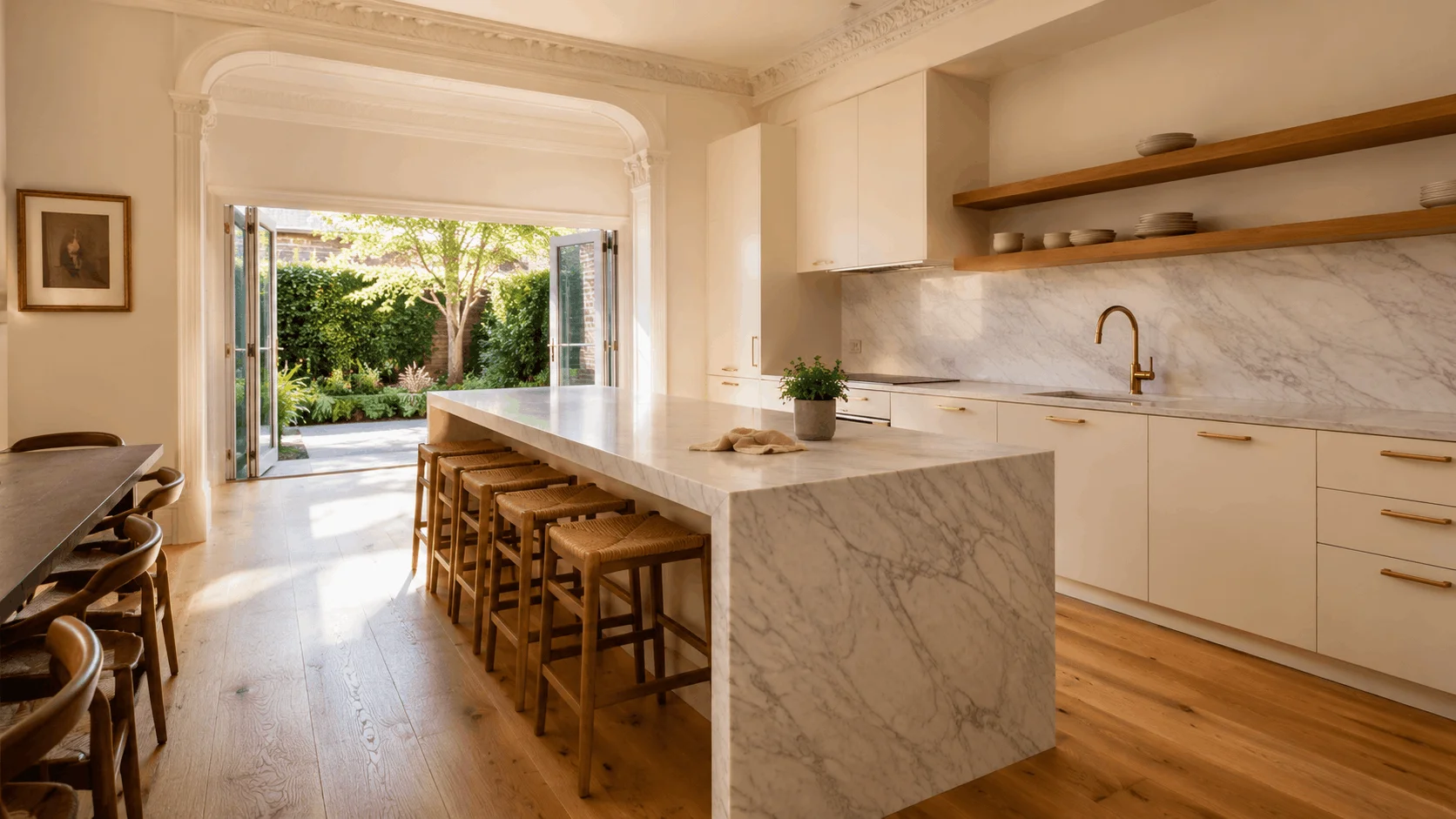
The number most Melbourne kitchen companies won’t put in writing is the one you need most before you make any decision. Not a ballpark. Not a range so wide it’s useless. A real number — anchored to real materials, real labour, and real suburb context.
We’ve been building bespoke kitchen joinery in Melbourne for long enough to know why the industry hedges. Specific numbers invite comparison. Specific numbers mean you might not call. We’ve decided that’s not how we want to work. If the pricing in this post rules us out for your project, that’s the right outcome for both of us. If it helps you understand what you’re buying and why — and eventually brings you to our workshop — that’s the right outcome too.
This post gives you actual 2026 pricing across all three tiers of kitchen cabinetry, a complete trade-by-trade budget map, and suburb-by-suburb context for Melbourne North. No vague ranges without explanation. No softening for commercial reasons.
We’ve recently published detailed guides for kitchen renovation in Northcote and custom joinery in Fitzroy North — both worth reading if you’re in those suburbs specifically. This post covers the financial picture across all of Melbourne North, from Brunswick to Eltham.
The Three Tiers of Kitchen Cabinetry in Melbourne — And What Each Actually Costs
There are three distinct markets for kitchen cabinetry in Melbourne in 2026. They do not overlap in a meaningful way, and the choice between them is not primarily about budget — it’s about what your space actually needs. Here’s what each tier really costs.
Tier 1 — Flat-Pack (Self-Supplied and Installed)
Flat-pack kitchens come from IKEA (SEKTION/METOD), Kaboodle (Bunnings), Kinsman (Harvey Norman), and online suppliers like DIY Kitchens. The product is a fixed-increment modular system — cabinets come in standard widths of 300mm, 600mm, 900mm, 1200mm — and the room is fitted around them.
What flat-pack materials actually cost:
- IKEA METOD complete kitchen (cabinets only, no bench, no appliances): $3,000 – $7,500 for a standard 3–5m kitchen depending on configuration and door choice
- Kaboodle equivalent from Bunnings: $2,500 – $6,000
- Professional installation on top: $2,500 – $5,000 for a standard kitchen at tradie day rates
Total flat-pack kitchen, installed, no bench, no appliances: $5,500 – $13,000
Where flat-pack works well: new builds with square rooms, rental investments, first-pass renovations pending a larger project, and situations where the budget ceiling is firm under $15,000.
Where flat-pack fails in Melbourne North: Victorian terrace walls are almost never square, plumb, or level. Standard flat-pack modules leave visible gaps at wall returns, under cornices, and at floor level. The workarounds — filler panels, caulk, trim strips — look exactly like what they are. In a heritage terrace kitchen where every other detail has been carefully considered, the compromise is obvious.
Tier 2 — Semi-Custom (Kitchen Company Supply and Install)
Semi-custom comes from Freedom Kitchens, Kaboodle Premium, Kinsman’s upper ranges, and local kitchen companies offering a design service. The underlying product is still modular — standardised cabinet increments — but the service wraps it in a design consultation, wider colour and door options, and professional installation.
Semi-custom pricing (cabinetry supply and install, no bench, no appliances):
| Kitchen size | Typical range |
|---|---|
| Small (under 4m run) | $12,000 – $22,000 |
| Medium (4–7m) | $20,000 – $38,000 |
| Large with island (7m+) | $35,000 – $58,000 |
Honest assessment: semi-custom is a real upgrade from flat-pack in finish quality and design service quality. The limitations are the same as flat-pack — standardised sizing, fitting compromises in irregular spaces, filler panels at wall returns. In a post-war brick veneer with regular walls, that may not matter. In a Northcote or Brunswick terrace, it almost always does.
Tier 3 — Bespoke Workshop-Made Joinery
This is our tier. We’re going to be direct about that, because the pricing context requires it.
Bespoke joinery is not fitted to a space — it is made for the space. Every cabinet is fabricated in our Melbourne workshop to the surveyed dimensions of the room. Scribing to irregular walls and uneven floors is built into the fabrication process, not an afterthought. Hardware specification (Blum throughout), carcass material (18mm HMR board), and finish (2-pack polyurethane) are set at a standard that performs over a 20–30 year lifespan.
Bespoke joinery pricing — supply only (excludes stone benchtop, appliances, plumbing, electrical):
| Kitchen scope | Supply-only range |
|---|---|
| Compact galley (under 4m total run) | $8,000 – $12,000 |
| Standard L-shape or single-wall (4–7m) | $12,000 – $20,000 |
| Open-plan with island (7m+ total run) | $18,000 – $30,000+ |
| Whole-home (kitchen + laundry + wardrobes) | $30,000 – $70,000+ |
The supply-only figure matters because it’s what you’re comparing when you evaluate joinery companies. Stone, appliances, plumbing, and electrical are priced separately by those trades and vary independently of the joinery decision. The custom kitchen cabinets page covers our full specification in detail.
The Real Cost of a Complete Kitchen Renovation in Melbourne North
Joinery is one line item in a kitchen renovation budget. Here is what the full project typically looks like across all trades in Melbourne North in 2026.
| Trade / item | Budget range (AUD) | Notes |
|---|---|---|
| Bespoke joinery (supply only) | $18,000 – $35,000+ | See tier breakdown above |
| Stone benchtop (supply and install) | $3,500 – $12,000 | Engineered stone at low end; natural marble or quartzite at high end — thickness and edge profile drive cost |
| Appliances | $4,000 – $25,000 | Entry-level integrated at low end; Gaggenau/Miele full suite at high end |
| Splashback (tiling or glass) | $800 – $2,500 | Standard subway tile at low end; handmade ceramic or fluted glass at high end |
| Plumbing (relocation / new rough-in) | $1,000 – $3,500 | Cost rises sharply if sink moves more than 1.5m from existing waste point |
| Electrical (new circuits, lighting, rangehood) | $800 – $3,000 | LED strip lighting in overhead cabinets adds $600–$1,200 |
| Painting (kitchen zone) | $1,500 – $4,500 | Full repaint after joinery install — do not skip this step |
| Flooring (if replacing) | $2,500 – $10,000 | Victorian terrace Baltic Pine restoration: $4,000–$8,000; new engineered timber: $5,000–$12,000 |
| Structural / builder’s works | $0 – $120,000+ | $0 for in-place renovation; $30,000–$60,000 for lean-to demolition and replacement; $80,000–$200,000+ for full rear extension |
Total complete kitchen renovation (in-place, no structural works): $35,000 – $110,000
Total complete kitchen renovation (with new rear extension): $120,000 – $350,000+
These ranges are wide because the variation in scope is wide — not because we’re being deliberately vague. The single most important variable in any Melbourne North kitchen budget is whether structural work is involved.
An in-place kitchen renovation — where the walls stay, the layout stays, and the project is joinery, trades, and finishes — is a contained and plannable project. The moment a wall comes down or a rear addition goes on, you’re in a construction project with kitchen joinery as one component. The joinery cost doesn’t change. The total project cost changes enormously. Getting clear on that distinction before you start talking to designers and builders is the most useful thing this section can give you.
What Actually Drives the Price of Bespoke Kitchen Joinery
Within the bespoke tier, the price of a kitchen is not arbitrary. Seven specific variables move the number. Understanding them lets you make deliberate decisions about where to invest and where to pull back.
1. Number of drawers vs doors
Drawers cost more to fabricate than doors. A Blum Legrabox or Tandembox drawer box runs approximately $180–$350 per unit. A door runs $60–$120. A kitchen designed with all-drawer base cabinets — which is the modern functional preference, and for good reason — will cost 18–28% more in joinery than the equivalent cabinet count in doors.
That premium is not decorative. Drawers give full-width access to every centimetre of the cabinet. Doors give you a dark corner that requires a torch and a crouch. We see homeowners scale back the drawer specification to save money and regret it within six months of using the kitchen every day.
2. Carcass material specification
We use 18mm HMR (moisture-resistant) board throughout — carcass, shelves, internal panels. Flat-pack and lower-tier semi-custom typically uses 12mm standard board.
The material cost difference is approximately 12–18%. The performance difference in Melbourne North’s Victorian terrace environment — where older drainage systems, subfloor ventilation issues, and proximity to original plumbing create ambient humidity — is significant. We don’t offer a standard-board option because we know where these kitchens live.
3. Door finish
- Melamine (flat-pack standard): included in base cost — functional but limited durability on edges and corners
- Vinyl wrap: adds approximately 15–25% to door costs — softer look, susceptible to heat delamination near ovens
- 2-pack polyurethane (our standard): adds 35–55% to door costs vs melamine — factory-hard finish, does not peel, chip, or yellow over time; this is what you see in high-specification residential and commercial joinery
- Timber veneer: adds 50–80% to door costs — requires higher skill in fabrication and finishing; used where the design brief calls for a natural material
4. Hardware tier
- Generic soft-close runners and hinges: base cost reference point
- Blum Clip Top Blumotion hinges + Tandembox Antaro drawers: adds $600–$1,800 to a standard kitchen vs generic hardware
- Blum Legrabox (our premium drawer system): adds $1,200–$3,000 vs generic
Blum hardware carries a lifetime mechanical guarantee. This is not a marketing specification — it is a measurable, transferable warranty on the mechanical components. We use it across every project because it removes the risk of drawer runners failing in year four.
5. Degree of scribing required
Scribing means fabricating the joinery to fit precisely against irregular walls and uneven floors — as opposed to installing modules against those surfaces and filling the gaps with caulk and trim. In a new build with square, plumb walls: minimal scribing, minimal cost impact. In a 130-year-old Northcote terrace where no wall is plumb, the floor has settled unevenly, and the cornice has a 12mm bow over 3 metres: extensive scribing is required throughout.
Add $800–$2,500 to the fabrication cost vs a square, plumb room. This is unavoidable in most Melbourne North heritage homes and is built into our survey and quote process from the start.
6. Island complexity
A straight rectangular island with four flat painted ends is the base-cost island. The number moves when you add: a waterfall stone end panel (stone cost separate), integrated power and USB outlets, a breakfast bar overhang requiring structural support within the carcass, or curved cabinetry on any face.
Island complexity adds $3,000–$8,000 to the joinery component alone, excluding the stone, which is priced separately by the stonemason based on material choice and edge profile.
7. Integrated appliances
Every integrated appliance — fridge, dishwasher, rangehood, oven column — requires a custom-built cabinet housing to precise specifications. These units are not expensive in isolation ($400–$900 per integrated housing), but they add to total cabinet count and require exact coordination with appliance dimensions and installation sequence. Full appliance integration across a standard kitchen adds $2,500–$5,500 to the joinery scope.
Melbourne North Suburb-by-Suburb Context — Does Location Affect Joinery Cost?
The short answer is: location affects the scope of the project more than the unit cost of the joinery. The irregular structural conditions of a heritage suburb add fabrication complexity. The lot sizes and home types of the northern growth suburbs affect total run length. Here’s what that looks like suburb by suburb.
Victorian terrace suburbs — Northcote, Fitzroy North, Brunswick, Clifton Hill
Narrow lots, irregular structures, highly variable ceiling heights and floor levels. Most projects are in-place renovations or modest rear extensions — the lot constraints and heritage overlays limit what’s structurally possible. Scribing is typically extensive. Total bespoke joinery supply for a complete kitchen runs $30,000–$60,000 in most terrace projects, with the higher end reflecting larger footprints or island additions.
Post-war suburban suburbs — Coburg, Preston, Reservoir
More regular brick veneer structures, wider lots, fewer heritage constraints. Scribing requirements are lower than in the terrace precinct. Projects often involve more open-plan reconfiguration because the structures allow it. Joinery cost tends to sit at the lower end of the bespoke range: typically $25,000–$50,000 for a complete bespoke kitchen.
Larger lot and acreage northern suburbs — Ivanhoe, Heidelberg, Eltham
Larger homes, often with genuine open-plan rear extensions already in place. Higher total run lengths, larger islands, more whole-home scope (kitchen, pantry, laundry, butler’s pantry). Joinery cost trends toward the upper end: typically $45,000–$85,000+ for a complete open-plan kitchen.
For the detailed planning and layout context specific to terrace renovations, our recent posts on kitchen renovation in Northcote and custom joinery in Fitzroy North go deep on those suburb-specific challenges.
The Flat-Pack vs Bespoke Decision — An Honest Framework
This is not a sales pitch for the bespoke tier. Flat-pack and semi-custom are the right answer for a meaningful proportion of kitchens in Melbourne North. Here’s a genuine decision framework.
Choose flat-pack if:
- The property is a rental investment or planned for short-term resale within five years
- The room is a new build with genuinely square, level, and plumb walls and floors
- The total joinery budget is firmly under $15,000
- The renovation is a temporary measure pending a larger structural project
Choose semi-custom if:
- The room is largely regular — post-1980 construction with minor irregularities
- The budget sits between $18,000 and $35,000 for joinery
- A design service and product warranty are important, but a precision fit is not critical to the outcome
Choose bespoke if:
- The property is a Victorian or Edwardian terrace — which accounts for the majority of residential stock in Northcote, Fitzroy North, Brunswick, and Clifton Hill
- Walls and floors are irregular, and scribing is required for a clean result
- The kitchen will be used daily for 15–20+ years before the next renovation
- Material quality and hardware performance matter for daily function over the long term
- The project involves an architect or interior designer — bespoke joinery is the only tier that works within a design-led specification with exact dimensional requirements
The cost premium for bespoke over flat-pack is real — typically 3–5x on the joinery line item. So is the performance gap in longevity, precision, and material quality. The decision is not about which is better in the abstract. It’s about which is right for the specific property, brief, and budget.
For a deeper look at how we approach heritage-sensitive joinery — the design philosophy behind the pricing decisions — the kitchen renovations Camberwell page covers our full methodology.
Frequently Asked Questions
How much do kitchen cabinets cost in Melbourne in 2026?
Kitchen cabinet costs in Melbourne in 2026 depend heavily on the product type. Flat-pack cabinets (IKEA, Kaboodle) typically cost $3,000–$8,000 in materials for a standard kitchen. Semi-custom flatpack with a kitchen company ranges from $8,000–$18,000 supply. Bespoke, workshop-made joinery from a specialist like Silk Touch starts at $18,000 for a compact kitchen and ranges to $80,000+ for a large open-plan kitchen with island. These figures are for joinery supply only and exclude stone benchtops, appliances, plumbing, and installation labour.
What is the difference between flat-pack and bespoke kitchen joinery?
Flat-pack kitchens use standardised cabinet modules in fixed sizes (typically 600mm, 900mm, 1200mm increments). They must be fitted to the room, leaving filler gaps at walls and corners. Bespoke joinery is made to the exact dimensions of your space, scribed to uneven walls and floors, and built to a higher carcass and hardware specification. In heritage Melbourne homes with irregular structures, bespoke joinery is often the only option that produces a finished result without visible gaps or compromise.
What hidden costs should I budget for beyond kitchen cabinets?
Beyond joinery supply, Melbourne kitchen renovations typically involve: stone benchtops ($3,000–$15,000+), appliances ($4,000–$20,000+), splashback tiling or glass ($800–$3,500), plumbing relocation ($1,500–$4,000), electrical work ($1,200–$3,500), painting ($1,500–$4,000), and builder’s structural works if walls are being moved or a rear extension added ($30,000–$120,000+). A full kitchen renovation in Melbourne North including all trades typically runs $45,000–$150,000+ depending on scope.
Why does bespoke joinery cost more than flat-pack?
Bespoke joinery costs more for five reasons: materials (18mm HMR carcass board vs thinner flat-pack board), hardware (Blum soft-close drawers and hinges vs basic runners), fabrication (workshop-made to exact dimensions vs standardised modules), finishing (2-pack polyurethane spray finish vs vinyl wrap or melamine), and installation precision (laser-levelling and scribing to uneven walls vs filling gaps with caulk and trim). The cost premium is real — typically 3–5x flat-pack — but so is the performance and longevity gap.
How much does a kitchen renovation cost in Melbourne North suburbs like Northcote or Brunswick?
In Melbourne North suburbs including Northcote, Fitzroy North, Brunswick, and Coburg, kitchen renovation costs vary by scope. A compact galley kitchen in a Victorian terrace (joinery supply only) ranges from $20,000–$30,000 for bespoke. An L-shaped or rear extension kitchen runs $30,000–$55,000 in joinery. A full open-plan kitchen with island starts around $50,000–$80,000+. Total project cost including all trades for a heritage terrace kitchen renovation in Melbourne North typically falls between $60,000 and $180,000 depending on whether structural work is involved.
The pricing in this post is what you should expect to budget. Anyone quoting significantly less for bespoke joinery is cutting specification somewhere — materials, hardware, fabrication precision, or installation time. The way to know which is to ask the right questions before you sign anything. We’ve built our quoting process to make those questions easy to ask and straightforward to answer.
The next step is an in-home consultation — not to sell you something, but to understand the actual scope of your project before any number means anything. We measure the space, talk through the brief, and give you a clear picture of where your project sits across all three tiers.