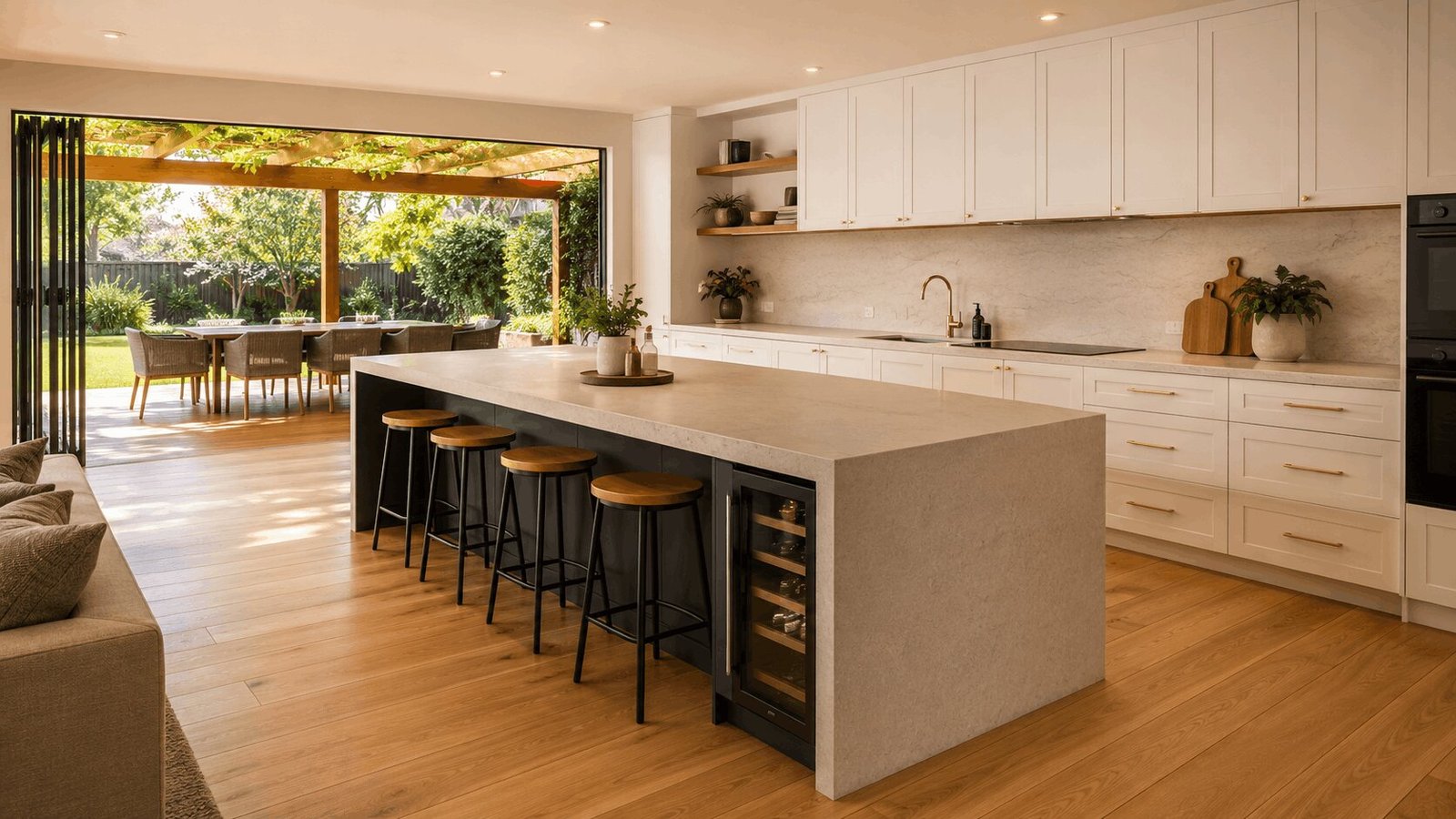
Christmas Day. Thirty-five people. The pergola is packed — backyard cricket already underway, cold drinks on the outdoor table, the smell of something on the Weber. Inside, the kitchen has three adults trying to work in a 3.5m galley. There is no bench space. The dishwasher has been running since 9am. Nobody can see the guests. Nobody is relaxed. The food gets out, eventually, but the cook has spent the whole day isolated at the back of the house.
That kitchen was not designed for what this household actually does with it.
Wantirna’s housing stock was built between 1975 and 1995 on blocks of 650 to 1,000+ sqm — some of the most generous residential land in Melbourne’s outer south-east. The outdoor entertaining infrastructure is almost always already there: a covered pergola, a concrete slab, an established garden that has had decades to mature. What is almost never there is the joinery that connects the indoor kitchen to that outdoor zone, gives the cook a central position in the household’s social life, and provides the functional capacity for 35 people at Christmas to feel genuinely easy.
The entertainer kitchen renovation in Wantirna is not an aesthetic project. It is an infrastructure project. The right island size, the right scullery configuration, the right alfresco connection, and the right cabinetry specification are the decisions that determine whether Christmas works — or whether the cook spends it in a galley.
The broader case for why Melbourne’s outer east and south families are choosing bespoke joinery for exactly these reasons is in the why families are switching to custom joinery guide. This post is specific to Wantirna — the hosting brief, the spatial opportunity, and the joinery decisions that make it work.
Wantirna’s Entertainer Opportunity — Why the Block Size Changes the Brief
Wantirna is a bespoke-joinery-friendly suburb in a way that most of Melbourne is not. The combination of Knox City Council’s minimal heritage overlay footprint, blocks that routinely run to 700–1,000+ sqm, and a demographic of established families who have lived in the same home for 10–25 years creates conditions that make the entertainer kitchen renovation not only spatially achievable, but an obvious next step.
What the block size actually enables
A Wantirna home on 750 sqm has 40–50% more rear yard depth than a typical outer-east brick veneer on 650 sqm — and roughly double the rear depth of a North Fitzroy terrace on a 200 sqm lot. That spatial advantage translates directly into renovation scope:
- A rear extension of 5–6m is achievable without sacrificing a meaningful garden
- A 1800mm × 1050mm island fits with correct 1050mm clear aisles on all working sides
- A dedicated scullery of 2500mm × 2000mm sits adjacent to the kitchen without compressing either zone
- A covered alfresco area of 4m × 5m connects to the open-plan kitchen through bifold or stacking sliding doors with a flush floor threshold
None of these outcomes require compromise in Wantirna. In an inner-city terrace, none of them are simultaneously achievable.
The outdoor infrastructure is already there
Wantirna’s housing stock, built between 1975 and 1995, almost universally includes a covered pergola or concrete slab at the rear. This outdoor entertaining zone did not come from the kitchen renovation — it has been there for 20 or 30 years. What the kitchen renovation does is connect to it properly: through a widened rear opening (3600mm+ bifold or stacking doors), a flush or near-flush floor threshold, sight lines from the island to the pergola, and a material palette that reads coherently from indoors to out.
The hosting demographic
Wantirna’s family demographic entertains regularly and at scale. This is not dinner-party-for-six entertaining. This is extended-family Christmas, street barbecue, 40th birthday entertaining — events that require kitchen infrastructure, not just kitchen aesthetics. The original closed galley that came with a 1982 Wantirna double-storey was never designed to support this. The renovation that corrects this — open-plan kitchen, large island, scullery, alfresco connection — is the dominant brief Silk Touch Joinery receives from this suburb.
The Entertainer Island — Sizing for Wantirna’s Open-Plan Zones
The island bench is the centrepiece of the entertainer kitchen and the single decision that most determines whether the kitchen functions at scale. Wantirna’s open-plan zones — typically created by removing the wall between the original closed kitchen and the rear living space — give this suburb the room to specify islands that inner-city renovations can only approximate.
Why island sizing is a spatial equation, not a preference
The island can only be as large as the room allows while maintaining minimum clear aisle widths on all working sides: 900mm absolute minimum, 1050mm preferred on the primary cook’s side between the island and the perimeter cabinet run. The island dimension is therefore not chosen aesthetically and retrofitted into the space — it is derived from the room’s dimensions after the perimeter cabinet runs are placed.
The minimum viable entertainer island: 1500mm × 950mm
At 1500mm long, the island provides meaningful prep on the kitchen-facing side and seating for three on the living-facing side. Below 1500mm in length, the island functions as a prep surface but not as an entertaining focal point. Below 950mm in width, the 300mm seating overhang leaves insufficient prep depth (620mm) for serious cooking use alongside guests seated at the bench.
The target entertainer island: 1700mm × 1000mm
For a Wantirna open-plan zone of approximately 5m × 6m, a 1700mm × 1000mm island is the standard entertainer specification. At this size:
- The kitchen-facing side has 700mm of prep depth — comfortable for two cooks working simultaneously during an event
- The living-facing side accommodates four bar stools at 420mm centres with a 300mm overhang
- The island’s visual proportion is correct for the room — it reads as the centrepiece, not an afterthought
The full entertainer island: 1800–2000mm × 1050mm
Achievable in Wantirna’s larger rear extension zones — 5m × 7m or more. At this scale, the island accommodates: a preparation sink on the kitchen-facing side (undermount, 400mm × 300mm, with a mixer tap in a finished-metal specification matching the rest of the hardware); a drinks fridge integrated into the island base on the entertaining-facing end; and seating for five on the living-facing side. This is the island that makes a Wantirna kitchen into a serious entertainer centrepiece.
Island features specific to the entertainer brief
- Waterfall stone end panel. The stone benchtop continues vertically down the visible end of the island — typically the end facing the living zone. At 30mm thickness, it provides a visual anchor and a clean, finished face toward the entertaining space.
- Integrated drinks fridge on the entertaining end. A 30–45cm integrated drinks fridge column in the island base, accessible from the living side. Keeps beverages at reach for guests without requiring them to enter the kitchen work zone.
- Island power. A recessed pop-up GPO (Clipsal or Legrand) in the island surface for appliance use during prep. On the entertaining side, a USB-A and USB-C integrated outlet for guest device charging during events.
- Overhead extraction. A 900mm rangehood directly above the island cooking zone, sized to the cooktop’s output. For a high-performance wok burner or dual-fuel cooktop, 1000+ m³/h extraction is required. Coordinate the rangehood housing column with the overhead cabinet schedule before finalising.
The rule: measure the room before committing to an island dimension. Never specify the island before the aisle clearances have been confirmed. A 1700mm island specified without checking the perimeter cabinet positions may require aisles of only 850mm — 200mm less than the preferred 1050mm — which eliminates the benefit of the larger island under real use conditions.
The Scullery — The Entertainer’s Most Valuable Investment
A scullery is a secondary kitchen zone separated from the main kitchen by a wall and a door that closes. For an entertainer household in Wantirna, it is the single highest-return addition to a kitchen renovation — not because it looks impressive, but because of what it removes from the main kitchen zone.
What the scullery actually does during an event
In a kitchen without a scullery, post-meal cleanup happens in the main kitchen — the same zone where guests are sitting at the island, where the second course is being plated, and where the renovation’s material palette is on display. In a kitchen with a scullery, a closed door separates the cleanup zone from the social zone. The main kitchen remains visually clean throughout the event and immediately after it. The cook and whoever is helping with cleanup are not visible from the island or the alfresco zone.
As detailed in the scullery vs butler’s pantry guide, the scullery’s defining feature is the closed door. Without it, it is a butler’s pantry — visible from the kitchen, visible to guests. The scullery is invisible by design.
The entertainer scullery specification for a Wantirna household
For a Wantirna home hosting 25–40 people, the scullery brief is more demanding than a standard family scullery:
- Second sink. A single or 1.5-bowl undermount sink at minimum 450mm × 350mm — large enough to process party-sized serving platters and catering trays alongside standard washing-up volume
- Second dishwasher. Non-negotiable. The scullery dishwasher runs continuously during an event; the main kitchen dishwasher handles glassware and anything fragile
- Bench length. Minimum 2400mm to allow simultaneous cleanup of multiple items and prep of secondary courses during the event
- Overhead cabinetry. Full-height to ceiling, enclosed, for storage of serving equipment, large platters, catering trays, and bulk consumables (napkins, wax paper, bags, foil)
- Appliance tower. A full-height integrated column for the coffee machine, secondary blender, food processor, and rice cooker — all moved out of the main kitchen
- Door. A pocket sliding door (cavity slider preferred) — a door that closes completely on the scullery is non-negotiable for the entertainer brief
Scullery cost for the entertainer scope
A full entertainer scullery in Wantirna — 2500mm+ wide, second sink, second dishwasher, full overhead cabinetry to ceiling, appliance tower, pocket door — typically costs $15,000–$25,000 in joinery supply. Additional trades: plumbing rough-in $2,000–$3,500; electrical $1,200–$2,000.
The Alfresco Connection — Designing the Kitchen-to-Outdoor Flow
The covered pergola in a Wantirna backyard is the suburb’s defining outdoor asset. The kitchen renovation is the project that finally makes the connection between the indoor kitchen and that outdoor zone function the way it should have from the beginning.
For context on how this alfresco-first approach plays out in comparable outer-east suburbs, the kitchen renovation Vermont post covers the same indoor-outdoor design thinking for similar 1980s housing stock two suburbs over.
The bifold door opening sets the geometry for everything else
The bifold or stacking sliding doors connecting the open-plan kitchen to the outdoor entertaining zone must be positioned and dimensioned before the kitchen cabinet layout is designed. The door opening width determines the quality of the indoor-outdoor connection:
- A 2400mm opening creates a reasonable connection between kitchen and alfresco
- A 3600mm opening creates a genuine indoor-outdoor room that flows as a single space during entertaining
- A 4200mm opening essentially eliminates the boundary between the kitchen zone and the outdoor entertaining zone
In Wantirna’s 1980s homes, the original rear opening is typically a single sliding door of 1800–2100mm. Widening this opening to 3600mm+ is the structural intervention that makes the indoor-outdoor entertainer connection work at the scale Wantirna households require. This requires a builder’s assessment, a structural engineer’s beam specification, and a building permit — but it is the intervention that the renovation is built around.
Floor level transition
The transition from the kitchen floor (engineered timber or large-format tile) to the outdoor entertaining surface (concrete, paving, or composite decking) should be flush or within 10mm. A step down to the outdoor level creates a physical and visual barrier that interrupts flow during events — guests navigate it consciously, and the kitchen and outdoor zone read as separate rooms. Achieving a flush transition requires coordination between the builder (slab level), the kitchen designer (floor material thickness), and the outdoor living contractor (paving or decking height) at the design phase, before any work begins.
The outdoor kitchen connection
For Wantirna households with serious outdoor entertaining briefs, an outdoor kitchen adjacent to the indoor kitchen — accessible through the open bifold doors — is an increasingly common addition. Outdoor kitchens fall outside kitchen joinery scope (they require UV-stable and moisture-resistant materials that differ from indoor cabinet specifications), but they must be coordinated with the indoor kitchen design: the outdoor kitchen bench height should match the indoor island height for visual continuity, and all supply connections (gas, water, power) must be roughed into the outdoor slab during the indoor renovation’s construction phase, not added later.
Kitchen Layout Options for Wantirna’s Entertainer Brief
The Open-Plan L-Shape With Large Island
The most common Wantirna entertainer outcome. An L-shaped cabinet run against two walls, with a large island centred in the open space that results. Bifold doors to the alfresco sit at the rear. The island faces the doors — the cook has a direct line of sight to the guests on the pergola and in the garden. Joinery supply: $18,000–$30,000+ for a 7m+ total run with island.
The open-plan conversion — removing the wall between the original closed galley and the rear living space — is the structural prerequisite for this layout in Wantirna’s 1975–1985 housing stock. A structural engineer’s assessment is required before any wall removal; in most Wantirna homes, the rear kitchen wall is load-bearing and requires an LVL beam or steel.
For an in-depth treatment of what the open-plan conversion process involves in outer-east Melbourne homes, the kitchen renovation Blackburn guide covers the wall removal and structural permit pathway in detail.
The U-Shape With Central Entertainer Island
For Wantirna’s larger rear extension zones — 5m × 7m or more. Three walls of cabinetry with a large central island (1700–1800mm × 1050mm). The U-shape provides the maximum storage density of any layout: two full perimeter runs with drawer and cabinet storage, a scullery access point at one end, and the island as the unambiguous entertaining centrepiece. Joinery supply: $20,000–$30,000+ depending on run length.
The Galley-to-Open-Plan Conversion
For Wantirna homes where the original kitchen was a closed galley that has not been opened. Wall removal (structural engineer assessment required), bifold door installation, and a new open-plan kitchen with island replaces the original configuration. Most common in Wantirna’s 1975–1985 housing stock. Joinery supply: $18,000–$30,000+; builder’s structural works are additional.
The Kitchen-Scullery Package
For Wantirna’s most motivated entertainers — a full kitchen plus scullery as a combined brief from the outset. The kitchen handles the presentation and cooking zone; the scullery handles cleanup, appliance storage, and all post-event processing. The two rooms share a material palette and are designed as a unified project. Combined joinery supply: $28,000–$50,000+ depending on both scopes.
2026 Material Palettes for Wantirna Entertainer Kitchens
Wantirna’s demographic values quality and warmth over fashion-forward design. The palettes that work best in this suburb are ones that read immediately as high quality to a wide range of guests without requiring the homeowner to hold a specific aesthetic position.
The Warm Contemporary Classic
Warm white 2-pack Slim-Shaker profile cabinetry throughout. Honed engineered stone benchtop in warm grey-white, 30mm on the island with a waterfall end panel, 20mm on the perimeter runs. American Oak open floating shelves on one section of the overhead cabinet run. Aged brass bar handles. This palette is the most consistently popular in Wantirna’s 2026 entertainer renovations — it reads as a quality result to the widest range of guests, ages well under daily entertaining use, and works in both north and west-facing light conditions.
The Two-Tone Entertainer
Warm white or greige upper cabinets, with a contrasting deep-toned island base — charcoal, deep navy, or forest green in 2-pack polyurethane. The contrasting island base visually anchors the entertaining zone and communicates the centrepiece of the kitchen to guests entering from the alfresco. Matte black bar handles on the island base; aged brass on the perimeter cabinets. Stone benchtop in a complementary warm grey-white. This is the entertainer’s version of the two-tone kitchen — the contrast communicates intentionality at the scale of a large gathering.
The Stone-and-Oak Entertainer
For Wantirna’s higher-investment entertainer brief. American Oak veneer island base and feature cabinetry, matched with a natural stone benchtop (honed Calacatta or Bianco Carrara) and a waterfall end panel in the same stone. Aged brass hardware throughout. This palette communicates material quality immediately — natural stone and timber veneer read as premium materials to guests in a way that engineered stone and 2-pack do not. Requires a higher fabrication specification and costs 20–30% more than an equivalent 2-pack palette.
The full material philosophy behind Silk Touch Joinery’s premium joinery approach is covered on the kitchen renovations Brighton page — the same design principles apply across Melbourne’s south and south-east, not only the bayside.
Joinery Specifications for the Wantirna Entertainer Kitchen
Carcass
18mm HMR (Moisture Resistant) board throughout — non-negotiable. Under the island’s integrated drinks fridge, in the scullery (second sink, second dishwasher), and under the kitchen sink, moisture exposure is consistent and significant. HMR board is the correct specification regardless of home age, regardless of how far the carcass sits from direct water contact.
Benchtop thickness
30mm minimum for the island. A 30mm stone benchtop is meaningfully more robust under heavy entertaining use — hot dishes placed directly on the surface, heavy pot transfers, catering-scale prep volume — than a 20mm benchtop. The visual presence of a 30mm island benchtop is also substantially more authoritative at the scale of a 1700–2000mm island. Specify 30mm for the island; 20mm for the perimeter benchtops is appropriate.
Island sink
For the entertainer brief, the island preparation sink should be a minimum of 400mm × 300mm (single bowl undermount). A 1.5-bowl configuration — one 400mm × 300mm preparation bowl, one 250mm × 200mm rinsing bowl — is the entertainer upgrade: the rinsing bowl handles fruit and vegetable prep during service without requiring the preparation bowl to be cleared or the scullery to be accessed for basic rinse tasks.
Hardware
Blum Legrabox or Tandembox Antaro full-extension soft-close drawers throughout. At entertainer scale — base drawers holding serving platters, large pots, and catering equipment at the upper end of their weight rating, operated at high frequency during events — the Blum lifetime mechanical guarantee is the specification that protects the renovation investment over the long term. Generic drawer hardware at 30kg load cycles typically fails within 3–5 years under entertaining-frequency use.
Rangehood
A 900mm rangehood with minimum 1000 m³/h extraction capacity is the baseline for an entertainer kitchen with a 900mm cooktop. For a wok burner or a high-BTU commercial-style cooktop, specify 1200 m³/h. Coordinate the rangehood specification with the cabinetry layout before finalising the overhead cabinet schedule — the rangehood housing column must accommodate the duct run to the exterior.
2026 Cost Guide — Custom Kitchen Joinery in Wantirna
All figures below are supply-only joinery costs — cabinetry, doors, drawer systems, and hardware. Stone, appliances, trades, and structural works are listed separately.
Joinery supply only:
| Kitchen scope | Supply-only range (AUD) |
|---|---|
| Compact in-place renovation (under 4m total run) | $8,000 – $12,000 |
| Standard L-shape or single-wall (4–7m total run) | $12,000 – $20,000 |
| Open-plan entertainer kitchen with island (7m+ run) | $18,000 – $30,000+ |
| Scullery addition (compact, 2000mm × 1500mm) | + $10,000 – $15,000 |
| Scullery addition (entertainer scope, 2500mm × 2000mm+) | + $15,000 – $25,000 |
| Whole-home package (kitchen + laundry + wardrobes) | $30,000 – $70,000+ |
Structural and builder’s works (not joinery — for context):
| Item | Estimated range (AUD) |
|---|---|
| Structural engineer’s assessment | $500 – $1,200 |
| Building permit (Knox City Council) | $800 – $2,000 |
| Wall removal + beam (load-bearing) | $7,500 – $16,000 |
| Bifold door widening (to 3600mm+) | $4,000 – $9,000 |
| Rear extension (single-storey, 5m depth) | $90,000 – $200,000+ |
All-trades kitchen add-ons:
| Trade / item | Budget range (AUD) |
|---|---|
| Stone benchtop (30mm island + 20mm perimeter) | $4,000 – $14,000 |
| Appliances (cooktop, oven, dishwasher, fridge) | $6,000 – $25,000+ |
| Splashback | $800 – $2,500 |
| Plumbing (island sink + scullery) | $2,000 – $5,000 |
| Electrical (island GPO, LED strip, rangehood circuit) | $1,500 – $4,000 |
| Painting | $1,000 – $4,500 |
| Flooring (engineered timber, continuous to deck threshold) | $3,500 – $10,000 |
Frequently Asked Questions
How much does kitchen joinery cost in Wantirna in 2026?
Bespoke kitchen joinery in Wantirna starts at $8,000–$12,000 supply-only for a compact galley under 4m. A standard L-shaped or single-wall kitchen (4–7m) runs $12,000–$20,000. An open-plan entertainer kitchen with large island (7m+ total run) starts at $18,000–$30,000+. A whole-home joinery package covering kitchen, laundry, and wardrobes runs $30,000–$70,000+. These are supply-only figures and exclude stone benchtop ($2,500–$12,000), appliances ($4,000–$25,000), plumbing, electrical, and structural works.
What island size suits an entertainer kitchen on a Wantirna block?
For an entertainer kitchen on a Wantirna block with an open-plan zone of 5m × 6m or larger, a 1600mm × 1000mm island is a strong functional target — large enough to seat four on the living-facing side, with a full 900mm prep zone on the kitchen-facing side and 1050mm clear aisles on all working sides. On very generous blocks with larger rear extensions, a 1800mm × 1050mm island with a waterfall stone end panel and an integrated drinks fridge on the entertaining side is achievable and frequently specified in Wantirna’s larger homes.
Should I include a scullery in my Wantirna kitchen renovation?
For an entertainer household in Wantirna, a scullery is one of the highest-return additions to a kitchen renovation. It removes all post-entertaining cleanup from the main kitchen zone — second sink, second dishwasher, appliance storage — so the kitchen remains presentable throughout and after an event. Wantirna’s larger blocks and common rear extension potential make a scullery spatially achievable without significant compromise. Scullery joinery supply starts at $10,000–$15,000 for a compact configuration. See the scullery vs butler’s pantry guide for the full decision framework.
Does Wantirna require planning permits for kitchen renovation?
For internal joinery replacement in Wantirna — cabinets, benchtops, splashback — no planning permit is required. Wantirna falls under Knox City Council, which has a relatively light heritage overlay footprint. If your project involves wall removal, a rear extension, or alfresco additions, a building permit will be required. A structural engineer’s assessment is required for any wall removal before a building permit is issued.
Do you service Wantirna and surrounding Melbourne south-east suburbs?
Yes. Silk Touch Joinery is actively working across Melbourne’s outer east and south-east including Wantirna, Wantirna South, Rowville, Wheelers Hill, Scoresby, Forest Hill, Vermont, and surrounding Knox and Monash suburbs. Contact us to book a free in-home consultation at your Wantirna property.
Book a Free Consultation
Wantirna homeowners have the blocks, the demographic, and the outdoor infrastructure to build the entertainer kitchens that inner-city suburbs spend premium prices trying to approximate. The renovation that connects the kitchen to the pergola, gives the cook a 1700mm island and a direct line of sight to the guests, and absorbs all post-event cleanup into a closed scullery — that renovation is not aspirational in Wantirna. It is practical.
Silk Touch Joinery is a bespoke kitchen, wardrobe, and whole-home joinery business serving Melbourne’s outer east and south-east. We visit the property, design around how the household actually entertains, and produce joinery built to the specification that a 35-person Christmas requires.