
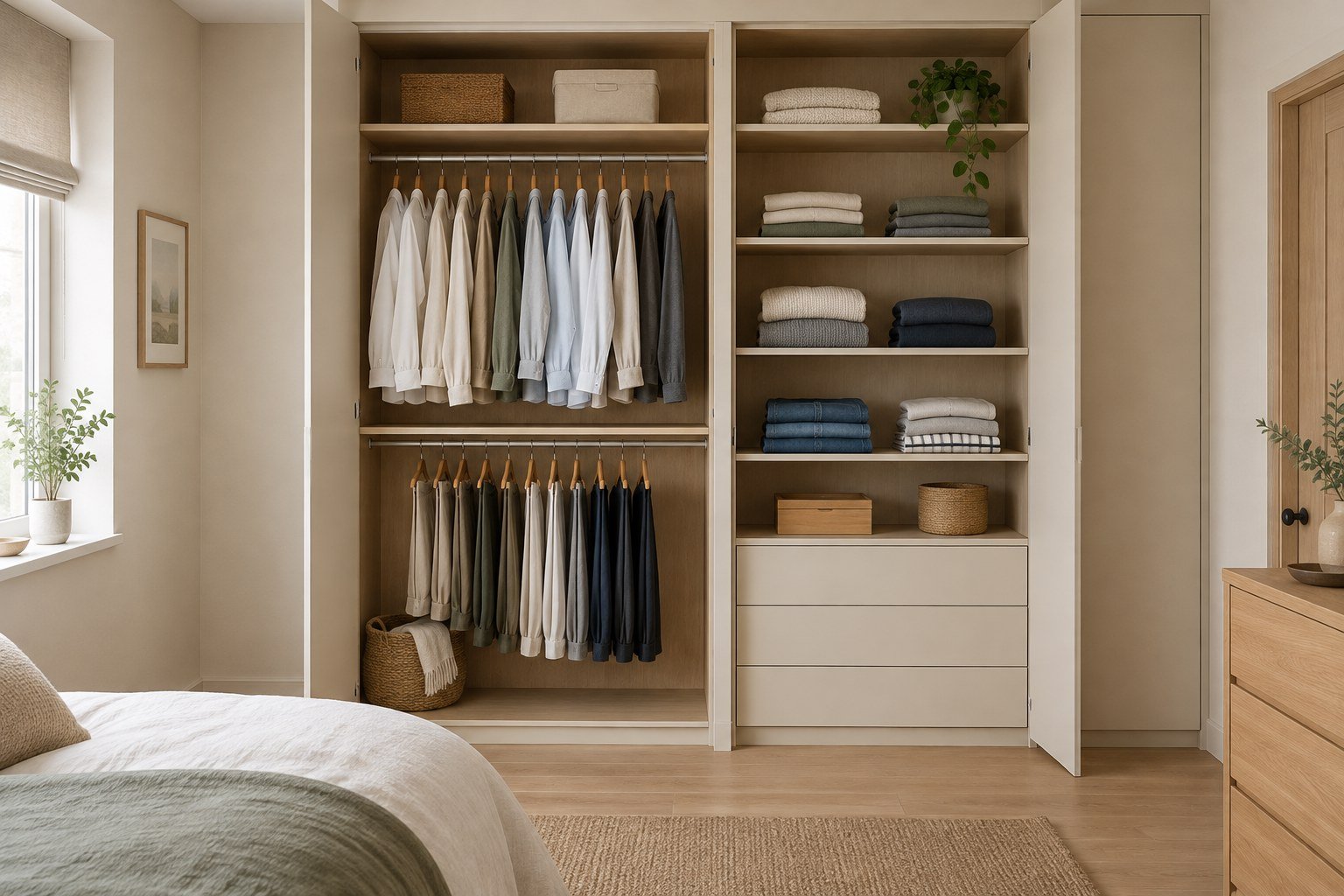
A shared wardrobe does not have to start with two matching halves. Before choosing the internal arrangement, decide which belongings each person needs to store, what is genuinely shared and when you both need access. Those decisions give the cabinetry discussion something more useful than a line down the middle.
An equal division may suit you. Different arrangements may suit you too. The point is to agree on what each section needs to do before its appearance fixes the allocation.
Table of Contents
Describe each person’s storage separately
Start with the clothes and accessories each person actually intends to keep in the wardrobe. One person may prefer to hang shirts and trousers; another may fold most of their everyday clothes. Neither preference tells you how the other person wants to use their section.
Be specific about the difference between an item having a place and having a place you would choose to use. A shelf allocated to folded clothes is only a useful starting point if its owner wants to fold and stack those clothes. Likewise, hanging space should answer an actual preference rather than an assumption about who needs it.
Discuss where shoes, bags and occasional clothing belong as part of that same conversation. If something will be stored elsewhere, say so. There is no need to make this wardrobe responsible for every item in the bedroom.
Give shared belongings a deliberate place
Some items may belong to both people. Others may simply have ended up in the same cupboard. Make that distinction before describing a section as shared.
If you both use a particular bag or keep spare bedding in this wardrobe, discuss where it should go and who needs access to it. A shared shelf reached through one person’s everyday section may be acceptable to you both, or it may be an arrangement you want to avoid. Naming it now makes that choice explicit.
Do not treat the space left after allocating personal storage as automatically available for shared items. Work out what those items are first. If you disagree about a particular item’s place, keep that question open in the brief rather than quietly assigning it to whichever section looks less full.
Compare the moments when you need access
Personal ownership and access are different questions. Two separate sections may still bring both people to the same part of the wardrobe at the same time.
Talk through an ordinary morning: where would each person stand, which drawer would they open and what would the other person need next? If you usually get ready separately, discuss that instead. Your routine is the starting point; there is no need to plan around an imagined household.
Use the walk-through to identify questions for the designer. For example, would one person need to wait while the other uses an adjacent drawer? Would an item described as shared be behind a door someone else is using? Actual openings, dimensions and access need to be checked against the proposed cabinetry and room. This conversation identifies what needs checking; it does not establish that a layout fits.
Test a different allocation before matching the interiors
For example, consider two people sharing a wardrobe. One wants to hang most everyday clothes and has little need for drawers. The other prefers folded storage and only needs hanging space for a smaller group of items. They also want to keep a shared travel bag in the wardrobe.
Two identical interiors would give both people the same arrangement, but that alone would not answer either person’s preferences. An alternative to discuss is a section with more hanging storage for the first person and more folded storage for the second. The final balance would depend on their belongings and the available space, rather than a standard split.
The travel bag introduces a separate decision. If its proposed place means regularly opening the first person’s section, both users need to be comfortable with that. They could discuss a shared position, accept access through a personal section or choose to store the bag elsewhere. None of those choices is automatically right.
Now test the alternative against the access conversation. If both people want to use neighbouring storage at once, flag that for the designer before agreeing to the arrangement. A division that answers ownership still needs to work with the actual room and proposed openings.
Bring the unresolved choices to the cabinetry discussion
You do not need to arrive with a finished wardrobe drawing. Bring a clear account of each person’s storage preferences, the genuinely shared items and the moments when access matters to you both.
Where preferences conflict, explain the priority rather than choosing a fitting prematurely. “We both need this item, but neither of us wants it in our everyday section” gives the discussion a specific problem to resolve. It is more useful than marking an empty compartment “shared” and leaving its purpose undecided.
For a Melbourne wardrobe project, discuss your wardrobe cabinetry requirements with Silk Touch Joinery. Bring the storage preferences and access questions you have agreed on.