Across Melbourne’s east and south, the kitchen renovation brief has already changed, and the clearest signs are showing up in homes that were renovated during the 2010 to 2016 boom.
Five years ago, many families still started with a simple question: IKEA or a kitchen company?
In 2026, the more common question is different: bespoke or semi-custom?
That shift matters because it shows that flat-pack has started to move out of the main decision set for many owner-occupier family homes across Doncaster, Balwyn, Box Hill, Blackburn, Surrey Hills, Mitcham, Hampton, Bentleigh, Brighton, and the broader eastern and southern suburbs.
This is not a design trend in the superficial sense. It is a practical response to what homeowners have now lived through. Kitchens installed between 2010 and 2016 are reaching the point where hardware, finishes, and moisture-prone zones begin to show their age. Families who have already lived through one renovation cycle are making different decisions the second time around.
They are comparing not just price, but lifespan. Not just layout, but storage performance. Not just finishes, but how the kitchen will actually behave under daily family use for the next 10 to 20 years.
That is why custom joinery is increasingly becoming the default brief for Melbourne’s east and south.
For the full pricing picture before the reasons, our kitchen cabinet costs guide covers the complete breakdown across all three tiers. This post focuses on the why, what is driving the shift, and what it means for your renovation brief.
The renovation shift is already visible in Melbourne homes
The strongest way to understand this shift is to look at what is happening across real homes, not just what people say online.
The brief in 2026 is different from the brief of 2020. It is less about making a room look updated and more about making the home work properly for the way a family actually lives. That change is visible in the kinds of questions homeowners ask, the scope they choose, and the level of quality they are now willing to consider.
One simple way to see the change is to compare the old and new renovation mindset side by side.
| 2020 renovation brief | 2026 renovation brief |
|---|---|
| Kitchen only | Whole-home joinery |
| Flat-pack comparison | Bespoke comparison |
| Cheapest viable option | Long-term value and performance |
| Basic storage | Integrated storage systems |
| Replace cabinets | Improve how the home works |
| Short-term finish | 10 to 20 year durability |
| Showroom-led decisions | Peer-led and experience-led decisions |
Across consultations in Melbourne’s east and south, the questions homeowners ask today are different from the questions they asked five years ago.
They are less likely to ask, “What is the cheapest way to replace this kitchen?”
They are more likely to ask:
- How long will this last?
- What happens in the moisture zones?
- Can we make better use of this room?
- Should the laundry and wardrobes be done at the same time?
- What does this look like in a home we plan to stay in?
That is the real signal. The move to bespoke joinery is not just about style. It is about how families now think about value, durability, and the long-term function of the home.
Across Melbourne’s east and south, the question is changing. Families are no longer asking whether they should replace their kitchen. They’re asking what specification will still perform well in 2036.
What homeowners are noticing in their own kitchens
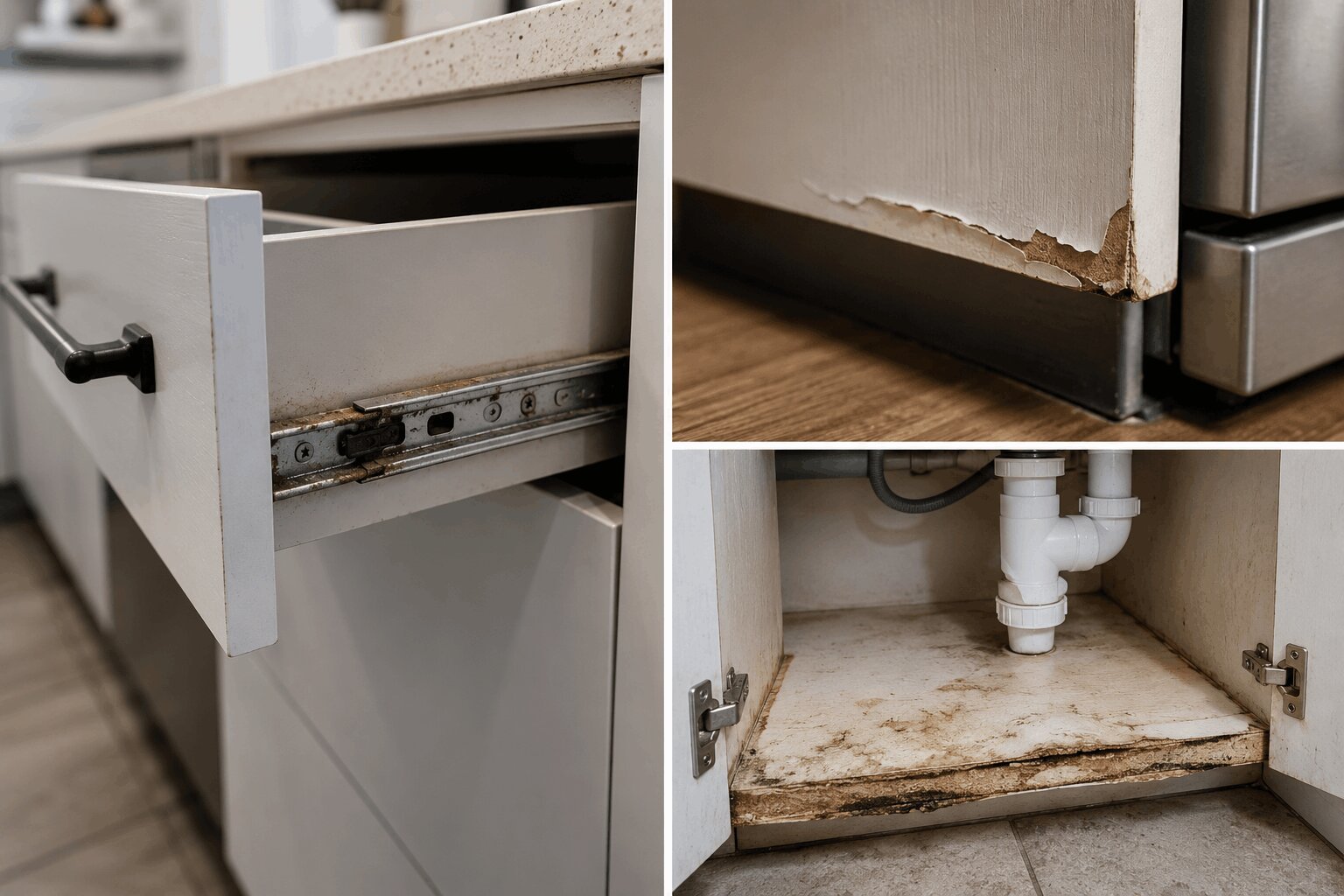
One of the clearest reasons this shift is happening is that homeowners are now seeing the signs for themselves.
A kitchen does not fail all at once. It fails in small, repeated ways. At first the changes are easy to ignore. Then they become part of daily life. Then they start to shape the renovation conversation.
Drawer runners stop feeling smooth
Drawer runners are often the first component homeowners notice changing. At the beginning, drawers glide cleanly and close with a controlled soft-close action. Over time, the movement becomes less smooth. The action feels rougher. The drawer may not align properly. The damping is weaker. In some cases the drawer still functions, but it no longer feels good to use.
That matters because kitchen drawers are opened and closed constantly. In a family home, that wear builds quickly.
Hinges need more adjustment
Cheaper hardware often needs more adjustment over time. Doors start to sag or sit slightly out of line. Homeowners usually live with it longer than they should, because the problem is not dramatic enough to trigger immediate replacement. Then one day the door no longer feels right, and the cycle of fixing begins.
Vinyl wrap and moisture zones reveal age fast
Vinyl-wrap failures are common in kitchens that have spent years near heat, steam, and cleaning products. The edges lift first. Corners begin to separate. The finish starts to look tired in high-use areas. Once that happens, the whole kitchen can feel older than it really is.
The same thing happens in moisture-prone zones. Under-sink cabinets, dishwasher-adjacent panels, and kickboard areas are the places where swelling and breakdown show up first. If moisture has been working into the board for years, the damage can be slow but cumulative.
The kitchen still looks acceptable, but it no longer feels good to use
This is the point where many homeowners change their thinking. The room may still look passable from across the room. It may still function at a basic level. But it no longer feels good to live with every day.
That is why many families are replacing kitchens that, on paper, are not that old. The room may be visually passable. It is the function that is wearing down.
Why families are changing how they think about renovation
The biggest reason bespoke joinery is becoming more attractive is not just that older kitchens are failing. It is that homeowners are now making decisions differently.
Many families are not renovating with a short exit plan in mind. They are renovating because they expect to stay.
Families are renovating to stay, not to sell
If a family is planning to sell in two or three years, the goal is often to make the home presentable and marketable. In that case, the cheapest practical solution can make sense.
But if the family intends to stay for the next 10 to 20 years, the priorities change. The kitchen is no longer just a visual feature. It is a daily-use system that needs to support the household for the long term.
That is where durability starts to matter more.
Durability now matters more than first cost
The longer the ownership horizon, the less attractive repeat repairs become. A homeowner who intends to stay does not want to replace drawer runners twice, fix swelling under the sink, or live with a kitchen that constantly feels tired.
For many owner-occupiers, bespoke joinery becomes easier to justify simply because they are investing in the home they will live in, not the home they will sell.
The question has changed from “What is cheapest?” to “What will still work in 10 years?”
This is the most important behavioural change in the market. The decision is no longer a one-year purchase decision. It is a long-horizon household decision.
That shift is why many homeowners now look at custom joinery as the more sensible option rather than the more indulgent one.
The hidden cost of replacing the same kitchen twice
One of the biggest mistakes homeowners make is focusing only on the upfront price.
That makes sense. It is the number they see first. But the purchase price is not the whole story.
A cheaper joinery system can carry hidden costs over time:
- more frequent repairs
- replacement hardware
- alignment adjustments
- damaged finish panels
- earlier full replacement
That is the part that does not show up in the initial quote.
The actual comparison is not just between buying a cheaper kitchen and a more expensive kitchen. It is between buying a kitchen once and maintaining it lightly, or buying a kitchen cheaply and paying for the wear in stages.
When you look at it that way, the long-term difference becomes clearer.
| Decision | Initial saving | Long-term outcome |
|---|---|---|
| Budget hardware and finishes | Lower upfront cost | More repairs, earlier replacement |
| Premium hardware and bespoke joinery | Higher upfront cost | Longer lifespan, fewer compromises |
That is why premium hardware is not really a luxury discussion. It is a lifecycle discussion.
The question is not only what the kitchen costs today. It is what it costs to live with it over 10 to 15 years.
Pricing transparency has changed the conversation
For years, many homeowners assumed bespoke joinery was far beyond their budget.
That assumption was understandable. A lot of renovation content online was vague. It quoted huge ranges without explaining what drove the numbers. The result was confusion, and confusion tends to push people toward the safest cheap option.
In 2026, the market is more transparent.
Homeowners now have access to better pricing explanations, clearer comparisons, and more realistic project examples. That has changed the conversation.
The gap between flat-pack and bespoke is often smaller than people think, especially once installation, quality of hardware, and longevity are factored in.
| Kitchen type | Typical cost |
|---|---|
| Flat-pack + professional installation | $5,500 to $13,000 |
| Bespoke compact kitchen supply | $8,000 to $12,000 |
| Bespoke 4 to 7m kitchen supply | $12,000 to $20,000 |
| Semi-custom supply and install | $18,000 to $38,000 |
The key point is not that bespoke is cheap. It is that the perceived cost gap is often much bigger than the actual one.
Once homeowners see the real numbers, bespoke joinery stops feeling like a distant luxury and starts feeling like a serious option.
For the full pricing picture before the reasons, our kitchen cabinet costs guide covers the complete breakdown across all three tiers.
Why Melbourne East is leading the shift
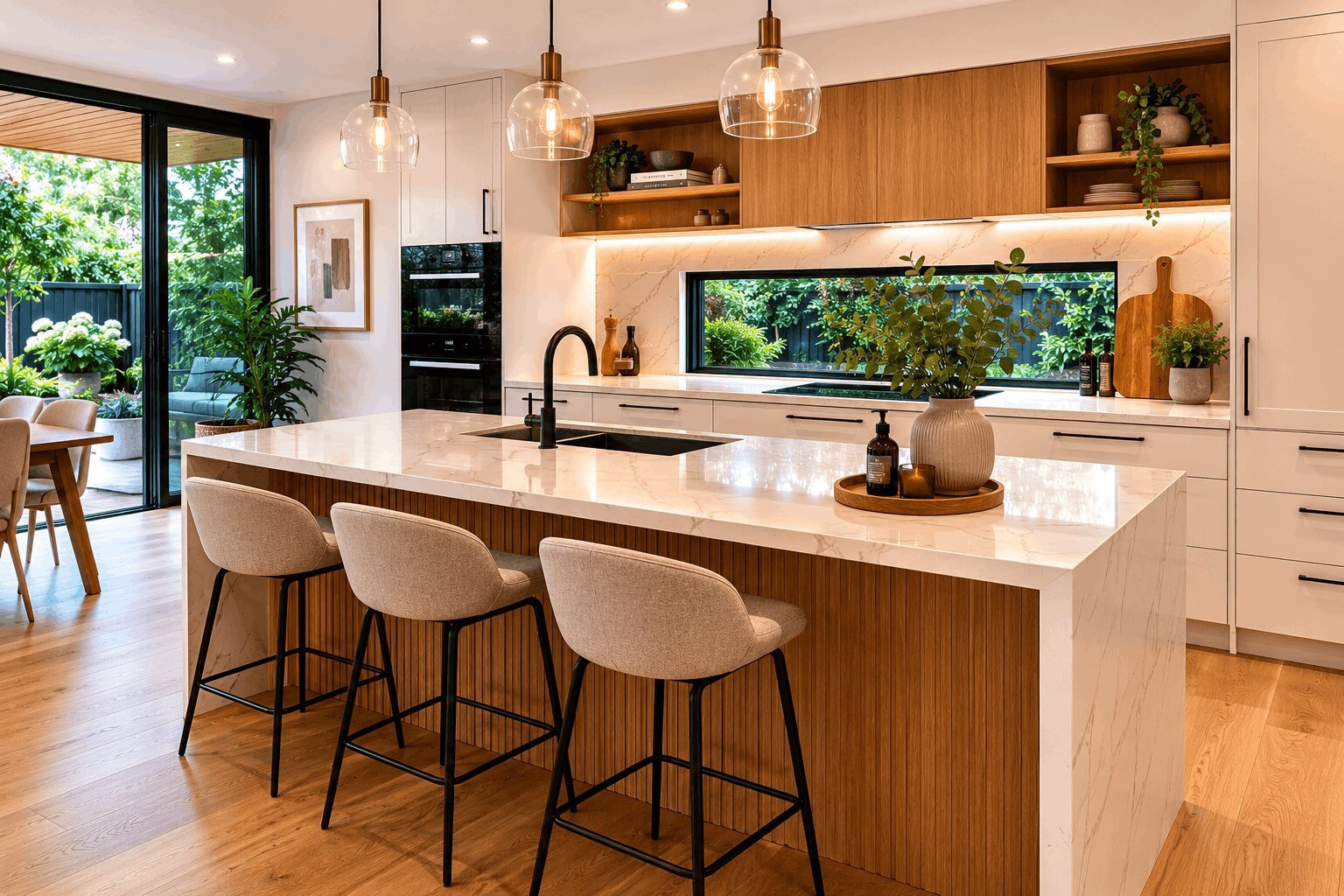
Melbourne’s east has become one of the clearest examples of this change.
Suburbs such as Doncaster, Balwyn, Box Hill, Blackburn, Surrey Hills, and Mitcham have a strong concentration of family homes that are well past their first renovation cycle. Many of these properties are owner-occupied, and many households have already settled into the area for the long term.
That matters.
A family that has lived in a home for 10 or 15 years is much more likely to think carefully about how the kitchen performs, not just how it looks. These homeowners know what worked, what did not, and what they want to change the second time around.
They are also more likely to value integrated storage, cleaner design lines, and durable materials that support a busy household.
The eastern suburbs are not simply buying new kitchens. They are upgrading the way the home functions.
If you are comparing project types in this part of Melbourne, the Doncaster kitchen renovations and Balwyn kitchen joinery pages are useful references for the kind of work that is driving this shift.
Why Melbourne South is following close behind
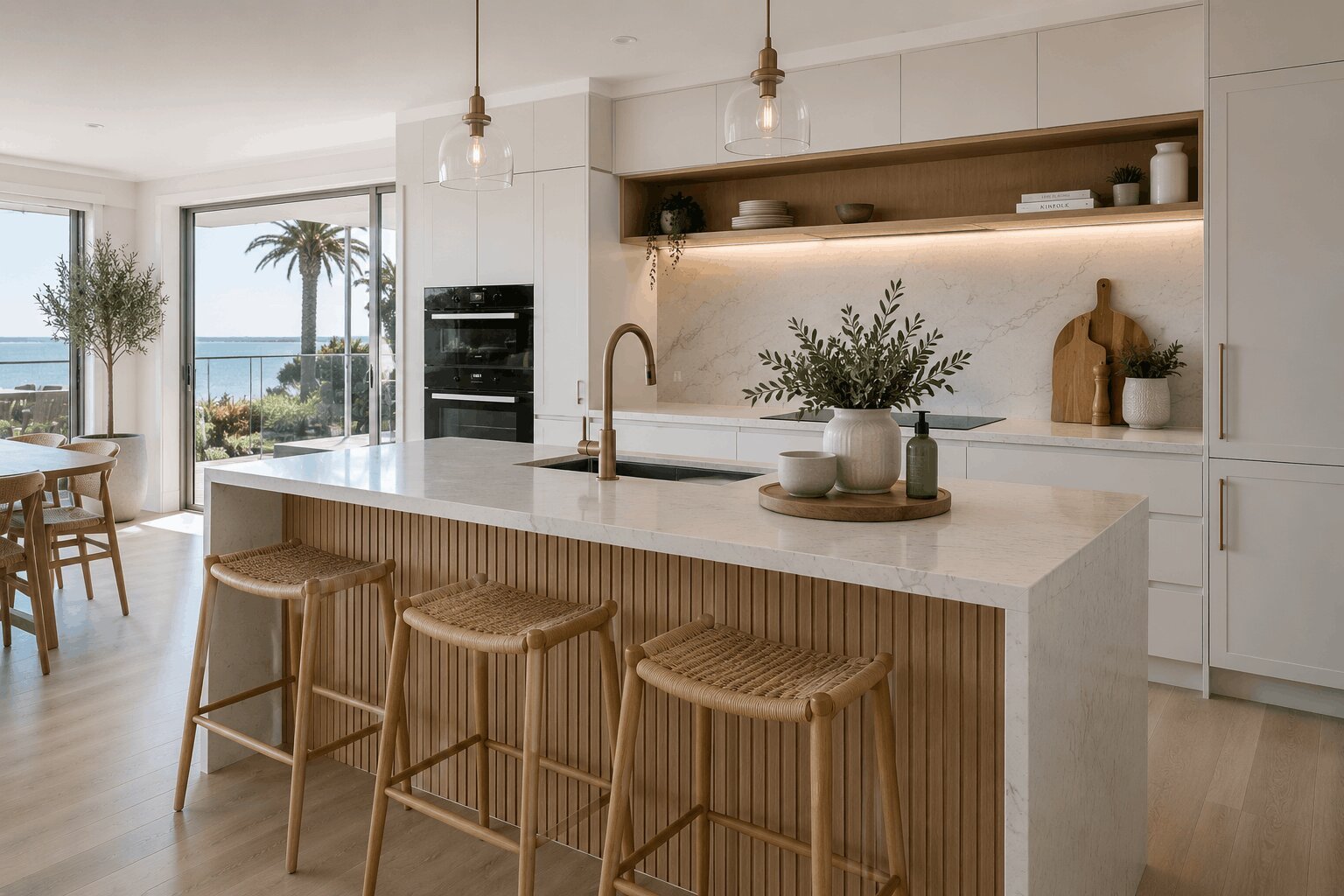
The south is now moving through a similar pattern, but with a slightly different specification logic.
Brighton, Hampton, Bentleigh, Rowville, and Wheelers Hill are seeing more homeowners ask for joinery that can handle broader environmental pressures as well as family use.
Bayside homes face different conditions from inland eastern homes.
Moisture matters more.
UV exposure matters more.
Material longevity matters more.
That is one reason many homeowners in Melbourne’s south are moving toward better structural boards, more durable finishes, and stronger hardware systems earlier in the decision process.
They are not just upgrading because they want a nicer kitchen. They are upgrading because the local conditions make lower-grade systems age faster.
That is a meaningful difference.
For a closer look at the southern specification approach, the kitchen renovations Brighton page is the best place to start.
Whole-home joinery is replacing the kitchen-only brief
One of the biggest changes in 2026 is that kitchens are no longer being thought of as standalone projects.
The brief has expanded.
A family that once would have replaced only the kitchen now often wants the kitchen, laundry, wardrobes, and sometimes a home office or storage wall done together.
That shift makes sense.
If the family is already living in the home long term, and if the design language is going to be updated anyway, then it is often more efficient to solve the storage and joinery problems in one coordinated brief.
That can mean:
- kitchen
- laundry
- wardrobes
- walk-in robes
- mudrooms
- study joinery
- entertainment units
- storage walls
There is also a strong design reason for this. When the kitchen, wardrobes, and laundry are made to the same standard, the house feels more intentional. The material palette becomes cohesive. The joins feel considered. The home starts to work as one system rather than a series of disconnected rooms.
That is part of why whole-home packages are becoming more common across Melbourne’s eastern family suburbs.
It is also why many homeowners now begin with one room but end up expanding the brief.
If you are looking at a broader joinery project in the east, the custom joinery Box Hill page is a useful example of how the whole-home conversation is evolving.
Three renovation patterns we keep seeing
These are composite examples, but they are the type of briefs that now appear again and again.
The Family Upgrade
A family in Doncaster or Box Hill has lived in the home for more than a decade. The original kitchen still works, but the hardware is failing and the storage no longer suits the household.
The first brief is kitchen replacement only.
Then the family realises the laundry is also inefficient, and the wardrobes are due for an update too. The project expands into a kitchen, laundry, and storage package.
The goal is not luxury. The goal is consistency and long-term function.
The Period Home Owner
A couple in Balwyn or Surrey Hills owns a period home with a kitchen that was renovated years ago using a generic modular system.
The room functions, but it never quite felt right in the house.
The new brief is about improving fit, proportion, and detail. The cabinetry needs to suit the architecture of the property rather than sit awkwardly inside it.
That often means bespoke joinery, better scribing, and more careful integration of appliances and storage.
The Bayside Renovator
A family in Brighton or Hampton has an original kitchen that is now well past its best. The first concern is not only storage, but durability in a coastal environment.
The brief includes stronger materials, better moisture resistance, and finishes that can stand up to a more demanding setting.
The kitchen is still a family kitchen. The difference is that the environment forces a more careful specification.
These stories are repeated across Melbourne’s east and south because the underlying pattern is the same. The home has aged. The household has changed. The old kitchen brief no longer fits.
How to tell if your kitchen is reaching the tipping point
If a kitchen is around 10 years old, there are a few clear warning signs worth paying attention to.
- soft-close mechanisms are no longer smooth
- hinges need regular adjustment
- doors are starting to sag
- vinyl-wrap edges are lifting
- moisture marks are appearing under the sink
- drawers no longer feel solid
- storage is no longer working for the household
- the kitchen feels visually tired even if it is still technically usable
Not every sign means the kitchen must be replaced immediately. But the pattern matters.
If several of these issues are appearing together, the kitchen is probably entering the part of its life cycle where repair is no longer the best answer. At that point, it is worth asking whether the home needs a refresh, a replacement, or a more complete joinery upgrade.
The key question is not whether the kitchen still functions at a basic level. It is whether it still functions well enough for the way the household lives now.
What this means for families planning a renovation in 2026
The real lesson behind this shift is simple.
For many families, the decision is no longer about replacing cabinets. It is about matching the joinery specification to the way the household actually lives.
That means looking at ownership horizon, daily use, environmental conditions, and the role the kitchen plays inside the home.
If the family plans to stay, the case for bespoke joinery becomes stronger.
If the home is going to support a long-term household, the case for better hardware and more durable materials becomes stronger.
If the project is expanding beyond the kitchen, the case for whole-home joinery becomes stronger again.
The brief has changed because the home has changed, the family has changed, and the local market has changed with it.
That is why custom joinery is gaining ground across Melbourne’s east and south.
Closing thoughts
The move toward bespoke joinery across Melbourne’s east and south is not being driven by trends in the fashion sense.
It is being driven by experience.
Families have seen what happens when lower-grade hardware reaches year ten. They have seen the difference between moisture-resistant materials and standard board products. They have watched neighbours renovate and experienced premium joinery firsthand inside real homes rather than display centres.
At the same time, property values have changed the renovation equation, pricing transparency has reduced uncertainty, and whole-home storage expectations have become more sophisticated than they were a decade ago.
The result is a different renovation brief.
For many owner-occupier families, the question is no longer whether bespoke joinery is appropriate.
The question is which level of scope, material specification, and long-term investment makes the most sense for the way they plan to live.
If you’re planning a kitchen, wardrobe, laundry, or whole-home joinery project across Melbourne’s east or south, book a free in-home consultation and discuss the options in the context of your home, your layout, and your long-term plans.