
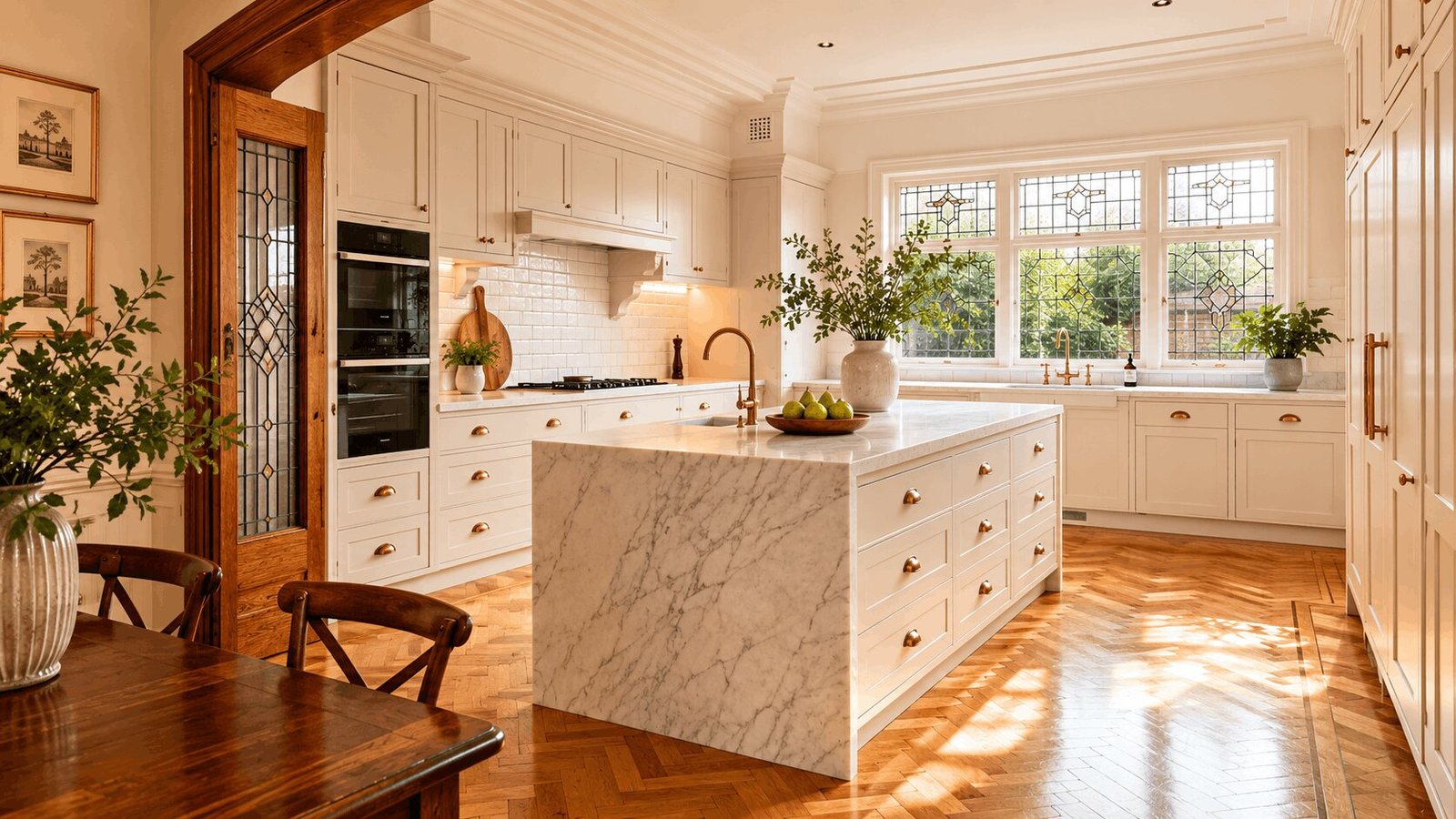
There is a particular kind of kitchen that turns up again and again in Balwyn’s interwar homes. It sits at the rear of the house, accessed through a narrow passage or a butler’s pantry that once separated the domestic world from the formal one. The room itself is generous by terrace-house standards — often 4m × 4m or larger — but it faces the wrong direction, opens onto nothing useful, and was designed for a household that employed a cook. The homeowner who lives there now is the cook. They want to be part of family life while they’re doing it. The original kitchen makes that impossible.
Renovating a kitchen in a 1930s Balwyn home is not a simple brief. The architecture imposes real constraints — Boroondara City Council’s heritage overlay framework is serious and actively enforced — but it also offers something that newer homes simply cannot provide: rooms with real proportions, original parquetry floors, Art Deco cornices with genuine geometric precision, and leadlight windows that have been filtering morning light through coloured glass for ninety years. The opportunity is not to erase those things. It is to design bespoke joinery that lives comfortably alongside them, in materials and specifications built to last another eighty years.
The heritage overlay context for Boroondara — which governs Balwyn — is closely related to what we covered in our post on kitchen renovation in Northcote under Darebin Council, though the architectural character here is quite different. For the broader Silk Touch approach to heritage kitchen joinery across Melbourne’s inner suburbs, the kitchen renovations Camberwell page covers our full design philosophy.
Balwyn’s Interwar Architecture — Why It’s a Different Heritage Problem
Spend any time looking at Melbourne’s period home renovation market and you’ll notice that the conversation is dominated by Victorian and Edwardian terraces — the inner-north archetype. Balwyn’s housing stock is something else entirely, and the renovation challenges it presents are different in ways that matter.
The architectural character of the interwar period (1920s–1940s)
Where Victorian and Edwardian homes express heritage through floral ornament — carved timber brackets, acanthus-leaf plaster cornices, cast-iron lacework — interwar homes express it through geometry. Art Deco cornices in Balwyn are stepped and angular. Georgian Revival homes have restrained classical proportions — pilasters, symmetrical fenestration, low-pitched roofs. California Bungalows have deep eaves and exposed rafter tails. The ornament is present but disciplined. There is nothing fussy about it.
This geometric restraint is, in practice, more compatible with contemporary kitchen joinery than Victorian ornament is. A flat-slab or Slim-Shaker kitchen in a clean warm white or off-white 2-pack sits naturally against an Art Deco stepped cornice in a way that the same kitchen would feel more at odds with a Victorian floral plaster ceiling. The interwar home has already done some of the aesthetic heavy lifting for you.
The spatial character
Balwyn’s interwar homes are typically wider and more spatially generous than inner-city terraces. A double-fronted 1930s Georgian Revival in Balwyn will have a kitchen zone that is often 4m × 5m or larger once the rear is properly opened — room for a proper island, a pantry column, and full overhead cabinetry, without the tight galley compromises of a single-fronted terrace. The challenge in Balwyn is not making things fit. It is making considered decisions about what the larger space should become.
These homes are also, in most cases, on substantially larger lots than their inner-city counterparts — 400–700 sqm is typical, with rear gardens that make a deck connection from the kitchen a logical aspiration. Rear extension projects that create an indoor-outdoor kitchen-living zone are among the most common briefs we encounter in Balwyn.
The butler’s pantry legacy
This is the feature that defines the interwar Balwyn kitchen situation more than any other. The butler’s pantry — a narrow passage or prep room between the formal dining room and the kitchen proper — was a structural expression of domestic service culture. The cook used the kitchen; the family used the dining room; the pantry was the transition zone between the two worlds. In 2026, it is an architectural artefact that sits squarely in the way of the open-plan kitchen-dining connection most Balwyn homeowners want.
The good news is that this spatial problem has a very good solution that is also the architecturally appropriate one — more on that in the layout section below.
Boroondara Heritage Overlays — What Balwyn Kitchen Renovations Actually Require
Boroondara City Council has one of Melbourne’s most active heritage planning regimes. Heritage Overlay schedules cover the majority of pre-war residential streets across the municipality — Balwyn and Balwyn North are extensively covered. For homeowners encountering this for the first time, the framework can feel intimidating. In practice, for most kitchen renovation scopes, it is less restrictive than it appears.
What typically does NOT require a planning permit
Internal joinery replacement — cabinets, benchtops, splashback, overhead cabinetry — does not require a planning permit under Boroondara’s heritage framework. You are replacing the contents of a room, not altering the building’s heritage fabric. Changing the internal layout without altering external walls is similarly permit-free. Adding a skylight in a position not visible from the street sits in a grey area — always confirm with Boroondara Council’s planning team before proceeding, as individual Heritage Overlay schedules vary.
For the majority of Balwyn kitchen renovation scopes — a joinery replacement within an existing footprint, even with a full layout reconfiguration — you can begin design development and fabrication without waiting for any planning outcome.
What typically DOES require a permit
Any works that alter the external appearance of a heritage-overlaid property will trigger the planning permit requirement. This includes new or enlarged windows, changes to the rear roofline, demolition of original fabric, and rear additions visible from the street or from the streetscape of an adjoining property. Boroondara’s heritage team is thorough — applications are assessed carefully and conditions can be specific. A heritage planning permit in Boroondara typically takes 8–16 weeks from submission to determination.
The practical upshot for most Balwyn kitchen renovations
In-place joinery replacement is permit-free and can proceed immediately. The structural conversation — wall removal, opening up the butler’s pantry, rear extension — is where Boroondara engagement begins, and where timelines extend significantly. If you are planning structural works, engage a heritage consultant early. Their pre-application advice can save significant time in the formal assessment process.
Silk Touch’s role in the planning phase is to design joinery to the approved structural envelope, working in sequence with your builder and heritage consultant. For in-place renovations, we can begin design development immediately without waiting for planning outcomes.
If you are uncertain about the permit status of your specific project, Book Your Consultation — we can help you scope the joinery component while the planning picture is being clarified.
Kitchen Layout Options for Balwyn’s Interwar Homes
Balwyn’s interwar homes present a relatively consistent set of layout scenarios. Here are the four most common briefs we work with.
The In-Place Interwar Kitchen Renovation
For homeowners who want to renovate within the existing kitchen footprint — perhaps the structure has already been opened in a previous renovation, or the scope is limited to a joinery replacement. In Balwyn’s larger interwar kitchens — 4m × 4m or more — an in-place renovation produces a genuinely complete kitchen without structural complexity.
The key decisions at this scale: island or no island (in most cases, yes — the footprint supports it), pantry column position, whether to retain or modify the original kitchen window configuration, and how to handle the ceiling junction where the joinery meets period-height ceilings of 2.8–3.2m. An in-place renovation that resolves all of these well is often the most architecturally satisfying outcome — it works with what the house already is, rather than converting it into something else.
The Butler’s Pantry Conversion — Scullery Option
This is, in our view, the most architecturally appropriate and functionally superior outcome for Balwyn interwar homes where the butler’s pantry is intact. Rather than demolishing the pantry passage and folding the space into the main kitchen, you retain it and refurbish it as a dedicated scullery: a secondary prep zone with a second sink, dishwasher housing, appliance storage, and dry goods pantry.
The main kitchen remains the showpiece — the room you see from the dining zone and the living space, with bespoke joinery designed to be looked at. The scullery absorbs the mess: the coffee machine, the food processor, the pile of dirty prep bowls. Serious cooks understand why this works. The division of labour between show kitchen and work kitchen is not a nostalgic affectation — it is a genuinely functional spatial organisation for a household that cooks properly.
Joinery for a scullery conversion typically runs $8,000–$14,000 supply for a 2.0–2.5m run with a basic fit-out, more with integrated appliances. The structural works (confirming the pantry wall is non-load-bearing, any electrical and plumbing reconfiguration) are in your builder’s scope.
The Butler’s Pantry Removal — Open Kitchen
For homeowners who want to open the butler’s pantry into the main kitchen, creating a larger contiguous cooking zone. This requires demolishing the dividing wall — builder’s scope, and a Boroondara planning permit may be required if the wall is part of the heritage fabric of a listed property. The result is a kitchen 1.5–2.0m deeper than the original, enough to accommodate a generous island and significantly improved traffic flow.
When the removal works well, the result is an open kitchen that reads as a single generous room from the dining zone. The joinery runs through both former zones as a single palette — there is no visible trace of the division that was there. This outcome is more straightforward to execute successfully in Balwyn’s large-footprint homes than it would be in a narrow inner-city terrace, where every centimetre matters and transitions are harder to resolve.
The Rear Extension Kitchen
For Balwyn homes where a rear extension has been approved — or where an existing 1980s or 1990s lean-to addition is being replaced with a properly designed contemporary addition. In this scenario, the new rear zone is designed from the structure outward. Ceiling height, bifold or sliding door placement, and connection to the deck or garden are all determined before the joinery brief is set. The kitchen brief follows the architecture; the architecture does not follow the kitchen.
Rear extensions in Balwyn are subject to Boroondara planning assessment. The council’s typical heritage condition is that the original building’s rear roofline and rear façade fabric must remain intact and legible as a period structure — the contemporary addition reads as clearly contemporary rather than attempting to mimic the original. When this is done well, the result is a home where the period architecture is visible and intact from the street and a well-resolved contemporary kitchen-living zone exists behind it. The contrast between old and new, handled with care, is one of the more satisfying outcomes in residential renovation. For a detailed look at how we approach joinery in a contemporary extension context alongside period architecture, the Doncaster kitchen renovations post covers a comparable brief in a neighbouring suburb.
Material Palettes for Balwyn’s Period Homes
Balwyn’s interwar architecture calls for palettes that acknowledge the period without recreating it. Three approaches cover the range of briefs we encounter.
The Transitional Heritage Palette
The most appropriate choice for the majority of Balwyn period kitchens. Warm white or soft off-white 2-pack Slim-Shaker profile doors — the Shaker profile’s clean routed channel references the interwar period’s restrained geometric ornament without veering into Art Deco pastiche. The geometry reads as correct without announcing itself. Warm quartz or honed Bianco Carrara benchtop. Aged brass cup-pull or bar handle hardware — the material choice is specific to the period. Simple white ceramic tile splashback in a brick stack or straight lay.
This palette reads as timeless. It could have been installed in 1975 or 2026, which is exactly right for a period home — you want the joinery to belong to the house, not to a particular moment in interior design fashion. In fifteen years, this kitchen will still look like it belongs there.
The Art Deco Contemporary
For Balwyn’s more strongly Art Deco properties — where the cornices have distinct stepped profiles, where the original built-ins have geometric detailing, where the architecture announces its period clearly — a palette that explicitly references the geometric aesthetic: two-toned cabinetry in warm cream uppers and deep forest green or charcoal lowers in 2-pack, a stepped or geometric handle profile in aged brass, a honed black granite or Nero Marquina stone benchtop for contrast, and a geometric tile splashback in a period-appropriate mosaic or large-format hexagonal tile.
This palette is bold. It works only if the building’s architecture is explicitly Art Deco and the homeowner has the confidence to commit to it fully. Half-measures — a hint of green, a slightly geometric handle — produce a confused result. The palette earns its boldness when it is responding to a building that is equally bold.
The Quiet Contemporary
For homeowners who want to leave the period architecture entirely to the rest of the home and treat the kitchen as a clean contemporary room within it. Flat-slab warm white 2-pack, handleless or integrated J-pull profile, honed engineered stone benchtop in a warm grey. This is closest to the Japandi approach covered in the Thornbury post — the heritage building provides the richness and the kitchen provides the calm. Works best when the kitchen is in a rear extension zone, separated from the original fabric by an identifiable threshold: a change in ceiling height, a structural beam, or a deliberate material shift in the floor plane.
In an extension zone, this palette is exactly right. Directly adjacent to original Art Deco cornices and leadlight windows, it needs careful handling — the restraint can read as disconnection rather than calm if the transition between old and new is not resolved clearly.
Joinery Specifications for Balwyn Period Homes
A technically informed section for homeowners who want to understand what they are specifying — and why the details matter.
Carcass construction
18mm HMR (High Moisture Resistant) board throughout — non-negotiable in any kitchen environment. Balwyn’s pre-war homes have older drainage infrastructure and subfloor conditions that can produce higher ambient moisture levels than newer construction. HMR board resists swelling and delamination where standard particleboard will not.
Door profile and finish
The Slim-Shaker profile in 2-pack polyurethane is the correct specification for the transitional heritage palette. The profile’s clean routed channel — typically 8–12mm wide and 4–6mm deep — references period geometry without requiring ornate detailing. For flat-slab doors in a contemporary extension zone, a perfectly flat 2-pack door requires a flawless spray finish: specify a minimum of two sealer coats plus two colour coats, applied in a controlled environment. Any dust contamination or surface irregularity in the finish reads as a fault on a flat slab in a way that the Slim-Shaker profile forgives.
Hardware — period-appropriate options
Aged brass cup-pull in 60–75mm diameter is the most authentic hardware choice for a transitional heritage palette in a Balwyn interwar home. It references the period’s material preferences without being reproduction furniture hardware. The aged brass finish — a living, unlacquered brass that develops a patina over time — reads as warm and quality in a way that lacquered brass does not. An aged brass bar handle in 160–200mm is a contemporary-friendly alternative for homeowners who prefer a cleaner line. Integrated J-pull profiles are appropriate only in the quiet contemporary palette or in an extension zone — not adjacent to original period fabric.
All hardware should be Blum or equivalent grade for the mechanical components — soft-close concealed hinges and undermount drawer systems. Balwyn’s homeowners have lived with good joinery before and will notice the difference in how drawers close.
Scribing to the existing building
Interwar Balwyn homes have more regular construction than Victorian terraces — straighter walls, better original level — but still require precision scribing at wall returns and ceiling junctions. Balwyn’s parquetry timber floors, often in a different plane from a tiled or poured kitchen floor where previous work has been done, require careful kickboard scribing to the actual floor surface. A 3mm gap between the kickboard and an original parquetry floor is not acceptable at this specification level.
Overhead cabinet proportion in high-ceilinged rooms
In Balwyn’s interwar rooms — typically 2.8–3.2m ceiling height — overhead cabinets must be proportioned deliberately. Stopping at a standard 900mm above the bench in a 3.0m ceiling leaves an awkward gap of 1.0m or more between the cabinet tops and the ceiling. Two resolution options: run overhead cabinets to ceiling height with a cornice profile at the top that echoes the room’s existing cornice moulding, or stop deliberately at 2100mm with open shelving above, leaving a significant negative-space gap that reads as a design decision rather than an oversight. Both work. The standard approach — cabinets that simply stop short of the ceiling without explanation — does not.
Kickboard height
Balwyn’s interwar homes have substantial skirting boards, often 150–180mm high. A standard 100mm kitchen kickboard looks undersized by comparison. Specify kickboards at 150mm minimum to maintain visual consistency with the room’s existing proportions.
2026 Cost Guide — Kitchen Joinery in Balwyn
All prices are Silk Touch supply-only figures for bespoke joinery. Installation, trades, and additional items are listed separately below.
Joinery supply (bespoke, supply only)
| Kitchen scope | Supply-only range (AUD) |
|---|---|
| Compact galley or in-place renovation (under 4m total run) | $8,000 – $12,000 |
| Standard L-shape or single-wall kitchen (4–7m total run) | $12,000 – $20,000 |
| Open-plan kitchen with island (7m+ total run) | $18,000 – $30,000+ |
| Scullery / butler’s pantry conversion (2.0–2.5m run) | $8,000 – $14,000 |
| Whole-home joinery package (kitchen + laundry + wardrobes) | $30,000 – $70,000+ |
Complete renovation — all trades (in-place, no structural works)
| Trade / item | Budget range (AUD) |
|---|---|
| Bespoke joinery (supply only) | $8,000 – $30,000+ |
| Stone benchtop | $2,500 – $12,000 |
| Appliances | $4,000 – $25,000 |
| Splashback | $800 – $2,500 |
| Plumbing | $1,000 – $3,500 |
| Electrical | $800 – $3,000 |
| Painting | $1,000 – $4,500 |
| Flooring (if replacing) | $2,500 – $10,000 |
Balwyn-specific additional costs to budget for
Heritage consultant’s report, if required by Boroondara Council for your project: $1,500–$3,500. Boroondara planning permit fees, if structural works are involved: $800–$2,000 in council fees, plus 8–16 weeks of elapsed time. Parquetry floor restoration or extension — if the kitchen floor is being matched to original parquetry in the adjoining room — is specialist work that runs $3,500–$8,000 with a qualified floor contractor. Do not assume a general flooring contractor can match and seamlessly blend original jarrah or Baltic Pine parquetry.
These additional costs are specific to Balwyn’s housing stock and the Boroondara planning environment. Factor them into the budget at the brief stage, not at the contract stage.
Frequently Asked Questions
How much does kitchen joinery cost in Balwyn in 2026?
Bespoke kitchen joinery in Balwyn starts at $8,000–$12,000 supply-only for a compact galley under 4m. A standard L-shaped or single-wall kitchen (4–7m) runs $12,000–$20,000. An open-plan kitchen with island (7m+ total run) starts at $18,000–$30,000+. A whole-home joinery package covering kitchen, laundry, and wardrobes runs $30,000–$70,000+. These are Silk Touch supply-only figures and exclude stone benchtop ($2,500–$12,000), appliances ($4,000–$25,000), plumbing, electrical, and any structural or heritage works.
Does Balwyn have heritage overlays that affect kitchen renovation?
Yes — Balwyn falls under Boroondara City Council, which has extensive heritage overlay coverage. Many streets in Balwyn and Balwyn North are covered by Heritage Overlay schedules. For internal joinery replacement — cabinets, benchtops, splashback — no planning permit is typically required. However, if your project involves altering the external envelope (new windows, rear additions visible from the street, changes to the roofline), a planning permit from Boroondara Council will likely be required. Silk Touch works alongside your builder and heritage consultant during this phase — our joinery is designed to the approved structural outcome.
What door profile works best for a period home kitchen in Balwyn?
For Balwyn’s interwar and Art Deco homes, the Slim-Shaker profile is the most consistently appropriate choice — it references the period’s clean geometric detailing without being a pastiche of Victorian ornament. A flat-slab door can work in a very contemporary rear extension but feels incongruous directly adjacent to original interwar cornices and joinery. The transitional profile — a restrained Slim-Shaker in a warm neutral 2-pack — reads as contemporary without erasing the building’s character. For strongly Art Deco properties, a beaded-inset or stepped profile can echo the period’s geometric motifs more directly.
How long does a kitchen renovation take in Balwyn?
Silk Touch fabricates joinery in 6–8 weeks from signed design approval. Installation in a standard Balwyn period home kitchen takes 3–5 days. If structural works are involved — wall removal, rear extension — and a heritage permit is required, add 8–16 weeks for Boroondara Council’s permit process before construction can begin. Total project timeline including heritage permit, structural works, and joinery installation: typically 20–32 weeks for a comprehensive Balwyn kitchen renovation.
Do you do kitchen joinery in Balwyn and surrounding inner east Melbourne suburbs?
Yes. Silk Touch Joinery is actively working across Melbourne’s inner east including Balwyn, Balwyn North, Surrey Hills, Box Hill, Blackburn, Doncaster, and surrounding Boroondara and Whitehorse suburbs. Contact us to book an in-home consultation at your Balwyn property.
A Balwyn interwar home has survived eighty or ninety years. The parquetry floors were laid by craftspeople who expected them to outlast their working lives. The Art Deco cornices were plastered with the same assumption. The kitchen renovation that serves a home like this best is one designed with that same long view — bespoke joinery in materials and specifications that match the building’s original quality, in a palette that acknowledges the period without being constrained by it. That is the standard we work to, and it is the standard these homes deserve.
For a broader view of how Silk Touch approaches heritage kitchen joinery across Melbourne’s inner east, the kitchen renovations Camberwell page covers our full design philosophy and service offer.