
Most homeowners assume the problem with their entryway is a lack of storage.
In reality, the issue is usually something less obvious: daily visual and physical friction.
Shoes accumulate in corners. School bags migrate across the floor. Jackets pile onto hooks. Deliveries, pet accessories, umbrellas, sports gear, and seasonal items compete for the same few square metres. Over time, the entryway stops functioning as a transition space and starts feeling like a permanent holding zone for unfinished tasks.
This is why modern mudroom benches with integrated storage have become one of the most influential joinery trends of 2026. The best designs do far more than provide a place to sit while putting on shoes. They create hidden order, reduce visual clutter, and make arriving home feel noticeably calmer.
Today’s most successful mudroom benches are not designed as furniture. They are designed as architectural systems.
Why Do Entryways Create More Stress Than Other Rooms?
Unlike most areas of the home, an entryway handles movement, storage, weather, and routine simultaneously.
Every arrival introduces new objects into the space. Shoes come off. Bags get dropped. Coats need somewhere to go. Pets bring in dirt and moisture. Family members move through the area carrying groceries, sports equipment, laptops, or children.
Without a clear organisational system, the entryway quickly becomes a clutter magnet.
One of the most common complaints homeowners express is that open hooks and shelving only look organised when they are empty. Once backpacks, winter jackets, scarves, and daily essentials are added, the space feels chaotic regardless of how expensive the joinery may be.
This is where integrated storage changes the equation.
Rather than displaying everything, modern mudroom benches conceal most of the household’s daily clutter behind doors, drawers, lift-up seats, or enclosed compartments. The visual result is immediate. The space feels calmer because fewer objects compete for attention.
Good design is often less about adding features and more about removing distractions.
Mudroom Bench Design Rules at a Glance
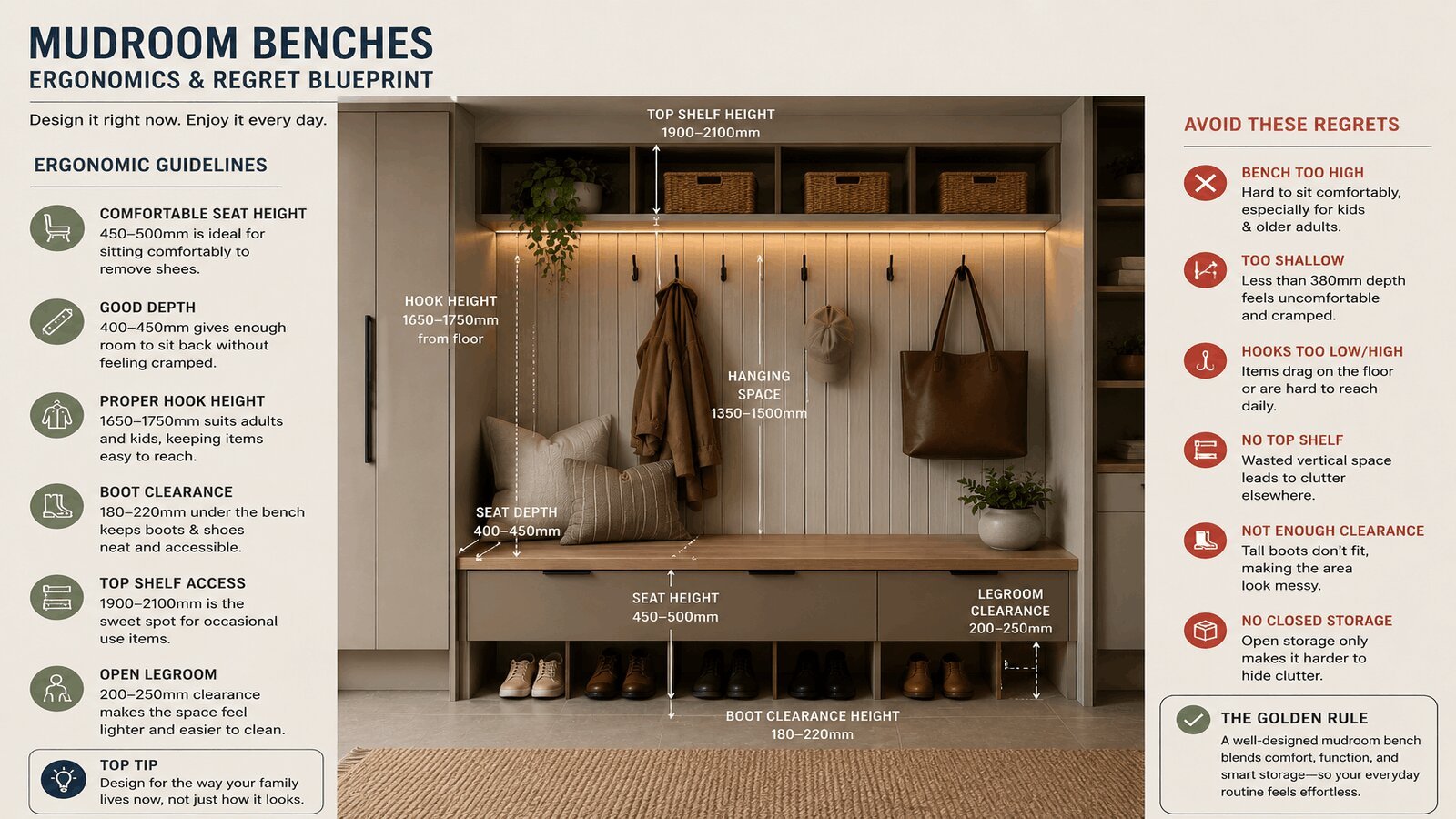
For homeowners planning a new mudroom, these are the measurements designers consistently return to:
| Element | Recommended Dimension |
|---|---|
| Bench height | 17–19 inches (approximately 450 mm) |
| Bench depth | 14–17 inches |
| Perch bench depth | 12–14 inches |
| Minimum circulation clearance | 36 inches |
| Preferred circulation clearance | 42 inches |
| Hallway warning threshold | Under 42 inches wide |
These dimensions help ensure the mudroom supports movement rather than becoming an obstacle.
What Are the Biggest Mudroom Bench Design Trends for 2026?
The mudroom is undergoing the same transformation seen throughout contemporary interior design.
The all-white utility aesthetic that dominated previous years is giving way to richer, more grounded interiors.
Designers are increasingly specifying colours such as putty, mushroom, warm taupe, clay, greige, charcoal, and muted deep plum. These softer, earthy tones create a more welcoming atmosphere while disguising everyday wear far better than bright white finishes.
Material selection is evolving as well.
Instead of highly processed surfaces, homeowners are gravitating toward matte white oak, walnut veneer, and natural-grain timber finishes. These materials help storage feel integrated into the architecture of the home rather than appearing as a separate piece of furniture.
The geometry of storage is changing too.
Open cubbies are being replaced by vertical grid matrices, full-height cabinetry, and slab-front joinery that conceals clutter while maintaining clean visual lines. These more disciplined compositions create a stronger sense of order, particularly in busy family homes.
The Rise of Fluted Glass
One of the most interesting developments is the growing use of fluted glass panels within mudroom cabinetry.
Fluted glass allows natural light to move through the space while obscuring the contents behind it. This makes cabinetry feel lighter and less imposing, especially in narrow hallways where solid storage walls can feel heavy.
The effect is practical and architectural at the same time.
Traditional Mudrooms vs Modern Integrated Systems
| Traditional Mudroom | 2026 Integrated Mudroom |
|---|---|
| Open hooks | Concealed storage fronts |
| Open cubbies | Vertical grid storage systems |
| Bright white cabinetry | Putty, clay, greige and plum tones |
| Basic seating bench | Storage-integrated seating |
| Utility-focused design | Architectural millwork |
| Static storage | Ventilated and moisture-managed storage |
| Visible clutter | Hidden organisation |
The difference is not simply aesthetic.
Modern systems are designed to reduce the amount of visual information a homeowner processes every day.
How Are Modern Mudroom Benches Becoming Household Command Centres?
The most advanced mudrooms now function as operational hubs for the entire household.
Rather than storing only shoes and coats, these spaces increasingly incorporate:
- Built-in charging stations
- Device storage compartments
- LED-lit cabinetry
- Under-shelf task lighting
- Family message centres
- Laundry integration
- Pet storage zones
- Drying systems for wet gear
This shift reflects how families actually use their homes.
The entryway has become a point where technology, storage, organisation, and daily routines intersect.
Moisture Management Is the New Luxury
One of the biggest design changes happening behind the scenes is the integration of moisture-control features.
Forward-thinking mudroom designs now include:
- Ventilated storage compartments
- Boot trays
- Pull-out drying racks
- Drying rails
- Mechanical ventilation systems
- Heated floor mats and heat-assisted drying zones
These features help wet shoes, umbrellas, jackets, and sports gear dry properly instead of trapping moisture inside cabinetry.
The result is a cleaner, healthier, and more durable storage environment.
For households with pets, these same systems help manage muddy paws, leashes, towels, grooming supplies, and outdoor equipment without affecting the rest of the home.
The 4 Mudroom Bench Mistakes Designers See Most Often
1. Building the Bench Too Deep
Many homeowners assume deeper storage is always better.
In reality, an oversized bench often narrows the hallway and creates a bottleneck.
A mudroom should improve circulation, not restrict it.
2. Ignoring Hallway Width
When hallways become too narrow, even beautiful joinery can feel intrusive.
If a passageway is already tight, a fixed built-in bench may not be the best solution.
Maintaining comfortable flow should always take priority over adding storage.
3. Relying Too Heavily on Open Storage
Open storage photographs beautifully.
It performs far less impressively in real life.
Most busy families generate enough daily items that fully exposed storage quickly becomes visual clutter.
A combination of concealed and open storage generally delivers better long-term results.
4. Forgetting About Moisture
Wet shoes and damp jackets create ongoing problems when stored inside sealed cabinetry.
Without ventilation, moisture accumulates and can lead to unpleasant odours, reduced material longevity, and poor usability.
The most successful mudrooms actively manage moisture rather than simply hiding it.
What Makes a Mudroom Bench Truly Successful?
The best mudroom benches share a surprisingly simple characteristic.
They support the flow of daily life without drawing attention to themselves.
They provide somewhere to sit, somewhere to store, and somewhere for everyday items to disappear when not in use.
They preserve circulation.
They reduce visual noise.
They make organisation feel effortless.
Most importantly, they remove the subtle stress that accumulates when household clutter has nowhere permanent to go.
That is why modern mudroom design in 2026 is no longer centred on storage capacity alone.
It is centred on creating a calmer arrival experience.
When thoughtfully designed, a mudroom bench with integrated storage does more than organise shoes and bags. It transforms the way a home feels the moment someone walks through the door.
Frequently Asked Questions
How deep should a mudroom bench be?
For most homes, a mudroom bench depth between 14 and 17 inches provides comfortable seating while maintaining good circulation. Compact perch-style benches can work at 12 to 14 inches deep.
What is the ideal height for a mudroom bench?
A height between 17 and 19 inches, or approximately 450 mm, aligns closely with standard chair ergonomics and works well for everyday use.
Are built-in mudroom benches suitable for narrow hallways?
They can be, but circulation should always be prioritised. If a hallway is under approximately 42 inches wide, careful planning is required to avoid creating a cramped passage.
Is open or closed storage better for a mudroom?
Most designers now favour a combination of both. Closed storage helps conceal clutter, while limited open storage provides convenient access to frequently used items.
What materials are trending for mudroom joinery in 2026?
Matte white oak, walnut veneer, natural-grain timber finishes, fluted glass, and earthy colours such as putty, clay, greige, charcoal, and muted plum are among the most popular choices.