
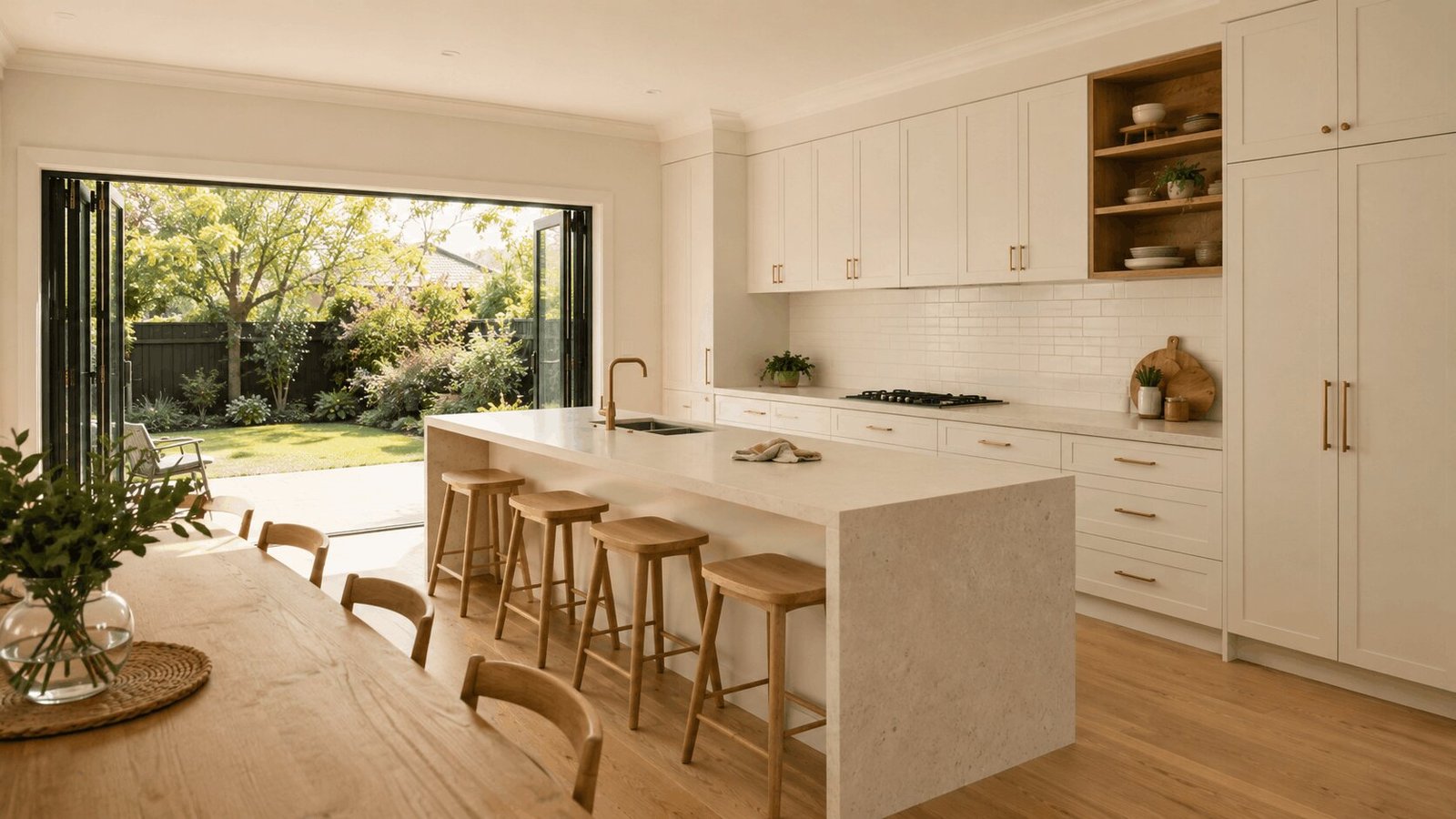
Across Melbourne’s east and south, the renovation brief has changed.
Five years ago, many families started with a simple question: IKEA or a kitchen company?
In 2026, the more common question is very different: bespoke or semi-custom?
That shift matters. It shows that flat-pack has started to move out of the main decision set for many owner-occupier family homes across Doncaster, Balwyn, Box Hill, Blackburn, Surrey Hills, Mitcham, Hampton, Bentleigh, Brighton, and the broader eastern and southern suburbs.
This is not a design trend in the superficial sense. It is a practical response to what homeowners have now lived through. Kitchens installed between 2010 and 2016 are reaching the point where hardware, finishes, and moisture-prone zones begin to show their age. Families who have already lived through one renovation cycle are making different decisions the second time around.
They are comparing not just price, but lifespan. Not just layout, but storage performance. Not just finishes, but how the kitchen will actually behave under daily family use for the next 10 to 20 years.
That is why custom joinery is increasingly becoming the default brief for Melbourne’s east and south.
For the full pricing picture before the reasons, our kitchen cabinet costs guide covers the complete breakdown across all three tiers. This post focuses on the why, what is driving the shift, and what it means for your renovation brief.
What “Switching” Actually Means — The Three Tiers in 2026
Before looking at the reasons behind the shift, it helps to define exactly what homeowners are comparing.
Many renovation discussions lump everything into two categories: cheap and expensive.
The reality is more nuanced.
In 2026, Melbourne’s kitchen market broadly operates across three tiers.
Tier 1 — Flat-Pack Joinery
This includes systems such as IKEA METOD, Kaboodle, Kinsman, and online flat-pack suppliers.
The appeal is straightforward. Standardised cabinet sizes, predictable supply chains, and lower upfront costs.
| Scope | Typical Cost |
|---|---|
| Compact kitchen | $5,500–$9,000 |
| Standard family kitchen | $8,000–$13,000 |
Flat-pack remains appropriate in several situations:
- rental properties
- short-term ownership horizons
- budget-sensitive projects
- new builds with highly regular room geometry
The limitation is that the system is built around fixed cabinet increments rather than the exact dimensions of the room.
For many households, that compromise is acceptable.
For others, it becomes the reason they renovate again.
Tier 2 — Semi-Custom Kitchen Companies
This category sits between flat-pack and true bespoke joinery.
Examples include larger kitchen companies, design-and-install providers, and modular systems with upgraded finishes.
The homeowner receives:
- design assistance
- installation management
- broader finish selections
- greater project coordination
| Scope | Typical Cost |
|---|---|
| Standard kitchen | $18,000–$38,000 |
For regular rooms and straightforward layouts, semi-custom can be an effective middle ground.
Many homeowners who previously would have chosen flat-pack now enter the market at this level.
Tier 3 — Bespoke Workshop-Made Joinery
This is where the biggest growth is occurring.
Every cabinet is manufactured specifically for the room rather than selected from a predefined module system.
The joinery is designed around:
- exact site measurements
- architectural constraints
- storage requirements
- appliance specifications
- material selections
- family lifestyle patterns
| Scope | Typical Cost |
|---|---|
| Compact galley under 4m | $8,000–$12,000 |
| Standard L-shape or single-wall 4–7m | $12,000–$20,000 |
| Open-plan with island 7m+ | $18,000–$30,000+ |
| Whole-home package | $30,000–$70,000+ |
This category is increasingly becoming the default choice for:
- owner-occupier family homes
- heritage properties
- irregular room layouts
- long-term renovations
- whole-home joinery projects
The important point is that the switch described throughout this article is not occurring across every homeowner demographic.
Investors still choose flat-pack.
Short-term renovators still choose flat-pack.
Many new builds still choose flat-pack.
The shift is happening specifically among owner-occupier families across Melbourne’s eastern and southern suburbs who intend to stay in their homes for the next decade or longer.
That distinction matters because it explains why the brief itself has changed.
The question is no longer:
“What is the cheapest way to get a new kitchen?”
The question is increasingly:
“What specification will still feel right in fifteen years?”
What Has Changed Since 2020
The shift toward bespoke joinery is easier to understand when you look at how homeowner briefs have changed over time.
| 2020 renovation brief | 2026 renovation brief |
|---|---|
| Kitchen only | Whole-home joinery |
| Flat-pack comparison | Bespoke comparison |
| Cheapest viable option | Long-term value and performance |
| Basic storage | Integrated storage systems |
| Replace cabinets | Improve how the home works |
| Short-term finish | 10 to 20 year durability |
| Showroom-led decisions | Peer-led and experience-led decisions |
Across consultations in Melbourne’s east and south, the questions homeowners ask today are different from the questions they asked five years ago.
They are less likely to ask, “What is the cheapest way to replace this kitchen?”
They are more likely to ask:
- How long will this last?
- What happens in the moisture zones?
- Can we make better use of this room?
- Should the laundry and wardrobes be done at the same time?
- What does this look like in a home we plan to stay in?
That is the real shift.
The move to bespoke joinery is not just about style. It is about how families now think about value, durability, and the long-term function of the home.
Reason 1 — The Flat-Pack Hardware Failure Wave
The strongest reason behind the shift toward bespoke joinery is also the least emotional.
It is not design.
It is not social media.
It is not trends.
It is hardware failure.
Across Melbourne’s eastern and southern suburbs, a large number of kitchens installed between 2010 and 2016 are now reaching the point where their weaknesses are becoming impossible to ignore. Many of these kitchens were installed during Australia’s major flat-pack renovation boom, when IKEA expanded aggressively, DIY renovation culture accelerated, and homeowners were looking for practical ways to modernise family homes without committing to higher-end joinery.
Those kitchens are now 10 to 15 years old.
The performance gap between budget hardware and premium hardware is no longer theoretical.
Families are living with it every day.
The most common complaints are remarkably consistent:
- drawer runners that no longer close smoothly
- soft-close mechanisms that have lost damping performance
- hinges requiring constant adjustment
- doors sagging over time
- vinyl-wrap lifting around dishwasher zones
- moisture damage under sinks
- base cabinets swelling near plumbing penetrations
A kitchen can still look acceptable from across the room while performing poorly every single day.
That distinction matters because kitchens are not occasional-use furniture. They are among the most heavily used systems in a family home.
A drawer opened 20 times per day reaches more than 100,000 cycles surprisingly quickly.
The difference between a premium runner and a budget runner becomes visible long before the kitchen reaches cosmetic end-of-life.
What Joiners Are Seeing in 2026
The current renovation wave is revealing a pattern.
Homeowners replacing older flat-pack kitchens are often not renovating because they dislike the design.
They are renovating because the kitchen has stopped functioning properly.
In many cases, the visual style could have remained acceptable for several more years.
The hardware could not.
One of the most common failure points is the drawer system.
Generic soft-close runners frequently lose smooth operation after years of heavy family use. The drawer still opens and closes, but the experience deteriorates. The movement becomes rougher. Alignment drifts. Damping weakens. Eventually components require replacement.
The same pattern appears with hinges.
Lower-cost hinge systems often need periodic adjustment as doors gradually move out of alignment. Homeowners compensate for years before ultimately replacing components altogether.
The issue is not that every flat-pack kitchen fails.
Many do not.
The issue is that the failure rate becomes increasingly visible after year ten.
That visibility is changing renovation decisions.
The Cost Difference Looks Different After Fifteen Years
The discussion around premium hardware is often framed as a luxury upgrade.
In reality, it is closer to a maintenance calculation.
Consider the difference between:
- replacing multiple runners over a kitchen lifespan
- replacing hinges repeatedly
- repairing swollen cabinet sections
- living with declining performance every day
versus specifying premium hardware at the beginning.
The premium becomes easier to justify once homeowners understand the total ownership timeline rather than only the installation cost.
This is one reason Blum hardware has become such a common specification within Melbourne’s higher-end renovation market.
Blum’s full-extension drawer systems, soft-close mechanisms, and hinge systems are designed around long-term cycle performance rather than entry-level price competition.
For owner-occupier families planning to remain in the home for the next 10 to 20 years, that difference becomes increasingly important.
The conversation shifts from:
“How much does the kitchen cost?”
to:
“How many times do I want to renovate this kitchen?”
Experience Is Replacing Assumption
Ten years ago, many homeowners had never lived with a flat-pack kitchen long enough to evaluate long-term durability.
Today they have.
That changes the brief dramatically.
The family renovating in Doncaster today often has direct experience with:
- runner failures
- hinge issues
- moisture damage
- peeling finishes
- storage limitations
They are no longer making decisions based on marketing material.
They are making decisions based on what happened in their own home.
That is why the shift toward bespoke joinery feels less like a trend and more like a correction.
The evidence is already sitting in thousands of kitchens across Melbourne’s east and south.
Reason 2 — Families Are Renovating to Stay, Not to Sell
The second reason is not really about property values.
It is about ownership horizon.
A growing number of Melbourne families are no longer renovating with a short exit plan in mind. They are renovating because they expect to stay in the home for the next decade or longer.
That changes the calculation completely.
Families with school-aged children, established routines, and strong ties to the area are far more likely to invest in joinery that improves daily life over the long term. The question becomes less about resale optics and more about whether the home works properly for the household.
That is especially true in suburbs like Doncaster, Balwyn, Box Hill, Blackburn, Surrey Hills, Mitcham, Hampton, Bentleigh, and Brighton, where many homeowners are already settled into the neighbourhood and are improving the home they intend to keep.
When a family plans to stay, durability matters more.
Storage matters more.
Hardware performance matters more.
The cost of doing the job twice matters more.
This is why bespoke joinery has become easier to justify. It is not being judged only as a capital expense. It is being judged as a long-term lifestyle decision.
For many owner-occupiers, that is the point where custom joinery starts making more sense than a lower-cost alternative.
Reason 3 — Pricing Transparency Has Closed the Perceived Cost Gap
One of the most important changes in Melbourne’s renovation market has nothing to do with materials, hardware, or design.
It is information.
For years, many homeowners assumed bespoke joinery was dramatically more expensive than it actually was.
The assumption was understandable.
Most renovation websites published enormous cost ranges with very little explanation behind them.
A homeowner researching kitchen costs would see estimates such as:
- $10,000–$80,000
- $15,000–$100,000+
- “Custom pricing available on request”
Those numbers created uncertainty rather than clarity.
In the absence of specific information, many families filled in the blanks themselves.
The conclusion was often:
“Custom joinery is probably out of our budget.”
That assumption pushed thousands of homeowners directly toward flat-pack and lower-tier semi-custom options before they had even explored the actual numbers.
The Market Is More Transparent in 2026
The renovation conversation today is very different.
Homeowners now have access to:
- detailed pricing guides
- renovation breakdowns
- project examples
- material explanations
- specification comparisons
The result is that many families are discovering the gap between flat-pack and bespoke is smaller than they expected.
A compact workshop-made kitchen supplied at $8,000–$12,000 is often much closer to the fully installed cost of a flat-pack kitchen than most homeowners assume.
At the standard family-kitchen level, the comparison becomes even more interesting.
| Kitchen Type | Typical Cost |
|---|---|
| Flat-pack + professional installation | $5,500–$13,000 |
| Bespoke compact kitchen supply | $8,000–$12,000 |
| Bespoke 4–7m kitchen supply | $12,000–$20,000 |
| Semi-custom supply and install | $18,000–$38,000 |
The gap still exists.
But the perceived gap and the actual gap are often very different things.
Homeowners Are Comparing Total Outcomes
The conversation is increasingly moving beyond initial price.
Families are now evaluating:
- storage efficiency
- lifespan
- hardware quality
- finish durability
- layout optimisation
- future maintenance
rather than simply comparing cabinet costs.
Once those factors enter the discussion, bespoke joinery starts competing differently.
The question becomes:
“What am I actually getting for the difference?”
That is one reason custom joinery is becoming more accessible psychologically even when it is not necessarily cheaper.
The homeowner understands the trade-off more clearly.
The decision becomes informed rather than assumed.
For the complete side-by-side pricing breakdown across all three tiers, our kitchen cabinet costs guide covers the full comparison in detail.
The Entry Point Surprise
One of the most common reactions during consultations is simple surprise.
Many homeowners expect bespoke joinery pricing to begin where it actually ends.
They assume workshop-made cabinetry automatically belongs in a luxury-only category.
In reality, the entry point for bespoke has always been more attainable than the market believed.
The difference is that homeowners now have better visibility into the numbers.
That transparency is changing renovation decisions across Melbourne’s east and south.
Not because custom joinery suddenly became affordable.
Because people finally understand what it costs.
Reason 4 — Melbourne’s Renovation Wave Is Creating Peer Visibility
Most renovation decisions feel personal.
In reality, they are heavily influenced by what homeowners see around them.
Across Melbourne’s eastern and southern suburbs, a large-scale renovation wave is creating a powerful form of social proof.
Families are no longer evaluating kitchens in isolation.
They are seeing completed renovations firsthand.
The Neighbour Effect Is Real
A homeowner in Box Hill visits a friend’s renovated kitchen.
A family in Doncaster attends a birthday gathering in a newly renovated open-plan home.
Parents from the same school community see a neighbour’s new laundry and wardrobe package.
The experience is immediate.
Not a showroom.
Not an Instagram advertisement.
Not a display home.
A real family home being used every day.
That distinction matters because quality becomes much easier to understand in person.
You feel the drawer action.
You notice the cabinet alignment.
You see the way the joinery integrates into the room.
You experience the storage.
The difference becomes tangible.
Showrooms Sell Possibility. Real Homes Sell Certainty
A showroom can demonstrate finishes.
A showroom can demonstrate layouts.
What it cannot demonstrate is how a kitchen feels after years of actual family use.
Neighbour-to-neighbour visibility solves that problem.
Homeowners see kitchens operating in real environments.
They see:
- children using drawers
- appliance integration
- pantry functionality
- storage capacity
- finish durability
under genuine living conditions.
That experience is often more influential than any marketing campaign.
Eastern and Southern Melbourne Amplify Word-of-Mouth
This effect is particularly strong across Melbourne’s established family suburbs.
Areas such as:
- Balwyn
- Doncaster
- Box Hill
- Surrey Hills
- Mitcham
- Hampton
- Bentleigh
- Brighton
have dense social networks built around:
- schools
- sporting clubs
- community groups
- long-term neighbourhood relationships
Renovation information travels quickly through those networks.
A successful project becomes visible.
Questions get asked.
Recommendations get shared.
Future renovation briefs evolve.
The effect compounds over time.
Expectations Rise With Exposure
Perhaps the biggest consequence of peer visibility is that homeowner expectations gradually move upward.
A family who originally planned a simple cabinet replacement may start reconsidering:
- full-height cabinetry
- integrated storage
- walk-in pantry conversions
- wardrobe upgrades
- laundry joinery
- premium hardware
after seeing what is possible inside comparable homes nearby.
The renovation brief becomes more ambitious because the benchmark changes.
This is one reason bespoke joinery adoption often accelerates suburb by suburb.
The shift is not driven primarily by advertising.
It is driven by exposure.
The more homeowners see genuinely well-executed custom joinery inside real family homes, the harder it becomes to return to the compromises they accepted previously.
That visibility is now operating at scale across Melbourne’s east and increasingly across the southern bayside suburbs as the renovation wave continues moving outward.
Reason 5 — The Coastal South Dimension — Materials That Must Last
As the renovation wave continues moving south, another factor begins influencing joinery decisions.
Environment.
Melbourne’s bayside suburbs create conditions that many inland kitchens never experience. Homes in Hampton, Brighton, and surrounding coastal areas are exposed to salt air, higher ambient moisture, stronger UV, and more variation in humidity. Those conditions affect how joinery ages over time.
A cabinet system that performs adequately inland may age very differently closer to Port Phillip Bay.
Salt Air Changes the Performance Timeline
One of the recurring patterns in bayside renovations is accelerated material degradation.
The kitchen may not look dramatically different during the first few years.
The divergence becomes visible later.
Common issues include:
- vinyl-wrap edges lifting sooner
- hardware finishes deteriorating faster
- increased swelling around moisture-prone zones
- faster wear on lower-grade materials
The kitchen is still performing the same tasks.
The environment is simply less forgiving.
This is one reason many homeowners in Melbourne’s southern suburbs are increasingly specifying higher-grade materials from the beginning.
The cost difference feels more reasonable when the alternative is renovating again earlier than expected.
Moisture Resistance Becomes a Structural Decision
One of the most important specifications in coastal environments is the cabinet carcass itself.
Standard particleboard performs adequately in many situations.
The issue appears when moisture enters vulnerable areas repeatedly over long periods.
Under-sink cabinets.
Dishwasher-adjacent panels.
Laundry joinery.
Kickboard zones.
These are the locations where swelling typically begins.
For this reason, many bespoke projects across Melbourne’s south increasingly specify:
- 18mm HMR board throughout
- moisture-resistant structural panels
- improved sealing strategies
- better hardware systems
The goal is not luxury.
The goal is stability.
Finishes Matter More Near the Bay
The finish system also becomes more important.
Many homeowners underestimate how much movement and environmental variation a kitchen experiences across its lifespan.
Temperature changes.
Steam exposure.
Humidity shifts.
Direct sunlight.
Daily cleaning.
All of these factors affect surface longevity.
This is why 2-pack polyurethane finishes continue gaining traction across Melbourne’s premium renovation market.
Unlike vinyl-wrap systems, which rely on adhesion around edges and profiles, a properly applied 2-pack finish forms a hard, chemically bonded surface.
The long-term durability difference becomes increasingly visible after years of use.
Particularly in coastal environments.
UV Exposure Is Becoming a Bigger Issue
Another factor emerging in contemporary bayside homes is sunlight.
Many renovated southern-suburb homes now feature:
- larger glazing
- open-plan living zones
- north-facing kitchen areas
- extensive natural light
These spaces are highly desirable.
They also expose cabinetry to far more UV radiation than older kitchen layouts.
Material selection therefore becomes part of the design process rather than something considered afterward.
For some projects, this includes advanced surface options such as Fenix NTM, which offer strong UV resistance alongside a highly refined matte finish.
The Bayside Brief Is Becoming More Sophisticated
One reason Silk Touch’s southern-suburb expansion is occurring now is that homeowner expectations are evolving.
The conversation is no longer simply:
“What colour kitchen should we choose?”
It increasingly includes:
- moisture resistance
- hardware lifespan
- UV performance
- finish durability
- long-term maintenance
The renovation brief becomes more technical.
More informed.
More specification-driven.
That shift naturally aligns with bespoke joinery because workshop-made cabinetry allows materials to be selected intentionally rather than inherited from a predetermined system.
The full coastal specification approach, including material selections specific to Melbourne’s bayside suburbs, is covered in detail on the kitchen renovations Brighton page.
Reason 6 — The Whole-Home Joinery Brief Has Replaced the Kitchen-Only Brief
Perhaps the most commercially significant change in Melbourne’s renovation market is that kitchens are no longer being considered alone.
Five years ago, many projects followed a predictable pattern.
Replace the kitchen.
Finish the project.
Revisit wardrobes and storage later.
That sequencing is becoming far less common.
In 2026, the renovation brief increasingly begins at a whole-home level.
One Design Language Across the House
Families are approaching joinery differently.
Instead of viewing the kitchen as an isolated room, they are looking at the home as a connected environment.
The discussion now often includes:
- kitchen
- laundry
- wardrobes
- walk-in robes
- mudrooms
- study joinery
- entertainment units
- storage walls
within the same planning process.
The reason is partly aesthetic.
A homeowner specifying warm white 2-pack cabinetry, American Oak shelving, and aged brass hardware in the kitchen often wants the same language carried throughout the house.
The result feels more cohesive.
More intentional.
More architectural.
Families Want One Disruption Period
The practical reason is equally important.
Renovation fatigue is real.
Most households do not want:
- multiple measurement appointments
- repeated installation periods
- recurring dust and disruption
- separate design processes
across several years.
If the kitchen renovation is already happening, many families prefer to solve the storage problem everywhere at once.
That logic becomes particularly compelling in owner-occupier homes where the family expects to remain long term.
The Storage Expectations Have Changed
Another driver behind the whole-home shift is that modern family storage requirements are significantly more complex than they were twenty years ago.
Homes now need space for:
- hybrid work setups
- larger wardrobes
- sporting equipment
- school storage
- charging stations
- integrated appliances
- concealed utility zones
The kitchen alone cannot solve those challenges.
Joinery increasingly becomes a house-wide storage system rather than a room-specific product.
The Economics Also Improve
There is a financial argument as well.
Combining multiple joinery scopes often creates efficiencies across:
- site measurement
- design development
- material ordering
- installation sequencing
Rather than commissioning separate projects over five years, many families now approach the house as a single coordinated brief.
This is one reason whole-home packages in the $30,000–$70,000+ range have become increasingly common across Melbourne’s eastern family suburbs.
As explored in the Box Hill custom joinery post, homeowners are increasingly commissioning kitchens, wardrobes, laundries, and storage systems together rather than as isolated upgrades.
The Renovation Brief Has Matured
At a broader level, this reflects a change in how homeowners think about value.
The goal is no longer simply replacing old cabinets.
The goal is improving how the home functions every day.
That leads naturally toward a larger conversation.
Not:
“What kitchen do we want?”
But:
“How do we want the entire house to work?”
Once the discussion reaches that point, bespoke joinery becomes much easier to justify.
Because the value is no longer being measured cabinet by cabinet.
It is being measured across the daily experience of the entire home.
That shift may be the clearest sign of all that Melbourne’s eastern and southern renovation market has moved into a different phase.
The kitchen remains the centrepiece.
But increasingly, it is only the beginning of the brief.
The Melbourne East vs South Comparison — How the Brief Differs by Zone
Although the shift toward bespoke joinery is occurring across both Melbourne’s east and south, the renovation brief is not identical in each area.
The housing stock is different.
The environmental conditions are different.
The design priorities are different.
Understanding those differences helps homeowners make better decisions about specification, materials, and project scope.
| Factor | Melbourne East (Doncaster, Balwyn, Box Hill, Blackburn, Mitcham, Surrey Hills) | Melbourne South (Brighton, Hampton, Bentleigh, Wheelers Hill, Rowville) |
|---|---|---|
| Dominant housing type | 1960s–1980s brick veneer homes, double-storey family houses, some interwar homes | Mix of interwar period homes, post-war housing, contemporary coastal builds |
| Typical lot size | 500–900 sqm | 400–700 sqm closer to bayside; larger in outer south-east |
| Primary renovation driver | Modernising long-held family homes | Upgrading older homes for long-term coastal living |
| Key joinery challenge | Open-plan conversion, storage integration, whole-home consistency | Moisture resistance, UV exposure, coastal material performance |
| Most common kitchen scope | Open-plan kitchen with island, 7m+ layout | Open-plan family kitchen with upgraded coastal specifications |
| Typical kitchen supply budget | $18,000–$30,000+ | $18,000–$32,000+ depending on material specification |
| Most common wardrobe project | Walk-in robe conversion from existing room space | Full-wall built-in wardrobes with premium finishes |
| Dominant 2026 palette | Warm white Slim-Shaker, American Oak shelving, aged brass | Coastal contemporary palettes, white Shaker, marble-look stone, brushed nickel |
| Typical ownership horizon | 10–20 years | 10–20 years |
| Most common renovation model | Whole-home joinery package | Kitchen + wardrobe + laundry package |
Despite these differences, one pattern remains consistent across both regions.
Families are increasingly prioritising:
- durability
- storage performance
- long-term value
- cohesive design language
over minimum upfront cost.
That common priority is one of the strongest reasons bespoke joinery continues gaining momentum across both sides of Melbourne.
What the Switch Looks Like in Practice — Three Real Brief Types
The shift toward custom joinery becomes easier to understand when viewed through actual renovation patterns.
These are not individual client projects.
They are composite examples built from the types of briefs increasingly appearing across Melbourne’s eastern and southern suburbs.
Brief Profile 1 — The Eastern Family Upgrade
A family of four living in a 1970s double-storey home in Doncaster or Box Hill.
The existing kitchen was installed more than a decade ago.
The layout still functions reasonably well, but the hardware is beginning to fail. Drawer runners feel rough. Storage no longer suits the household. The finish is visibly ageing.
The original plan is a kitchen replacement.
During the design process, the brief expands.
The family decides to include:
- kitchen
- laundry
- two bedroom wardrobes
within the same project.
The selected palette is warm white 2-pack cabinetry with American Oak shelving and aged brass hardware.
The goal is not luxury.
The goal is consistency, storage efficiency, and a solution that still feels appropriate fifteen years from now.
Typical whole-home joinery supply range:
$35,000–$55,000+
Brief Profile 2 — The Period Home Kitchen
A couple living in a 1930s home in Balwyn or Surrey Hills.
The kitchen was renovated years ago using a generic semi-custom system that never fully suited the architecture of the house.
The cabinetry works.
The room does not.
The proportions feel wrong.
The detailing feels disconnected from the character of the building.
The renovation brief focuses on restoring visual consistency between the kitchen and the original structure.
Key inclusions often include:
- bespoke Slim-Shaker cabinetry
- full-height storage
- butler’s pantry integration
- precise scribing to irregular walls
- upgraded appliance integration
The emphasis is not on maximum size.
It is on precision.
Typical kitchen joinery supply range:
$18,000–$28,000+
Brief Profile 3 — The Coastal South First-Timer
A young family purchasing a long-term home in Hampton or Bentleigh.
The kitchen is original.
Storage throughout the house is limited.
The family intends to remain in the property for the foreseeable future.
Rather than completing renovations in stages, they choose to solve the entire storage problem at once.
The brief commonly includes:
- open-plan kitchen with island
- walk-in wardrobe conversion
- laundry joinery
- integrated storage solutions
Material selection becomes a major part of the discussion because of the bayside environment.
The specification often includes:
- HMR board throughout
- 2-pack polyurethane finishes
- Blum hardware systems
- UV-conscious surface selections
The focus is long-term performance rather than short-term cost reduction.
Typical whole-home joinery supply range:
$40,000–$65,000+
Frequently Asked Questions
Why are Melbourne families choosing custom joinery over flat-pack in 2026?
Four factors are driving the shift.
First, rising property values have made long-term renovation investment easier to justify. Second, many homeowners are now experiencing the real-world limitations of flat-pack kitchens installed 10 to 15 years ago. Third, pricing transparency has reduced the perceived gap between bespoke and flat-pack solutions. Fourth, the renovation wave across Melbourne’s east and south has created strong neighbour-to-neighbour visibility, allowing families to experience high-quality joinery firsthand before making decisions.
How much more does custom joinery cost than flat-pack in Melbourne?
The gap is often smaller than homeowners expect.
A compact bespoke kitchen under 4 metres typically starts between $8,000–$12,000 supply, while many professionally installed flat-pack kitchens end up costing $5,500–$13,000 once installation is included.
At larger project sizes, bespoke joinery frequently becomes competitive with semi-custom supply-and-install packages while delivering greater flexibility, stronger material specifications, and more precise use of space.
For the complete breakdown, see the kitchen cabinet costs guide.
What suburbs in Melbourne’s east and south does Silk Touch Joinery service?
Silk Touch Joinery services Melbourne’s eastern and southern suburbs including:
- Doncaster
- Templestowe
- Balwyn
- Box Hill
- Blackburn
- Surrey Hills
- Mitcham
- Nunawading
- Burwood
- Vermont
- Forest Hill
- Wantirna
- Wheelers Hill
- Rowville
- Bentleigh
- Hampton
- Brighton
- Mont Albert
and surrounding areas.
Is custom joinery worth it for a family home in Melbourne’s eastern suburbs?
For owner-occupier families expecting to remain in the home for the next decade or longer, bespoke joinery is often the strongest long-term specification.
The biggest advantages tend to be:
- higher-performing hardware systems
- improved storage efficiency
- better moisture resistance
- longer finish lifespan
- precise integration into existing rooms
For investment properties or short-term ownership plans, the calculation may be different.
Does Silk Touch Joinery service Brighton and Melbourne’s south?
Yes.
Silk Touch Joinery is actively expanding across Melbourne’s southern bayside suburbs including Brighton, Hampton, Bentleigh, and surrounding areas alongside its established eastern-suburbs work.
For homeowners specifically researching bayside renovations, the kitchen renovations Brighton page covers the material and specification considerations unique to coastal environments.
Closing Thoughts
The move toward custom joinery across Melbourne’s east and south is not being driven by trends in the fashion sense.
It is being driven by experience.
Families have now seen what happens when lower-grade hardware reaches year ten. They have seen the difference between moisture-resistant materials and standard board products. They have watched neighbours renovate and experienced premium joinery firsthand inside real homes rather than display centres.
At the same time, property values have changed the renovation equation, pricing transparency has reduced uncertainty, and whole-home storage expectations have become far more sophisticated than they were a decade ago.
The result is a different renovation brief.
For many owner-occupier families, the question is no longer whether bespoke joinery is appropriate.
The question is which level of scope, material specification, and long-term investment makes the most sense for the way they plan to live.
If you’re planning a kitchen, wardrobe, laundry, or whole-home joinery project across Melbourne’s east or south, book an in-home consultation and discuss the options in the context of your home, your layout, and your long-term plans.