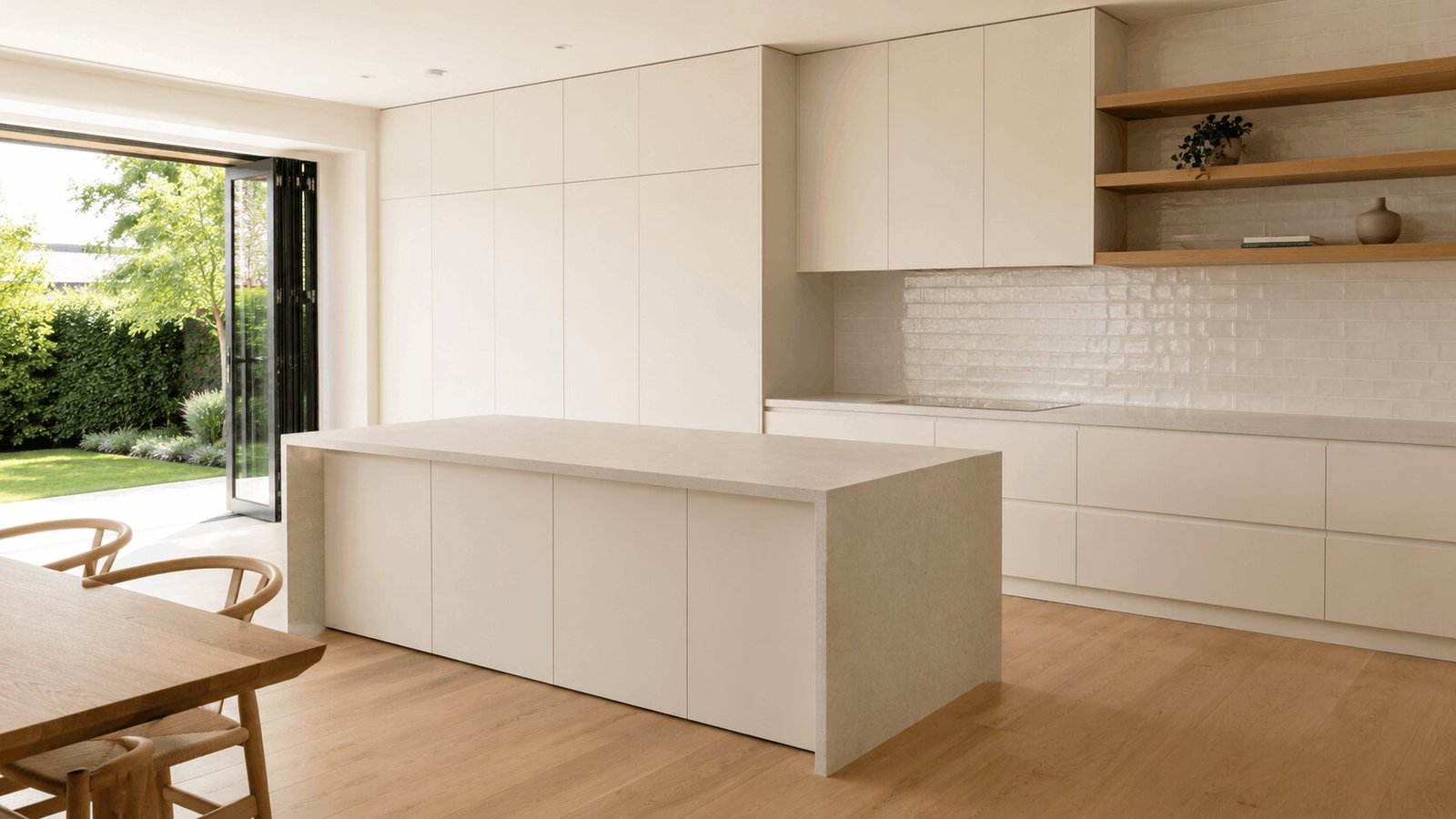
Handleless kitchen cabinets are the most visually copied and least accurately represented kitchen product online. Every kitchen inspiration feed shows handleless. Very few sources tell you what they cost to do correctly, what goes wrong when they’re done cheaply, or in which homes they genuinely work versus in which homes they are an aesthetic imposition on an incompatible building. The gap between what the photography shows and what the reality delivers is wider for handleless kitchens than for any other cabinetry specification.
Silk Touch Joinery installs both handleless and hardware kitchens. We have no commercial incentive to push you toward one over the other. What we do have is a clear, experience-based view — built across hundreds of installations — on when each is right. This post gives you what the industry typically doesn’t: the cost comparison between handleless systems, the daily experience of living with each type, and the specific situations where choosing handleless over hardware (or hardware over handleless) is the correct call.
For a practical reference point on the two contexts where handleless works best and worst in Melbourne homes, the Japandi kitchen Thornbury post covers the minimal-aesthetic case for handleless, while the Art Deco kitchen Surrey Hills post covers exactly why hardware is the right specification in the opposite context.
The Four Types of Handleless Kitchen Cabinets — What’s Actually Available
Most homeowners asking about “handleless kitchens” do not know there are four distinct systems, each with different costs, ergonomics, and maintenance profiles. Choosing between them is not a style decision — it is a functional and budgetary decision that shapes the entire kitchen specification. Here is what is actually available.
Type 1 — Integrated J-Pull Profile
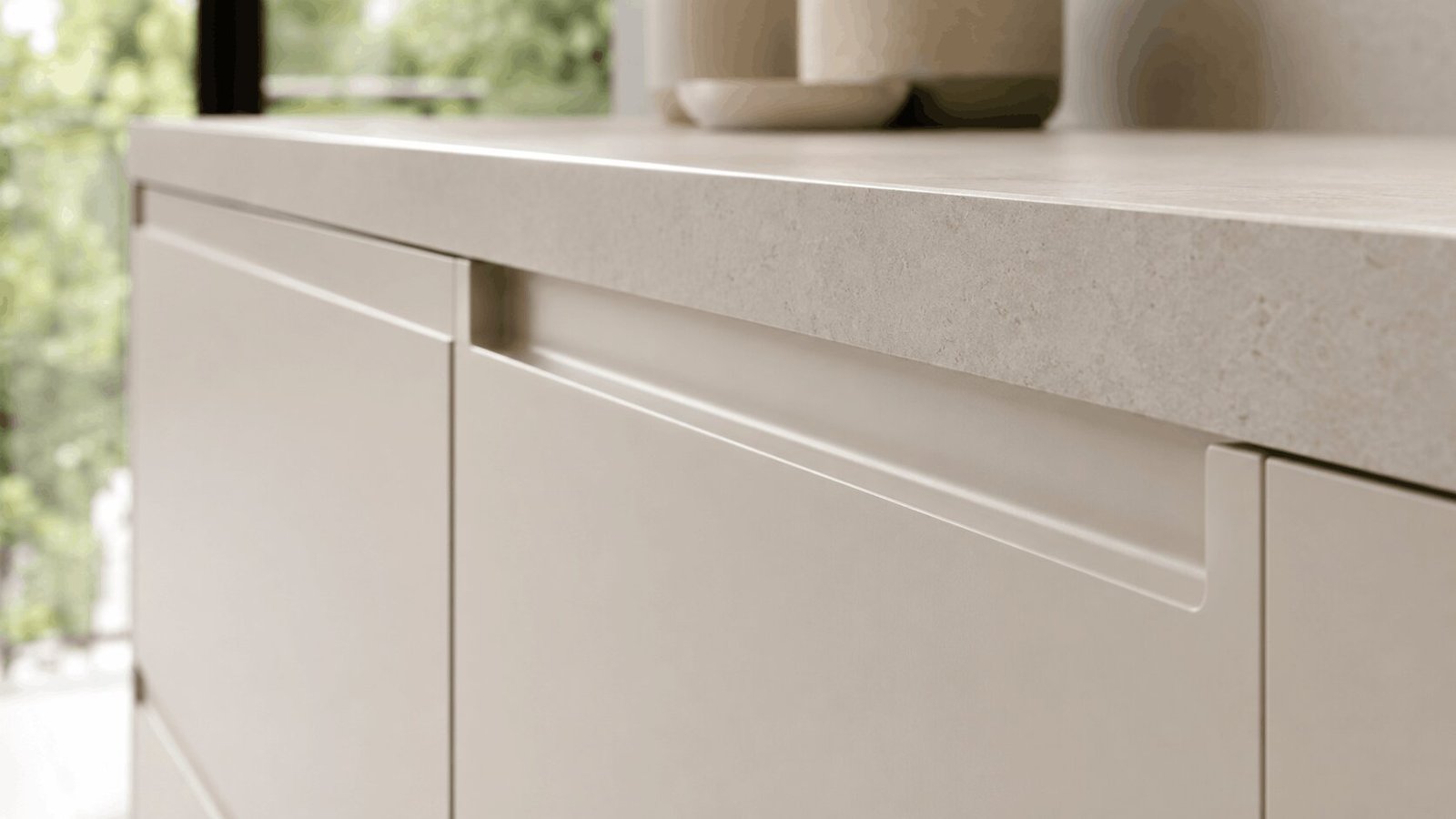
The J-pull is the most common bespoke handleless option in Melbourne. It is a recessed channel machined into the top or bottom edge of the door face — the finger inserts into the channel to pull the door or drawer open. The channel is typically 18–22mm deep and runs the full width of the door. There is no hardware on the door face at all: no visible fixings, no separate component, nothing to clean around. The door face is a completely uninterrupted flat panel.
A J-pull must be CNC-machined for consistency — a hand-routed J-pull channel shows variation in depth and edge quality that is visible and tactile on a flat-slab door. Routing typically adds $30–$60 per door to the fabrication cost compared to a flat-slab door without routing. The position of the channel varies by application: top edge for overhead cabinets, bottom edge for base cabinets, and both edges on tall pantry or appliance tower doors. The J-pull channel does collect grease and debris over time — it requires a narrow brush or cloth to clean — but it is easier to maintain than a cup pull and slightly more demanding than a bar handle.
Type 2 — Push-to-Open (Blum Tip-On)
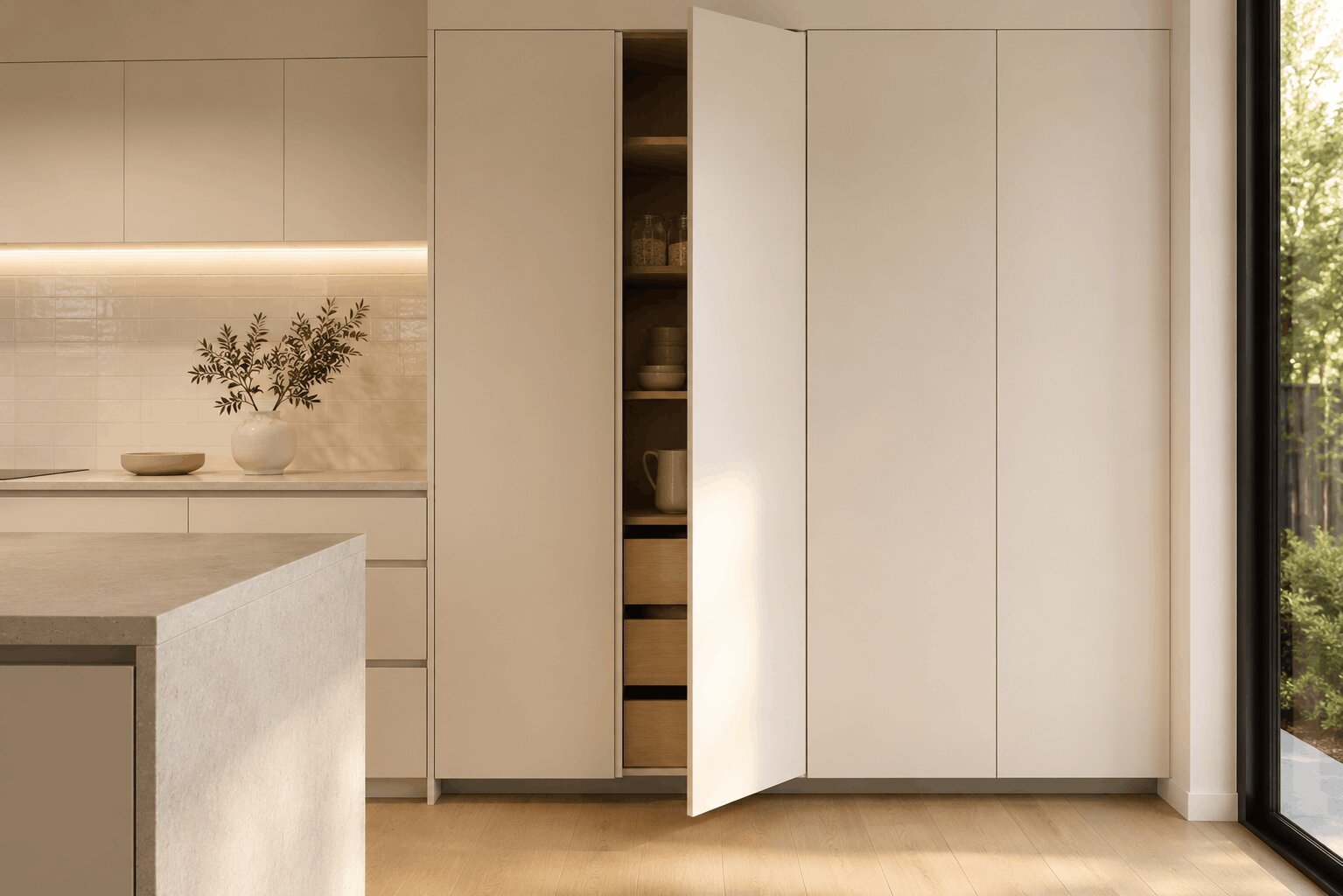
A push-to-open mechanism is spring-loaded and integrated into the hinge or drawer runner. Pressing the door or drawer face opens it — there is no channel, no visible opening mechanism, and no grip required. Blum Tip-On is the industry standard for this system and provides a consistent opening force with a soft-close return. It produces the most completely clean door face of any handleless system.
Tip-On adds $30–$60 per door and $50–$100 per drawer to the hardware cost versus standard soft-close. It works excellently for overhead cabinet doors and lightly loaded drawers. It has genuine limitations at the base drawer level under heavy load — a fully loaded drawer carrying cast-iron cookware or a dense pot collection at 30kg+ requires more opening force than a standard Tip-On provides comfortably. The press-and-release action is also counterintuitive when a drawer is offering resistance. Best applications are overhead cabinets, appliance tower doors, and lightly loaded base drawers. The mechanisms require periodic spring-tension adjustment — typically once every two to three years — as the tension softens with use.
Type 3 — Recessed Horizontal Rail System
A continuous aluminium rail running horizontally across the full cabinet run — at the top of base cabinets and the bottom of overhead cabinets — serves as the grip for all doors in its zone. This is the most visually dramatic handleless option. The continuous rail creates a strong horizontal line across the kitchen face that reinforces and emphasises the rectilinear character of the design. Ergonomically, it is also the strongest handleless system — the grip is consistent and intuitive, analogous to grasping a bar handle.
It is the most expensive handleless option. The aluminium rail profile, its fixings, and the modified door fabrication to accommodate it typically add $1,500–$3,500 to a standard kitchen’s cost. Cleaning requires regular attention at the rail-to-door junction, where grease and dust accumulate — more maintenance than a bar handle or J-pull. The installation must be precise: the continuous rail must be level across its full run, and in a kitchen with any wall or floor variation, achieving a visually level rail requires careful survey and installation. Any deviation is immediately visible. This system rewards quality installation; it punishes shortcuts.
Type 4 — Finger-Pull Channel
A finger-pull channel is a shallow groove — typically 8–12mm deep — routed into the door face itself rather than the edge. The finger rests in the groove to open the door. It is less common in Melbourne bespoke joinery than J-pull or push-to-open, and it is lower cost: the channel is shallower and simpler to machine, making it marginally cheaper than bar handles. The grip depth is insufficient for drawers under significant load, limiting its practical application to overhead cabinet doors where the weight of the door is the primary consideration. On the right flat-slab door and in the right design context, the channel reads as a considered horizontal detail rather than a compromise — a subtle interruption of the flat surface that adds a shadow line without introducing hardware.
The Genuine Pros of Handleless Kitchen Cabinets
Pro 1 — Visual Cleanliness at Scale
In a kitchen with a large cabinet run — 7m or more in total — the absence of hardware creates a visual calm that hardware kitchens cannot achieve at the same scale. Twenty bar handles on a 7m kitchen, however carefully specified, introduce a repeated vertical element that interrupts the horizontal plane of the cabinet face. A handleless 7m run reads as a single uninterrupted surface. The eye moves across it without stopping. This is why handleless kitchens are disproportionately represented in architectural photography and design media — they perform on camera in a way that a hardware kitchen, however beautiful in person, rarely matches. If a large, open-plan kitchen is the context, handleless deserves serious consideration on visual grounds alone.
Pro 2 — Safety with Children
Bar handles and cup pulls on base cabinets present a genuine physical hazard for young children. Hip-height hardware at the exact level of a toddler’s eye and face is a documented source of facial injuries in kitchen environments. Handleless base cabinets — whether J-pull, Tip-On, or rail — eliminate this hazard completely. For families with children under five, handleless base cabinets are not merely an aesthetic choice. They are a safety specification with practical daily consequences. This consideration alone is sufficient to drive the handleless decision in households where it would otherwise be borderline.
Pro 3 — No Hardware Wear or Tarnish
Brass hardware develops patina over time — sometimes beautifully, sometimes not. Chrome hardware shows water spots and smears at the highest-contact points. Matte black hardware fades and shows wear at the grip location within a few years of daily use. A handleless kitchen has no hardware to maintain. There is no polishing, no replacement of worn finishes, and no inconsistency between a handle installed in 2026 and a replacement installed in 2031. This matters most in high-use kitchens — busy family homes and frequent entertainers — and in coastal and near-coastal environments where salt air accelerates tarnishing on exposed metal hardware. In a Brighton or Hampton home three streets from the bay, a handleless kitchen sidesteps the hardware maintenance conversation entirely.
Pro 4 — Aesthetic Longevity
The handleless profile is the least date-specific kitchen design choice available in 2026. Hardware selections — the specific finish, proportion, and profile of a bar handle — are more directly subject to trend cycles. A flat-slab handleless kitchen in warm white 2-pack specified in 2026 will look contemporary in 2036. The same kitchen fitted with a handle profile that is distinctively “of 2026” may date more visibly as that profile recedes from trend. This argument has limits — genuinely well-chosen hardware ages well and can be replaced at reasonable cost — but handleless begins from a position of greater aesthetic neutrality. For homeowners who renovate once per decade and want the result to carry, that neutrality has real value.
Pro 5 — Easier Cleaning of the Cabinet Face
A flat uninterrupted cabinet face with no hardware fixings, no shadow gaps between hardware and door face, and no hardware profile to clean around is the most straightforward surface to maintain in a kitchen. A damp cloth across a flat 2-pack door requires no navigation around handles. In kitchens where the cabinet faces are near the cooking zone and subject to grease splash — particularly immediately above the cooktop or beside a wok burner — this is a practical daily advantage that accumulates over years of use. The daily wipe-down is faster and more complete.
The Real Cons of Handleless Kitchen Cabinets
Con 1 — Fingerprint Visibility on Dark Finishes
This is the most commonly reported disappointment in handleless kitchens and the detail most kitchen companies do not volunteer. A flat dark door face — charcoal, forest green, navy, deep blue — with no hardware to draw the eye elsewhere shows every fingerprint. On a dark 2-pack door in a satin finish, the marks left by a hand opening an overhead cabinet are visible from across the kitchen within hours of cleaning. The handleless profile concentrates contact exactly on the door face — there is no handle to grab, so the hand rests directly on the door. On a light door, fingerprints are far less visible. Warm white and greige handle daily use well. On a dark palette, they are a daily presence.
The mitigation is straightforward but requires acknowledging before committing to the specification: light colours work with handleless; dark colours work against it. If the design brief is a dark handleless kitchen and the household includes children or heavy daily kitchen use, factor in a daily wipe-down as a maintenance requirement. It is not occasional. If daily maintenance is not realistic for the household, a hardware kitchen with a dark palette will be a more satisfying long-term result than a handleless dark kitchen that looks marked by mid-afternoon.
Con 2 — Opening Ergonomics Under Load
A J-pull channel is entirely functional for lightweight overhead cabinet doors and lightly loaded drawers. It is less comfortable for heavily loaded base drawers. The finger-into-channel motion requires more force and a more precise grip than grasping a bar handle when the drawer is carrying significant weight — a full pot collection, a heavy cast-iron skillet set, a drawer loaded with bulky serving equipment. Under that load, the J-pull experience is noticeably less satisfying than a well-positioned 200mm bar handle that allows a full palm grip and a straight pull.
Push-to-open under load is worse still. The press-and-release action is counterintuitive when the drawer is resisting — the natural instinct is to pull, not press. A fully loaded Legrabox drawer at 30kg+ on a Tip-On mechanism is a daily frustration rather than a daily satisfaction. Handleless is most ergonomically successful in kitchens where base storage is primarily drawers with moderate loads and overhead cabinets with standard loads. In a kitchen with a serious cooking brief and heavy base drawer requirements, the ergonomic case for bar handles at the base level is strong and practical.
Con 3 — Heritage and Period Home Incompatibility
Handleless cabinetry is a contemporary design vocabulary. It functions architecturally in buildings whose language is neutral or contemporary. In Melbourne’s Victorian, Edwardian, and interwar homes — where the cornice profile, the parquetry floor, the tiled hallway, and the leadlight windows belong to a specific historical aesthetic — a handleless flat-slab kitchen reads as a visual conflict. The kitchen has been renovated into a different architectural language from the building that surrounds it. The mismatch is not a question of taste — it is a question of architectural coherence.
As covered in the kitchen renovation mistakes Melbourne post, starting with aesthetics before considering architectural compatibility is one of the most common and expensive renovation errors. Hardware — specifically aged brass cup pulls, shaker-profile doors, or bar handles in period-appropriate finishes — is the correct specification for heritage Melbourne homes. The Art Deco kitchen Surrey Hills post documents exactly why: in a building with a specific historical character, hardware that speaks to that character delivers a result that feels resolved and intentional, while handleless delivers a result that feels imposed.
Con 4 — Flat-Slab Substrate and Finish Requirements
A handleless kitchen is almost always a flat-slab door kitchen. A flat-slab door is the most unforgiving canvas for a joinery finish. Any substrate imperfection, any spray-applied paint inconsistency, any minor surface variation reads directly and fully on the door face — there is no routed profile edge or shadow gap to break up the surface and distract the eye. This means handleless kitchens require a higher quality substrate and finish specification than an equivalent Shaker-profile kitchen to achieve the same visual result.
The substrate must be perfectly flat, the primer coats must be sufficient (minimum two for 2-pack polyurethane), and the colour coats must be applied by an experienced spray finisher with the patience to achieve a consistent surface across the full door face. A handleless kitchen produced by a joiner with lower finishing standards will show every imperfection — waves in the panel, inconsistent sheen, brush marks at the edges. A handleless kitchen from a quality bespoke workshop will look flawless. The difference between these two outcomes is entirely in the substrate and finishing specification. If a joiner is quoting a handleless kitchen at the same price as a Shaker-profile kitchen in the same finish, something is being compressed — either the substrate quality or the finishing process. The correct handleless flat-slab kitchen in 2-pack polyurethane should cost 10–18% more than an equivalent Slim-Shaker door in 2-pack for this reason alone.
Con 5 — Maintenance of Push-to-Open Mechanisms
Push-to-open mechanisms — Blum Tip-On and equivalent systems — require periodic adjustment as the spring tension changes with use. A correctly adjusted Tip-On opens cleanly and quietly with a gentle, decisive press. A Tip-On that needs adjustment fires too eagerly, opens with too much force, fails to open at the expected press point, or begins closing again before the user can reach inside the cabinet. In a kitchen with 12–15 Tip-On overhead doors, the statistical likelihood of at least one mechanism being out of adjustment at any given time is high. This is not a failure — it is a maintenance characteristic that belongs in the decision-making process. Homeowners choosing a full push-to-open kitchen should plan for a periodic joinery service call — typically once every two to three years — to reset spring tensions across the installation. It is a modest cost, but it should be anticipated rather than discovered.
The Cost Comparison — Handleless vs Hardware in Melbourne 2026
This is the section that most kitchen companies avoid. Handleless is not inherently more or less expensive than a hardware kitchen — the cost difference depends entirely on which handleless system is specified and which hardware alternative it is compared against. Here is the honest comparison.
| Configuration | Cost impact vs a Slim-Shaker kitchen with standard bar handles |
|---|---|
| J-pull integrated profile (flat-slab door) | Approximately equal — J-pull routing cost (~$30–$60 per door) roughly offsets the hardware cost saved (~$15–$35 per handle). Net difference under $500 on a standard kitchen. |
| Push-to-open Blum Tip-On (overhead cabinets only) | +$600–$1,200 — Tip-On mechanisms on all overhead doors adds to hardware cost without removing an equivalent bar-handle cost (base cabinets typically still have bar handles in a mixed system). |
| Push-to-open throughout (all doors and drawers) | +$1,200–$2,400 — full Tip-On system across all doors and drawers; higher mechanism count and more complex installation. |
| Recessed horizontal rail system | +$1,500–$3,500 — aluminium rail profile, modified door fabrication, precision installation. Most expensive handleless option. |
| Finger-pull channel (overhead cabinets only) | −$100–$300 — simpler routing, no hardware cost. Marginally cheaper than bar handles. |
The bottom line is direct: if a homeowner chooses a J-pull handleless kitchen to save money, they will be disappointed — the saving is minimal. If they choose it for the visual result and understand its maintenance characteristics, they will be satisfied. The decision should always be made on design grounds, not budget grounds. The budget consideration is in the finish specification, not the handleless system itself.
Where handleless genuinely adds cost is in the finishing specification premium. A flat-slab handleless door requires a higher substrate and spray-finish quality to look correct — as explained in Con 4 above. A correctly specified handleless flat-slab kitchen in 2-pack polyurethane should cost 10–18% more than an equivalent Slim-Shaker door in 2-pack, purely on substrate and finishing requirements. That premium is the real cost of handleless done properly, and it is the number most absent from online cost comparisons.
For context across the full budget range: kitchen renovation Vermont provides a practical example of how scope and specification choices flow through to final costs on a post-war block where handleless is a viable option.
When to Choose Handleless — and When Not To
A direct decision framework. No hedging. The following is based on what we have observed works and what we have observed fails.
Choose handleless (J-pull) when:
- The kitchen is in a contemporary setting — a rear extension, a new build, or a post-war home where the architecture does not carry a period-specific character. The design vocabulary is neutral enough to support a flat-slab profile without creating conflict.
- The colour palette is light — warm white, greige, soft clay, natural oak veneer. Light colours handle daily contact well. Dark handleless kitchens require a maintenance discipline most households do not sustain.
- The kitchen is primarily used by adults. The ergonomic limitations of a J-pull at the base drawer level are less relevant when children are not interacting with base cabinetry at the grip height.
- The design brief is Japandi, minimal, or contemporary. As documented in the Japandi kitchen Thornbury guide, handleless is not merely a preference in a genuine Japandi brief — it is a structural design requirement. Hardware in a Japandi kitchen is a contradiction of the brief.
- The homeowner has been given an accurate picture of the fingerprint visibility and mechanism maintenance characteristics, has considered them in the context of their household, and has made a deliberate choice to proceed.
Do not choose handleless when:
- The kitchen is in a Victorian, Edwardian, or interwar heritage home. Hardware is the architecturally appropriate specification. The building’s existing detail — cornice, parquetry, leadlight, decorative brick — belongs to a period vocabulary that handleless contradicts.
- The palette is dark. The fingerprint maintenance cost is too high for most households with a charcoal, forest green, or navy flat-slab door and no hardware to redirect the eye.
- The primary base storage is very heavy drawers — cast-iron cookware, large pots and pans, a dense pot collection. The ergonomic case for bar handles at heavy base drawer load is real and daily.
- The finish specification budget is being compressed. A handleless kitchen produced at lower quality than it requires will look worse than a Shaker-profile kitchen at the same budget. The finishing premium is not optional — it is the price of entry for handleless done correctly.
The full spectrum of bespoke joinery design decisions — from handleless to hardware, flat-slab to profile, minimal to layered — is covered in the context of Melbourne’s most demanding brief tier at the bespoke joinery Toorak page.
Handleless Kitchen Cabinets in Melbourne’s Housing Types — A Quick Reference
| Home type | Handleless or hardware? | Reason |
|---|---|---|
| Victorian / Edwardian terrace (Hawthorn, Balwyn, Surrey Hills) | Hardware | Heritage architecture conflicts with flat-slab handleless profile. Period-appropriate hardware is architecturally resolved. |
| Interwar Art Deco / Georgian Revival (Surrey Hills, Camberwell) | Hardware | Period-specific hardware — brass cup pull, bar handle in aged brass or satin nickel — is architecturally correct for the building type. |
| Post-war brick veneer (Vermont, Mitcham, Blackburn) | Either — depends on palette and use | Neutral architecture supports both specifications. Light palette and moderate daily use → handleless viable. Dark palette or heavy base drawer use → hardware preferred. |
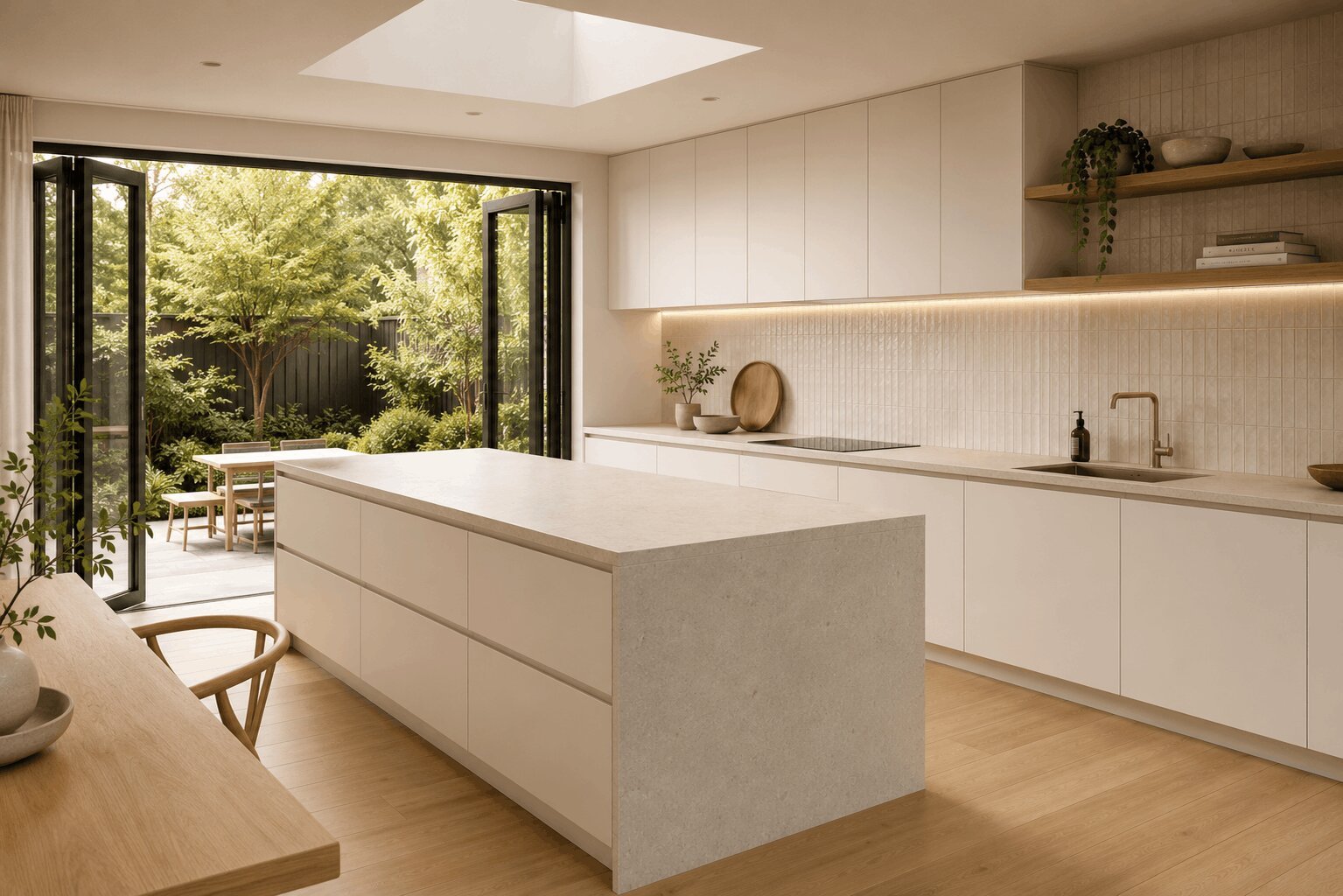
| Contemporary rear extension (any suburb) | Handleless preferred | New architecture without period constraints. Handleless feels architecturally resolved in a new build context where the existing building does not impose a historical vocabulary. |
| Japandi-brief kitchen (any suburb) | Handleless (J-pull or push-to-open) | Handleless is a design principle in a genuine Japandi brief, not merely a preference. Hardware introduces a visual element that contradicts the minimal, hardware-free aesthetic. |
| Large family kitchen with heavy drawer use | Hardware preferred | Ergonomic advantage of a bar handle at heavy base drawer load is real and daily. The case for hardware strengthens as base drawer weight increases. |
| Coastal / bayside home (Brighton, Hampton) | Hardware in brass or bronze | Coastal environments accelerate hardware tarnish, but finish selection manages this well. The architectural case for hardware in period bayside homes is strong; handleless loses the low-maintenance advantage it might otherwise hold. |
2026 Cost Ranges — Handleless Kitchen Joinery in Melbourne
The following ranges are based on Silk Touch Joinery’s confirmed 2026 pricing across handleless kitchen joinery in Melbourne. All figures are supply-only; installation, stone, appliances, and trades are additional.
| Kitchen scope | Handleless supply-only range (AUD, 2026) |
|---|---|
| Compact galley under 4m — J-pull profile | $8,000 – $12,500 |
| Standard L-shape or single-wall 4–7m — J-pull profile | $12,500 – $21,000 |
| Open-plan with island 7m+ — J-pull throughout | $19,000 – $33,000+ |
| Premium upgrade: rail system throughout | Add $1,500–$3,500 to above ranges |
| Push-to-open (Tip-On) on overhead doors | Add $600–$1,800 to above ranges |
Common add-on costs for a complete handleless kitchen project in Melbourne:
| Add-on | 2026 range (AUD) |
|---|---|
| Stone benchtop (engineered or natural) | $2,500 – $12,000 |
| Appliances | $4,000 – $25,000 |
| Splashback (tile, stone, or glass) | $800 – $2,500 |
| Plumbing | $1,000 – $3,500 |
| Electrical | $800 – $3,000 |
| Painting | $1,000 – $4,500 |
| Flooring | $2,500 – $10,000 |
A note on the finishing specification premium: the handleless premium above standard Shaker-profile kitchens sits primarily in the finishing quality, not the system cost. Budget the finishing specification first. The system choice — J-pull, push-to-open, or rail — follows from the design brief and the available budget for the full project. For a free in-home estimate across any of these configurations, book a free consultation and we will price each system against your specific layout and palette.
Frequently Asked Questions
What are handleless kitchen cabinets?
Handleless kitchen cabinets are cabinet door and drawer fronts with no external hardware — no knobs, cup pulls, or bar handles visible on the door face. Opening is achieved through one of four methods: an integrated J-pull channel routed into the door edge (the most common bespoke option), a push-to-open mechanism (touch-latch or Blum Tip-On), a recessed horizontal rail system across the full cabinet run, or a finger-pull channel at the top or bottom edge of the door. Handleless kitchens are popular in contemporary, Japandi, and minimal kitchen design because they produce a completely uninterrupted flat cabinet face.
Are handleless kitchens more expensive than kitchens with handles?
It depends on the handleless method. A J-pull integrated profile (routed into the door edge) costs approximately the same as a standard thin bar handle kitchen — the routing cost offsets the hardware cost, with a net difference under $500 on a standard kitchen. A push-to-open system (Blum Tip-On) adds $600–$1,800 to a standard kitchen’s cost because every door and drawer requires the Tip-On mechanism in addition to standard hinges and runners. A horizontal rail system across the full cabinet run is the most expensive handleless option — the aluminium rail and its installation adds $1,500–$3,500 to the joinery cost. So handleless is not automatically more expensive — it depends which system is specified.
What are the main disadvantages of handleless kitchen cabinets?
Four genuine disadvantages. First, fingerprint visibility — a flat dark or satin-finish door face with no hardware shows fingerprints acutely. Lighter colours hide them better; dark 2-pack without hardware is the worst-case scenario. Second, opening ergonomics — a J-pull channel requires reaching into the channel at the door edge. Some users find this less intuitive than grasping a bar handle, particularly when hands are wet or carrying items. Third, heritage incompatibility — handleless profile is a contemporary vocabulary that conflicts with Victorian, Edwardian, and interwar heritage architecture. In heritage homes, a hardware kitchen is more appropriate. Fourth, flat-slab requirement — handleless cabinets are almost always flat-slab doors. In a kitchen with irregular walls or lower-quality substrate, a flat-slab door reveals every surface imperfection. Quality substrate and finish are non-negotiable.
Which Melbourne kitchen styles suit handleless cabinets best?
Handleless cabinets work best in contemporary open-plan kitchens in post-war homes — Mitcham, Blackburn, Vermont, Box Hill — where the architectural language is neutral enough to support a flat-slab profile. They also suit Japandi-influenced kitchens where hardware-free doors are a design principle, and rear extension kitchens where the new construction is architecturally distinct from any adjacent heritage structure. Handleless cabinets do not work well in Victorian, Edwardian, or interwar heritage homes where the absence of hardware creates a conflict with the building’s period detail.
Do you install handleless kitchen cabinets in Melbourne?
Yes. Silk Touch Joinery produces handleless kitchen cabinets across all four systems — J-pull integrated profile, push-to-open (Blum Tip-On), recessed rail, and finger-pull channel. All are available in the same material and finish specifications as our standard kitchen joinery. Contact us to book a free in-home consultation.
The Honest Conclusion
Handleless kitchens are not universally better or worse than hardware kitchens. They are the correct specification in specific contexts and the wrong specification in others. A J-pull handleless kitchen in a contemporary open-plan rear extension, in warm white 2-pack, installed by a workshop with the substrate and finishing quality the system requires — that is a kitchen that will look as good in ten years as it does on the day it is installed. The same system in a dark palette, in a Victorian terrace, with a compressed finishing budget — that is a kitchen that will disappoint within 18 months.
The decision requires knowing your home’s architecture, your palette, your household’s daily use patterns, your cooking brief, and your maintenance expectations. Those are exactly the conversations a free in-home consultation is designed to have. We measure the space, review the architectural context, discuss how the kitchen is actually used, and price each specification option against your brief — handleless and hardware both — so the choice is yours to make with full information.