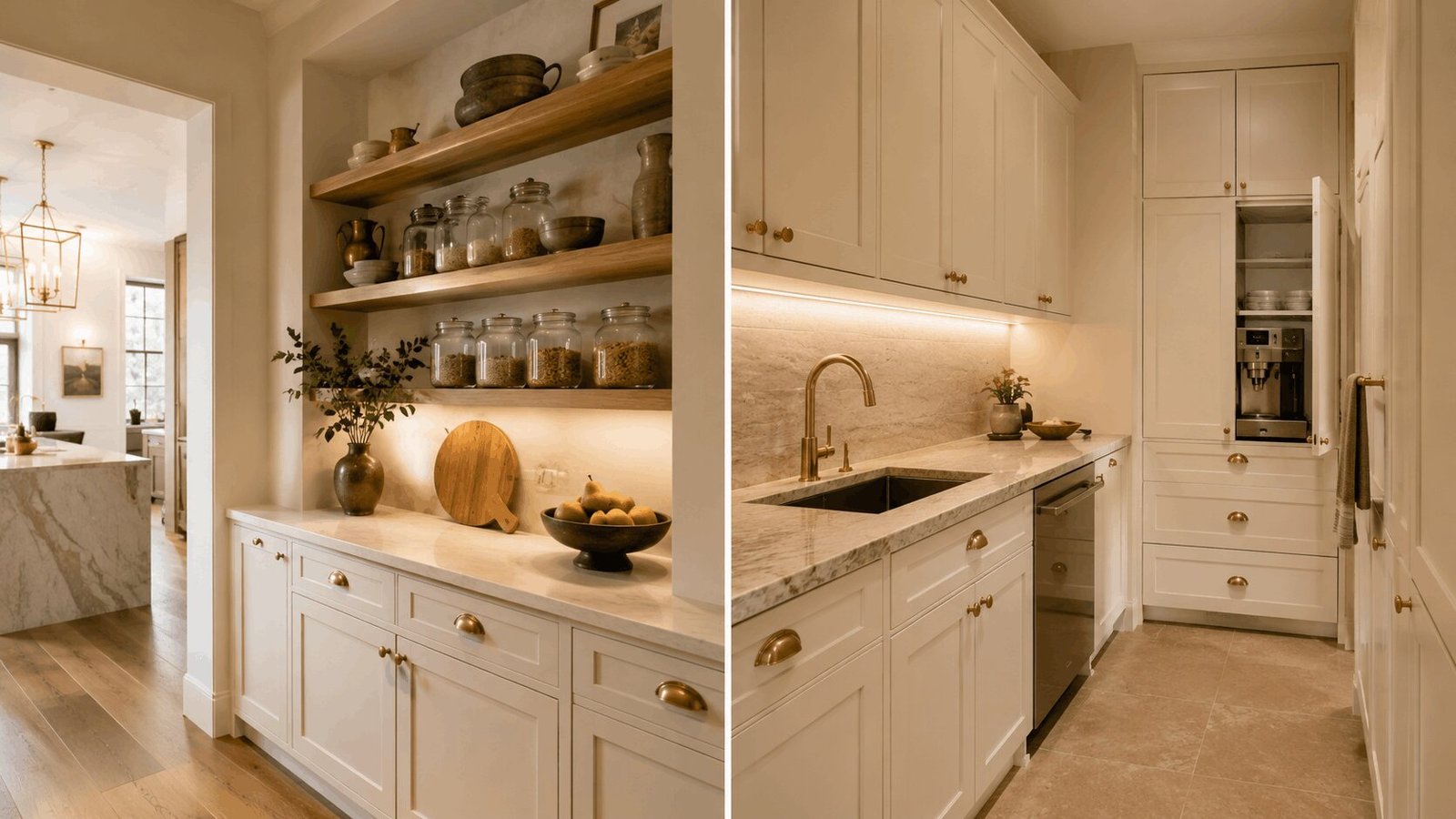
scullery or a butler’s pantry is not a style preference in Melbourne homes in 2026, it is a functional decision about how your kitchen needs to work every day. In a rear extension with roughly 2.5m of additional floor space behind the main kitchen, the difference is immediate: one option stays visible and elevated, the other hides the mess and keeps the main kitchen immaculate. Both can be correct. They solve different problems for different households.
The Silk Touch position is straightforward. This is not an aesthetic choice first. It is a spatial and behavioural choice based on three things: how seriously the household cooks, how important kitchen presentation is when entertaining, and how much floor space is genuinely available. The right answer follows from those factors, not from trend language.
“Both options were touched on in our post on kitchen joinery in Balwyn – where the original butler’s pantry passage is a defining feature of many interwar homes. This post gives both options the full treatment they deserve: definition, design, specification, cost, and the verdict framework for deciding which is right for your Melbourne home.”
Defining the Terms – What a Butler’s Pantry and a Scullery Actually Are
Many Melbourne homeowners use the terms interchangeably. They are not the same thing, and the difference matters once the room is framed and the cabinetry order is locked in.
A butler’s pantry started as a service room between the kitchen and the formal dining room. Its purpose was to stage food, hide service ware, and keep the kitchen itself out of sight. In Melbourne’s interwar homes in places like Balwyn, Surrey Hills, and Camberwell, those original passages still exist in many houses as narrow rooms with built-in cabinetry. In 2026, the butler’s pantry has been recontextualised for modern living. It is now a secondary prep and storage zone that extends the main kitchen while still feeling presentable. It is usually open or semi-open, easy to access, and visually aligned with the main kitchen.
A scullery has an older, harsher job description. Historically, it was the room where dishes were washed and equipment was cleaned away from the main kitchen. In 2026, the scullery keeps that exact logic. It is a fully functional secondary kitchen zone that absorbs mess so the main kitchen does not have to. It is enclosed or semi-enclosed, almost always includes a second sink, usually includes a second dishwasher, and is intended to hide appliances, dishes, and cleanup.
The functional distinction is simple. A butler’s pantry organises the kitchen and makes cooking easier. A scullery removes the mess from view and absorbs cleanup entirely. Both are legitimate. The wrong one is the one that does not match how the household actually lives.
The practical difference in plain language
A butler’s pantry is the better answer when the main need is storage, staging, and keeping small appliances out of sight without creating a separate workroom. A scullery is the better answer when the main need is cleanup containment, second-sink functionality, and a closed room that stops daily cooking from spilling into the main kitchen.
The Butler’s Pantry – Design, Specifications, and When It’s the Right Choice
A butler’s pantry works best when the household wants a polished extension of the kitchen rather than a separate utility room. It should feel deliberate, not improvised. In Melbourne renovation terms, the ideal butler’s pantry often sits inside an alcove, a widened passage, or a small room created off the side of a new kitchen extension.
A minimum viable butler’s pantry is approximately 1800mm wide by 600mm deep. That is enough for a bench run, overhead cabinetry, and some open shelving. It is the alcove version, and it can work well when the surrounding floor plan is tight. A proper butler’s pantry room starts at around 2400mm by 1800mm, which gives enough room for a bench, vertical cabinetry, overhead storage, and a usable access zone. A generous butler’s pantry at around 3600mm by 2000mm or larger can include a wine fridge, integrated microwave column, and much more extensive dry-goods storage.
A good butler’s pantry should include a bench surface, overhead cabinets to the ceiling, one section of open shelving, and a clean storage layout for pantry goods and small appliances. In many Melbourne homes, it will also include a microwave tower, a bar fridge or under-bench fridge, and an appliance garage so the coffee machine and toaster can be hidden when not in use. The room should still look good if a guest walks past it. That is the point. It is semi-presentable by design.
The material palette should match the main kitchen. Same door profile, same colour, same hardware, same design language. If the butler’s pantry looks like a separate afterthought, it fails visually even if it functions reasonably well. The one area where some variation is acceptable is the bench surface. Since it gets less direct scrutiny than the main kitchen, it can sometimes use a less expensive stone or laminate, but only if the overall palette still reads as one project.
A butler’s pantry is the right choice in four main situations. First, the household is naturally organised and keeps surfaces clear. A semi-open pantry exposes bad habits immediately. Second, the main kitchen does not generate heavy daily cleanup. Third, the renovation includes a natural alcove or passage that can be converted without forcing awkward circulation. Fourth, the home has heritage character, especially in Melbourne’s eastern suburbs, where the original pantry passage has architectural logic worth preserving.
It is also the better choice when the goal is not full cleanup concealment but rather dry-goods storage, small appliance hiding, and a better visual rhythm around the kitchen. In other words, it is the design solution for people who want the kitchen to look cleaner and work better, but not necessarily disappear behind a closed door.
What a well-executed butler’s pantry actually does
It gives the homeowner a space for staging meals, storing coffee gear, keeping pantry goods visible and ordered, and preventing the main kitchen from being cluttered by day-to-day storage. It does not replace the kitchen. It extends it.
The Scullery – Design, Specifications, and When It’s the Right Choice
A scullery is the option for households that want the main kitchen to stay pristine no matter what is happening behind the scenes. If the butler’s pantry is an elegant extension, the scullery is a working room. It is the pressure-release valve for serious cooking, family mess, and entertaining.
A minimum viable scullery is approximately 2000mm wide by 1500mm deep. That gives enough room for a sink, a dishwasher, bench space, overhead cabinets, and a usable access zone. A full scullery starts at around 2500mm by 2000mm and allows a more functional arrangement with a proper appliance tower and better circulation. A generous scullery of 3000mm by 2500mm or more can support two-wall layouts, stronger appliance storage, and a clearer division between prep and cleanup.
The sink is non-negotiable. A scullery without a sink is not a scullery. The second dishwasher is also central to the concept. This is what makes the room a true working zone rather than just a large pantry. The idea is to absorb the dirty work: plates, pots, prep debris, small appliances, and the routine clutter that would otherwise take over the main kitchen bench. If the household cooks heavily or entertains often, that distinction is not cosmetic. It changes how the home feels on a daily basis.
A well-designed scullery should include an undermount sink, a second dishwasher, full-height enclosed cabinetry, and an appliance tower that houses the coffee machine, toaster, kettle, blender, and other day-to-day devices out of sight. The room must also have a door. A scullery without a door is just a pantry with expensive plumbing. A pocket sliding door is usually the cleanest solution because it does not consume circulation space. A swing door can work, but only when the layout is generous enough to avoid collisions.
Material choices matter here too. The carcass should be 18mm HMR board throughout, because sink and dishwasher adjacency create sustained humidity. The finish should match the main kitchen so the whole project reads as one joined system. Hardware needs to be durable and reliable under wet-hand, high-frequency use. This is not the place for decorative compromises.
The scullery is the right choice when the household cooks seriously and daily, when entertaining standards are high, when young children create constant mess, or when the main kitchen is expected to look formal and calm even during heavy use. It is particularly effective in rear-extension projects where the room can be built into the brief from the beginning instead of being forced into an existing leftover space.
Why the scullery changes daily life
It stops the main kitchen from becoming the dumping ground for every plate, appliance, and prep item. That is the real value. Not luxury for its own sake, but the removal of friction from daily routines.
Head-to-Head Comparison – Six Criteria
The best way to decide is to compare the two options against the criteria that actually affect Melbourne homes. The differences become obvious once they are put side by side.
Criterion 1 – Function
A butler’s pantry extends and organises the kitchen. It gives the household more storage, more prep room, and a way to conceal some small appliances, but it does not eliminate cleanup from the main kitchen. A scullery is more complete. It takes on the dirty work entirely, including dishes, appliance storage, and post-meal clutter. That means the main kitchen can stay in presentation mode. The butler’s pantry is the more elegant extension. The scullery is the more functional machine.
Criterion 2 – Space required
A butler’s pantry can start as a fairly compact alcove at around 1800mm by 600mm. A proper room starts around 2400mm by 1800mm. A scullery needs more committed space because it includes plumbing, a door, and a layout that supports cleanup use rather than just storage. The minimum is around 2000mm by 1500mm. Both options require dedicated floor area. Neither is something you conjure from nowhere. If there is no existing room or extension depth, the decision may be made for you by the floor plan.
Criterion 3 – Cost
The butler’s pantry is usually cheaper at comparable sizes, mainly because it does not require a second sink or dishwasher integration. The scullery costs more because it is a more technical room and because the trades list grows quickly once plumbing and electrical are introduced.
| Option | Compact (alcove/small room) | Standard room | Full room |
|---|---|---|---|
| Butler’s pantry | $8,000 – $12,000 | $12,000 – $16,000 | $16,000 – $22,000+ |
| Scullery | $10,000 – $15,000 | $15,000 – $20,000 | $20,000 – $30,000+ |
That difference matters because the joinery supply is only part of the real spend. The scullery usually brings extra plumbing for the second sink rough-in, more electrical work for appliances and the second dishwasher, and a more complex fit-out sequence. In practical terms, the scullery is the higher-cost answer because it solves a bigger problem.
Criterion 4 – Visual impact
A butler’s pantry is meant to be seen. It can be a proper design feature with open shelving, visible stone, and a clean, high-end palette that rewards good styling. A scullery is the opposite. It is meant to disappear behind a closed door. Its success is measured by the fact that guests do not see the chaos. One is a visible luxury. The other is invisible efficiency.
Criterion 5 – Maintenance
A butler’s pantry requires discipline because it is semi-visible. If the family drops mail, appliances, and random clutter into it, the room becomes exposed evidence of disorder. A scullery is more forgiving. The door closes, and the main kitchen remains unaffected. That makes the scullery easier to live with for busy households, especially those with children or heavy cooking routines. The butler’s pantry rewards orderly households. The scullery protects less orderly ones from themselves.
Criterion 6 – Heritage home compatibility
The butler’s pantry aligns naturally with Melbourne’s interwar homes, especially in Balwyn, Surrey Hills, and Camberwell, where original pantry passages still exist in many houses. Restoring that footprint with modern joinery is architecturally coherent. A scullery is less tied to a specific architectural era. It works in post-war homes, new extensions, and heritage homes, but it is usually chosen because of lifestyle and floor plan rather than history. For many heritage projects, the butler’s pantry is simply the better fit.
The Verdict Matrix – Which One Is Right for Your Melbourne Home
This is the part that matters. The correct answer depends on the kind of house, the kind of household, and the way the kitchen will be used.
Scenario A – Heritage interwar home with an original butler’s pantry passage
Verdict: Butler’s pantry. The architecture calls for it. If the passage already exists in a Balwyn, Surrey Hills, or Camberwell home, restoring it as a functional 2026 butler’s pantry is the most resolved outcome. Use stone, full-height cabinetry, and open shelving. Keep the same visual language as the kitchen. This is the right answer because it respects the original footprint instead of fighting it.
Scenario B – Post-war family home with a rear extension
Verdict: Scullery. In a Doncaster, Box Hill, Blackburn, or Mitcham family home, a rear extension usually creates the floor area needed for a proper scullery. If the household cooks daily and the kitchen is the social centre of the home, the second sink and dishwasher are not luxuries. They are what keep the main kitchen from becoming a mess zone. This is the highest daily-impact choice in the whole comparison.
Scenario C – Couple in a larger apartment or townhouse with limited space
Verdict: Butler’s pantry alcove. A full scullery is usually too space-hungry in a compact home. An alcove butler’s pantry at around 1800mm wide can still achieve the main goals: appliance concealment, dry-goods storage, and a cleaner kitchen presentation. Do not try to force a scullery into a footprint that is too small. The result will feel cramped and underused.
Scenario D – High-volume cooking household
Verdict: Scullery, with a second dishwasher as non-negotiable. If the home produces serious daily cooking output, cleanup volume will overwhelm a standard kitchen. In that scenario, the scullery is the only answer that truly preserves the main kitchen. The second dishwasher is the key line item. Without it, the room is not doing enough work for the household it serves.
For the broader approach to whole-home joinery, including how secondary kitchen zones integrate with the main kitchen brief across Melbourne’s eastern suburbs, the custom joinery Kew page covers our design philosophy.
Can You Have Both? The Combined Scullery-Butler’s Pantry
Yes. In larger rear extensions, especially those with 4m or more of depth, the combined configuration is increasingly practical in Melbourne’s eastern and southern suburbs. It is not a compromise. It is a two-part system.
The first zone, immediately off the main kitchen, functions as the butler’s pantry. It is open, elegant, and used for visible storage, coffee preparation, wine, and staging. The second zone sits behind a door or short corridor and functions as the scullery. It takes the sink, dishwasher, heavy cleanup, and appliance storage that must be hidden.
This arrangement works because each room does one job extremely well. The butler’s pantry is the public-facing support room. The scullery is the private working room. There is no overlap, and therefore less compromise. The visible zone can stay beautiful while the hidden zone absorbs the mess.
To make that work, the extension usually needs a minimum depth of 4.0m to 5.0m. On larger lots in Melbourne’s eastern suburbs, that is achievable without sacrificing the entire garden. In functional terms, the combined setup gives the homeowner the best of both worlds. In budget terms, it is the most expensive option, but it is also the most comprehensive.
The approximate joinery supply cost is $12,000 to $18,000 for the butler’s pantry component and $15,000 to $22,000+ for the scullery component, producing a combined supply-only total of roughly $27,000 to $40,000+ before plumbing and electrical are added.
Joinery Specifications for Both Options
This is where projects succeed or fail. A room can be correctly planned and still perform badly if the joinery is under-specified.
The carcass should be 18mm HMR board throughout for both options. That matters even more in the scullery because humidity is higher around sinks and dishwashers. Standard particleboard is the wrong choice there. The finish should be 2-pack polyurethane and should match the main kitchen door profile and colour so the two spaces read as one integrated project.
Hardware should be from a reliable full-extension soft-close system such as Blum Legrabox or Tandembox Antaro. In the scullery, where hands may be wet or messy, access quality matters every day. Drawers and cupboards should open easily and fully, not just halfway.
Internal power also needs to be planned properly. In a scullery, a double GPO every 900mm along the bench run is the baseline. The appliance tower should include internal power at mid-height, and the coffee machine should have a dedicated circuit at the rear where required. In both zones, charging points and appliance access should be built in from the start rather than patched in later.
The door choice is also important. A pocket sliding door is the best option for a scullery because it preserves circulation space and avoids a swing path in a busy kitchen. A surface-mounted slider can work where the wall structure does not allow a cavity. The key is to avoid the kind of door that makes the room awkward to use.
Bench height should stay at the standard 900mm. There is no useful reason to lower it for the scullery. The room is for practical work, not for seated use, and the standard height remains the correct specification.
In short, do not treat the secondary kitchen zone as a cut-down version of the main kitchen. It needs to be built with the same discipline, or it will fail under real daily use. That point is especially relevant if the project is part of a larger renovation sequence, which is exactly why kitchen renovation mistakes Melbourne belongs in the planning process before the build starts.
Cost Summary – What to Budget in Melbourne in 2026
The following figures are the practical planning numbers for 2026. They reflect joinery supply only, with additional trade costs listed separately. The real total depends on how much structural work, plumbing, and electrical work the project needs.
| Configuration | Joinery supply only | Additional trades |
|---|---|---|
| Butler’s pantry alcove (1800-2400mm) | $8,000 – $12,000 | Stone bench: $2,500 – $6,000; Electrical: $800 – $1,500 |
| Butler’s pantry room (2400mm x 1800mm) | $12,000 – $16,000 | Stone bench: $3,000 – $8,000; Electrical: $800 – $1,500 |
| Butler’s pantry full room (3600mm+) | $16,000 – $22,000+ | Stone bench: $4,000 – $10,000; Electrical: $1,000 – $2,000 |
| Scullery compact (2000mm x 1500mm) | $10,000 – $15,000 | Plumbing: $1,500 – $3,500; Electrical: $1,200 – $2,500 |
| Scullery standard room (2500mm x 2000mm) | $15,000 – $20,000 | Plumbing: $1,500 – $3,500; Electrical: $1,200 – $2,500 |
| Scullery full room (3000mm+) | $20,000 – $30,000+ | Plumbing: $2,000 – $4,000; Electrical: $1,500 – $3,000 |
| Combined butler’s pantry + scullery | $27,000 – $40,000+ | Plumbing + electrical for scullery component |
The butler’s pantry is generally easier on budget because the trade scope is lighter. The scullery is higher cost because plumbing and appliance integration introduce more complexity. For broader context on total kitchen budgeting, the kitchen cabinet costs Melbourne North guide is the better companion piece because it shows how joinery sits inside the larger renovation cost stack.
Frequently Asked Questions
What is the difference between a scullery and a butler’s pantry?
A butler’s pantry is a secondary room or large alcove adjacent to the kitchen, primarily used for food storage, preparation, and often visible from the main kitchen. It typically has a bench, overhead cabinets, open shelving, and may include small appliances. A scullery is a more enclosed secondary kitchen zone — typically behind or beside the main kitchen — with a second sink, second dishwasher, and full appliance storage. The scullery is designed to hide the mess: dishes, prep cleanup, and small appliances are all contained within it, leaving the main kitchen perpetually presentable. The butler’s pantry is more open and social; the scullery is more functional and concealed.
How much does a butler’s pantry cost in Melbourne in 2026?
A butler’s pantry in Melbourne in 2026 typically costs $8,000–$18,000 in bespoke joinery supply, depending on the run length and scope. A compact butler’s pantry alcove (1800–2400mm wide, bench and overhead cabinets with open shelving) starts at $8,000–$12,000 supply. A larger butler’s pantry room (3000–4000mm wide with integrated appliance storage, stone bench, and full cabinet run) runs $12,000–$18,000+ supply. These are joinery supply-only figures and exclude stone benchtop, plumbing, electrical, and any structural works required to create the space.
How much does a scullery cost in Melbourne in 2026?
A scullery in Melbourne in 2026 typically costs $10,000–$22,000 in bespoke joinery supply. A compact scullery (2000–2500mm wide, second sink, dishwasher housing, bench and overhead cabinets) runs $10,000–$15,000 supply. A full scullery room (3000mm+ wide with double sink, second dishwasher, appliance tower, full cabinet run, and stone bench) costs $15,000–$22,000+ supply. The scullery typically costs more than a butler’s pantry of equivalent size because it requires a second sink rough-in (plumbing: $1,500–$3,500 additional), a second dishwasher circuit (electrical: $800–$1,500 additional), and a more complex cabinetry layout to accommodate appliance integration.
Which Melbourne home types suit a scullery vs a butler’s pantry?
A butler’s pantry suits: larger open-plan homes where the pantry zone is visible from the kitchen and serves as a social prep space; heritage homes (Balwyn, Surrey Hills, Camberwell) where a butler’s pantry was part of the original architectural brief; and any home where the primary motivation is dry goods storage and small appliance concealment rather than full cleanup concealment. A scullery suits: family homes where serious daily cooking creates cleanup volume that overwhelms the main kitchen; homes where the main kitchen is the entertaining focal point and all mess must be hidden; and rear-extension designs where a secondary zone behind the main kitchen is part of the structural brief.
Do you design and install scullery and butler’s pantry joinery in Melbourne?
Yes. Silk Touch Joinery designs and installs bespoke scullery and butler’s pantry joinery across Melbourne’s eastern and southern suburbs. Both are part of our whole-home joinery offering — designed in the same material palette as the main kitchen and installed in the same project sequence. Contact us to book a free in-home consultation.
If you are going to live in your Melbourne home for the next 15 to 20 years, the question of scullery versus butler’s pantry is worth getting right now. It is a spatial decision that is difficult to undo once the extension is built and the services are in place. A free in-home consultation gives you the layout assessment, the cost estimate for both options, and a direct recommendation for your specific home and household.