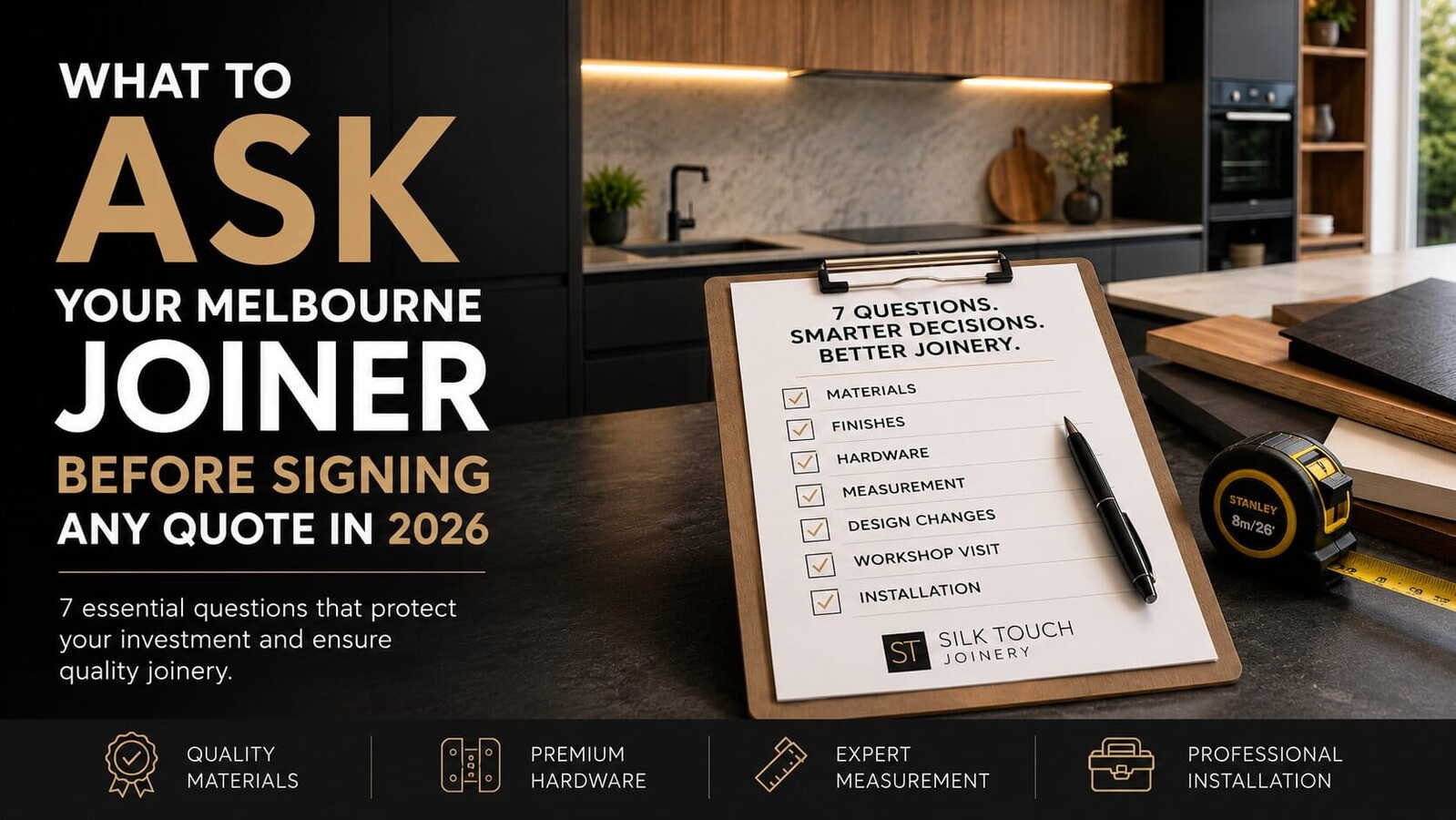
Silk Touch Joinery is a Melbourne-based bespoke joinery workshop that designs, fabricates, and installs custom kitchen, wardrobe, and whole-home joinery for residential properties across Melbourne’s east, south, and inner suburbs. A joinery quote in Melbourne in 2026 can represent anything from a flat-pack-equivalent modular system to a fully workshop-made bespoke product and the difference is not always visible in the document itself.
Three quotes can look almost identical on paper and still describe three very different products. That is why so many homeowners end up comparing price instead of specification, and why the cheapest quote is rarely the best guide to long-term value.
A joinery quote can be clean, polished, and full of confident language while still hiding major differences in carcass thickness, board type, finish type, hardware, site measure process, and installation responsibility.
This post exists to make those differences visible.
Open your kitchen quotes side by side, and you will often see the same words repeated: bespoke, quality, soft-close, premium, custom, painted, durable. None of those words tell you enough by themselves.
For the full specification context behind these questions, what HMR board is, why Blum hardware matters, and what 2-pack polyurethane costs relative to alternatives, the kitchen cabinet costs guide covers the pricing framework, and the kitchen renovation mistakes Melbourne post covers what happens when the wrong specification is chosen.
Why Joinery Quotes Are Hard to Compare in Melbourne
The joinery market in Melbourne in 2026 has three quality tiers operating under broadly similar language. A flat-pack kitchen installed by a kitchen company, a semi-custom modular kitchen from a national chain, and a bespoke workshop-made kitchen from a specialist joiner can all be described as custom kitchen joinery with soft-close hardware and quality finishes.
That is the problem.
The terminology is often close enough to sound comparable, but the specification behind it is not.
1. Soft-close means nothing specific.
Soft-close describes a function, not a quality tier. Blum Legrabox rated at 40kg full-extension load with a lifetime mechanical guarantee is soft-close. Generic soft-close hardware is also soft-close.
Blum Legrabox and Tandembox Antaro drawer systems carry a lifetime mechanical guarantee and are rated to 40kg full-extension load, the specification that separates workshop-made bespoke joinery from semi-custom and flat-pack alternatives.
2. Quality finish could mean almost anything.
2-pack polyurethane, vinyl wrap and melamine are often described as quality finishes despite having very different performance characteristics.
3. The carcass is invisible.
18mm HMR (moisture-resistant board) resists moisture-induced swelling in kitchen environments where standard particleboard used in many flat-pack and semi-custom systems begins to degrade within 8-12 years of sustained exposure.
The seven questions below cut through this directly.
The 7 Questions – Ask Every One Before You Sign
Question 1 – “Is the carcass 18mm HMR board throughout, including under the sink?”
Why this question matters
The carcass is the structural body of every cabinet. It is the part that holds the whole kitchen together, even though it disappears from view once the job is finished. That is exactly why it matters so much. Homeowners tend to focus on doors, handles and benchtops because those are visible, but the structural box underneath determines whether the kitchen stays square, resists moisture, and survives daily use over time.
In Melbourne kitchens, this matters more than many homeowners realise. Kitchens in older homes often deal with uneven floors, small leaks, steam, plumbing movement, and moisture exposure around the sink and dishwasher. If the carcass is made from weaker or unspecified board, the whole kitchen becomes more vulnerable to swelling, edge breakdown and long-term movement. The quote may still look premium, but the underlying structure may not be.
18mm HMR board is the specification that shows the joiner is thinking long term. It is not just about surviving the first year. It is about remaining stable, clean, and serviceable after years of cooking, cleaning and everyday use. If a joiner cannot answer this question clearly, the quote is still too vague to sign.
What a good answer sounds like
A good answer will be specific, immediate and unambiguous. It should name the board type, the thickness, and where it is used. A serious joiner should also be willing to show the material schedule, quote notes or product specification if asked. That level of clarity is a good sign because it shows the business is quoting a defined product rather than relying on broad language.
This is also where the difference between workshop-made joinery and lower-spec systems becomes visible. In a quality bespoke job, the carcass specification is not hidden. It is part of the design logic. The joiner knows what they are using, why they are using it, and how it performs in a kitchen environment.
What a concerning answer sounds like
Vague answers are the problem. Phrases like moisture-resistant where needed, standard board, or we usually use a good board do not confirm anything useful. If the joiner cannot name the board, the thickness and the application zones without hesitation, then the homeowner still does not know what is being purchased.
A quote should reduce uncertainty, not create it. If the carcass specification is not explicit, the kitchen may look custom on paper while being built on a much lower structural standard.
Question 2 – “Is the door finish 2-pack polyurethane or vinyl wrap?”
Why this question matters
The door finish is the most visible part of the kitchen, and it is also one of the easiest places for a quote to hide a quality difference. This is where many homeowners get caught out. The quote may say painted, polyurethane or premium finish, but those words do not tell you enough. Different finishing systems behave very differently once the kitchen is exposed to heat, steam, fingerprints, cleaning products and daily handling.
2-pack polyurethane is a catalysed paint system sprayed in multiple coats and cured under controlled conditions. It is a higher-spec finish with a long service life when applied properly. Vinyl wrap is a film-based system that is heat-pressed onto the door substrate. It can look good on day one, but it is more vulnerable to edge lift, corner wear and steam-related failure in active kitchen zones.
In practical terms, this matters most around dishwashers, cooktops, sinks and corner doors. A homeowner may never notice the difference in a showroom. They will notice it years later when a finish starts to lift, chip or look tired long before the cabinetry itself should be wearing out. That is why the finish question is not cosmetic. It is structural in a long-term value sense.
What a good answer sounds like
A strong answer will state the exact finish system, not just a loose description. The joiner should say 2-pack polyurethane clearly and be able to explain how it is applied, cured and maintained. Even better, they should be able to tell you whether the doors are sprayed in-house or through a finishing partner, and what product line is being used.
That kind of answer tells the homeowner that the finish is defined, repeatable and intentional. It also makes the quote much easier to compare with others, because the finish is now a specification rather than a marketing phrase.
What a concerning answer sounds like
If the answer is just painted finish, premium finish or polyurethane finish, the homeowner still does not know enough. Those terms are too broad. They can be used honestly, but they can also be used to blur the line between high-spec 2-pack and lower-spec alternatives.
If the finish type is not stated in exact terms, the quote is not yet transparent enough. In a kitchen build, finish is too important to leave to interpretation.
Question 3 – “What hardware do you use, specifically the brand and model for drawers and hinges?”
Why this question matters
Hardware is the part of the kitchen that gets used every single day. It is opened, closed, loaded and adjusted more often than almost any other component in the room. That makes it one of the most important places to verify quality. A kitchen can look expensive while still being fitted with generic runners and hinge systems that feel fine at first but deteriorate faster than the rest of the joinery.
Hardware is also where quotes often become vague. The phrase soft-close is not enough. Soft-close only describes the function. It does not tell you the load rating, the lifespan, the manufacturer, the adjustment quality or the long-term serviceability. A lower-spec runner and a premium drawer system can both be called soft-close even though the real-world difference is enormous.
That is why Blum is such an important named reference. If the joiner is using Blum Legrabox, Tandembox Antaro, or Blum Clip Top Blumotion hinges, they should have no problem naming them. If they avoid the brand and stay at the level of general description, the homeowner should treat that as incomplete information rather than a minor detail.
What a good answer sounds like
A good answer should name the drawer system, the hinge system and the manufacturer without delay. It should also be able to explain why those products were chosen. A serious joiner will know the difference between a general soft-close product and a specified premium hardware platform. They should also be able to explain how that hardware affects daily use, door alignment and service life.
This is one of the clearest markers of a transparent quote. If the joiner can name the hardware model, they are signalling that the quote is built around actual specification, not just appearance.
What a concerning answer sounds like
Quality European hardware, premium soft-close or German hardware are not enough. Those are marketing phrases. They may sound reassuring, but they do not identify the actual product being installed. If the quote has no named hardware, the homeowner is still being asked to trust an unspecified system.
That is not a strong position to be in before signing. The more expensive the joinery, the more important the hardware specification becomes.
Question 4 – “Do you do your own site measure before producing drawings?”
Why this question matters
This question separates careful joinery businesses from those that are rushing the process. A drawn plan is not the same as a real room. Melbourne homes, especially older ones, rarely follow perfect geometry. Walls can be out of plumb, floors can fall in different directions, and corners can vary far more than most homeowners expect.
A joiner who works from plans alone is building on assumptions. A joiner who measures the actual room before drawing is working from reality. That difference affects every part of the job, from cabinet height and filler panel design to overhead alignment and the final fit around walls, floors and services. If the site measure is rushed or skipped, problems often only appear once fabrication has started or installation is underway.
This matters even more when the job includes stone benchtops. The cabinetry must be fully installed and settled before templating, because the actual room dimensions matter more than the theoretical drawings. That is why measure quality and sequence matter so much in a bespoke job.
Stone benchtops must be templated from installed joinery, not from drawings, to account for the actual dimensions of the room. A stonemason templating from drawings in a Melbourne heritage or post-war home risks producing a benchtop that does not fit.
What a good answer sounds like
The best answer is simple and confident. The joiner should say that they always perform a physical site measure before producing final drawings. They should also be able to explain how they check plumb, square and level, and how they account for variations in the actual room.
That answer tells the homeowner the project is being designed around reality rather than assumptions. It also shows that the joiner understands the risk profile of Melbourne housing stock and is managing it properly.
What a concerning answer sounds like
We can work from your plans, we will measure once the job is confirmed, or we only need one quick measure are all responses that should raise caution. Those answers may sound efficient, but they often mean the drawings are being prepared too early.
If a joiner is not willing to explain their measuring process clearly, the homeowner should be cautious. Joinery fit is too expensive to leave to guesswork. As noted in the kitchen renovation mistakes Melbourne guide, measurement errors are one of the most expensive problems to fix later.
Question 5 – “What is your process if I want to make a design change after sign-off?”
Why this question matters
Design changes after sign-off are one of the most common reasons a joinery project gets more expensive or takes longer than expected. Many homeowners do not realise how quickly a bespoke job becomes locked in. Once drawings are approved and fabrication begins, the room is no longer a flexible concept. It is a production schedule, material list and machine plan.
That means changes are no longer just ideas. They become variations. Variations can affect cutting, edge finishing, hardware ordering, spray schedules, delivery timing and installation sequencing. Even a small change can ripple through the rest of the job if it is made late enough.
That is why this question matters before signing. It tells the homeowner whether the joiner has a defined process for handling changes, whether there are clear rules around when changes are still easy to make, and whether the business is honest about cost and timing impacts. A transparent answer now prevents conflict later.
What a good answer sounds like
A good joiner will explain the change process clearly. They should be able to distinguish between minor pre-fabrication adjustments and major post-sign-off changes. They should also say how those changes are costed, how they affect the timeline, and when the point of no return begins.
That level of clarity is a sign of an organised workshop and a disciplined production process. It also gives the homeowner a realistic expectation of how tightly the project needs to be controlled after approval.
What a concerning answer sounds like
It will be fine, we can change anything later or no problem, we will sort it out are not reassuring answers. They sound flexible, but they usually mean the process is not well controlled or the joiner is avoiding the topic.
In a genuinely bespoke system, changes are possible, but they are not frictionless. If the joiner cannot explain the process before signing, the homeowner may be signing up to avoidable surprises later.
For the timeline implications of that process, see the kitchen renovation timeline Melbourne guide.
Question 6 – “Can I visit your workshop before I sign?”
Why this question matters
A workshop visit is one of the clearest ways to judge the real quality of a joinery business. A polished quote and a clean website can only tell you so much. A working workshop tells you how the business actually operates. It shows the equipment, the organisation, the level of care in production, and the quality standard visible in work in progress.
This is especially useful for homeowners trying to compare lower-spec and bespoke joinery options. A workshop visit makes the difference tangible. You can see the materials, inspect the finish quality, observe the production environment and get a clearer sense of whether the business is set up to produce the level of work the quote implies.
It also reveals confidence. A joiner who is comfortable with a workshop visit is usually comfortable with scrutiny. That does not guarantee the final result, but it is a strong signal. A joiner who resists the idea may have a reason to avoid that visibility.
What a good answer sounds like
The best answer is direct and welcoming. The joiner should invite the visit, make scheduling easy and be willing to explain what the homeowner will see. That kind of response suggests they are proud of their operation and expect the workshop to reflect the standard of the final product.
A good visit does not need to be theatrical. It just needs to be real. The homeowner should be able to see active work, materials, machinery and people in the production environment. That is where confidence is earned.
What a concerning answer sounds like
We are too busy, the workshop is not set up for visitors, or we can send photos instead are all weak responses. They may be harmless in some cases, but they also reduce visibility at the exact moment when the homeowner is trying to verify quality.
If a joiner is reluctant to show the workshop, the homeowner should note that carefully. Transparency is not a burden when the product is genuinely strong.
Question 7 – “Who does the installation, your own team or subcontractors?”
Why this question matters
Installation is where joinery becomes real. A cabinet can be well designed, carefully fabricated and beautifully finished, but if the installation is poor the end result will still look wrong. Doors may need repeated adjustment, panels may not align, scribing may be rough, and the final fit may not reflect the quality of the workshop work.
That is why this question matters so much. If the fabrication and installation teams are separate, the project loses continuity. The people installing the joinery may not know the design intent as well as the people who built it. They may not understand the tolerances, the sequence, or the fine details that matter at the final stage. That can weaken accountability.
Homeowners should know whether the installation is handled by the business itself or outsourced. There is nothing wrong with subcontracting in principle, but it changes the quality control chain. A company that keeps installation in-house is making a stronger statement about responsibility and consistency.
What a good answer sounds like
A good answer will say clearly whether the joiner uses its own team and how that team is involved in quality control. Ideally, the person answering the question should be able to explain how install standards are managed from workshop to site.
That kind of answer shows continuity. It tells the homeowner that the same business is accountable for the final result rather than passing responsibility down the chain.
What a concerning answer sounds like
We use trusted contractors, we have a network of installers, or it depends on the job are all answers that should prompt further questions. They do not automatically mean the install will be poor, but they do mean the homeowner needs to understand who is actually responsible on the day.
For a bespoke joinery project, installation is not a side issue. It is the final expression of the whole job. If the joiner cannot explain who does it, the quote is still incomplete.
How to Use These Questions
These questions work best in conversation, not by email. Evasion is easier in writing. In person, tone, confidence, and specificity become much easier to assess. A joiner who answers clearly will usually do so without hesitation. A joiner who is vague will usually stay vague across several questions, not just one.
That does not mean every vague answer is a red flag, but it does mean the quote should not be signed until the specification is made explicit. Ask the seven questions directly during the consultation, and listen for exact names, processes, and materials. Do not accept broad phrases like premium finish, quality hardware, or moisture-resistant board without the detail underneath.
The quote document should also match the conversation. Check that it specifies the board type and thickness, the finish type and process, the hardware brand and model, and whether a physical site measure has been completed. If those details are missing, they should be added before signing, not after.
These are not adversarial questions. They are the questions a serious homeowner should ask and a confident joiner should welcome. Bring this list to every consultation, compare every response carefully, and use the answers to separate polished language from genuine specification.
For broader context on how bespoke joinery is scoped and priced, the custom joinery Kew page explains how Silk Touch approaches every project brief.
The Pre-Sign Checklist
Before signing any Melbourne joinery quote in 2026, confirm the following in writing or verbatim from your joiner:
- Carcass specification: 18mm HMR board throughout, not standard particleboard and not unspecified board.
- Door finish: 2-pack polyurethane, not vinyl wrap and not an unspecified painted finish.
- Hardware: Blum Legrabox or Tandembox Antaro drawers and Blum Clip Top Blumotion hinges, not generic soft-close hardware.
- Site measure: A physical site measure is completed before drawings are produced, not just taken from existing plans.
- Design change policy: The process and cost implications of changes after sign-off are confirmed before the job starts.
- Workshop visit: A workshop visit has either been completed or clearly offered before signing.
- Installation team: The installation team is confirmed as the joiner’s own team, not subcontractors.
If any of those seven items cannot be confirmed clearly and confidently, that is not a minor gap. It is the most important information you have learned during the quoting process.
Frequently Asked Questions
What is the most important question to ask a Melbourne joiner before signing a quote?
The most important question is whether the kitchen uses 18mm HMR board throughout, including moisture-prone areas such as sink and dishwasher cabinets.
How do I know if a joinery quote is for 2-pack or vinyl wrap doors?
Ask directly whether the finish is 2-pack polyurethane or vinyl wrap. Do not rely on generic phrases such as painted finish.
Should my joiner do a physical site measure before producing drawings?
Yes. Drawings should always be based on actual site conditions rather than theoretical dimensions.
What hardware brand should I ask for in a joinery quote?
Ask specifically for Blum Legrabox or Tandembox Antaro drawers and Blum Clip Top Blumotion hinges.
Can I visit the Silk Touch Joinery workshop before signing?
Yes. Workshop visits provide one of the clearest insights into a joiner’s quality standards and production process.
Ready to Choose the Right Joiner?
A joiner who welcomes these questions and answers them confidently is demonstrating the transparency that quality workmanship earns.