Stand at the bench in a Blackburn closed-off kitchen and you’ll know the feeling. You’re facing a wall, hands in the mixing bowl or at the cooktop, and the family is somewhere behind you — the kids doing homework at the dining table, a partner pouring drinks before dinner. You can hear them. You cannot see them. The kitchen is 3.5 metres from the living room and functionally a different world.
The renovation that solves this problem is well understood. The wall comes down, the kitchen opens up, the family connects. But the “without the compromise” part — the part that most Blackburn open-plan renovations fail to deliver — is not about the wall removal. It is about everything that happens in the joinery design after the wall comes down.
A demolished wall with a flat-pack kitchen installed in the resulting space is not an open-plan renovation. The design decisions that make the open-plan outcome genuinely work — island positioning, aisle widths, sight lines to the garden, material palette cohesion — require a level of precision that bespoke joinery is designed to deliver and modular kitchens are not.
The open-plan conversion dynamic is common across Melbourne’s eastern suburbs — we covered the structural and layout fundamentals for kitchen renovation in Mitcham and the family storage priorities in kitchen renovations Doncaster. This post is specific to Blackburn — its brick veneer construction, its garden-facing layouts, and what the open-plan conversion looks like when it is executed without compromise. For context on why Melbourne east families are increasingly choosing bespoke for this project, the recent east and south joinery guide covers the broader picture.
Blackburn’s Open-Plan Renovation — Why the Suburb Is Ready for It
Blackburn is, in housing terms, one of Melbourne’s most consistent suburbs. The post-war brick veneer homes built between the 1950s and 1970s on generous 550–750 sqm lots account for the overwhelming majority of the suburb’s residential stock. Tree-lined streets, established gardens, single-storey construction throughout. It is a suburb that was built at a specific moment in Australian domestic life — and the kitchens built into those homes reflect the conventions of that moment: closed, separated from the living zone, designed for the household’s cook to work in isolation.
In 2026, Blackburn’s renovation wave is, in large part, a collective decision to correct that design constraint.
The structural case for Blackburn
Three features of Blackburn’s housing stock make open-plan conversions particularly achievable in the suburb.
First, single-storey construction. A structural beam spanning a wall opening in a single-storey home carries only the roof load — not an upper floor above. The beam specification is simpler, the structural cost lower, and the construction sequence less disruptive than an equivalent conversion in a double-storey home.
Second, generous lot depth. With rear yards typically running 15–25 metres deep, the garden is a genuine visual and physical destination from the kitchen. Bifold or stacking sliding doors to a deck or alfresco zone are not a luxury addition in Blackburn — they are the natural completion of the open-plan conversion. The outdoor space earns the investment.
Third, the relative consistency of construction method across the suburb means that structural engineers and builders experienced in Blackburn’s housing stock have a well-developed understanding of the typical wall configurations. There is less uncertainty in the assessment process than in suburbs with more varied construction periods.
One important caveat: Blackburn’s brick veneer homes often have internal brick walls — not just timber-frame partition walls — between zones. A brick internal wall is far more likely to be load-bearing than a timber-frame partition. The structural assessment is always required, and the cost of removing a brick load-bearing wall is meaningfully higher than removing a lightweight partition. More on this in the next section.
The cultural moment
Two cohorts are driving Blackburn’s renovation activity in 2026. The first is empty nesters — homeowners who bought in the suburb in the 1990s or earlier, whose children have grown, and who are now renovating for a different life in the same home. The kitchen that worked (barely) for a household of five does not work well for two people who now cook together, entertain regularly, and want the kitchen to be a genuinely social space.
The second cohort is younger families who have bought post-war homes in the suburb and are converting them for contemporary family life from the start. They are not renovating a kitchen they have lived with for decades — they are correcting a design constraint they identified before they moved in.
Both cohorts want the same outcome. The timing of their convergence has created a visible renovation momentum in Blackburn that is accelerating peer visibility and normalising the investment level required to do the project properly.
Before the Wall Comes Down — What Every Blackburn Homeowner Must Do First
The wall removal is the most visible part of the open-plan conversion. It is not the first part. A significant share of Blackburn open-plan renovations run into delays, unexpected costs, or structural complications because the sequence is approached in the wrong order. This is the correct order.
Step 1 — Structural engineer assessment (not optional)
Never assume a wall in a Blackburn home is non-load-bearing without a structural engineer’s assessment. In the suburb’s 1950s–1970s brick veneer homes, internal walls may be brick construction — and a brick internal wall requires far more significant structural intervention to remove than a timber-frame partition.
A structural engineer’s report costs $500–$1,200 and determines the beam specification required for the opening. It is a required document for the building permit application. Without it, no building permit will be issued and no legitimate builder will begin demolition work.
Step 2 — Building permit
All wall removal work in Blackburn requires a building permit from Whitehorse City Council. Whitehorse has a relatively light heritage overlay footprint, and most Blackburn open-plan conversions require only a building permit (not a planning permit) for the structural work. Internal joinery replacement — cabinets, benchtops, splashback — requires no permit at all. Budget 3–6 weeks for permit approval in a standard Whitehorse application.
Step 3 — Services identification
Before demolition, a licensed electrician and plumber must identify and reroute any services running through or adjacent to the wall being removed. In Blackburn’s older homes, electrical services inside walls are frequently undocumented — the cost of identifying and rerouting them is the most common source of budget surprises in an open-plan conversion. Budget $800–$2,500 for services identification and rerouting in a standard Blackburn wall removal, and treat that figure as a minimum.
Step 4 — Joinery design to the structural outcome
Silk Touch designs the kitchen layout after the structural drawings are confirmed — not before. The beam position, the resulting opening width, and the floor level at the junction of original and new zones all affect the joinery brief directly. A cabinet layout finalised before structural drawings are approved creates rework. This is not an inefficiency in the process — it is the correct sequence.
If you are unsure where your project sits in this sequence, book a free in-home consultation — we can walk through the full sequence at your Blackburn property and help you understand what each step involves before you commit to anything.
The Five Compromises That Make Open-Plan Renovations Fail — And How to Avoid Each One
A wall removed and a new kitchen installed in the resulting space is not, by itself, an open-plan renovation. The five decisions below are the ones that determine whether the investment delivers on its potential — or produces a connected space that still does not quite work.
Compromise 1 — The Undersized Island
This is the most common open-plan failure in Blackburn. A wall comes down, a kitchen is installed, and an island is added — but the island is 1200mm × 600mm because “that’s what fit.” It is too narrow for two people to prep at simultaneously. It seats one child uncomfortably on a stool. The breakfast bar overhang is 150mm — not enough knee clearance for an adult to sit at properly. The island that was meant to be the centrepiece of the new open-plan zone becomes a dumping surface for school bags and mail.
The fix: The minimum functional island for a Blackburn open-plan kitchen is 1200mm long × 900mm wide, with a minimum 900mm clear aisle on all working sides (1050mm preferred on the primary cook’s side). Breakfast bar overhang must be at least 300mm for knee clearance — 350mm is preferred. In Blackburn’s typical rear-zone kitchen spaces (often 4.5m × 5.5m or larger after wall removal or rear extension), a 1500mm × 950mm island is achievable without compromising aisle widths. Do not accept a smaller island to save $800 in stone. The functional difference over 20 years of daily use vastly exceeds the cost difference.
Compromise 2 — The Wrong Sight Line
The open-plan conversion is designed so the cook faces the wall — not the living zone. The island is positioned parallel to the rear wall, with the cook standing behind it facing the kitchen cabinetry run. From this position, the cook’s back is to the living zone. The family can see the cook’s back. The cook cannot see the children, the guests, or the garden.
The fix: The cook must face the living zone and the garden when working at the island. This means the island is positioned so the primary prep zone faces outward — toward the living room and the bifold doors. The kitchen run (with the cooktop, sink, and overhead cabinets) sits against the wall behind the cook. This configuration — back to the wall, face to the living zone — is the one that makes the social function of an open-plan kitchen actually work. It is not an aesthetic preference. It is the functional premise of the entire renovation.
Compromise 3 — No Zone Definition
Removing the wall solves the isolation problem but creates a new one: without a defined transition between kitchen and living zone, the two spaces merge into an undifferentiated room that functions poorly as either. Food smells permeate the living zone. The television is visible from the cooktop (a consistent distraction during food preparation). There is no psychological separation between the work of cooking and the rest of the household’s activities.
The fix: The island bench defines the zone boundary. Its position determines where the kitchen ends and the living zone begins. The island should be oriented so that the kitchen side is the working face — prep, storage, sink where applicable — and the living side is the social face: breakfast bar seating, clean benchtop surface. Materials reinforce the boundary. The joinery palette on the kitchen side matches the perimeter cabinetry; the living-facing end of the island can introduce a contrasting material — a different paint colour on the island base, a timber panel on the outward-facing end — that signals the transition and gives the space a visual focal point.
Compromise 4 — Ignoring the Garden Connection
Blackburn’s rear yards are one of the suburb’s defining assets. A kitchen that does not connect visually and physically to that garden misses the fundamental opportunity of the open-plan conversion in this suburb. A kitchen designed without bifold or stacking sliding doors to the rear — or with windows too small to create a genuine indoor-outdoor relationship — delivers only half the value the renovation is capable of delivering.
The fix: Design the kitchen layout with the bifold or sliding door position as a fixed point, not an afterthought. The doors should be positioned so that they are visible from the island’s primary prep position, they create a direct flow path from the kitchen to the deck without crossing the working aisle, and the open door position does not obstruct the overhead cabinet run or reduce working bench length. The kitchen layout must be designed around the door position — not fitted into the space left over after the door is placed.
Compromise 5 — The Mismatched Finish
An open-plan kitchen is visible from every point in the combined kitchen-living zone. It is visible from the outdoor deck when the bifold doors are open. It is the backdrop to every family dinner, every gathering, every morning. Finishes that might pass unnoticed in a closed kitchen — vinyl wrap doors showing early edge lift, a stone benchtop join seam in a high-visibility location, overhead cabinets stopping 200mm below the ceiling and leaving a dust-trap gap — are consistently visible and consistently disappointing in an open-plan zone.
The fix: The finish specification for an open-plan kitchen must be higher than for an equivalent closed kitchen, because the kitchen is always on display. 2-pack polyurethane finish (not vinyl wrap) is the minimum in an open-plan zone. Stone benchtop in a single slab where the layout allows — avoid joins in high-visibility locations. Overhead cabinets running full height to the ceiling with a clean cornice termination. These are not luxury specifications. They are the minimum that makes the investment in the open-plan conversion look proportionate to its cost.
Layout Options for Blackburn Open-Plan Kitchens
The Wall Removal L-Shape With Island
The most common Blackburn outcome. A wall is removed between the original closed kitchen and the living zone. The cabinetry is rearranged as an L-shape within the enlarged footprint, with an island positioned at the boundary between kitchen and living. The result is a connected zone where the cook faces the living area and, through the bifold doors, the garden. This layout suits Blackburn’s majority housing type well — the existing kitchen footprint is generous enough that the L-shape with island works without extension. Joinery supply for an open-plan kitchen with island (7m+ total run): $18,000–$30,000+.
The Rear Extension With Bifold Connection
For homeowners wanting more floor area than the in-place conversion allows. A 3–5m single-storey rear extension creates a purpose-built kitchen-living zone with bifold doors designed into the structure from the start. Blackburn’s block sizes make this achievable without sacrificing a meaningful rear yard. The kitchen is designed from the structural frame outward — full flexibility over ceiling height, door position, island size, and the relationship between the indoor and outdoor zones. Builder’s structural works for a Blackburn rear extension typically run $80,000–$180,000. Joinery supply for the kitchen component: $18,000–$30,000+.
The In-Place Galley Renovation
For homeowners who want a significantly better kitchen without the cost and disruption of structural work — either as a permanent outcome or as a first-stage renovation before a later open-plan conversion. The original closed-kitchen footprint is retained and a full joinery replacement is carried out within it. In a Blackburn galley of 3.5m × 3.5m, this produces a highly functional kitchen — particularly when integrated appliances (fridge, dishwasher) are specified to free up visual space and reduce visual clutter. Joinery supply: $12,000–$20,000 for a standard 4–7m total run.
2026 Material Palettes for Blackburn Kitchens
Blackburn’s aesthetic is warm, family-practical, and connected to the suburb’s defining green character. The three palettes Silk Touch is currently specifying most frequently in the suburb reflect those qualities.
The Garden-Facing Warm
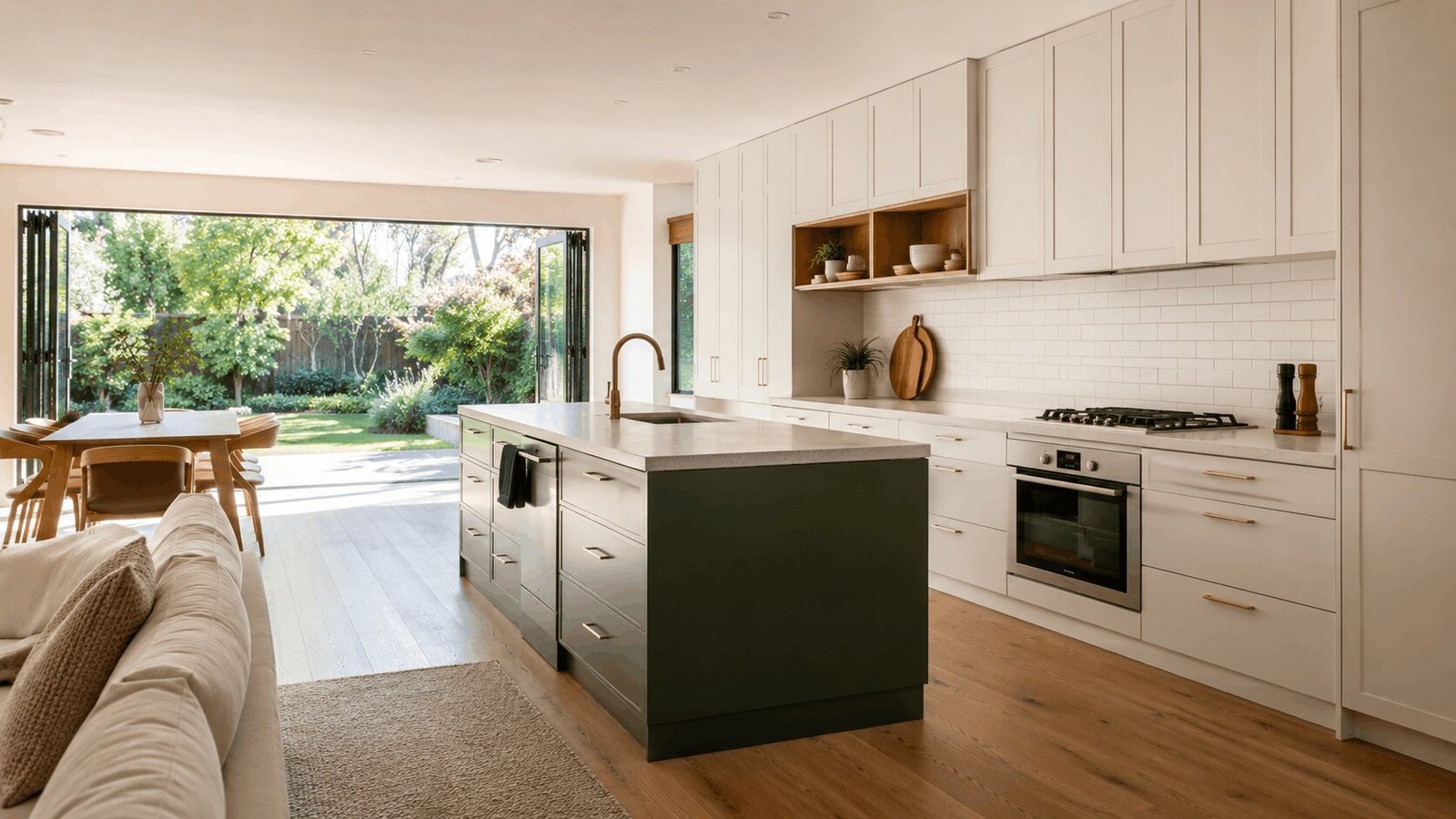
Warm white 2-pack Slim-Shaker profile throughout the perimeter cabinets and overhead run. Engineered stone benchtop in warm grey-white with a honed finish. Aged brass bar handles. A section of American Oak open shelving on the overhead run visible from the living zone — the one detail that softens the kitchen and signals the shift from workzone to display. This palette is designed to read warmly from the living zone at all times of day and to complement the garden view through the bifold doors. It connects the kitchen to Blackburn’s leafy outdoor character without trying to compete with it. The most popular palette choice in the suburb in 2026.
The Two-Tone Contrast
Warm white perimeter cabinets with a contrasting island base in a deep, grounded tone — charcoal, forest green, or warm navy. The island’s contrasting base reinforces its zone-definition function: the kitchen side reads white; the living-facing side reads dark. The contrast gives the open-plan zone a clear visual focal point and makes the island itself feel more like a piece of furniture than a cabinet. Matte black hardware throughout. This palette works particularly well in Blackburn’s larger rear-extension kitchens where the island is genuinely generous in size and the contrast can be carried without the darker tone feeling overwhelming.
The Understated Timber
Warm white 2-pack Slim-Shaker perimeter cabinets with an American Oak veneer island base. The timber island is warmer and more organic than a painted island — it reads as furniture within the open-plan zone rather than as cabinetwork. Aged brass hardware. Honed engineered stone benchtop. This palette suits Blackburn’s garden-oriented lifestyle particularly well — the natural timber element connects to the suburb’s strong outdoor character without introducing the maintenance demands of solid timber joinery.
The design philosophy behind how Silk Touch approaches open-plan kitchen joinery across Melbourne’s inner and middle-east suburbs is covered in more depth on the kitchen renovation Hawthorn page.
2026 Cost Guide — Kitchen Renovation in Blackburn
Joinery Supply (excludes stone, appliances, plumbing, electrical)
| Kitchen scope | Supply-only range (AUD) |
|---|---|
| Compact galley, in-place renovation (under 4m total run) | $8,000 – $12,000 |
| Standard L-shape or galley (4–7m total run) | $12,000 – $20,000 |
| Open-plan kitchen with island (7m+ total run) | $18,000 – $30,000+ |
| Whole-home package (kitchen + laundry + wardrobes) | $30,000 – $70,000+ |
Structural Works for Open-Plan Conversion (builder’s scope — not joinery)
| Structural item | Estimated cost range (AUD) |
|---|---|
| Structural engineer’s assessment | $500 – $1,200 |
| Building permit (Whitehorse City Council) | $800 – $2,000 in fees |
| Services identification and rerouting (electrical/plumbing) | $800 – $2,500 |
| Timber-frame partition wall removal | $2,000 – $5,000 |
| Load-bearing brick wall removal + beam install | $6,000 – $15,000 |
| Rear single-storey extension (3–5m depth) | $80,000 – $180,000+ |
All-Trades Kitchen Renovation Add-Ons
| Trade / item | Budget range (AUD) |
|---|---|
| Stone benchtop | $2,500 – $12,000 |
| Appliances | $4,000 – $25,000 |
| Splashback | $800 – $2,500 |
| Plumbing | $1,000 – $3,500 |
| Electrical | $800 – $3,000 |
| Painting | $1,000 – $4,500 |
| Flooring (if replacing) | $2,500 – $10,000 |
All joinery figures are supply-only and exclude installation, trades, stone, and structural works. Pricing is based on confirmed 2026 figures. Structural works costs are indicative estimates based on typical Blackburn conditions and will vary depending on wall construction, opening width, and existing services.
Frequently Asked Questions
How much does a kitchen renovation cost in Blackburn in 2026?
Bespoke kitchen joinery in Blackburn starts at $8,000–$12,000 supply-only for a compact galley under 4m. A standard L-shaped or single-wall kitchen (4–7m) runs $12,000–$20,000. An open-plan kitchen with island (7m+ total run) starts at $18,000–$30,000+. A whole-home joinery package covering kitchen, laundry, and wardrobes runs $30,000–$70,000+. These are supply-only figures and exclude stone benchtop ($2,500–$12,000), appliances ($4,000–$25,000), plumbing, electrical, and any structural works such as wall removal or rear extensions.
Do I need a structural engineer before removing a wall in my Blackburn kitchen?
Yes — always. Never assume a wall is non-load-bearing in a Blackburn home without a structural engineer’s assessment. In Blackburn’s 1950s–1970s brick veneer homes, internal walls can be load-bearing even when they appear to be lightweight internal partitions. A structural engineer’s report costs $500–$1,200 and determines the beam specification required for the opening. This assessment is required before a building permit is issued and before any contractor begins demolition work.
What is the minimum island size for an open-plan Blackburn kitchen?
The minimum functional island for a Blackburn open-plan kitchen is 1200mm long × 900mm wide, with a minimum 900mm clear aisle on all working sides (1050mm preferred on the primary cook’s side). An island smaller than 1200mm × 900mm is too narrow for comfortable prep and too short for more than one person to use. In Blackburn’s larger rear extension kitchens, a 1500mm × 950mm island is achievable and strongly recommended — it allows prep on one end, seating on the other, and a practical work triangle that does not require the cook to constantly reposition.
Do I need a planning permit for a kitchen renovation in Blackburn?
For internal joinery replacement in Blackburn — cabinets, benchtops, splashback — no planning permit is required. Blackburn falls under Whitehorse City Council, which has a relatively light heritage overlay footprint. If your project involves removing a load-bearing wall, adding a rear extension, or altering the external envelope of the property, a building permit (and in some cases a planning permit) will be required. A structural engineer’s report is required for any wall removal before a building permit can be issued.
Do you service Blackburn and surrounding Melbourne East suburbs?
Yes. Silk Touch Joinery is actively working across Melbourne’s east including Blackburn, Blackburn North, Blackburn South, Nunawading, Mitcham, Box Hill, Surrey Hills, Balwyn, and surrounding suburbs. Contact us to book a free in-home consultation at your Blackburn property.
Ready to Plan Your Blackburn Kitchen Renovation?
Open-plan living without the compromise is achievable in Blackburn. The suburb’s housing stock, block sizes, and outdoor character make it one of Melbourne’s east’s most rewarding settings for this renovation. But achieving it without compromise means making the five design decisions in this post correctly from the start — island sizing, sight lines, zone definition, garden connection, and finish specification. The wall removal is the easy part. These decisions are what determine whether the renovation delivers on its potential for the next 20 years, or falls short in ways that are visible every day.
If you are planning a custom kitchen renovation in Blackburn, we would like to visit your property, understand your home, and show you what is genuinely possible within your brief and your budget.