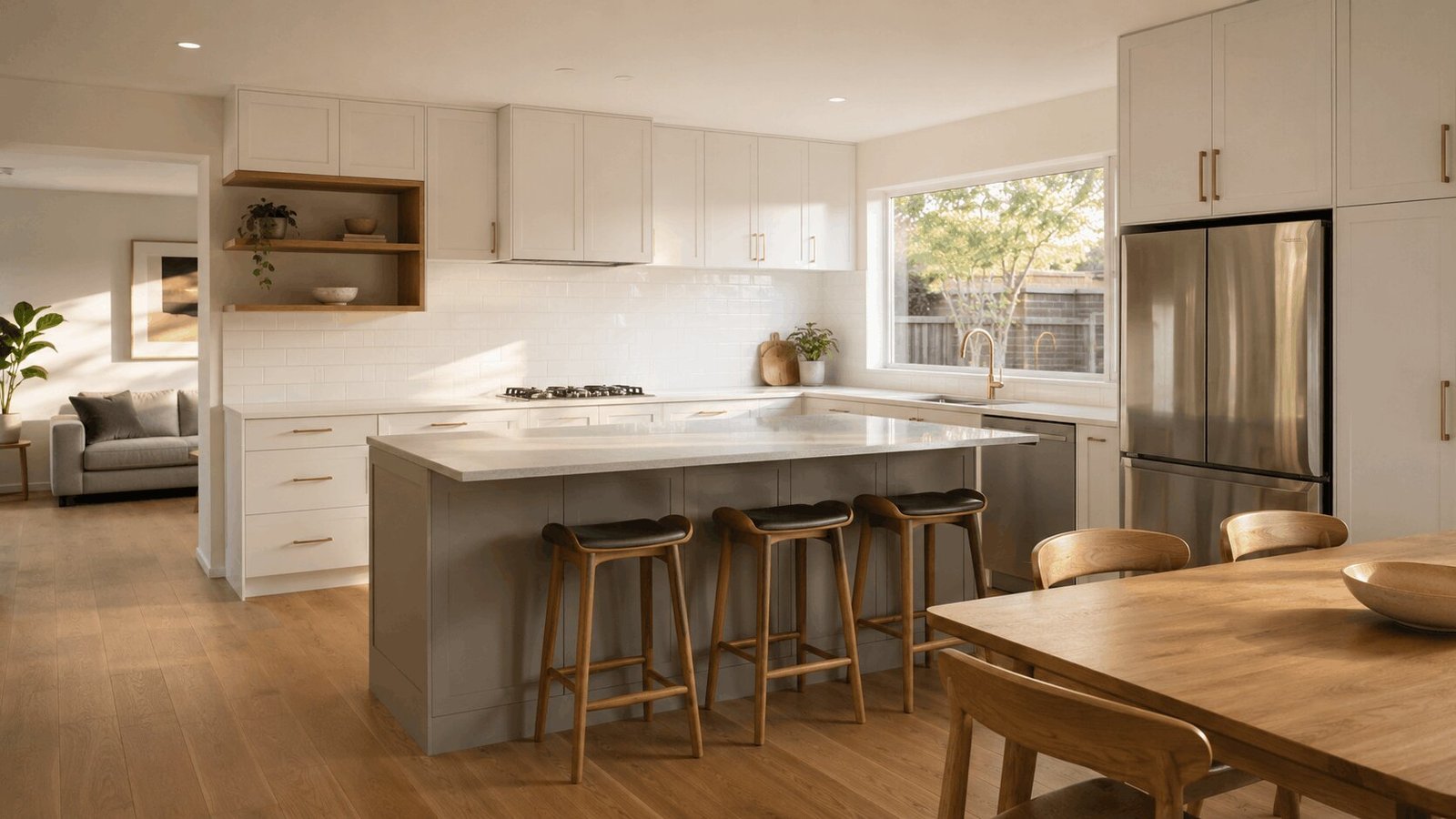
Picture a family that’s lived in Box Hill for twenty years. They’ve watched the suburb transform around them — the food scene, the new apartment towers near the station, the wave of renovations rolling through the streets of Box Hill South and Box Hill North. And they’ve decided that this year, they’re finally doing it. Not just the kitchen. The kitchen and the wardrobes. At the same time, with the same joiner, using the same palette throughout.
That’s the brief Silk Touch Joinery is hearing more and more from Box Hill families right now. Not two separate projects with two separate timelines and two separate material decisions. One whole-home joinery project, coordinated from design through installation, that leaves the home reading as considered from end to end — not assembled room by room over a decade.
We’ve covered the kitchen-specific brief in detail for nearby kitchen renovations Doncaster and the period home context in kitchen joinery Balwyn. This post focuses on Box Hill’s specific housing mix and the whole-home joinery opportunity that its renovation wave is creating. For the full cost picture, the kitchen cabinet costs guide covers the pricing framework.
Box Hill’s Housing Mix — Why One Layout Doesn’t Fit All
Box Hill is the most housing-diverse suburb we’ve covered in this series. The joinery brief looks genuinely different depending on which part of the suburb the property sits in, and which era it was built in. Treating it as a single housing type — as some renovation guides do — misses the point entirely.
Here’s how the four main housing types in Box Hill break down, and what they mean for the joinery conversation.
The Victorian and Edwardian Workers’ Cottage
Found mostly in Box Hill South and older pockets near the station, these are compact homes — typically on lots of 10m × 20m, often single-fronted or narrow double-fronted. The original kitchen is at the rear, and while Whitehorse City Council’s heritage overlay is considerably lighter than Boroondara’s, there are still fabric considerations to respect if the property sits in an overlay zone.
The renovation path here is either an in-place joinery replacement — new cabinets, new benchtop, new splashback within the existing footprint — or a modest rear extension that opens the kitchen to an outdoor zone. Either way, the joinery scope is typically modest: a compact galley or single-wall run, well-specified for storage efficiency. Kitchen joinery supply for this housing type runs $8,000–$20,000 depending on scope and materials.
The 1960s–1970s Brick Veneer
The dominant housing type in central and northern Box Hill. Regular structure, wider lots, and an original closed-off kitchen at the rear that was designed when open-plan living wasn’t yet the default. These homes follow the same renovation logic that we see in Mitcham and Doncaster: the separating wall comes down (confirm load-bearing status first — budget $500–$1,200 for a structural engineer’s report if you’re unsure), the kitchen opens to the living and dining zone, and an island is added to define the kitchen within the larger space.
The spatial generosity of these homes compared to the workers’ cottages is significant — there’s room to do a proper L-shape with a generous island, and the result can be genuinely transformative. Kitchen joinery supply for this housing type runs $12,000–$30,000+ depending on open-plan scope, island size, and material selections.
The 1970s–1980s Double-Storey Brick
Box Hill’s family home of choice, and the primary candidate for the whole-home joinery package that this post focuses on. Ground-floor open-plan zone, upstairs bedrooms. In many of these homes, the ground-floor wall removal has already happened — a previous owner opened up the kitchen a decade ago, or the home was built with a semi-open layout. What remains is a dated kitchen joinery fit-out in a space that already has good bones.
The renovation brief here is: replace the joinery, bring in an island if one isn’t already there, and — critically — address the upstairs bedrooms at the same time. The master bedroom wardrobe is typically undersized by contemporary standards. The secondary bedrooms may have original sliding-door built-ins with no internal fit-out to speak of. Commissioning kitchen and wardrobe joinery together, in a consistent palette, is the natural outcome for this housing type. It’s the Box Hill whole-home brief.
The Contemporary Townhouse
Near Box Hill Central and the station precinct, a growing number of contemporary townhouses occupy compact lots — often 200–300 sqm. These homes have kitchens that are well-proportioned for their footprint but leave little room for modification. The brief here is not about adding space; it’s about extracting every usable centimetre from the space that exists.
Key decisions for townhouse kitchens: integrated appliances throughout (an integrated fridge, dishwasher, and rangehood make a compact kitchen read as deliberately minimal rather than cramped), full-height overhead cabinets to ceiling (no wasted space above), no wasted space at wall returns (custom-scribing fills every corner), and a peninsula rather than a freestanding island if floor space is tight — a peninsula attached to the cabinet run on one end requires significantly less clear floor space than a freestanding island. Wardrobe joinery in these homes is equally constrained: floor-to-ceiling built-ins with precise internal fit-outs, rather than walk-in configurations that require floor area these homes don’t have.
Kitchen Joinery for Box Hill Homes — Layout Options
The L-Shape With Island
The most common outcome in Box Hill’s 1970s–1980s brick veneer and double-storey homes. An L-shaped cabinet run with an island positioned to define the kitchen zone within the open-plan space. In Box Hill family kitchens, the island brief is typically serious — a 1,500mm × 900mm minimum is the starting point, not the exception.
One Box Hill-specific consideration worth raising early in the design process: a dedicated wok burner or high-output cooktop is common in this suburb. This has real implications for the rangehood specification and the overhead cabinet layout. A powerful rangehood — 900mm wide, 1,000+ m³/h extraction rate — needs correct overhead clearance and cabinetry setback from the cooking zone. The standard clearance recommendation of 650mm from cooktop to rangehood base needs to increase for high-BTU cooking equipment. Get the appliance specification confirmed before the joinery layout is finalised — retrofitting a rangehood specification into an already-designed overhead cabinet run is an expensive problem.
The Galley-to-Open-Plan Conversion
For Box Hill’s older workers’ cottages and 1960s brick veneer homes where the kitchen remains closed off from the living zone. The wall removal creates the spatial connection that transforms how the home functions day to day — the difference between a kitchen you cook in and a kitchen you live in.
Always confirm load-bearing status before removal, and budget for a structural engineer’s report if there’s any uncertainty. Post-conversion, the kitchen layout typically becomes an L-shape or single wall with island — the structural outcome (beam span, post positions) will influence what’s possible, so work through the structural solution before the joinery design is completed.
The Compact Townhouse Kitchen
For Box Hill’s newer townhouse stock, where every linear metre of kitchen must work harder than it would in a larger home. The key decisions: integrated appliances throughout, full-height overhead cabinets to ceiling, no wasted space at wall returns, and a peninsula rather than a freestanding island if the footprint demands it. The goal is a kitchen that reads as deliberately considered rather than cramped by circumstance — and in Box Hill’s contemporary townhouses, the joinery specification is what makes that distinction.
The Whole-Home Joinery Package — Kitchen, Wardrobes, and Laundry Together
This is the section most relevant to Box Hill’s current renovation wave — and the angle that makes this post different from any suburb guide we’ve written previously.
Why whole-home makes sense in Box Hill right now
Box Hill homeowners undertaking a first-generation renovation are typically doing kitchen and wardrobes within the same 12-month window. It’s rarely a deliberate strategy — it’s simply that both are due at the same time, after 20 or 25 years. The question is whether to commission them as two separate projects, with two different joiners making two independent material decisions, or as a single coordinated project.
The case for commissioning them separately is scheduling flexibility — you can do the kitchen first, live in the result, and then address the wardrobes. The case against it is everything else. Different joiners making independent decisions about white 2-pack means different whites, different profiles, different hardware. The kitchen and the bedroom wardrobes look like they were designed by different people. Because they were.
What a whole-home package delivers
A single material palette across every room. If the kitchen is warm white 2-pack Slim-Shaker profile with American Oak open shelving and aged brass hardware, the bedroom wardrobes and laundry joinery use the same palette. The home reads as designed rather than assembled. The practical benefit beyond aesthetics: one site visit for measurement across all rooms, one design development process, one installation sequence with minimal household disruption — rather than two or three separate disruption events spread across a year.
One note worth making clearly: commissioning kitchen and wardrobes together does not reduce the unit cost of either room. The kitchen costs what it costs; the wardrobes cost what they cost. What the whole-home approach reduces is coordination overhead, the number of site visits required across the project, and the risk of material inconsistency between rooms.
What a whole-home package typically includes in a Box Hill home
- Kitchen: L-shape with island, pantry column, integrated appliances — $12,000–$30,000+ supply
- Master bedroom wardrobe: floor-to-ceiling built-in or walk-in conversion — $2,500–$8,000 supply
- Secondary bedroom wardrobes (2–3 rooms): $1,200–$3,500 each supply
- Laundry joinery: bench, overhead cabinet run, integrated cabinet for washer/dryer — $3,500–$8,000 supply
- Total whole-home package: $30,000–$70,000+ supply across all rooms
If you’re at the stage of considering the scope of your Box Hill renovation, book a free consultation and we’ll scope the whole home in one visit.
Box Hill-Specific Brief Additions — What This Suburb’s Kitchens Need
Box Hill is one of Melbourne’s most culturally diverse suburbs. Its large and long-established Chinese-Australian community has shaped the suburb’s food culture, its commercial character, and — practically — the way its kitchens are used. The joinery brief in Box Hill reflects this in ways that don’t come up as often in other Melbourne east suburbs. Here are three specific additions that are more common in Box Hill than anywhere else we work.
High-Output Cooking Specifications
Many Box Hill households cook at a higher heat output and larger volume than the average Melbourne kitchen is designed for. The joinery and specification implications are real:
The rangehood cabinet position is the critical one. Allow for a 900mm minimum rangehood width, and ensure the overhead cabinet above the cooking zone is positioned at a minimum 650mm clearance from the cooktop — and higher clearance if a wok burner is specified. A rangehood that’s undersized for the cooking output, or positioned too close to the cooktop, doesn’t function properly and creates a long-term problem. Get the appliance specification confirmed — including extraction rate — before the joinery layout is drawn.
For benchtop material adjacent to the cooking zone: engineered stone with good heat tolerance (Silestone, Caesarstone) is the right call. Avoid timber benchtops immediately adjacent to a high-output cooking zone.
Pantry column internal specification: large dry-goods storage is a genuine brief priority. Adjustable shelves at variable heights, pull-out baskets at lower levels for large bags of rice or flour (typically 5–10kg packages), and a full-height column of at least 600mm wide to accommodate the range of storage sizes required.
The Large Refrigeration Brief
Many Box Hill households run larger refrigeration than a standard Australian kitchen is configured for — a 900mm French door fridge, or a separate beverage fridge in addition to the primary fridge. The joinery brief must account for the actual appliance dimensions before cabinetry layout is finalised. A 900mm fridge in a kitchen designed for a 600mm fridge leaves no room for the fridge-adjacent cabinetry that most homeowners want. Confirm all appliance dimensions — including depth as well as width — before design development is completed. This is a step that seems obvious and is regularly skipped until it becomes a problem.
The Pantry Depth and Storage Specification
A practical note for Box Hill kitchens: dedicated storage for a broad range of dry goods, condiments, and specialty cooking ingredients is a genuine brief consideration — and the standard 350mm-deep pantry column with fixed shelves doesn’t serve this brief well. The back of a shallow pantry with fixed shelves becomes inaccessible within weeks of moving in. The better specification is a deeper pantry column (600mm depth where the layout allows) with pull-out internal shelving at multiple heights — so every centimetre of the column is genuinely accessible.
2026 Material Palettes for Box Hill Kitchens
Box Hill’s aesthetic sensibility is warm and practical. Less design-industry precious than suburbs closer to the city, less period-specific than Balwyn or Canterbury. The palettes that work consistently across the suburb’s diverse housing mix tend to be ones that read as quality without requiring a strong design position.
The Warm Family Classic
Warm white 2-pack Slim-Shaker profile throughout. Engineered stone benchtop in warm grey-white. Aged brass or brushed nickel bar handles. White subway tile splashback. This palette is the most universally appropriate across Box Hill’s housing types — it works in the 1960s brick veneer, the 1980s double-storey, and the contemporary townhouse without feeling out of place in any of them. It reads as quality without being trend-dependent. In 2026, it remains the most commonly specified palette in the suburb.
The Two-Tone Contemporary
Warm white upper cabinets paired with a contrasting tone on lower cabinets and the island — warm greige, soft sage, or charcoal are all appearing in Box Hill homes this year. Matte black bar handles. Engineered stone in a warm neutral. This palette is appearing strongly in Box Hill’s 1970s–1980s brick home renovations, where homeowners want a contemporary result without committing to a strong aesthetic position. The two-tone contrast gives the kitchen visual interest and a sense of intention without requiring the kind of design confidence that a fully saturated colour palette demands.
The Timber-Accented Warm
Warm white 2-pack base with American Oak open shelving above a section of the bench run and on part of the overhead cabinet zone. Aged brass hardware. Honed engineered stone benchtop. The timber accent brings warmth and texture to the kitchen without the full cost — or the maintenance considerations — of timber veneer cabinetry throughout. It works particularly well in Box Hill’s double-storey homes where the kitchen-living zone receives good natural light. Oak reads very differently in a bright north-facing room versus a dim south-facing one; Box Hill’s generally north- or east-facing rear zones suit it well.
For the broader design and material philosophy that underpins how Silk Touch approaches whole-home joinery across Melbourne’s east, the custom joinery Kew page covers our full approach.
2026 Cost Guide — Custom Joinery in Box Hill
All figures below are supply only and exclude installation, stone, appliances, plumbing, electrical, painting, and flooring unless stated.
Kitchen joinery — supply only
| Kitchen scope | Supply-only range (AUD) |
|---|---|
| Compact galley or in-place renovation (under 4m total run) | $8,000 – $12,000 |
| Standard L-shape or single-wall (4–7m total run) | $12,000 – $20,000 |
| Open-plan kitchen with island (7m+ total run) | $18,000 – $30,000+ |
Wardrobe joinery — supply only
| Wardrobe scope | Supply-only range (AUD) |
|---|---|
| Single built-in robe, basic fit-out (1,800mm wide) | $1,200 – $3,500 |
| Single built-in robe, full fit-out with Blum drawers and LED | $2,500 – $6,000 |
| Walk-in wardrobe, 2.0m × 2.4m, three-sided fit-out | $4,000 – $8,000 |
Whole-home package — supply only
| Package scope | Supply-only range (AUD) |
|---|---|
| Kitchen + laundry + 2 bedroom wardrobes | $30,000 – $55,000 |
| Kitchen + laundry + 3 bedroom wardrobes + home office | $45,000 – $70,000+ |
All-trades add-ons per room (supply and install): Stone benchtop $2,500–$12,000 · Appliances $4,000–$25,000 · Splashback $800–$2,500 · Plumbing $1,000–$3,500 · Electrical $800–$3,000 · Painting $1,000–$4,500 · Flooring $2,500–$10,000
Frequently Asked Questions
How much does custom joinery cost in Box Hill in 2026?
Custom kitchen joinery in Box Hill starts at $8,000–$12,000 supply-only for a compact galley under 4m. A standard L-shaped or single-wall kitchen (4–7m) runs $12,000–$20,000. An open-plan kitchen with island (7m+) starts at $18,000–$30,000+. A whole-home joinery package covering kitchen, wardrobes, and laundry runs $30,000–$70,000+. Wardrobe joinery starts at $1,200–$3,500 for a single built-in with basic fit-out, and $4,000–$8,000 for a walk-in. All figures are supply only and exclude stone, appliances, plumbing, electrical, and any structural works.
What are the most common kitchen layouts renovated in Box Hill?
Box Hill’s housing stock is diverse — 1960s–1980s brick veneer homes, double-storey brick homes, and older Victorian and Edwardian workers’ cottages all appear in the suburb. The most common renovation layouts are: the L-shaped kitchen in an existing open-plan zone (most 1970s–1980s homes have already been partially opened up), the galley-to-open-plan conversion where the original closed kitchen wall is removed, and the full open-plan rear extension for larger lots in Box Hill South and Box Hill North. All three are achievable under Whitehorse City Council’s relatively streamlined planning environment.
Do you do whole-home joinery packages in Box Hill?
Yes — Silk Touch Joinery offers whole-home packages covering kitchen, wardrobes, laundry joinery, home office, and wall units. Many Box Hill clients commission kitchen and wardrobe joinery simultaneously to achieve a consistent material palette across the home. A whole-home package (kitchen + laundry + wardrobes) runs $30,000–$70,000+ depending on scope. Commissioning multiple rooms together also allows more efficient workshop scheduling and a single installation sequence.
Does Box Hill require planning permits for kitchen renovation?
For internal joinery replacement in Box Hill — cabinets, benchtops, splashback — no planning permit is required. Box Hill falls under Whitehorse City Council, which has a relatively light heritage overlay footprint compared to inner-suburb councils. If your project involves removing a load-bearing wall, adding a rear extension, or altering the external envelope, a building permit (and sometimes a planning permit) will be required. Silk Touch works alongside your builder during the permit phase — our joinery is designed to the approved structural outcome.
Do you service Box Hill and surrounding Melbourne East suburbs?
Yes. Silk Touch Joinery is actively working across Melbourne’s east including Box Hill, Box Hill North, Box Hill South, Blackburn, Nunawading, Surrey Hills, Balwyn, Doncaster, and surrounding suburbs. Contact us to book a free in-home consultation at your Box Hill property.
Box Hill’s renovation wave is being driven by families who want to do this properly — kitchen, wardrobes, laundry, all in one coordinated project with a consistent material palette and a single installation sequence. The result is a home that feels considered from end to end rather than renovated incrementally over a decade. If you’re at the planning stage for a Box Hill renovation — whether that’s a kitchen alone, or the whole home — we’d be glad to come out, see the space, and talk through what’s possible.