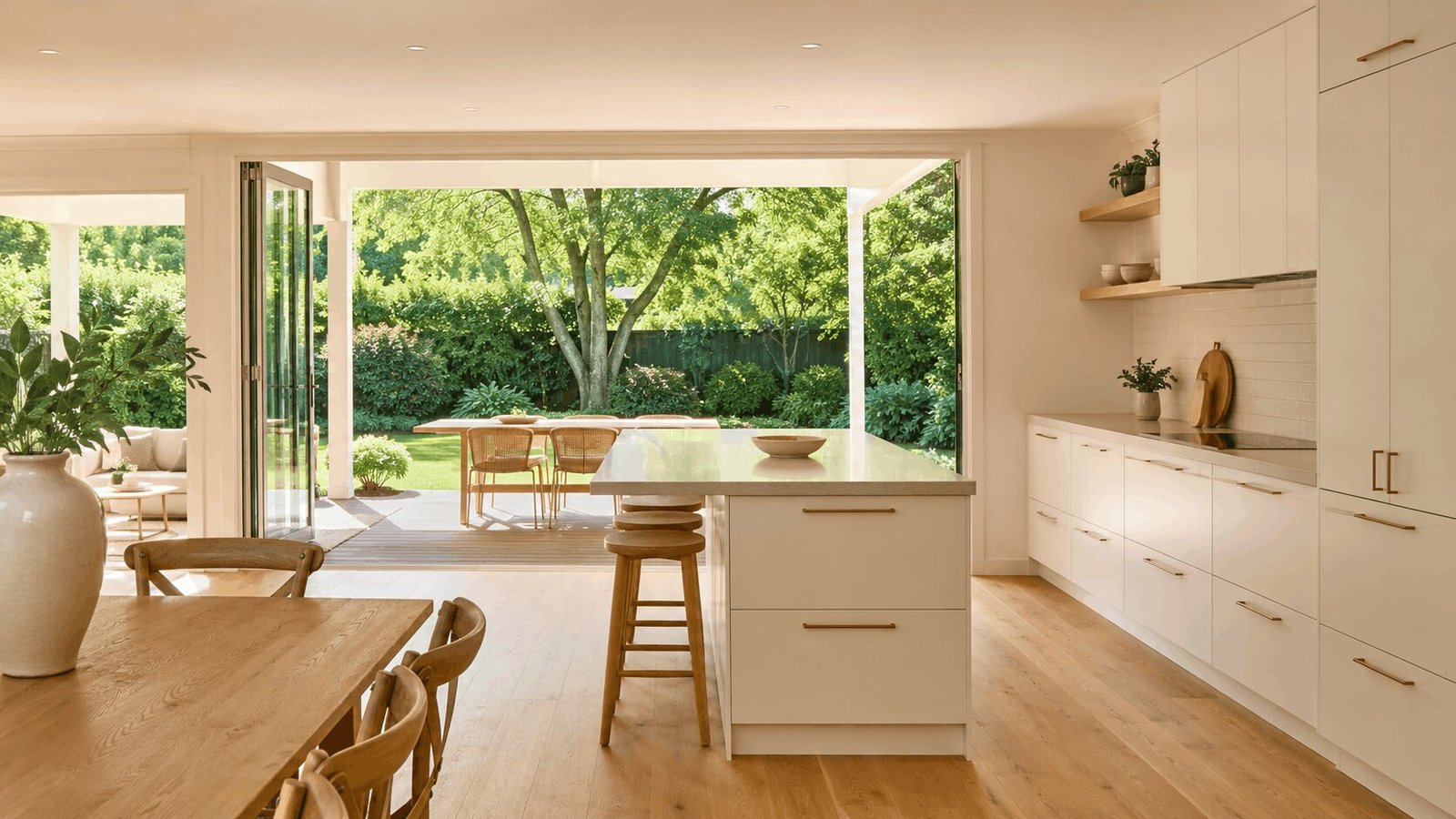
Vermont, 3133, is one of Melbourne’s most consistently leafy outer-east suburbs: a low, wide, single-storey suburb of predominantly 1960s–1980s brick veneer homes sitting on generous 650–900 sqm blocks, surrounded by mature elm, plane, and gum canopies along tree-lined streets. The rear gardens here face north or north-west on a high proportion of blocks, drawing long arcs of morning light through a setting that inner-city homeowners spend entire renovation budgets trying to manufacture.
The problem is the kitchen. The original 1960s–1970s kitchen in a Vermont home is typically a closed galley at the rear of the house — one small window facing east, a wall separating the kitchen from the living zone, and the entire rear garden invisible from the bench. In a suburb defined by its outdoor character, this is the home’s central design failure. The renovation that fixes it is understood by most Vermont homeowners before they call anyone. The wall comes down, the kitchen opens up, the bifold doors go in, the garden becomes part of the home.
What is less understood is how much the joinery decisions determine whether that outcome is actually delivered — or whether wall removal produces a better-positioned but equally dysfunctional kitchen with a view. The island position, the bench height, the material palette, the overhead cabinet height relative to a 2.4m ceiling — these are joinery decisions. They determine whether the garden connection the renovation set out to achieve is realised in every moment of daily use.
The open-plan conversion fundamentals — structural assessment, trade sequence, island sizing — are covered in depth in the kitchen renovation Blackburn post and the kitchen renovation Mitcham guide. This post focuses on what is specific to Vermont — the leafy outer-east setting, the block sizes that create genuine design opportunity, and the material choices that connect the kitchen to the suburb’s outdoor character.
Vermont’s Housing Stock — What the Kitchen Renovation Is Starting From
Vermont’s housing stock is the renovation context. Understanding which of the suburb’s three main housing typologies your home falls into determines the structural scope, the joinery brief, and the realistic budget range before the first conversation with a designer.
The 1960s Single-Storey Brick Veneer (Most Common)
The 1960s single-storey brick veneer is Vermont’s dominant housing type — a low, wide home with a low-pitched roof, internal brick walls, and a rear garden that sits to the north or north-west on most blocks. The original kitchen is at the rear of the home, typically configured as a closed galley (approximately 3.0m × 3.5m) or an enclosed L-shape, separated from the living zone by an internal brick wall that is frequently load-bearing.
What distinguishes Vermont’s 1960s brick veneer homes from their counterparts in Mitcham or Blackburn is the block. Vermont’s typical lot is 650–900 sqm — large enough to accommodate a rear extension, a covered deck of 3.5m × 4.5m or larger, and still retain a meaningful rear garden with room for the mature canopy trees that define the suburb. The renovation path for this housing type is the most common Vermont outcome: structural engineer assessment, building permit, wall removal, beam installation, open-plan kitchen with island, bifold doors to deck. Joinery supply for an open-plan kitchen with island (7m+ total run): $18,000–$30,000+.
The 1970s–1980s Updated Brick Veneer
The 1970s–1980s updated brick veneer is a Vermont home that was already renovated once — typically in the late 1990s or early 2000s. The kitchen wall may already be open to the living zone. The joinery — often semi-custom with vinyl-wrap door fronts — is now at end of life: wrapping is lifting at corners, drawer runners are failing, the laminate benchtop is discoloured, and the stone (if it was added in a partial renovation) has moved from contemporary to dated.
This is Vermont’s fastest renovation typology. No structural works are required; the open-plan footprint is already in place. The project is full joinery replacement within the existing room — new carcasses, new doors, new benchtop, new hardware. Design to installation runs 14–18 weeks from sign-off. Joinery supply for a standard 4–7m kitchen: $12,000–$20,000.
The Weatherboard Cottage (1940s–1950s, Pockets Near Mitcham Road)
The weatherboard cottage is less common in Vermont but present in older pockets, particularly near Mitcham Road and Boronia Road. These are 1940s–1950s homes on narrower lots (typically 450–550 sqm) with smaller original kitchen footprints and more complex structural configurations than the brick veneer stock. The renovation is more constrained — the site is less generous, the structural changes more involved, and any weatherboard heritage character may require sensitivity in external works. Joinery supply for a compact in-place renovation (under 4m total run): $8,000–$12,000.
The Garden Connection — Vermont’s Defining Renovation Opportunity
The garden connection is Vermont’s defining renovation opportunity and the correct starting point for every kitchen brief in this suburb. Vermont homeowners choose this suburb specifically for its outdoor character — the leafy streets, the generous blocks, the established tree canopy, the quietness. A kitchen renovation in Vermont that does not create a strong, deliberate connection to the rear garden is a renovation that has missed the point of the suburb.
Why the Garden Connection Is the Brief, Not the Finishing Touch
In Vermont, the orientation of an open-plan kitchen toward the north-facing rear garden is not an aesthetic preference. It is the renovation’s structural brief. A kitchen that opens to a covered deck — with direct sight lines from the island bench to the mature tree at the back boundary and morning light pouring in through bifold doors — delivers a qualitatively different daily experience from a kitchen that opens to a fence. Every joinery decision in a Vermont renovation must reference the outdoor connection the project is trying to achieve: not as a stylistic consideration, but as a functional one.
The Bifold Door Position Determines Everything
The rear bifold or stacking sliding doors are the single most consequential structural decision in a Vermont kitchen renovation because they define the kitchen’s relationship to the outdoor space — and the island must be positioned relative to the doors, not the other way around.
The sequence is non-negotiable: establish the bifold door position first, in consultation with the structural engineer and builder. Then design the island so the cook faces the doors when working at the primary preparation zone. Then design the cabinet runs around the island. If the cabinet layout is designed before the bifold position is confirmed, the island will almost certainly end up facing a wall or a side window — functionally correct but missing the suburb-specific opportunity.
The breakfast bar overhang on the garden-facing side of the island — 300mm minimum, 350mm preferred — must face the bifold doors. The person seated at the breakfast bar should be looking through open doors toward the garden, not toward a wall or a neighbour’s fence.
The Covered Deck and Alfresco Zone
Vermont’s lot sizes are large enough to accommodate a covered deck of 3.5m × 4.5m or larger without compromising the rear garden. This deck is not a separate outdoor room — it is a functional extension of the open-plan kitchen. The transition from the kitchen floor (typically engineered timber or large-format tile in a 600 × 600mm or 600 × 1200mm format) to the deck surface (hardwood or composite decking) should be flush or near-flush to maintain visual and practical continuity. This is a builder’s detail, but it must be coordinated at the kitchen design stage so the floor contractor can plan the threshold correctly.
A typical covered deck for a Vermont home: hardwood or composite decking, 3.5m × 4.5m, polycarbonate or Colorbond roof, integrated lighting and a ceiling fan. Budget range: $18,000–$35,000 depending on structure, roofing material, and finishes.
North Light and the Material Palette
Vermont’s 1960s–1980s homes were predominantly oriented with the rear boundary to the north or north-west — which means the bifold doors, and therefore the kitchen, face north. A north-facing kitchen in Vermont receives warm morning and midday light for the majority of the year. This has a direct consequence for material selection.
Warm material palettes — American Oak, warm white 2-pack, honed cream or grey-white engineered stone — read their best under warm north light. They glow. Cool grey or blue-toned palettes, which photograph beautifully in controlled studio conditions, look washed out and clinical in Vermont’s north light for most of the day. The material palette section below builds on this in detail.
Open-Plan Conversion in Vermont — The Structural Reality
An open-plan conversion in Vermont requires the same structural discipline as any brick veneer suburb in Melbourne’s east — never remove an internal wall without a structural engineer’s assessment. Vermont’s 1960s–1970s homes commonly have internal brick walls between the kitchen and the living zone, and these walls are frequently load-bearing. Treating them as non-structural is a costly assumption.
Vermont’s Internal Wall Configuration
The internal brick wall separating the original kitchen from the living zone in a 1960s Vermont brick veneer home is load-bearing on a high proportion of the suburb’s housing stock. Removing a load-bearing internal brick wall requires: a structural engineer’s assessment (cost: $500–$1,200), a building permit from Whitehorse City Council (cost: $800–$2,000), a builder for demolition, and installation of an approved steel or LVL beam to carry the load across the new opening. Total cost for load-bearing brick wall removal with beam installation in Vermont: typically $7,500–$16,000 depending on opening width and beam specification.
A timber-framed partition wall — less common but present in some 1970s–1980s homes — is a simpler removal. Cost: $2,000–$5,000 including patching, framing out the opening, and making good the ceiling and floor.
The Whitehorse City Council Building Permit Process
Vermont falls under Whitehorse City Council’s jurisdiction. Building permits for internal wall removal in Vermont are relatively straightforward — Whitehorse has a light heritage overlay footprint, and most Vermont properties are not affected by heritage controls. A planning permit is not required for internal structural changes that do not alter the external envelope of the property. Standard building permit timeline for a wall removal in Vermont: 3–6 weeks from submission to approval. All wall removal requires a structural engineer’s drawings as part of the permit application.
Coordinating the Joinery Brief with the Structural Works
Silk Touch Joinery designs the kitchen cabinet layout only after the structural drawings are confirmed and the opening width is known. The opening width determines the island dimensions. The island dimensions determine the surrounding cabinet configuration. Finalising the cabinet schedule before the structural drawings are approved produces a brief that will likely need revision — and revision after materials are quoted costs time. The correct sequence: structural engineer confirms opening width → Silk Touch designs to that opening → brief is finalised → fabrication begins.
Kitchen Layout Options for Vermont Homes
Vermont’s housing stock and block sizes support four main layout outcomes. The right choice depends on the housing typology, the available structural scope, and the homeowner’s brief.
The L-Shape With Garden Island
The L-shape with garden island is the dominant Vermont outcome. An L-shaped cabinet run is positioned against two walls — typically the rear wall and one side wall — with the island placed in the centre of the room, facing the bifold doors. The island serves as the visual anchor between the kitchen zone and the living and dining zone, and as the primary observation point toward the garden when standing at the bench.
Island minimum dimensions for a Vermont family kitchen: 1,500mm × 900mm. An island smaller than 1,500mm long is too short for two people to work at simultaneously and too short to seat three at the breakfast bar. An island smaller than 900mm wide cannot accommodate a full 300mm breakfast bar overhang and still leave adequate benchtop depth for preparation on the other side. The full argument for these minimums — and the most common island sizing errors in Melbourne renovations — is covered in the kitchen renovation mistakes Melbourne guide. Joinery supply for this layout at 7m+ total run: $18,000–$30,000+.
The U-Shape for Larger Extensions
The U-shape with island is the layout for Vermont homes undertaking a rear extension of 4m or more depth. Three walls of cabinetry provide maximum storage density for a family kitchen while maintaining clear sight lines to the garden through the open end of the U. A functional U-shape requires a minimum room width of 3,600mm between opposing cabinet faces — anything narrower produces aisles that do not meet the 1,200mm functional clearance standard for two people working simultaneously. For a Vermont home with a rear extension, this layout is achievable without spatial compromise.
The In-Place L-Shape Renovation
The in-place L-shape renovation is for Vermont homeowners who want a significantly better kitchen without structural works. The existing footprint is retained — full joinery replacement within the original room. Vermont’s 1960s brick veneer homes typically have an original kitchen measuring approximately 3.5m × 4.0m, which is large enough for a generous L-shape with a small peninsula or a breakfast bar overhang if an island is not feasible in the space. This is also the correct approach for the 1970s–1980s updated brick veneer typology described above, where the open-plan conversion has already been done. Joinery supply: $12,000–$20,000 for a standard 4–7m total run.
Adding a Scullery to the Rear Extension
A scullery — a secondary preparation and washing zone positioned behind the main kitchen, concealed behind a door or a pocket door — is a genuinely achievable addition for Vermont homeowners undertaking a rear extension. Vermont’s generous block sizes mean a scullery does not require a spatial compromise that would be unavoidable in a terrace or townhouse. A scullery behind the main kitchen removes cleanup, appliance clutter, and storage from the primary kitchen zone permanently. As covered in the scullery vs butler’s pantry guide, this is the most effective functional upgrade for a family kitchen where the main zone will be on display through the bifold doors. Scullery joinery supply: $10,000–$20,000+ depending on scope.
2026 Material Palettes for Vermont Kitchens
Vermont’s north-facing, garden-oriented kitchens are best served by warm material palettes that connect the interior to the leafy outdoor setting visible through the bifold doors. Three palettes are performing consistently well in Vermont’s 2026 renovations.
Palette 1: The Leafy Natural
The Leafy Natural palette is the definitive Vermont kitchen palette for 2026. It is warm, connected to the outdoor setting, and reads as a quality renovation without requiring a design-industry background to appreciate.
Composition: warm white 2-pack Slim-Shaker profile cabinets throughout all base and overhead runs. One section of American Oak open floating shelves replacing overhead cabinets on the most visible section of the run — typically the section adjacent to the bifold doors or facing the living zone. Honed engineered stone benchtop in a warm cream or warm grey-white (Caesarstone Calacatta Nuvo, Caesarstone Empira White, or equivalent). Aged brass bar handles throughout. Handmade ceramic subway tile splashback in off-white with a warm grey grout. Engineered timber flooring in a warm oak tone, running continuously from the living zone through the kitchen and to the deck threshold without interruption.
Under Vermont’s north light, this palette glows warmly in the morning and reads as natural, grounded, and genuinely connected to the garden visible through the bifold doors. It is the palette most likely to feel correct in 10 years as well as on completion day.
Palette 2: The Warm Two-Tone
The Warm Two-Tone palette combines warm white upper cabinets with a warm sage or soft clay lower cabinet base and island. Matte black hardware. Engineered stone benchtop in warm grey-white. Engineered timber or large-format tile floor continuing from the living zone.
The two-tone approach has been appearing strongly in Vermont’s 2026 renovations. The sage or clay lower cabinet references the garden setting — the green or earthy tones connect to what is visible through the bifold doors — while the white upper cabinets maintain brightness under north light. Matte black hardware provides a contemporary counterpoint that prevents the palette from reading as rustic or country. This palette works particularly well when the island is the sage or clay colour and the perimeter cabinets are all white — the island becomes the focal point both from the kitchen and from the living zone.
Palette 3: The Warm Timber Contemporary
The Warm Timber Contemporary palette uses American Oak veneer throughout — flat-slab door fronts and open shelving in matching Oak veneer. Honed engineered stone benchtop in warm cream. Aged brass cup-pull or bar handles. Handmade ceramic or honed natural stone splashback. Engineered timber floor in warm oak tone.
This palette is the most directly connected to Vermont’s natural setting. In a kitchen facing a north-facing garden full of established trees, the timber veneer interior reads as a continuation of the outdoor environment rather than a separate designed room. It requires press-bonded timber veneer door fabrication — a higher specification than a standard 2-pack door — and runs approximately 20–30% more expensive than an equivalent Slim-Shaker palette. It is the right choice for Vermont homeowners for whom the nature connection is the primary brief and for whom budget allows the premium.
The broader design philosophy behind how Silk Touch approaches kitchen joinery for Melbourne’s family-oriented eastern suburbs is covered on the kitchen renovation Hawthorn page.
Joinery Specifications for Vermont’s Outer-East Homes
Joinery specifications for Vermont homes must account for the suburb’s housing typology — older brick veneer construction with potential moisture management challenges — as well as the functional demands of family homes that will use this hardware intensively for 20+ years.
Carcass Construction
18mm HMR (high moisture resistant) board throughout — non-negotiable for all base cabinets in Vermont’s older homes. Vermont’s 1960s–1980s construction can carry residual moisture management challenges under kitchen sinks, adjacent to dishwashers, and in rear lean-to zones. HMR board is specifically required under the sink and adjacent to the dishwasher regardless of the home’s age. Standard particleboard carcasses are not appropriate for Vermont kitchens.
Door Profile
Slim-Shaker in 2-pack polyurethane is the universally appropriate door profile for Vermont’s housing stock. It complements the suburb’s suburban character, sits correctly with all three material palettes described above, and is available in any custom colour through standard RAL or Dulux colour references. Flat-slab works well in contemporary rear extension zones where the ceiling is higher and the architecture is more contemporary. Timber veneer (flat-slab) is the correct profile for Palette 3 above — a Slim-Shaker profile in timber veneer is less commercially available and materially more expensive than flat-slab veneer.
Hardware
Blum Legrabox or Tandembox Antaro full-extension soft-close drawers throughout all base cabinets. Blum Clip Top Blumotion concealed hinges on all doors. Blum hardware is specified across all Silk Touch projects because its 10-cycle-per-day designed lifespan aligns with the usage intensity of a Vermont family home. A Vermont kitchen will operate approximately 3,650–7,300 drawer cycles per year across a typical family’s usage. Blum’s warranty and performance at this cycle rate is documented and proven over more than two decades of Australian residential use.
Overhead Cabinet Height
In Vermont’s 1960s–1970s brick veneer homes, ceiling heights are typically 2.4–2.6m. Overhead cabinets in these homes must run floor-to-ceiling — a gap between the top of the overhead cabinet and a 2.4m ceiling collects dust, looks visually cramped, and makes the ceiling feel lower, not higher. Full-height cabinetry in a lower-ceiling home makes the ceiling feel higher because it eliminates the datum line at 700mm above bench height that draws the eye to the ceiling’s proximity. Specify full-height overheads in every Vermont brief as the default, not the premium option.
Floor Continuity
Floor continuity — a single flooring material running from the living zone through the kitchen and to the deck threshold without interruption — is one of the highest-impact decisions in a Vermont open-plan renovation. A change in floor surface at the kitchen boundary breaks the visual connection between interior and exterior at the precise point the renovation is trying to dissolve. The flooring material must be specified at the kitchen design stage so the floor contractor can plan the run correctly and the threshold detail at the bifold doors can be coordinated at a flush or near-flush level.
2026 Cost Guide — Kitchen Renovation in Vermont
All pricing below reflects Silk Touch Joinery’s confirmed 2026 supply-only figures for bespoke joinery, plus indicative ranges for structural works and all-trades add-ons. Supply-only means joinery fabrication and installation by Silk Touch — it excludes stone benchtop, appliances, structural works, and all other trades unless specified.
Joinery Supply Only
| Kitchen scope | Supply-only range (AUD) |
|---|---|
| Compact in-place renovation (under 4m total run) | $8,000 – $12,000 |
| Standard L-shape or single-wall (4–7m total run) | $12,000 – $20,000 |
| Open-plan kitchen with island (7m+ total run) | $18,000 – $30,000+ |
| Add scullery (compact, 2,000mm × 1,500mm) | + $10,000 – $15,000 |
| Whole-home package (kitchen + laundry + wardrobes) | $30,000 – $70,000+ |
Structural and Builder’s Works (Separate from Joinery)
| Item | Estimated range (AUD) |
|---|---|
| Structural engineer’s assessment | $500 – $1,200 |
| Building permit (Whitehorse City Council) | $800 – $2,000 |
| Brick internal wall removal + beam (load-bearing) | $7,500 – $16,000 |
| Timber-frame partition wall removal | $2,000 – $5,000 |
| Covered deck (3.5m × 4.5m, hardwood) | $18,000 – $35,000 |
| Rear extension (single-storey, 4m depth) | $80,000 – $180,000+ |
All-Trades Add-Ons
| Trade / item | Budget range (AUD) |
|---|---|
| Stone benchtop | $2,500 – $12,000 |
| Appliances | $4,000 – $25,000 |
| Splashback | $800 – $2,500 |
| Plumbing | $1,000 – $3,500 |
| Electrical | $800 – $3,000 |
| Painting | $1,000 – $4,500 |
| Flooring (engineered timber, if replacing) | $3,500 – $10,000 |
For a complete breakdown of how all-trades costs combine across a full renovation project, the kitchen renovation Mitcham guide walks through a staged project cost example in detail.
The Silk Touch Process for Vermont Projects
Silk Touch Joinery is a Melbourne bespoke joinery workshop serving Vermont, Vermont South, Forest Hill, Nunawading, Blackburn, and surrounding outer-east suburbs. All joinery is fabricated in the Melbourne workshop. The process for a Vermont project follows six stages.
- Free in-home consultation. Silk Touch visits the Vermont property, assesses the existing kitchen and rear yard, identifies the outdoor connection opportunity, and scopes what is structurally and practically achievable on the specific block. No charge. No obligation.
- Design development. 3D renders of the proposed layout, including the bifold door position, island orientation, and alfresco connection. Material samples reviewed in the actual room light — not from a catalogue. The material palette decision is made in the room, under north light, where the materials will actually be seen.
- Builder coordination. For Vermont projects involving structural works, Silk Touch coordinates with the builder during the permit phase. The joinery brief is designed to the approved structural drawings — the opening width confirmed by the structural engineer determines the island dimensions, which determines the surrounding cabinet configuration. Joinery is not finalised until the structural scope is locked.
- Workshop fabrication. All joinery is made in the Silk Touch Melbourne workshop. Fabrication lead time: 6–8 weeks from design sign-off. Custom 2-pack painting is completed in-workshop before delivery.
- Installation. A standard Vermont kitchen — L-shape with island, full-height overheads — installs in 3–5 days. Staged around the builder’s programme for projects involving structural works or rear extensions.
- Final commissioning. Hardware adjustment, door alignment, drawer runner calibration, full client handover. Blum hardware is adjusted to specification at the completion of the project, not left to the homeowner.
Book a free in-home consultation →
Frequently Asked Questions
How much does a kitchen renovation cost in Vermont in 2026?
Bespoke kitchen joinery in Vermont starts at $8,000–$12,000 supply-only for a compact galley under 4m. A standard L-shaped or single-wall kitchen (4–7m) runs $12,000–$20,000. An open-plan kitchen with island (7m+ total run) starts at $18,000–$30,000+. A whole-home joinery package covering kitchen, laundry, and wardrobes runs $30,000–$70,000+. These are supply-only figures and exclude stone benchtop ($2,500–$12,000), appliances ($4,000–$25,000), plumbing, electrical, and any structural works.
What are the best kitchen layouts for Vermont’s 1960s–1980s homes?
Vermont’s 1960s–1980s brick veneer homes on generous 600–800 sqm blocks offer strong open-plan conversion potential. The three most common renovation outcomes are: (1) in-place L-shape renovation within the existing kitchen footprint — best for homeowners wanting a significantly better kitchen without structural works; (2) wall removal to create an open-plan kitchen-dining zone with an island — the most popular choice and typically achievable within Vermont’s regular brick veneer construction; (3) rear extension with a full open-plan kitchen and alfresco connection — achievable on Vermont’s larger blocks without sacrificing meaningful garden space.
Does Vermont require planning permits for kitchen renovation?
For internal joinery replacement in Vermont — cabinets, benchtops, splashback — no planning permit is required. Vermont falls under Whitehorse City Council, which has a light heritage overlay footprint. If your project involves wall removal, a rear extension, or any external changes, a building permit (and in some cases a planning permit) will be required. All wall removal requires a structural engineer’s assessment before a building permit is issued.
How long does a kitchen renovation take in Vermont?
Silk Touch fabricates joinery in 6–8 weeks from signed design approval. Installation in a standard Vermont kitchen takes 3–5 days. If structural works are involved — wall removal, rear extension — total project timeline from design sign-off to completion is typically 14–22 weeks depending on builder programme and permit timing.
Do you service Vermont and surrounding Melbourne outer-east suburbs?
Yes. Silk Touch Joinery is actively working across Melbourne’s outer east including Vermont, Vermont South, Forest Hill, Nunawading, Blackburn, Mitcham, and surrounding suburbs. Contact us to book a free in-home consultation at your Vermont property.
Vermont’s Outdoor Advantage — Why a Kitchen Renovation Here Is Different
Vermont’s leafy outdoor setting and generous block sizes give kitchen renovations here a starting advantage that inner-city suburbs cannot manufacture. The garden, the deck connection, the north light — these assets already exist. They are already there, on the block, behind the house, waiting. The kitchen renovation is the project that finally lets the home make use of them.
A closed galley at the rear of a Vermont brick veneer home, with one east-facing window and a wall between it and the living zone, is a kitchen that has been turning its back on the suburb’s best asset since it was built. The renovation that removes that wall, opens the kitchen to the north, installs bifold doors to a covered deck, and positions the island so the cook faces the garden — that renovation is not an upgrade. It is a correction. It is the home finally living up to what the suburb already is.
If your Vermont kitchen is overdue for that correction, Silk Touch Joinery offers a free in-home consultation at your property. We will assess the existing layout, identify the outdoor connection opportunity specific to your block orientation and rear yard, and design a joinery brief that delivers the result Vermont’s setting deserves.