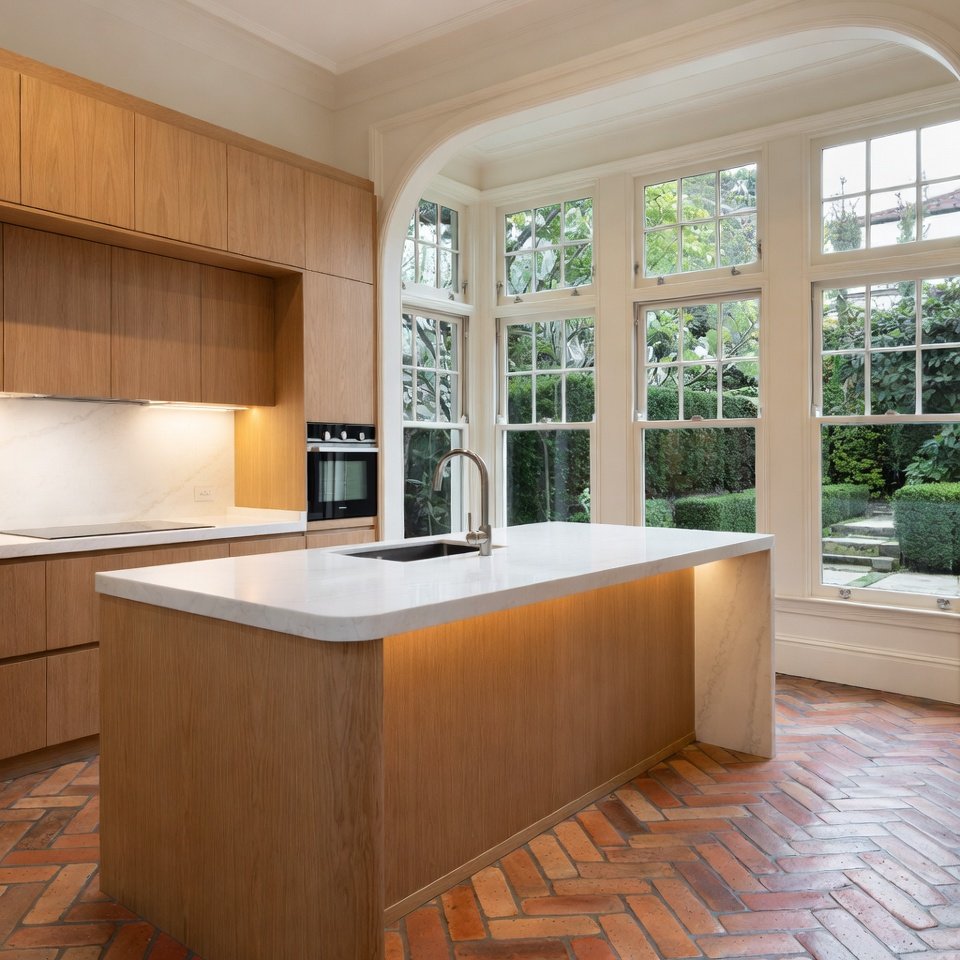
The Island That Changed the Brief
A Kew client came to Silk Touch with a Federation home, a gutted kitchen, and a single requirement: the island had to work as hard as the rest of the house. Seating for four. Concealed appliance zone. A waterfall benchtop in Caesarstone that didn’t fight the original Oregon pine floors.
What they did not want was a box in the middle of the room.
The island we built had soft-curved ends in American oak veneer, a recessed toe-kick that read as furniture rather than cabinetry, and Blum Legrabox internal runners on every drawer. It did not look like a kitchen island. It looked like it had always been there.
That project redefined what clients in Melbourne’s Inner East are asking for in 2026. And the brief is getting more specific, more technical, and more architecturally considered every quarter.
If you are planning a kitchen renovation in Toorak, Kew, or Camberwell—and kitchen renovations Camberwell are running at significant volume this year—this is the specification landscape you are entering.
Why the Kitchen Island Is the 2026 Hero Piece
The perimeter kitchen reached its logical ceiling. Every wall cabinet, every integrated appliance, every run of benchtop has been optimised. The island is where the remaining design decisions live—and in 2026, those decisions carry more architectural weight than any other element in the room.
Three forces are driving this.
First, Inner East homes are being used differently. Remote and hybrid work patterns mean kitchens operate across longer daily windows. The island is simultaneously a breakfast counter, a work surface, a homework station, and an entertaining centrepiece. A single-height, single-purpose slab no longer meets that brief.
Second, property values in Toorak, Kew, Hawthorn, and Camberwell have concentrated renovation investment into fewer, higher-specification projects. Homeowners are not refreshing kitchens. They are rebuilding them to a ten-year or twenty-year standard. The island reflects that ambition directly.
Third—and this is the specification shift—buyers and valuers now read kitchen joinery quality with increasing literacy. A poorly integrated island with visible carcass gaps, mismatched edge profiles, or builder-grade hardware is no longer invisible. It registers. It prices.
Here is what the market is specifying in 2026.
Trend 1: Soft Curves and Organic Shapes
The 90-degree corner is not gone. It is simply no longer the default.
Curved island ends—a radius of 150mm to 300mm on the terminal corners—are appearing across Inner East projects at a rate that marks a genuine trend rather than a styling anomaly. The driver is partly aesthetic, partly functional. A curved end eliminates the sharp corner that bruises a hip in a busy kitchen. It creates a natural circulation path. And in a Federation or Edwardian interior, a hard-cornered island always read as an insertion. A curved profile reads as belonging.
The specification challenge is that curves cost time. A flat door face takes minutes to machine. A curved carcass end requires a different workflow entirely—either CNC-routed solid substrate bent to profile, or kerfed MDF wrapped in veneer with a flexible adhesive bond. Done incorrectly, the veneer lifts at the apex within two years, particularly in kitchens with high humidity cycling.
Silk Touch CNC-routes curved carcass panels from 18mm moisture-resistant MDF and wraps them in Crown Cut American oak veneer with a full contact adhesive bond, edge-banded with a 1mm flexible ABS in a matched tone. The result holds geometry over time. It does not telegraph the substrate.
The other detail that separates executed curves from approximate ones: the benchtop overhang profile. A Caesarstone waterfall edge on a curved island end requires the stone to be thermoformed or mitred at the radius. Standard stone fabricators quote flat cuts. Specify the curve in the stone brief from day one, or you will receive a flat end panel that contradicts the cabinetry below it.
Trend 2: Multi-Level Islands and Waterfall Edges
A single benchtop height—900mm, which is the standard working surface specification—serves one function well and two functions adequately. It works for food preparation. It is marginal for seating adults comfortably. It is wrong for children doing homework.
Multi-level islands resolve this by integrating a raised or lowered zone into the island structure itself.
The most common configuration in 2026 Inner East projects:
- Primary working surface at 900mm in Caesarstone or natural stone, handling preparation and cooking adjacency.
- Raised breakfast bar at 1050mm on the opposite or end face, taking Blum Legrabox drawer carcasses beneath and providing comfortable stool seating without sightlines into the work zone.
- Lowered baking section at 820mm where specified by the homeowner—less common, but functional in households where pastry work is a regular activity.
The waterfall edge is the detail that completes this. A Caesarstone or Neolith waterfall—where the benchtop material runs continuously over the island end and to the floor—transforms the island from a cabinetry piece into an architectural element. The joint at the floor is the specification that separates competent execution from poor execution. A scribed base return, tightly fitted to the floor’s actual profile, reads as intentional. A gapped or caulked joint reads as a problem that was covered.
Material selection for waterfall edges matters. Caesarstone handles waterfall profiles reliably—it is an engineered quartz and its consistency means colour matching across horizontal and vertical faces is predictable. Natural marble is less consistent. The book-matched waterfall—where the stone is cut and folded to mirror the grain across the corner—is visually exceptional but requires a skilled fabricator and adds 20–35% to stone costs. It is worth specifying. It is not worth specifying without understanding the lead time implications.
Neolith and Dekton (both sintered stone products) are increasingly specified for waterfall islands where scratch and heat resistance are priorities. Both are thinner than engineered quartz at comparable strength—12mm profiles are achievable where Caesarstone typically runs at 20mm—which produces a finer, more architectural edge.
Trend 3: Furniture-Inspired Cabinetry and Integrated Seating
The kitchen island that reads as a piece of furniture—rather than a run of cabinetry with a stone top—is the dominant aesthetic shift of 2026. It is also the one most frequently executed incorrectly.
Furniture-style islands are characterised by several specific details. A recessed toe-kick in a contrasting material or colour, rather than the standard scribed MDF kick. Fluted or reeded timber panels on the seating face, machined from solid timber or applied as a routed veneer panel. Leg-style corner details that suggest the island sits on the floor rather than growing from it. And integrated seating—either a fixed upholstered bench return or a cantilever section designed to accept bar stools at a consistent knee clearance of 250mm minimum between seat and underside of benchtop overhang.
The luxury kitchens Kew projects driving this trend have Federation and Edwardian interiors as context. In those homes, a furniture-style island is architecturally correct. It does not compete with original joinery and cornices. It references them.
The specification failure mode is surface application without structural logic. Fluted panels glued over flat-front cabinetry read as decorative appliqué. Fluted panels that are the carcass face—routed into the substrate before finishing—read as designed. The distinction is 40mm of depth and a completely different fabrication workflow. It is visible to anyone who has seen both.
Integrated seating on the island perimeter requires a structural cantilever or a separate frame return, not an extended benchtop overhang. A Caesarstone overhang beyond 300mm without hidden steel support brackets is a structural specification error. At 400mm–500mm overhang—the minimum for comfortable seating—10mm flat steel plate supports welded to the carcass frame are the correct approach, concealed within the cabinetry body.
Trend 4: Hidden Storage and Integrated Appliance Zones
The visible appliance is in retreat.
In 2026 Inner East kitchens, the brief increasingly specifies that nothing should be on the benchtop. Coffee machine, toaster, kettle, mixer—all concealed. The island carries a significant share of this storage burden, and the internal specification determines whether that concealment is functional or merely theoretical.
Integrated appliance drawers on the island’s inner face—typically 200mm high Legrabox units with power outlets fitted to the rear wall of the drawer—allow small appliances to be stored at working height and slid out for use without relocation. The critical specification: the power outlet must be on a dedicated circuit with a flush-mounted GPO inside the carcass body, not an extension cord routed through a drill hole. This is a rough-electrical specification that must be confirmed with the site electrician before cabinet installation, not after.
Deep pot drawers under the primary work surface are standard specification. What is less standard—and more functional—is the internal organisation system within those drawers. A Blum Orgaline insert, sized to the actual cookware being stored, means the drawer functions at full capacity from day one rather than becoming a stacked chaos zone within six months.
Hidden storage on an island must also account for structural integrity. An island with four drawer stacks, a concealed appliance zone, and an integrated bin pull-out has significant internal framing requirements. The carcass must be 18mm marine-grade ply throughout, not 16mm MDF with ply exceptions. Every internal component—runners, soft-close mechanisms, pull-out frames—carries weight ratings that must be matched to the intended load. Blum Legrabox runners are rated to 70kg per drawer pair. Standard builder-supply runners are rated to 25–30kg. In a pot drawer carrying cast iron, the difference is not marginal.
For clients considering how an island’s hidden storage integrates with a broader kitchen storage strategy, Butler’s Pantry Designs Melbourne covers the overflow storage logic that makes island concealment viable.
Materials: Heritage Homes vs. New Builds
The material palette for a kitchen island in a Camberwell Federation home is not the same palette as a Kew contemporary extension. Both can be exceptional. Neither should pretend to be the other.
Heritage Context: Federation, Edwardian, Californian Bungalow
American oak veneer in a Crown Cut profile—where the grain runs vertically and produces the characteristic cathedraling figure—is the correct specification for heritage interiors. It references the timber joinery language of the original home without replicating it. Quarter Cut oak—tighter, more linear grain—reads as more contemporary and is better suited to transitional interiors where the extension is modern but the bones are period.
Finish specification matters as much as species. A hardwax oil finish on oak veneer reads as furniture. A high-gloss lacquer on the same substrate reads as 2012. For 2026 heritage kitchens, low-sheen polyurethane at 10–20% gloss level or a natural oil finish are the appropriate specifications.
Caesarstone Calacatta Nuvo or Elba remain the benchtop specifications that read correctly in heritage kitchens—white ground with warm grey veining that does not agitate against the timber. For homeowners who want natural stone, Statuario marble is the heritage-correct choice with the maintenance conversation that must accompany it.
Contemporary Extensions and New Builds
Fenix NTM in matte tones—Bianco Kos, Grigio Londra—works as an island base material where the design language is restrained and the benchtop carries the material interest. Neolith Calacatta Gold or Dekton Laurent provide the visual drama on the benchtop without the marble maintenance liability.
For clients in Brighton, the coastal humidity environment shifts the substrate specification—see kitchen renovations Brighton for the full material logic. The veneer bonding and MDF selection protocol for coastal postcodes differs from Inner East specifications.
For a detailed comparison of timber veneer species and their performance profiles, the Walnut vs Oak Veneers 2026 Guide covers the specification decision in full.
How Silk Touch Builds a Kitchen Island: The Process
The kitchen island is the most complex single piece in any kitchen project. It is also the piece most frequently under-specified at the quoting stage, which is where problems originate.
Silk Touch’s island build process runs as follows.
Week 1–2: Design and documentation. Every island begins with a free 3D design consultation where the space is measured to ±1mm and the design is modelled in full. The 3D render is not cosmetic. It is the document from which fabrication drawings are generated. Material selections, hardware specifications, internal configurations, and electrical rough-in requirements are all confirmed at this stage. Nothing goes to the factory floor without a signed-off drawing set.
Week 3–5: Factory fabrication. Silk Touch fabricates locally in Melbourne. The carcass is built from 18mm marine-grade ply with moisture-resistant MDF for door and panel faces. Curved components are CNC-routed to exact profile. Veneer is applied under controlled pressure with contact adhesive and edge-banded to the correct profile. Every drawer box is fitted with Blum Legrabox runners and adjusted to the specified weight rating before leaving the factory.
Week 6–7: Site installation and scribing. The island is installed in sections and scribed on-site to the actual floor profile. Heritage homes with original tessellated tile, Baltic pine boards, or uneven stone floors require this step—a factory-set base return that does not follow the floor’s actual geometry leaves gaps that read permanently. On-site scribing eliminates them. Blum soft-close mechanisms are set and adjusted after installation, not before.
Week 8: Benchtop templating and install. Stone templating occurs after the island carcass is set and level. The template is taken from the actual installed cabinet, not from the drawing. This eliminates the tolerance accumulation that causes stone overhangs to be inconsistent or waterfall edges to gap.
Total programme: 6–8 weeks from confirmed design to completed installation.
Common Costly Mistakes—and How They Are Prevented
Mistake 1: Specifying the island in isolation from traffic flow
An island that looks correct in a plan drawing can be wrong in the room. 900mm minimum clearance is required on all working sides of an island. 1000mm–1200mm is the correct specification where the island backs onto a cooking zone or a dishwasher. Builders frequently install islands at 750mm clearance to maximise island size. The result is a kitchen that cannot be used by two people simultaneously. Silk Touch models traffic flow in 3D before any dimension is confirmed.
Mistake 2: Stone overhang without structural support
As noted above: any overhang beyond 300mm requires concealed steel support. This is a fabrication specification, not a site fix. If it is not in the cabinetry build, it cannot be retrofitted cleanly. The benchtop will either be under-supported or the supports will be visible.
Mistake 3: Electrical rough-in after cabinet installation
Integrated appliance drawers, under-island power points, and LED strip lighting all require rough-in before the carcass goes in. A sparky returning after installation is cutting into finished cabinetry. Silk Touch coordinates electrical requirements with the site electrician at documentation stage, not during installation.
Mistake 4: Veneer grain direction not specified
On a furniture-style island, the grain direction on the seating face, the end panels, and the interior faces of any open shelving must be specified and consistent. Mismatched grain direction on adjacent panels reads as a fabrication error. It is not correctable after installation. The specification sits in the drawing set, or it is left to whoever is in the factory on the day.
Mistake 5: Undermounting sinks in islands without waterproofing protocol
Island sinks require a waterproofing membrane on the carcass top and sides immediately below the benchtop cutout. Without it, condensation and minor splash from the undermount joint penetrates the substrate over time. Ply carcasses handle moisture better than MDF—another reason the substrate specification matters.
The Verdict: Why 2026 Is the Year to Build It Right
The kitchen island trend in Melbourne’s Inner East is not moving toward simpler. It is moving toward more considered, more technically specified, and more architecturally integrated.
Curved ends require precision fabrication. Multi-level benchtops require structural and stone coordination. Furniture-style details require a fabricator who understands the difference between applied decoration and designed form. Hidden appliance zones require electrical planning that starts at documentation, not installation.
These are not details that emerge on-site. They are resolved at the design stage, in a 3D model, before a single sheet of ply is cut.
For Toorak, Kew, and Camberwell homeowners building at this level, bespoke joinery Toorak details how Silk Touch approaches heritage-context projects specifically—the material protocols, the heritage overlay considerations, and the documentation process that protects the client’s investment from the first drawing to the final adjustment.
The island is the most complex, most visible, and most used piece in your kitchen. Specify it accordingly.
Book your free 3D design consultation — and bring the brief, however rough. That is what the consultation is for.
Frequently Asked Questions
How much does a bespoke kitchen island cost in Melbourne in 2026? A mid-specification island—18mm ply carcass, Blum Legrabox runners, Caesarstone benchtop, veneer or 2-Pac finish—typically runs between $8,000 and $18,000 installed, depending on size, material selections, and internal configuration. Multi-level islands with waterfall edges and integrated seating sit at the upper end of that range. Stone selection is the largest single variable.
How long does a custom island take to build and install? Silk Touch’s standard programme is 6–8 weeks from confirmed design to completed installation. This includes factory fabrication, site delivery, carcass installation, scribing, and benchtop templating and fitting. Projects with natural stone benchtops or complex curved profiles may extend to 10 weeks.
Can a curved island work in a heritage home with an existing tessellated tile floor? Yes—and it frequently reads better than a hard-cornered island in that context. The critical execution detail is on-site scribing of the base return to the tile profile, and confirmation that the island footprint avoids damaging original tile runs. Silk Touch maps the tile layout at survey stage and positions the island accordingly.
What benchtop material is best for a kitchen island used heavily every day? For high-use islands, sintered stone (Neolith or Dekton) offers the strongest combination of scratch, heat, and stain resistance. Caesarstone is the reliable mid-specification choice. Natural marble is the correct specification where the aesthetic is the priority and the maintenance protocol is understood and accepted.
Do I need council approval for a kitchen island in a heritage overlay area? In most cases, no—internal kitchen works in heritage overlay areas in Boroondara or Stonnington do not require a planning permit provided they do not affect the external fabric of the building. However, if the renovation involves structural alterations, skylight additions, or external changes to a heritage-listed property, a planning application may be required. Silk Touch recommends confirming with your council’s planning department at project commencement.
What is the correct stool height for a kitchen island breakfast bar? For a 1050mm raised bar, specify stools with a 650–700mm seat height and a minimum 250mm knee clearance between seat and the underside of the benchtop overhang. For a 900mm standard benchtop used as a seating surface, specify 650mm counter stools. Confirm the stool manufacturer’s dimensions before the island overhang is fixed—the margin is narrow.
Does Silk Touch handle the full project including electrical and stone, or just the cabinetry? Silk Touch manages the full joinery scope—design, fabrication, delivery, and installation—and coordinates directly with your electrician and stone fabricator. For clients without existing trades, Silk Touch can recommend Melbourne-based sparky and stone fabrication partners with whom we have established working protocols. We do not subcontract the joinery itself.