Blum vs Hettich Hardware: Which Is Right for Your Custom Joinery?
Blum and Hettich both make hardware used in kitchens, wardrobes and other cabinetry, but a useful comparison starts with the exact hardware system and job, not the brand name alone.
That matters because some commonly compared products are not direct equivalents. Blum LEGRABOX is a box drawer system, while Hettich Actro 5D is a runner system. Likewise, Blum AVENTOS is a lift-system family for fronts that move upward, while Hettich WingLine L is a folding-door system.
For a Melbourne custom-joinery project, the practical question is therefore not simply “Blum or Hettich?” It is: which configured product best suits the drawer, door, load, movement, adjustment and layout requirements of this particular cabinet?
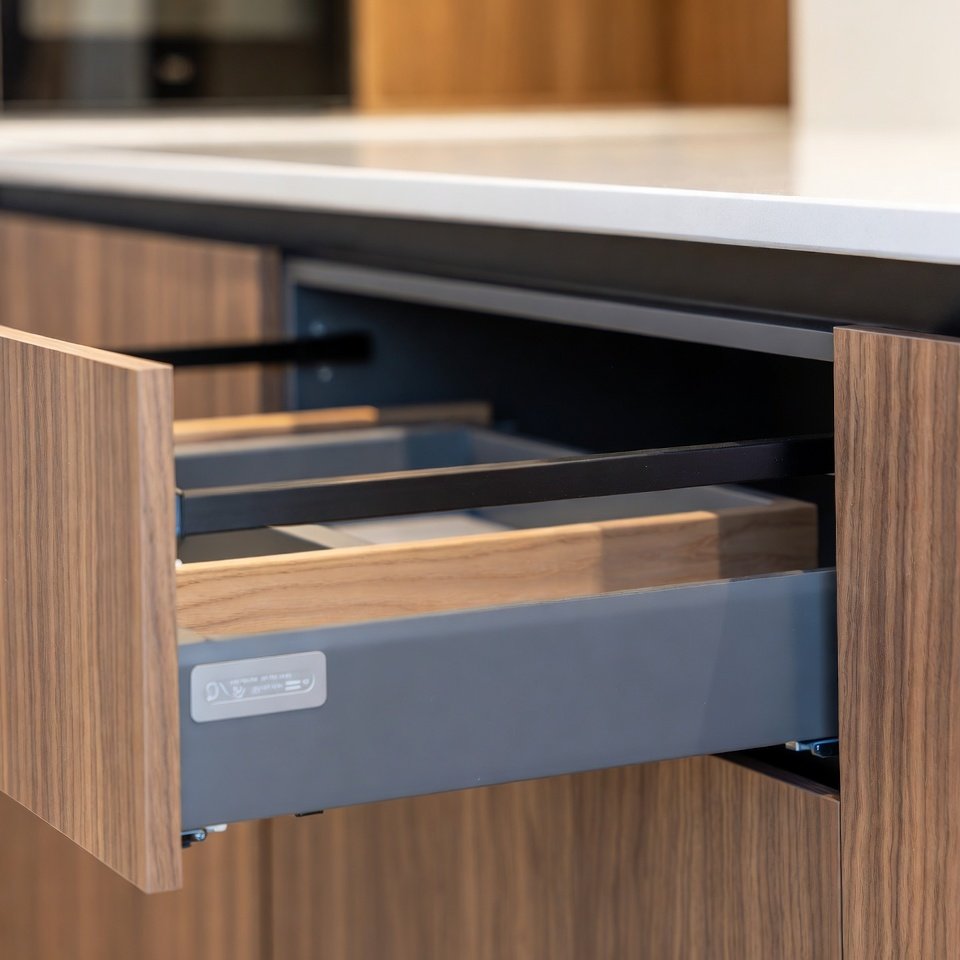
Quick answer: Blum vs Hettich
There is no universal winner.
- Consider Blum LEGRABOX when the design calls for a slim-sided box drawer system and you want to compare Blum’s 40 kg and 70 kg load-bearing classes, BLUMOTION soft close, and compatible opening or organisation options.
- Consider Hettich Actro 5D when the design calls for a runner system where five-way front adjustment, narrow reveals, or its 10 kg, 40 kg and 70 kg load-capacity options are relevant.
- For hinges, compare the exact hinge models rather than treating either manufacturer as a single hinge specification.
- For cabinet doors, do not treat AVENTOS and WingLine L as interchangeable. They create different door movements and suit different cabinet layouts.
The final choice should be made at product-and-application level.
Why Hardware Choice Matters in Custom Joinery
Hardware affects how cabinetry opens, closes, aligns and carries its intended load. It also affects the available drawer construction, internal organisation and door movement.
Before selecting a system, establish:
- whether the component is a drawer box, runner, hinge, lift or folding-door system;
- the drawer or door dimensions;
- the expected loaded weight;
- how the front needs to move;
- the available clearances;
- the adjustment needed during installation;
- the preferred handle, push-to-open or assisted-opening behaviour; and
- the exact product availability, warranty terms and cost at the time of specification.
A brand-level comparison is useful for creating a shortlist. The final specification still needs to be checked against the selected product.
Blum at a Glance
LEGRABOX
Blum describes LEGRABOX as a box system. Its current Australian product information lists 40 kg and 70 kg load-bearing classes.
Depending on the selected configuration, LEGRABOX can use:
- BLUMOTION soft close;
- SERVO-DRIVE electrical opening support;
- TIP-ON BLUMOTION or integrated TIP-ON for handleless applications; and
- AMBIA-LINE for internal organisation.
These options should not be assumed to be present on every LEGRABOX configuration. The exact runner length, load class and motion technology need to be specified for the cabinet.
AVENTOS
AVENTOS is Blum’s family of lift systems for cabinet fronts that fold up, swing up and over, lift vertically or pivot upward, depending on the model.
This makes AVENTOS relevant when the design calls for an upward-opening front. The correct AVENTOS model depends on the front movement, cabinet dimensions and other product-specific limits.
Hettich at a Glance
Actro 5D
Hettich describes Actro 5D as a drawer runner system with five-way adjustment. Its current Australian product information lists full-extension runners in 10 kg, 40 kg and 70 kg load-capacity classes.
Hettich also lists comfort-function variants including Silent System and push-to-open options. The exact function depends on the selected Actro 5D configuration, so “Actro 5D” should not be treated as one fixed opening-and-closing specification.
WingLine L
WingLine L is a folding-door system, not an overhead lift system. Hettich positions it for folding/sliding door applications including kitchen top units and wardrobes.
That distinction is important. A folding door and an upward-opening lift front solve different access and space-planning problems.
Side-by-Side Comparison
| Comparison point | Blum LEGRABOX | Hettich Actro 5D | What to verify |
|---|---|---|---|
| Product type | Box drawer system | Runner system | Desired drawer construction |
| Listed load classes | 40 kg and 70 kg | 10 kg, 40 kg and 70 kg | Exact product, length and intended loaded weight |
| Adjustment | Depends on the selected LEGRABOX configuration and fittings | Five-way front adjustment is a defining Actro 5D feature | Alignment and reveal requirements |
| Soft-close / opening behaviour | BLUMOTION and other motion technologies are available depending on configuration | Silent System and push-to-open variants are available | Exact selected mechanism |
| Internal organisation | AMBIA-LINE is designed for LEGRABOX | Depends on the drawer system and accessories selected with the runner | Required dividers, inserts and storage layout |
| Best decision method | Match the configured system to the cabinet | Match the configured system to the cabinet | Avoid brand-only decisions |
LEGRABOX vs Actro 5D is not a perfect like-for-like comparison
This is the most important correction to many simplified Blum-vs-Hettich comparisons.
LEGRABOX supplies a complete box-drawer platform. Actro 5D is a runner platform used with a compatible drawer construction. They can both be relevant to high-quality cabinetry, but they arrive at the drawer specification from different system architectures.
If a project team is comparing them, first decide the desired drawer construction. Then compare load class, dimensions, movement, front adjustment, internal organisation, finish, availability and price for the exact proposed configurations.
Blum vs Hettich Hinges
“Blum hinge” and “Hettich hinge” are both too broad to be meaningful specifications.
Each manufacturer offers hinge families in multiple configurations. The correct comparison should identify the exact models and check factors such as:
- overlay, inset or other door geometry;
- opening angle;
- door thickness and dimensions;
- integrated or separate damping where applicable;
- mounting-plate requirements;
- adjustment range;
- nearby walls, appliances or internal fittings; and
- the desired opening behaviour.
A single opening-angle or soft-close claim should not be applied to an entire hinge family without checking the exact product.
AVENTOS vs WingLine L: Different Door Systems
AVENTOS and WingLine L should not be described as direct alternatives without first defining the required door movement.
AVENTOS is a lift-system family. Depending on the model, a front can fold upward, swing up and over, lift vertically or pivot upward.
WingLine L is a folding-door system. The door wings fold and move to open access to the cabinet.
For a wall cabinet, wardrobe or other joinery element, compare:
- where the door needs to move when open;
- available space above and in front of the cabinet;
- cabinet and front dimensions;
- door weight and product limits;
- handle or handleless operation;
- access to the cabinet interior; and
- the visual result when the door is open and closed.
The better system is the one that matches the required door movement and the exact cabinet geometry.
Blum vs Hettich by Room
Kitchens
For kitchen drawers, start with the intended loaded weight, drawer width and depth, internal organisation, and how the fronts need to align. Large pot drawers and pantry storage may need a different specification from cutlery or utensil drawers.
For overhead cabinetry, decide the required door movement before choosing hardware. A lift front, a conventional hinged door and a folding-door system create different clearances and access.
For broader kitchen planning, see Silk Touch Joinery’s custom kitchens Melbourne service page.
Wardrobes
Wardrobes can combine drawers, hinged doors, folding doors and other opening systems. Compare hardware by the actual door or drawer geometry rather than assuming one manufacturer should be used throughout the room.
For wardrobe planning, see the custom wardrobes Melbourne service page.
Laundries and bathroom vanities
In laundries and vanities, hardware selection should be coordinated with the cabinet design, expected use and the material/environment requirements of the complete joinery specification. Do not infer a product’s suitability for a wet or humid location from the brand name alone; verify the exact product and installation requirements.
Silk Touch also provides custom laundry joinery and bathroom vanity joinery in Melbourne.
Wall units and other cabinetry
For wall units and other custom cabinetry, the same rule applies: identify the movement and loading requirement first, then choose the appropriate runner, hinge, lift or folding-door system.
Heritage Homes vs Modern New Builds
The age or architectural style of a home should not determine the hardware brand by itself.
Existing homes can present irregular walls, floors or openings, but those conditions need to be measured rather than assumed. Newer buildings can also require careful alignment.
Where fine front alignment is important, Actro 5D’s five-way adjustment may be relevant. That is a product feature, not a reason to assign Hettich automatically to every heritage project.
The correct specification should follow the measured cabinet and site conditions.
What to Compare Before Choosing Hardware
Before accepting a Blum-vs-Hettich recommendation, ask for the exact product or system being proposed and compare:
1. Product type
Confirm whether the proposal is for a drawer box, runner, hinge, lift system or folding-door system.
2. Load class
Use the manufacturer’s load class for the exact product and check it against the intended loaded drawer or door application.
3. Dimensions and clearances
Hardware systems have product-specific dimensional limits. Cabinet width, depth, height, front size and nearby obstructions can change the correct choice.
4. Opening and closing behaviour
Decide whether the project needs soft close, push-to-open, electrical assistance, a handle, or another operating method. Then verify that the selected configuration provides it.
5. Adjustment and alignment
Adjustment can matter when narrow, even reveals are part of the design. Compare the actual adjustment available from the proposed fittings.
6. Internal organisation
If drawer organisation is important, compare the insert and divider system alongside the drawer hardware rather than treating it as a separate afterthought.
7. Availability, price and warranty
Availability and price can change. Warranty terms can also depend on the market and product. Check current Australian information for the exact specification instead of relying on a generic brand-level promise.
Which Is Better: Blum or Hettich?
Neither brand is automatically better for every cabinet.
A useful specification narrows the decision in this order:
- What component is required?
- How must it move?
- What dimensions and loaded weight must it accommodate?
- What adjustment and internal organisation are required?
- Which exact Blum or Hettich configuration satisfies those requirements?
- What are the current availability, cost and warranty terms for that configuration?
For LEGRABOX and Actro 5D specifically, decide first whether the joinery design calls for a box-drawer system or a runner-based drawer construction. The product-level comparison becomes much clearer after that decision.
Frequently Asked Questions
Is Blum or Hettich better for kitchen drawers?
There is no universal winner. Compare the exact drawer construction, dimensions, loaded weight, adjustment, opening behaviour and organisation requirements. LEGRABOX and Actro 5D are different system types, so the project requirement should determine which is appropriate.
What is the difference between Blum LEGRABOX and Hettich Actro 5D?
Blum describes LEGRABOX as a box drawer system with 40 kg and 70 kg load-bearing classes. Hettich describes Actro 5D as a runner system with five-way adjustment and 10 kg, 40 kg and 70 kg load-capacity classes. They are therefore not direct like-for-like products.
Are all Blum and Hettich drawer systems rated to 70 kg?
No. Both manufacturers offer different products and load classes. The load rating must be checked for the exact selected system and configuration.
Is Hettich WingLine L an alternative to Blum AVENTOS?
Not directly. WingLine L is a folding-door system. AVENTOS is a family of lift systems for fronts that move upward. They can both be considered for cabinetry, but they create different door movements and have different application constraints.
Does Actro 5D include soft close?
Hettich lists Actro 5D variants with its Silent System as well as other comfort functions. Confirm the exact selected runner configuration rather than assuming every Actro 5D product behaves identically.
Should I choose hardware based on the warranty?
Warranty can be one decision factor, but use the current Australian terms for the exact product. Do not rely on a generic “Blum warranty versus Hettich warranty” duration unless the applicable manufacturer terms have been checked for the proposed hardware.
Planning Custom Joinery in Melbourne?
Silk Touch Joinery designs, manufactures, supplies and installs custom joinery for Melbourne projects.
to discuss your project requirements, cabinetry layout and hardware options.