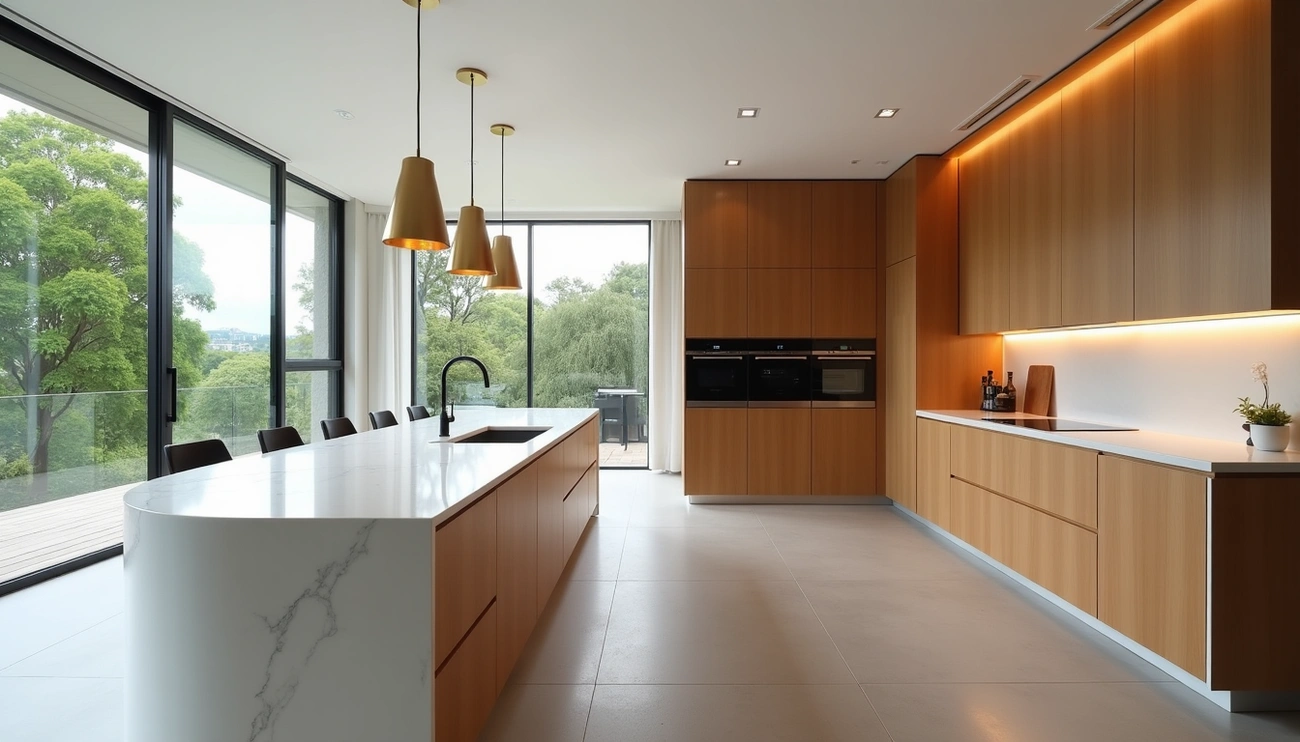
Luxury kitchens in Kew are experiencing a renaissance, particularly in the stunning Studley Park precinct, where architectural elegance meets natural beauty. Perched on the highest elevation of Studley Park Road, these residences offer incredible vistas of Melbourne’s cityscape while every window frames leafy treetops or landscaped greenery. Despite being just 5km from Melbourne’s CBD, the area delivers a remarkable sense of living within nature.
We’ve recently completed a minimalist masterpiece kitchen transformation that exemplifies the bespoke kitchen design 3101 residents demand. Custom joinery in Kew requires a deep understanding of the area’s unique architectural character—from historic Victorian estates to contemporary Studley Park designs. This project showcases how Studley Park architectural cabinetry can transform living spaces while respecting Kew’s distinctive charm. The village-like feel of the area, with its expansive parklands and retail destinations like High Street, has significantly influenced our approach to creating kitchens that balance sophistication with warmth.
The Architectural Context of Kew’s Luxury Kitchens
Kew stands as an architectural treasure trove where history and innovation coexist in remarkable harmony. The suburb’s built environment presents a fascinating juxtaposition of eras that directly influences how we approach kitchen design for discerning clients.
Kew’s blend of Victorian and modernist homes
The architectural landscape of Kew unfolds like a visual timeline of design evolution. Grand Victorian mansions with ornate facades sit confidently alongside sleek modernist structures, creating a neighbourhood that refuses to be defined by a single aesthetic. This architectural diversity demands an equally versatile approach to kitchen design – one that respects historical context when working within heritage homes yet embraces contemporary innovation for modern residences.
In my experience, creating luxury kitchens in Kew requires a deep understanding of architectural principles that extend far beyond cabinetry. When designing for Victorian-era properties, we often incorporate traditional joinery techniques and classical proportions, albeit with subtle contemporary touches. Conversely, our modernist projects embrace clean lines and minimalist detailing that complement the architectural shell.
Why Studley Park is a design destination
Studley Park has emerged as Kew’s premium design enclave for compelling reasons. Nestled among undulating topography, homes in this precinct benefit from exceptional natural light – a crucial element in kitchen design. The area’s elevated position creates unique spatial opportunities, with many residences featuring dramatic ceiling heights and expansive footprints that allow for bold kitchen statements.
Furthermore, the concentration of architectural talent drawn to Studley Park over the decades has established a legacy of design excellence. Many properties feature the work of notable mid-century architects, providing an inspiring foundation for the custom joinery that Kew residents increasingly seek. The interplay between indoor and outdoor spaces is another distinctive characteristic, influencing how we design kitchens that connect seamlessly with alfresco entertaining areas.
Understanding the local aesthetic expectations
The bespoke kitchen design that 3101 clients request typically reflects a sophisticated understanding of materials and craftsmanship. In this postcode, aesthetic expectations extend beyond visual impact to encompass tactile quality and functional intelligence. Residents prioritise authentic materials – natural stone, genuine timber veneers, and artisanal metalwork feature prominently in our Kew commissions.
Accordingly, there’s a marked preference for understated luxury rather than ostentatious displays. Kew kitchens typically favour architectural integrity over passing trends, with clients requesting designs that will maintain their relevance for decades. This long-term perspective aligns perfectly with our philosophy of creating Studley Park architectural cabinetry that transcends fashion in favour of timeless design principles.
Designing the Minimalist Masterpiece: The Studley Park Case
The Studley Park project presented a fascinating challenge—create a kitchen that disappears when not in use yet performs flawlessly when called into action. Our clients, a professional couple with a passion for entertaining, sought a space that would complement their home’s contemporary lines while maintaining absolute functional precision.
Client brief and architectural alignment
Initially, our clients approached us with a vision for a kitchen that would blend seamlessly into their open-plan living space. The brief emphasised clean lines, natural materials, and a connection to their garden views. The Victorian-era home had undergone a contemporary extension, creating a fascinating juxtaposition that demanded careful consideration.
In fact, the client’s primary requirement was that the kitchen should feel more like a piece of furniture than a utilitarian space. This aligned perfectly with the home’s architectural evolution—respecting the classical proportions while embracing modern minimalism. We proposed a concept that would highlight the impressive ceiling height while maintaining visual calm through strategic material selection.
The role of custom joinery in spatial flow
Custom joinery proved essential in creating the desired spatial harmony. We designed slender proportions for the cabinetry, with vast glazing that seems to bring the garden inside—a technique that visually expands the space. A four-metre-long horizontal window runs beneath the cabinetry, offering panoramic garden views while standing at the sink.
Moreover, the joinery includes push-to-open cabinetry and integrated pulls that maintain the clean aesthetic. The kitchen’s true brilliance lies in its disappearing act—copious cupboard doors with concealed hinges provide plentiful storage alongside dove-tailed solid-oak drawer boxes. This approach eliminates visual clutter, allowing the surrounding natural scenery to add drama to the space.
Balancing form and function in a minimalist layout
Essentially, minimalist kitchens aren’t just about aesthetics—they’re about removing distractions so the space works better. For the Studley Park project, we embraced the five-zoned approach to kitchen design, creating distinct areas for preparation, cooking, cleaning, storage, and socialising.
Consequently, we positioned an island directly beneath the ceiling’s central wooden beam, with three pendant lights creating a focal point. The working triangle principle guided our placement of the sink, refrigerator, and stove, ensuring efficiency without compromising the clean aesthetic. Three chairs at the island’s end offer garden views while eating, reinforcing the indoor-outdoor connection that makes Kew’s luxury kitchens so distinctive.
Crafting the Hidden Kitchen: Materials and Integration
The material palette forms the foundation of our hidden kitchen concept in Studley Park. Through meticulous selection and precision crafting, we’ve created a space that performs flawlessly yet appears almost architectural rather than functional.
Use of hand-selected timber veneers
The heart of this kitchen’s aesthetic lies in our premium timber veneers—ultra-thin slices (0.6-0.8mm) of genuine wood adhered to a premium MDF core for superior stability and resistance to warping [1]. Specifically, we employed book matching techniques, where adjacent veneer sheets mirror each other like an open book, creating visual harmony throughout the cabinetry [1]. Hand-selecting each veneer sheet allowed us to maintain continuous grain patterns across doors and drawers, producing a cohesive, natural flow that elevates the entire space.
Seamless appliance integration
For the Studley Park project, appliance integration was paramount to maintaining the minimalist aesthetic. Built-in appliances installed directly into cabinetry create clean, uninterrupted lines throughout [2]. We concealed the refrigerator, dishwasher, and range hood behind custom panels designed to match the surrounding cabinetry [3]. Additionally, we incorporated “door docks” where full-height external doors slide back via a special mechanism, revealing functional zones only when needed [4].
LED task lighting and Blum soft-close hardware
Beneath the cabinetry, strategically positioned LED lighting serves both practical and aesthetic purposes. Unlike traditional lighting, LEDs emit light in one specific direction, making them ideal for task illumination over work surfaces [5]. Meanwhile, every drawer and door features Blum’s TANDEMBOX Blumotion hardware—a premium system that ensures silent, effortless closing with up to 65kg capacity [6]. Backed by a lifetime warranty, these components deliver the tactile quality that discerning Kew clients expect [6].
Creating a clutter-free visual experience
Ultimately, the success of this hidden kitchen lies in its disappearing act. By concealing functional elements behind sleek panels, we’ve created a space that reads as architectural joinery first, kitchen second [7]. Push-to-open doors eliminate the need for handles, contributing to the streamlined aesthetic [7]. This approach transforms what could be a utilitarian space into something that harmonises perfectly with the home’s contemporary design language—creating that quintessential luxury kitchen Kew residents increasingly desire.
Curves, Transitions, and Technical Challenges
Curved elements form the most striking feature of our Studley Park project. Throughout the design process, these organic shapes demanded both technical precision and artistic vision to achieve their seamless integration into the space.
Why curved joinery is trending in 2026
Soft curves have firmly replaced sharp lines across modern kitchen design for 2026 [8]. Above all, this shift reflects a desire to create kitchens that feel like natural extensions of living spaces rather than utilitarian zones. Curved elements—particularly in islands and benchtops—add sophistication while complementing organic colour palettes [8]. For the luxury kitchens Kew residents desire, these flowing forms create a sense of movement that rigid designs simply cannot achieve.
Engineering the curve: from concept to install
Creating curved joinery requires specialised manufacturing capabilities [9]. Unlike standard cabinetry that can be pre-assembled as box units, curved kitchen cabinets demand custom fabrication [10]. Before construction, we engrave the rear face of panels with precise v-grooves, allowing them to bend gracefully around curved frames [11]. Each curved panel must maintain consistent radius measurements while supporting substantial countertop loads [9].
Softening the kitchen-dining transition
Undeniably, the curved elements in our bespoke kitchen design 3101 project help eliminate the abrupt divisions between functional zones. Custom joinery in Kew homes benefits from creating natural gathering points that encourage conversation [12]. The elimination of sharp corners improves traffic flow patterns while maximising usable floor space [9].
Precision in execution: tools and techniques
The construction of curved kitchen elements demands exceptional attention to detail [9]. On balance, the process requires specialised substrate preparation, advanced forming techniques, and modified finishing methods to ensure dimensional stability [9]. For our Studley Park architectural cabinetry, we utilised CNC machinery alongside traditional craftsmanship to achieve the precision these complex geometries demand [12].
Conclusion
Crafting the Studley Park kitchen represents our commitment to exceptional design that respects architectural context while pushing creative boundaries. Throughout this project, we balanced minimalist aesthetics with full functionality, creating a space that disappears when not in use yet performs brilliantly when needed. The marriage of hand-selected timber veneers, seamless appliance integration, and precision engineering demonstrates why Kew’s luxury kitchens stand apart in Melbourne’s design landscape.
Curved elements have certainly transformed the spatial experience, softening transitions between functional zones while adding visual interest. These organic forms, paired with our hidden kitchen concept, elevate the entire living space beyond mere utility to architectural poetry. The technical challenges we overcame—from complex joinery engineering to perfect material integration—showcase our dedication to craftsmanship at its highest level.
Ultimately, this project embodies the unique character of Kew itself—sophisticated yet understated, historically aware yet forward-looking. Our approach to custom joinery reflects the area’s architectural diversity while maintaining the material integrity that discerning clients expect. Accordingly, each kitchen we design becomes more than a cooking space; it transforms into a seamless extension of the home’s architectural language.
We invite you to view our full Kew portfolio on our dedicated Kew Service Page, where you’ll discover how we’ve applied these principles across various architectural styles throughout this remarkable suburb.
Key Takeaways
Discover how luxury kitchen design in Kew’s prestigious Studley Park combines architectural heritage with cutting-edge minimalism to create spaces that truly disappear when not in use.
• Minimalist luxury kitchens prioritise architectural integration over visual impact, creating spaces that function as furniture rather than utilitarian zones
• Hand-selected timber veneers with book-matching techniques and seamless appliance integration behind custom panels achieve the coveted “hidden kitchen” aesthetic
• Curved joinery elements are dominating 2026 kitchen trends, softening transitions between zones whilst requiring precision CNC manufacturing and specialised construction techniques
• Kew’s architectural diversity—from Victorian mansions to modernist homes—demands bespoke design approaches that respect historical context whilst embracing contemporary innovation
The success of luxury kitchen design lies in understanding that true sophistication comes from restraint. When every element serves both functional and aesthetic purposes, the kitchen transforms from a cooking space into an architectural statement that enhances the entire home’s living experience.
FAQs
Q1. What are the key features of luxury kitchens in Kew’s Studley Park area? Luxury kitchens in Studley Park often feature minimalist designs, custom joinery, seamless appliance integration, and high-quality materials like hand-selected timber veneers. They prioritise architectural integration and often include curved elements to soften transitions between spaces.
Q2. How much does a luxury kitchen renovation typically cost in Kew? While costs can vary significantly based on size and materials, a luxury kitchen renovation in Kew can range from approximately AUD 70,000 for a small kitchen to over AUD 275,000 for a large, high-end installation. Custom cabinetry and premium appliances contribute significantly to the overall cost.
Q3. What are some current trends in luxury kitchen design for 2026? Trends for 2026 include curved joinery elements, hidden kitchens that disappear when not in use, and the use of natural materials. There’s also a focus on creating kitchens that feel like extensions of living spaces rather than purely functional areas.
Q4. How do designers balance aesthetics and functionality in minimalist luxury kitchens? Designers achieve this balance by incorporating ample storage behind sleek panels, using push-to-open cabinetry, and integrating appliances seamlessly. They also employ strategic zoning for different kitchen activities while maintaining clean lines and uncluttered surfaces.
Q5. What types of materials are popular in Kew’s luxury kitchens? Popular materials include premium timber veneers, natural stone for countertops, and high-quality hardware like Blum soft-close mechanisms. LED task lighting and custom metalwork are also frequently used to enhance both functionality and aesthetics in Kew’s luxury kitchens.
References
[1] – https://www.oppeinhome.com/timber-veneer-kitchen
[2] – https://www.espressodesign.co.uk/post/creating-a-seamless-kitchen-integrating-high-end-appliances-into-bespoke-designs
[3] – https://www.mintkitchengroup.com.au/integrated-appliances-creating-a-seamless-kitchen-design/
[4] – https://www.houzz.com.au/magazine/9-cleverly-concealed-kitchens-open-up-stsetivw-vs~57869040
[5] – https://www.houzz.com.au/magazine/light-up-your-kitchen-with-leds-stsetivw-vs~25422891
[6] – https://www.rosemountkitchens.com.au/blog/soft-close-drawers/
[7] – https://www.decorilla.com/online-decorating/hidden-kitchens/
[8] – https://kinsman.com.au/news/top-kitchen-trends-for-2026-transform-your-culinary-space/
[9] – https://aretekitchens.com/news/how-the-curved-kitchen-island-is-redefining-austins-luxury-kitchen-landscape/
[10] – https://www.giarenovations.com.au/news-articles/the-power-of-curves-in-kitchen-design/
[11] – https://dankitchens.com.au/articles/the-allure-of-curves-in-the-kitchen/
[12] – https://www.leichtca.com/post/breaking-the-boxy-kitchen-why-curved-kitchen-design-is-shaping-modern-interiors