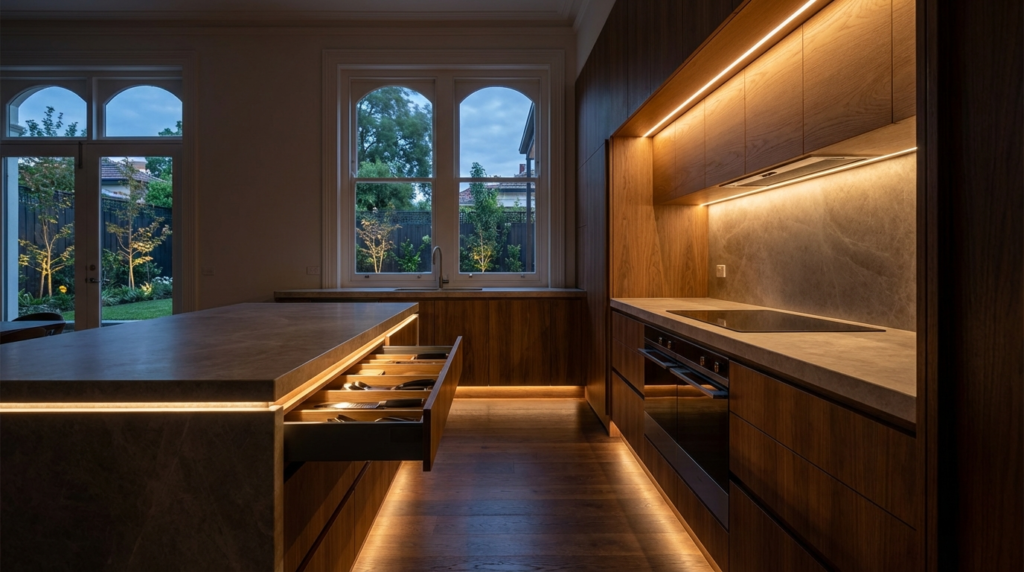
The Kitchen That Changed at 6pm
The Kew brief had a specific problem. The family used their kitchen across two entirely different contexts — school morning chaos and weekend dinner parties — and the existing lighting made no distinction between the two. One overhead fixture. One mood.
What we designed into the joinery was a three-layer LED system that the client controls with a single scene button.
7am mode: 4000K under-cabinet strips at 80% output. Cool, task-oriented. The island is a workbench. Lunchboxes are made efficiently.
6pm mode: 2700K toe-kick strips at 30%, island edge strips at 40%, overhead pendants at 60%. The room changes temperature. It becomes somewhere people want to be.
The joinery — American oak below, Caesarstone above — is the same room. The LED specification is what makes it two different experiences.
For kitchen renovations Kew projects specifically, the lighting specification conversation has become as important as the hardware conversation. Both are decided at documentation stage. Neither is an afterthought.
Why Layered LED Is Non-Negotiable in 2026 Premium Joinery
Five years ago, under-cabinet LED was a feature. A nice addition. Something specifiers included if the budget allowed.
In 2026, the absence of integrated LED in premium joinery is a visible omission — the equivalent of specifying quality hardware and then leaving the drawer faces without soft-close.
Three technical advances have driven this shift.
Driver miniaturisation. LED drivers — the power regulation components that convert mains voltage and enable dimming — have reduced in physical size to the point where they fit within a 100mm cabinet rail cavity. The technical excuse for not integrating drivers into the joinery carcass no longer exists.
Addressable strip quality. The difference between a $15-per-metre strip and a $65-per-metre strip is now visually apparent to any homeowner. Premium strips — specifically Hafele Loox 5 and equivalent quality systems — produce consistent colour temperature across their full length, do not produce visible hotspots at the LED positions, and maintain colour accuracy at dimmed outputs. The builder-grade alternatives that produce a cool blue tint at 20% dimming and an inconsistent yellow glow at full output are visible immediately in comparison.
Smart integration accessibility. Systems that integrate joinery LED with whole-home automation — Lutron, Control4, KNX — have reduced in cost and increased in installer availability to the point where specifying a smart-ready LED system is a decision made at the joinery documentation stage, not an expensive retrofit two years later.
Trend 1: Ultra-Thin Under-Cabinet and Toe-Kick Strips
The under-cabinet LED strip is the highest-value LED specification in a kitchen — the light that illuminates the benchtop work surface, eliminates shadow from overhead fittings, and defines the visual relationship between the cabinet base and the benchtop above.
The specification standard in 2026:
Strip specification: Hafele Loox 5 Series 2082, or equivalent at minimum 12W/m output and CRI ≥ 90. The CRI rating — Colour Rendering Index — determines how accurately the light represents the true colour of the surface beneath it. At CRI 90, Caesarstone Mineral greige reads as designed. At CRI 80 (the builder-grade standard), the same surface reads with a cast that shifts the colour character of the room.
Colour temperature: 2700K–3000K for heritage and transitional kitchens. 3000K–3500K for contemporary kitchens where the benchtop is lighter and task function is the priority. Not 4000K — this reads as commercial in a residential kitchen context.
Profile: Recessed aluminium channel, surface-flush with the underside of the cabinet. The strip is not visible from a standing position. The light source is hidden; only the light is seen.
Dimming: Always dimmable, connected to a trailing-edge dimmer rated to the total strip load. A 4-metre kitchen run at 12W/m = 48W — a standard trailing-edge dimmer handles this. A 10-metre run requires load calculation before specifying a dimmer.
Toe-kick strips are the specification that produces the floating cabinet effect — the horizontal light plane at floor level that visually separates the cabinetry base from the floor. At 2700K and 20% output, the toe-kick strip is not task lighting. It is the ambient element that makes a kitchen feel inhabited at 10pm without switching on the overhead system.
The 2026 Kitchen Benchtop Trends Melbourne post covers how benchtop material selection interacts with the colour temperature specification — a warm-toned quartzite reads differently under 2700K than under 3500K.
Trend 2: Integrated Wardrobe and Drawer Lighting
The wardrobe LED specification in 2026 operates on a different logic from the kitchen LED specification. In the kitchen, the primary function is task lighting. In the wardrobe, the primary function is activation — light that comes on when access happens and turns off when access ends, without switches.
Door-activated strip lighting uses a magnetic reed switch mounted in the door frame that completes the LED circuit when the door opens and breaks it when the door closes. The light appears with the door. The wardrobe interior is dark when not in use — extending LED life significantly over a continuously powered system.
Motion-activated strip lighting is the specification for walk-in wardrobes without doors — open dressing rooms where a passive infrared (PIR) sensor mounted at the entry point activates the full lighting circuit on approach and turns it off after a set period (typically 3–5 minutes) of no detected movement. This is the specification that the Kew project referenced in the introduction uses — the wardrobe lights are on when the client is there and off when they are not.
Drawer LED strips — narrow 4mm profile strips mounted on the forward drawer face interior wall, activating when the drawer opens — illuminate the internal organisation system without requiring an overhead light to angle correctly into an open drawer. In a 400mm deep drawer with a custom organiser insert, the strip at the front illuminates the full depth. Without it, the rear third of the drawer is in shadow regardless of the room lighting.
The luxury walk-in wardrobes Melbourne page covers the full wardrobe specification approach — the LED system is designed alongside the internal configuration, not added to it after the fact.
Specification note on American oak: Warm American oak veneer panels respond to LED colour temperature in a specific way. At 2700K, the honey tones in Crown Cut oak deepen and warm — the grain reads as more pronounced. At 3500K, the same panel reads cooler and the grain appears flatter. For American Oak Veneers In Depth projects, Silk Touch specifies 2700K throughout the wardrobe envelope — the material and the light work together rather than against each other.
Trend 3: Island and Feature Lighting with Dimming
The kitchen island in 2026 is a lit object as much as a functional surface. The LED specification for an island operates on three planes: above, below, and within.
Above — pendant integration. Island pendant lighting is architect or designer-specified in most Silk Touch projects. The joiner’s role is to ensure the canopy electrical connection points are positioned correctly for the pendant specification before the island is installed — after installation, relocating a pendant connection point requires reopening the ceiling. Silk Touch confirms pendant positions with the electrical trade before the island is fixed.
Below — toe-kick and base strip. The island toe-kick strip at 2700K, 20% output, creates the floating effect that is the signature detail of a well-specified island. The vertical face strip — a narrow strip mounted behind the island waterfall edge overhang, directed downward onto the stool zone — adds a second light plane that defines the seating area without a pendant.
Within — drawer and internal lighting. Island drawers — particularly pot drawers and deep storage drawers — benefit from the same door-activated strip specification as wardrobe drawers. A 600mm deep pot drawer with a 70kg load of cast iron is unlit unless the strip is there. With it, the full drawer contents are visible on opening.
Dimming scene control. The island lighting circuit is the one most frequently connected to a scene control system. A standard two-scene Lutron Diva dimmer — two buttons, two pre-set levels — allows the island to switch between a task lighting configuration and an entertaining configuration without accessing a phone app or a smart home panel. This is the accessible end of scene control and the specification Silk Touch recommends first for clients who want scene capability without full home automation investment.
Trend 4: Smart Systems and Colour-Temperature Control
Full smart LED integration — where the joinery lighting responds to time of day, presence detection, and external light level — is no longer a $50,000 custom installation reserved for Toorak penthouses. It is a $3,500–$8,000 specification decision that is made at documentation stage and installed during the joinery fit-out.
Tunable white strips — LED strips that shift colour temperature between 2700K and 5000K under instruction from a smart controller — are the product that makes the Kew project’s 7am/6pm scene distinction technically possible without installing two separate strip circuits. One strip, two temperatures, controlled by a scene button or a time schedule.
KNX integration is the professional-grade smart lighting specification used in Silk Touch’s highest-specification projects in Toorak and Kew. KNX is a wired protocol — the communication cable runs during the joinery installation, not as a retrofit — which means the decision to go KNX is made at documentation stage. The advantage over wireless systems is reliability: KNX does not depend on Wi-Fi signal strength or Bluetooth range. The disadvantage is cost: a KNX lighting system adds $8,000–$25,000 to the project depending on the number of circuits and scenes.
Lutron Caséta and Clipsal C-Bus are the mid-tier smart lighting specifications more commonly used in Silk Touch’s Camberwell and Hawthorn projects. Both are installer-programmable, app-controllable, and compatible with Apple HomeKit and Google Home. A Lutron Caséta system covering the kitchen and wardrobe lighting circuits runs $2,500–$5,000 installed, including the wall controls.
A note on wireless vs wired: Wireless smart lighting systems are easier to retrofit but dependent on signal continuity. In heritage homes with lathe-and-plaster walls — which attenuate wireless signal more than plasterboard — a wired system is the more reliable specification. Silk Touch confirms wall construction at survey and recommends accordingly.
Heritage Homes: Discreet LED That Respects the Architecture
The LED specification conversation in heritage homes requires a different starting point than in contemporary builds. The question is not “how much LED can we add?” — it is “where does LED add function without announcing itself?”
Heritage interiors in Hawthorn, Kew, and Camberwell have decorative features — ceiling roses, cornices, picture rails, dado rails — that create shadow and visual complexity at ceiling and wall level. Adding prominent LED strips in these contexts produces a visual conflict between the heritage elements and the modern technology. The correct approach is concealment and restraint.
Under-cabinet strips are invisible in heritage kitchens — the mounting position below the overhead cabinet rail means the strip is never in the sightline of the room. This is the LED specification that adds function (benchtop illumination) without any visual impact on the heritage character.
Toe-kick strips in heritage kitchens should be specified at lower output than in contemporary kitchens — typically 8W/m rather than 12W/m — and at 2700K. The effect is ambient rather than architectural, which is correct in a heritage context where the floor may be original tessellated tile or Baltic pine that does not need dramatising.
Wardrobe LED in heritage homes — where the wardrobe is often positioned in a former alcove or chimney breast — is the specification with the least visual conflict. The strip is inside the wardrobe. It activates when the wardrobe is open. It does not affect the room’s heritage character at all.
Recessed LED downlights in heritage ceilings are outside Silk Touch’s joinery scope but worth noting: Silk Touch coordinates with the electrical trade to ensure that any ceiling penetrations for downlights are positioned outside the original plaster rose and cornice geometry. A downlight cut through a heritage cornice is irreversible damage. Position confirmation is a documentation-stage item, not a site decision.
For bespoke joinery Toorak projects where the heritage context is most demanding, the LED specification is conservative by design — enough to function correctly, not enough to compete with the architecture.
How Silk Touch Designs and Installs LED
3D design with lighting simulation. The LED specification is included in the 3D model. Strip positions, driver locations, and switch positions are shown in the model before any commitment is made. For complex projects — multi-room LED with scene control — a rendered lighting simulation shows the approximate effect of different colour temperatures and dimming levels in the context of the actual room. This is not a substitute for a full lighting design, but it resolves the most common LED specification uncertainty before fabrication begins.
Factory wiring. LED drivers are installed in the carcass during factory fabrication. Driver location, cable routing, and connection point positions are built into the joinery — not resolved on-site. The strip itself is installed during site fit-out, connected to the pre-run cables. A factory-wired LED system eliminates the cable management improvisation that characterises retrofit LED installations and produces a result where no cable is visible anywhere in the finished joinery.
Switch and dimmer positioning. Switch and dimmer positions are confirmed with the electrical trade at documentation stage. In kitchens, the under-cabinet dimmer typically mounts inside a cabinet adjacent to the electrical supply point. In wardrobes, the PIR sensor mounting position is confirmed against the door swing direction — a sensor mounted where it is blocked by the open door does not function correctly.
On-site testing and calibration. At installation, all LED circuits are tested at full output, 50% output, and minimum output. Tunable white systems are tested across the full colour temperature range. Scene controllers are programmed and tested with the client present at handover — the client leaves knowing how every circuit and every scene operates.
Total programme from confirmed design to commissioned LED system: 6–8 weeks, with electrical coordination built into the timeline.
Cost Guide and Energy Considerations
Under-cabinet LED kit, standard kitchen run (4–6m), Hafele Loox 5, single temperature, dimmer included: $1,800–$3,200 supplied and installed.
Toe-kick LED, same kitchen: $800–$1,400 supplied and installed.
Wardrobe LED system, full walk-in (door-activated strips, motion PIR, island drawer strips): $2,400–$4,500 supplied and installed.
Island feature lighting (base strip, vertical face strip, no pendants): $1,200–$2,200 supplied and installed.
Scene control, two-circuit Lutron Diva (kitchen + island), two pre-set scenes: $800–$1,400 installed including programming.
Full smart LED system, Lutron Caséta, kitchen + wardrobe + vanity, app and scene control: $3,500–$6,500 installed.
KNX integrated lighting system, whole-home: $12,000–$30,000+ depending on circuit count.
Energy consumption: A full Hafele Loox 5 kitchen and wardrobe LED system — under-cabinet, toe-kick, island, and wardrobe — typically draws 80–120W total across all circuits. At Melbourne’s current electricity rate, running the full system at 50% output for 4 hours daily costs approximately $0.08–$0.12 per day. The operating cost argument for LED over any alternative light source is closed.
LED lifespan: Hafele Loox 5 rated at 50,000 hours. At 4 hours daily use, this is 34 years of operation before the strip requires replacement. In a premium joinery specification with a 20-year horizon, the LED system will outlast the renovation.
Real 2026 Inner East Projects
Kew, Federation kitchen and walk-in wardrobe, January 2026. The project referenced in the introduction. Three-layer kitchen LED — under-cabinet, toe-kick, island edge — on a two-scene Lutron Diva. Wardrobe on PIR motion activation. Tunable white strips in both spaces, 2700K entertainment mode / 3500K task mode. The client controls the scene from a single Lutron Pico remote on the kitchen wall.
Camberwell, Edwardian kitchen extension, December 2025. Under-cabinet Hafele Loox 5 at 2700K on the perimeter cabinets. Island specification was a vertical face strip behind the porcelain waterfall overhang, directed downward into the seating zone. No overhead LED — the architect specified pendants. The joinery LED and the pendant positions were coordinated at documentation stage to avoid visual conflict.
Hawthorn, heritage kitchen renovation, November 2025. Conservative specification — 8W/m under-cabinet strips at 2700K, no toe-kick (original tessellated tile floor). Wardrobe in a former study alcove: door-activated strips on a manual override switch. No smart integration — the heritage home had lathe-and-plaster walls throughout and the client declined a wired system on cost grounds. The result is functional, invisible, and appropriate to the architecture.
Toorak, full joinery project (kitchen, wardrobe, vanity), October 2025. KNX wired lighting throughout. Four scenes in the kitchen: morning task, daytime ambient, evening entertaining, and night (toe-kick only at 10%). Wardrobe on KNX occupancy sensor. Vanity LED mirror on KNX dimming circuit. The 2026 Bathroom Vanity Trends Melbourne post covers the vanity LED specification for this project in the bathroom context — the same KNX controller manages all three rooms from a single interface.
The Verdict: LED Is Now Part of the Joinery Specification
The LED system is not a lighting product added to a joinery project. It is a component of the joinery specification that is decided at documentation stage, wired at the factory, and installed as part of the fit-out.
The joinery without the LED specification performs correctly. The joinery with the correct LED specification performs as a designed object — one that changes character across the day, responds to presence, and makes the room feel inhabited rather than built.
In Silk Touch’s specification language, asking “should we include LED?” is the wrong question. The question is “which LED system is correct for this room and this client?”
That question is answered in the 3D consultation — with strip samples, colour temperature comparisons, and a scene simulation that shows the actual effect before a single panel is cut.
Book your free 3D design with LED simulation — the lighting conversation is part of the joinery conversation, and both start at the same meeting.
Frequently Asked Questions
What is the best LED strip brand for custom joinery in Melbourne? Silk Touch specifies Hafele Loox 5 as the primary LED system across kitchen, wardrobe, and vanity applications. The range produces consistent colour temperature across its full length, maintains colour accuracy at dimmed outputs, and is rated at 50,000 hours. It is available through professional joinery suppliers rather than hardware chains, and the quality difference relative to builder-grade alternatives is immediately visible in situ.
What colour temperature LED should I specify for a kitchen? 2700K–3000K for heritage and transitional kitchens where warm ambient quality is the priority. 3000K–3500K for contemporary kitchens with lighter surfaces where task clarity is more important than warmth. Avoid 4000K and above in residential kitchen contexts — this reads as commercial and does not complement timber veneer or natural stone benchtop specifications.
Can LED be added to existing joinery after installation? Yes, but the result is always a compromise relative to factory-wired integration. Retrofit LED requires surface-run cable, externally mounted drivers, and switch positions that may not be ideal. In an existing kitchen or wardrobe, a retrofit strip is better than no strip — but in a new joinery project, factory wiring eliminates every one of these limitations.
How much does LED joinery lighting cost in Melbourne in 2026? Under-cabinet LED for a standard kitchen run (4–6m) costs $1,800–$3,200 supplied and installed. A full walk-in wardrobe LED system with motion activation costs $2,400–$4,500. A complete smart LED system covering kitchen, wardrobe, and vanity on Lutron Caséta costs $3,500–$6,500. KNX whole-home integration starts at $12,000.
What is the difference between a smart LED system and a standard dimmer? A standard dimmer controls one circuit — manually adjusting the output of a single strip or group of strips. A smart system controls multiple circuits simultaneously, stores pre-set scenes (combinations of output levels across multiple circuits), and can be operated by a remote, an app, a time schedule, or a voice assistant. The practical difference is the ability to shift the room’s entire lighting character with a single input.
Does LED lighting affect the appearance of timber veneer in joinery? Significantly. American oak veneer at 2700K reads warmer and deeper — the grain figure is enhanced. The same panel at 3500K reads cooler and flatter. Walnut veneer at 2700K deepens to a rich chocolate; at 3500K it reads as mid-brown. Silk Touch confirms the LED colour temperature alongside the veneer specification — the two decisions are not independent.
Is LED lighting suitable for heritage homes in Melbourne’s Inner East? Yes — with a conservative specification approach. Under-cabinet strips are invisible in heritage kitchens and add function without affecting the heritage character. Toe-kick strips at lower output (8W/m) create ambience without architectural conflict. Wardrobe LED activates only when the wardrobe is open. The rule for heritage homes is concealment and restraint — LED that can be seen as a strip or fitting is the wrong specification.