Did you know that a well-executed kitchen renovation can boost your home’s value by up to 69%?
Understanding custom kitchen cost factors before starting your project is crucial for proper budgeting. Kitchen renovation costs in Melbourne typically range from $20,000 to $65,000+, depending on various elements . For a mid-size renovation, you might expect to invest between $25,000 and $50,000 , while more luxurious upgrades start at $50,000 and potentially climb much higher .
However, these figures only tell part of the story. When planning your custom kitchen, the price isn’t simply determined by square metres. Instead, it’s influenced by complexity, materials, and craftsmanship—much like a tailored suit rather than an off-the-rack purchase.
Furthermore, research from the Housing Industry Association suggests that average kitchen renovation prices for 2026 will be approximately $42,630 . Yet this figure varies significantly based on your choices of cabinetry ($8,000–$18,000), benchtops ($3,000–$9,000), and required trades ($5,000–$8,000) .
In this comprehensive guide, we’ll explore the key factors that influence custom kitchen prices in Melbourne, helping you understand where your money goes and how to budget effectively for your dream kitchen renovation.
Why Square Metre Rates Don’t Work for Custom Kitchens
Many homeowners assume that kitchen costs can be calculated simply by measuring the floor space and multiplying by a standard rate. This approach works for some renovation elements like tiling or flooring—but for custom kitchens, it’s entirely misleading.
Why joinery pricing Melbourne is based on complexity
Custom joinery pricing depends primarily on complexity rather than size. A compact kitchen with numerous drawers, pull-outs and specialised storage solutions requires more materials, hardware and labour than a larger kitchen with basic cupboards. Cabinet makers assess several factors when quoting:
- Number and type of cabinets (drawers cost more than doors)
- Internal configurations and storage solutions
- Construction techniques required
- Installation challenges in your specific space
The craftsmanship involved in creating precisely fitted joinery for your unique space requires skilled labour that can’t be reduced to a simple square metre calculation.
How layout and design choices affect cost
Your kitchen’s layout significantly influences the final price tag. Consider these design elements that drive costs beyond mere dimensions:
- Island benches require additional finishing on all sides
- Corner cabinets demand more complex solutions for accessibility
- Open shelving versus closed cabinetry affects material quantities
- Ceiling height variations require custom-sized upper cabinets
- Integrated appliances need precision cabinet construction
Each design decision creates ripple effects throughout the entire project. For instance, choosing a waterfall edge on your island bench not only requires additional stone but also demands more skilled fabrication.
Why two kitchens of the same size can cost vastly different
Two identically sized kitchens can have vastly different price points due to:
Material selection: Premium finishes like 2-pack polyurethane cabinetry or natural stone benchtops command higher prices than laminate alternatives.
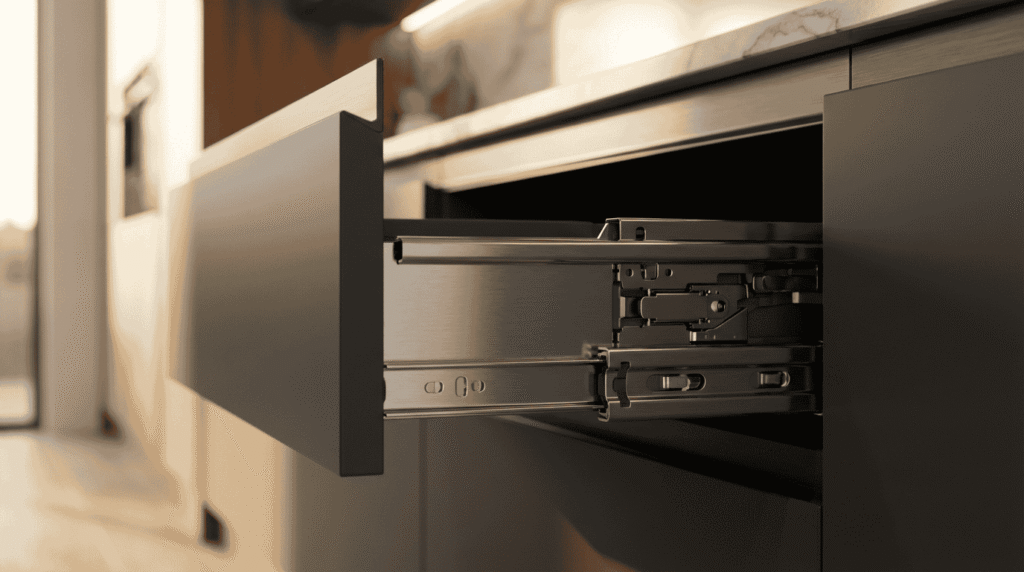
Hardware quality: Superior drawer runners, hinges and internal mechanisms from brands like Blum offer better functionality and longevity but at increased cost.
Structural modifications: One kitchen might require wall removal or services relocation while another uses existing infrastructure.
Complexity of details: Features like handleless cabinets, mitred edges or integrated lighting add sophistication but also increase manufacturing time and material costs.
The truly bespoke nature of custom kitchens means each project requires individual assessment based on its unique combination of materials, design elements and technical requirements—making square metre rates essentially meaningless as a budgeting tool.
The 3 Key Budget Levers in a Custom Kitchen
When planning a kitchen renovation, understanding the major cost drivers helps you control your budget more effectively. Throughout Melbourne, three main elements serve as your primary budget levers, allowing you to scale your investment up or down based on your priorities.
Cabinet finishes: Melamine vs. 2-Pack vs. Veneer
Cabinet materials create the foundation of your kitchen’s appearance and durability, with options spanning multiple price tiers:
Melamine represents the entry-level choice, offering practicality and value. This durable option features cabinets made from melamine-faced boards available in matte, gloss, and textured finishes. It’s particularly suitable for family kitchens or investment properties where practicality outweighs luxury. Melamine provides good functionality without the premium price tag of higher-end alternatives.
Moving up the scale, 2-Pack Polyurethane (often called 2Pac) offers a significant upgrade in appearance. This sprayed and baked paint system creates seamless edges and allows for virtually any colour choice. The process involves applying a two-part liquid concentrate that chemically cures to become remarkably hard—similar to automotive paint. Consequently, it delivers superior moisture and heat resistance compared to standard paint, making it ideal for Melbourne’s humid conditions.
At the premium tier, Timber Veneer provides the warm, natural appearance of real wood with greater stability than solid timber. This option features a genuine timber face applied to a stable core, delivering character without the complete cost of solid timber construction.
Benchtop materials: Laminate to natural stone
Your benchtop selection typically represents the second-largest material cost in a kitchen renovation:
Laminate benchtops remain the most budget-friendly option, costing substantially less than stone alternatives while offering impressive versatility. Modern laminates effectively mimic premium materials like timber and stone, providing design flexibility without the investment.
In the mid-range, Engineered stone (like Caesarstone) offers a more durable alternative to natural stone. Made by combining quartz, shells, or glass with bonding agents, these surfaces are less porous and more consistent in appearance than natural options.
For those seeking luxury, Natural stone such as granite and marble delivers unmatched visual impact. Each slab features unique patterns and organic textures that manufactured alternatives cannot truly replicate. Marble particularly adds a soft, luxurious aesthetic that many consider worth the additional maintenance requirements.
Internal hardware: From basic hinges to premium pull-outs
The often overlooked “invisible” components can substantially impact both functionality and budget:
Quality hardware dramatically affects your kitchen’s usability. Premium brands like Blum offer superior drawer runners, soft-close mechanisms, and specialised storage solutions that, although more expensive, provide significantly better daily functionality and longevity.
From basic hinges to sophisticated pull-out pantries, corner carousels, and integrated bin systems—these elements typically add 20-30% to cabinet costs but vastly improve your kitchen’s practicality. Consider allocating approximately 5-10% of your total interior budget specifically for door handles, locks, and hardware accessories.
What Else Impacts the Final Cost?
Beyond cabinetry and countertops, several additional factors substantially impact your final kitchen renovation cost.
Trades and services beyond cabinetry
Labour typically accounts for 40-50% of your total kitchen renovation budget [1]. Professional tradespeople charge varying rates depending on expertise and complexity:
- Cabinet makers often command premium hourly rates compared to other trades [1]
- Plumbers and electricians charge standard rates for basic work, with prices climbing for complex relocations [1]
- Plasterers become essential when removing old cabinets or fixtures, as they repair walls for a smooth finish [2]
Demolition, plumbing, and electrical considerations
Demolition teams may charge based on work extent, including disconnecting live wires, sealing plumbing, and hauling away debris [2]. Maintaining your current layout remains one sure way to control costs by avoiding expenses associated with relocating plumbing and electrical lines [2].
Moreover, structural modifications add considerable expense—removing a load-bearing wall requires engineering reports, permits, and support beams [3]. Upgrading from an electric cooktop to induction might necessitate a higher amp load on your distribution board, potentially requiring a new installation [3].
Splashbacks, flooring, and painting
Splashback costs vary according to:
- Material selection (glass, acrylic, or tile)
- Kitchen layout complexity
- Site preparation requirements
- Installation complexity [4]
Extending or replacing flooring adds unexpected expenses, especially if existing flooring proves difficult to match [3].
Temporary kitchen setup during renovation
Creating a functional temporary kitchen helps avoid additional accommodation costs [5]. Essential elements include:
- A designated area with access to electricity
- Compact refrigeration
- Basic cooking appliances like microwaves and hot plates
- Simple washing facilities [6]
This temporary setup allows you to prepare meals throughout the renovation process, reducing takeaway expenses and maintaining family routines [6].
How to Plan Your Renovation Budget Wisely
Proper preparation forms the foundation of successful kitchen renovations. Thoughtful budget planning prevents cost blowouts and ensures you achieve your dream kitchen without financial stress.
Why a renovation budget guide is essential
Effective budgeting ensures a smooth renovation process from start to finish. Firstly, establish clear parameters before diving into your project, as this helps determine where to invest and where to economise. Additionally, thorough planning helps avoid expensive last-minute changes that frequently derail renovations [7]. Tracking every expense using spreadsheets or dedicated apps helps maintain financial control throughout the project [8].
The importance of a contingency buffer
Setting aside a contingency fund is non-negotiable for Melbourne renovations. Experts recommend allocating 10-20% of your total budget for unexpected expenses [9]. This safety net proves vital when confronting hidden structural issues or discovering asbestos during demolition. In well-planned projects with detailed specifications, you might use only 3% of this buffer [10]. Nevertheless, having this financial cushion reduces stress and prevents compromising on quality when surprises emerge.
When to invest in design vs. save on materials
Strategic spending maximises your renovation’s impact:
- Invest in high-quality cabinetry, hardware and benchtops as they endure the most wear and tear [3]
- Consider engineered stone instead of natural stone for a premium look at lower cost
- Keep customisation minimal where possible—features like curved cabinetry significantly increase labour costs
How to avoid overcapitalising in your suburb
Ultimately, to prevent overcapitalisation, follow the 10% rule—limit your renovation budget to approximately 10% of your property’s current value, especially if selling soon [11]. Research the maximum sale prices in your area and ensure your renovation doesn’t exceed what the market can support [12]. Poor layout and design dramatically impact resale value, making professional design consultation worthwhile [11]. Book a consultation for an accurate quote because every home is unique and requires individualised planning to maximise return on investment.
Conclusion
Undertaking a kitchen renovation project in Melbourne requires careful planning and a thorough understanding of the various cost factors involved. As we’ve seen, custom kitchens defy simple square metre pricing because complexity, materials, and craftsmanship significantly influence the final investment. The three primary budget levers—cabinet finishes, benchtop materials, and internal hardware—allow you to scale your renovation according to your priorities and financial boundaries.
Beyond the visible elements, additional costs from demolition, plumbing, electrical work, and temporary kitchen setups must factor into your budget calculations. Therefore, establishing a comprehensive budget with a 10-20% contingency buffer protects you from unexpected expenses that commonly arise during renovations.
When allocating your funds, consider investing in high-quality cabinetry and hardware that withstand daily wear while perhaps economising on less critical elements. Additionally, always keep the property’s value in mind to avoid overcapitalisation—the 10% rule provides a useful guideline to ensure your renovation investment aligns with your home’s market position.
Ultimately, each kitchen renovation presents unique challenges and opportunities based on your specific space, requirements, and preferences. Book a consultation for an accurate quote because every home is unique, allowing expert designers to assess your space and provide tailored solutions that maximise both functionality and value. With proper planning and professional guidance, your new kitchen will not only enhance your daily life but also potentially add significant value to your Melbourne home.
Key Takeaways
Understanding these essential factors will help you budget effectively for your Melbourne kitchen renovation and avoid costly surprises.
• Custom kitchen costs aren’t based on square metres but on complexity, materials, and craftsmanship—two identical-sized kitchens can cost vastly different amounts.
• Control your budget through three key levers: cabinet finishes (melamine to veneer), benchtop materials (laminate to natural stone), and internal hardware quality.
• Factor in additional costs beyond cabinetry including trades, demolition, plumbing, electrical work, and temporary kitchen setup during renovation.
• Always include a 10-20% contingency buffer in your budget to handle unexpected expenses like structural issues or hidden problems.
• Follow the 10% rule to avoid overcapitalisation—limit renovation costs to roughly 10% of your property’s current value for optimal return on investment.
Remember that labour typically accounts for 40-50% of your total renovation budget, and professional consultation is essential since every home presents unique challenges and opportunities that require tailored solutions.
FAQs
Q1. What is the average cost of a kitchen renovation in Melbourne? The cost of a kitchen renovation in Melbourne typically ranges from $20,000 to $65,000+. For a mid-range renovation, you might expect to invest between $25,000 and $50,000, while more luxurious upgrades can start at $50,000 and potentially climb much higher.
Q2. What are the main factors that influence the cost of a custom kitchen? The primary factors influencing custom kitchen costs are cabinet finishes (from melamine to veneer), benchtop materials (from laminate to natural stone), and internal hardware quality. Additionally, complexity of design, layout choices, and required trades all play significant roles in determining the final price.
Q3. Why doesn’t square metre pricing work for custom kitchens? Square metre pricing isn’t effective for custom kitchens because costs are primarily based on complexity rather than size. Two identically sized kitchens can have vastly different price points due to material selection, hardware quality, structural modifications, and design intricacies.
Q4. How much should I budget for unexpected expenses during a kitchen renovation? It’s recommended to set aside a contingency fund of 10-20% of your total budget for unexpected expenses. This safety net is crucial for handling unforeseen issues like hidden structural problems or asbestos discovery during demolition.
Q5. How can I avoid overcapitalising on my kitchen renovation? To avoid overcapitalising, follow the 10% rule – limit your renovation budget to approximately 10% of your property’s current value. Research maximum sale prices in your area and ensure your renovation doesn’t exceed what the market can support. Consider investing in high-quality cabinetry and hardware while economising on less critical elements.
References
[1] – https://www.cameronconstruction.com.au/what-is-the-average-kitchen-renovation-cost-in-melbourne/
[2] – https://www.harringtonkitchens.com.au/kitchen-renovation-costs/
[3] – https://hackeraustralia.com.au/kitchen-renovation-costs-explained/
[4] – https://hipages.com.au/article/how_much_do_kitchen_splashbacks_cost
[5] – https://www.uzit.com.au/blog/how-to-live-in-house-during-kitchen-renovation
[6] – https://www.thegoodguys.com.au/whats-new/how-to-create-a-temporary-kitchen-during-a-renovation?srsltid=AfmBOooNPY9HZPNPWl6BsJL0BvV3dM4UUddNNa2h5PSFjjC7yRtw1CfO
[7] – https://www.haddonkitchens.com.au/kitchen-renovations/information/how-to-plan-a-kitchen-renovation-budget-layout
[8] – https://mccollcabinets.com.au/tips-for-managing-your-renovation-budget/
[9] – https://www.abodeconstruction.com.au/blog/kitchen-renovation-cost-in-australia-2025-comprehensive-guide
[10] – https://noblerenovation.com/why-contingency-matters-in-every-remodel/
[11] – https://www.ljhooker.com.au/blog/how-not-to-over-capitalise-on-your-home-renovation
[12] – https://duotax.com.au/insights/avoid-overcapitalisation/