The 3-Square-Metre Room That Changed Everything
The Camberwell family came to Silk Touch with a laundry that measured 2 metres by 1.5 metres. Dark. One overhead shelf. A top-loader that blocked the door from opening fully. A drying rack permanently deployed in the middle of the room because there was nowhere else for it to go.
Their brief was simple: “We want to stop dreading going in there.”
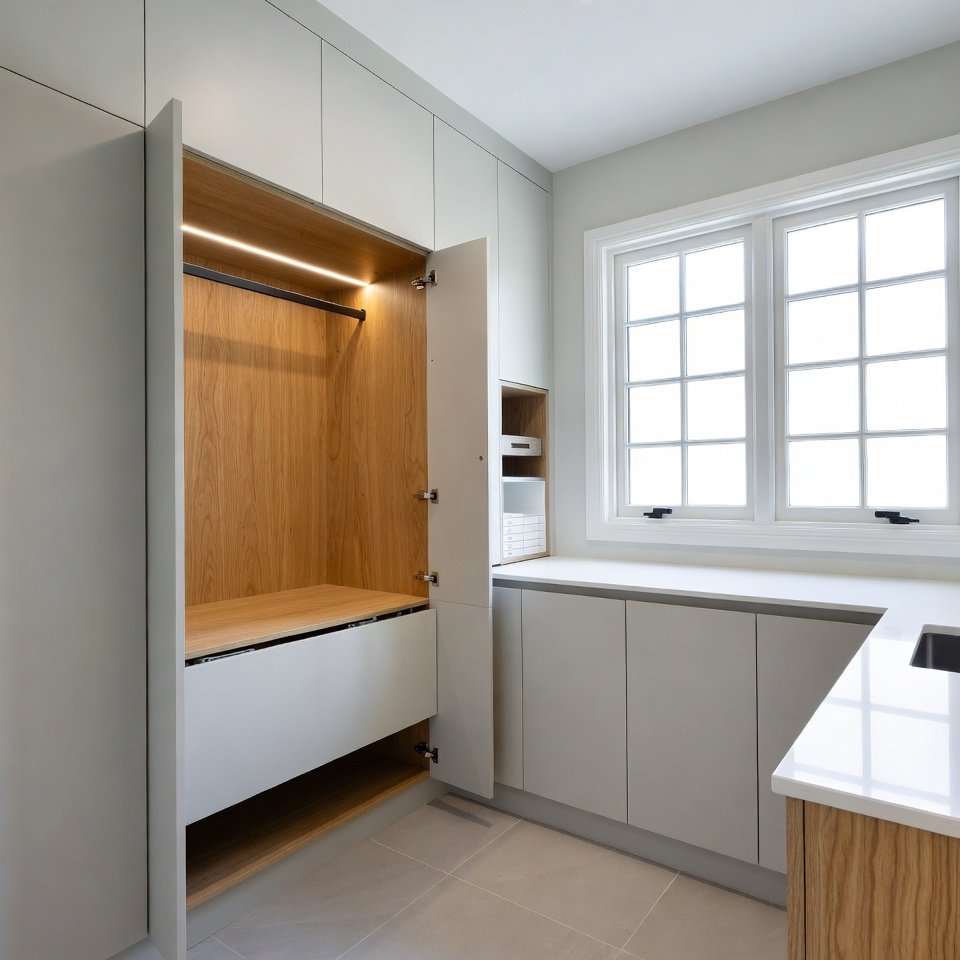
What we built in that same footprint: a pull-out folding bench over the front-loading machines. A full-height hidden drying cabinet with internal LED strip and HAWA pocket door—invisible when closed, fully functional when open. A tall pull-out hamper stack with three sorted baskets. An integrated sink with under-bench storage. And joinery finished in Fenix NTM Grigio Efeso that matched the family’s recently renovated kitchen two rooms away.
The room did not get larger. It got designed.
If you are planning a kitchen or laundry renovation in Camberwell or the surrounding suburbs, the laundry conversation often starts the same way—and finishes the same way too. Kitchen renovations Camberwell regularly prompt clients to address the laundry at the same time, because the aesthetic continuity argument is compelling once you see it in 3D.
Why a Custom Laundry Is the Smartest Upgrade in 2026 Melbourne Homes
The laundry is the most overlooked room in the Inner East renovation conversation. Budgets go to kitchens, bathrooms, and living areas. The laundry receives whatever is left over—or nothing at all.
This is changing, and the reason is practical rather than aspirational.
Melbourne’s Inner East housing stock—Federation terraces, Edwardian semis, Californian Bungalows—was built when laundries were service rooms positioned outside the primary living envelope. A copper tub in a lean-to. Functionality was the only brief.
In 2026, that same room is expected to process the laundry of a four-person household, store cleaning supplies, handle pet washing, function as an overflow pantry, and not look like a service room when the kitchen extension door is open. The original 1920s laundry allocation cannot meet that brief without joinery.
The argument for doing it properly is also financial. A well-designed custom laundry adds measurable value to a property in this market. Buyers in the $2.5M–$5M bracket—which describes much of Camberwell and Hawthorn—read laundry joinery quality as a proxy for the standard of the overall renovation. A builder-grade laundry in a premium kitchen renovation is a contradiction that valuers and buyers both notice.
Trend 1: Hidden Drying and Ironing Cabinets
The drying rack on the floor is the most space-consuming object in the average Melbourne laundry. It occupies between 0.4 and 0.6 square metres of floor space when deployed—in a 3-square-metre room, that is 15–20% of the total area, permanently unavailable.
The solution is a hidden drying cabinet: a full-height or three-quarter-height cabinet with internal horizontal drying rails and an integrated LED strip, concealed behind a HAWA pocket door that slides into the cabinet body on opening. When closed, it reads as a flush cabinet front. When open, it presents a fully functional drying zone without occupying floor space.
The technical specification:
- Cabinet depth: 600mm minimum to allow garments to hang without contact with the door frame
- Rail spacing: 300mm vertical centres, adjustable on a track system
- LED specification: Hafele Loox 5 strip at 3000K warm white — the same colour temperature used in kitchen under-cabinet lighting, which matters when the laundry is visible from the kitchen
- Door mechanism: HAWA Variofold pocket door system, rated to 25kg door weight, fully concealed within the cabinet body when open
- Ventilation: A 100mm exhaust port at the cabinet top, connected to the existing laundry exhaust, prevents moisture accumulation within the closed cabinet
The ironing station variant integrates a fold-down ironing board on the inside of the cabinet door—spring-loaded, rated to 8kg—that deploys at bench height and folds flush when not in use. The iron itself stores on a bracket inside the cabinet body. The entire system occupies 400mm of cabinet width.
Trend 2: Pull-Out Folding Stations and Drop-Down Benches
Standard laundry benchtops sit above the machines and provide approximately 600mm of depth. In a narrow laundry, this benchtop is inaccessible during loading and unloading cycles—you cannot fold on a surface you need to stand beside to reach the machine door.
The pull-out folding station solves this. A full-extension pull-out bench—typically 900mm wide, 550mm deep, finished in the same laminate or stone as the benchtop above—slides out on Blum Legrabox runners rated to 70kg, presenting a working surface at bench height directly in front of the user. When retracted, it sits flush with the cabinetry face. Nothing projects. Nothing obstructs.
The drop-down bench is the alternative for laundries with insufficient depth for a pull-out. A 600mm wide panel finished on both faces folds down from a wall-mounted bracket on soft-close hinge arms, presenting a bench surface at 900mm height. When folded up, it reads as a wall panel. The bracket mechanism supports 80kg static load—adequate for sorting and folding full loads.
Both solutions require Blum or Hettich hardware specified to the correct weight rating. The hardware specification conversation for laundry joinery follows exactly the same logic as kitchen hardware—load first, then mechanism, then finish. For a detailed technical comparison of both hardware systems, Blum vs Hettich Hardware Melbourne 2026 covers the specification decision in full.
Trend 3: Integrated Sink, Tap, and Drying Rack Combinations
The laundry sink is frequently an afterthought—a freestanding trough dropped into a corner with exposed plumbing and no storage beneath. In a custom laundry, the sink is a designed element with specific functional integration.
Undermount laundry sinks in stone composite or vitreous china are specified into a continuous benchtop, with the tapware chosen to match the kitchen specification. In Camberwell and Hawthorn homes where the kitchen benchtop is Caesarstone or Neolith, specifying the same material in the laundry creates visual continuity that reads as deliberate rather than accidental.
Below the sink, the under-bench space is not wasted on plumbing access alone. A pull-out cleaning caddy on Blum Legrabox runners—400mm wide, divided internally for spray bottles, cloths, and cleaning products—sits beside the plumbing stack and uses the full under-bench depth. The plumbing is accessible via a removable panel at the rear.
Above the sink, a retractable drying rack on a ceiling-mounted track system deploys over the sink area for hand-wash items and retracts flush to the ceiling when not in use. This is a mechanical solution that requires ceiling height of at least 2.4 metres to function correctly—standard in most Inner East homes, but worth confirming at survey stage.
The tap specification in a laundry context prioritises function over aesthetics without sacrificing either. A pull-out spray mixer tap with a retractable head allows the sink to function for both laundry soaking and pet washing without requiring a separate fixture. In homes where the laundry doubles as a pet-wash zone, this is the single specification change that makes the room genuinely multi-functional.
Trend 4: Tall Pull-Out Hampers, Shoe Storage, and Pet-Wash Zones
Storage in the laundry is not just about cabinetry capacity—it is about sorted, accessible storage that reduces handling time.
Tall pull-out hamper systems are full-height cabinets with two or three canvas or wire basket inserts on a single pull-out frame. The frame extends fully on Blum Legrabox runners, presenting all three baskets simultaneously. Sorted washing—lights, darks, colours—goes directly into the correct basket at source. No sorting step before machine loading.
The basket material specification matters in the laundry humidity environment. Powder-coated wire baskets handle moisture without corrosion. Canvas inserts require a breathable liner to prevent mildew. Silk Touch specifies wire for primary hamper baskets and canvas only for shoe storage or dry-goods applications.
Integrated shoe storage in the laundry is increasingly requested in Camberwell and Hawthorn families with children in multiple sports. A dedicated 300mm wide column with adjustable shelving at 150mm vertical centres, finished with a ventilated door panel, handles a family’s sports shoe rotation without the hallway pile that characterises most entry management systems.
Pet-wash zones are the fastest-growing specification in Melbourne Inner East laundries. A raised tiled zone—typically 800mm wide by 600mm deep with a recessed floor drain—at bench height replaces the bath-level struggle of washing a medium to large dog. The zone is tiled in the same tile specification as the laundry floor, with a hand-held shower rose on a slide rail and a soft-close timber-slatted ramp that folds up flush with the cabinetry when not in use.
The hidden storage logic that governs custom laundry design connects directly to the approach used in butler’s pantries. The Ultimate Guide to Butler’s Pantry Designs Melbourne covers the storage hierarchy principles that apply equally to laundry joinery planning.
Materials and Finishes That Last
The laundry operates in Melbourne’s most humidity-variable domestic environment. The morning shower from the adjacent bathroom, the steam cycle from the dryer, the wet dog after a winter walk—all of these create a humidity cycling pattern that standard kitchen materials do not fully account for.
Fenix NTM is Silk Touch’s preferred finish for laundry cabinetry door and panel faces. The oleophobic matte surface resists cleaning product residue and the fingerprint marking that occurs in a high-contact environment. The thermal self-healing property is relevant in the laundry context—a dropped iron or a scraping hamper basket creates exactly the micro-scratch conditions that Fenix’s acrylic resin surface can recover from.
American oak veneer on a moisture-resistant MDF substrate is the correct specification for laundries where the client wants timber warmth. Quarter Cut oak—tighter, more linear grain than Crown Cut—is preferred in laundry applications because the reduced grain figure reads as cleaner in a functional room context. The finish must be low-sheen polyurethane at 10–20% gloss level — anything higher shows water marks immediately.
For the aesthetic continuity that clients increasingly request—matching the laundry to the kitchen—the 2026 Kitchen Island Trends for Melbourne’s Inner East Homes post covers the material decisions in kitchen contexts. The same Fenix tones and oak veneer specifications that appear in that guide translate directly into the laundry without modification.
Carcass specification is non-negotiable in a laundry context: 18mm marine-grade ply throughout, not MDF with ply exceptions. The humidity differential across a laundry’s daily cycle — from dry morning to steam-heavy evening — stresses adhesive bonds and substrate integrity continuously. Marine-grade ply handles this. Standard particleboard does not.
Benchtops in laundries should be either Caesarstone or sintered stone (Neolith or Dekton). Laminate benchtops in laundry environments absorb moisture at joins and edges within three to five years. The replacement cost exceeds the original saving. The porcelain laundry sink undermount into Caesarstone is a specification that does not require revisiting.
How Silk Touch Designs and Builds Custom Laundries
Week 1: Free 3D design consultation and laser measure. The laundry survey is conducted with a laser measure accurate to ±1mm. Every wall variation, ceiling height change, door swing, window reveal, and plumbing position is recorded. Heritage laundries in Camberwell and Hawthorn regularly present 15–25mm wall variations across a 2-metre run — variations that a tape measure misses and a laser measure captures. The 3D model is built from the actual room, not a rectangular approximation of it.
Week 2: Design development and material confirmation. The 3D model is presented with material options and hardware specifications. The internal configuration — hamper positions, drying cabinet location, folding station mechanism — is confirmed in the model before anything goes to fabrication. Changes at this stage cost nothing. Changes after fabrication begins cost significantly.
Weeks 3–5: Local Melbourne manufacture. Every cabinet is fabricated at Silk Touch’s Melbourne workshop. The carcass is built, the doors are finished, the hardware is pre-fitted, and the internal organisation systems are installed before the joinery leaves the factory. The laundry arrives on-site as a complete system, not as flat-pack components.
Weeks 6–7: Installation and scribing. Heritage laundries require on-site scribing. The base return is cut to the actual floor profile. Wall panels are scribed to the actual plaster face. Gaps that would be visible in a standard installation are eliminated. The plumber connects the sink after the joinery is set and level — not before.
Week 8: Final adjustment and client walkthrough. Soft-close calibration is set with drawers loaded. Hamper runners are adjusted under basket weight. The drying cabinet mechanism is tested with garments in situ. The client walkthrough confirms every function before handover.
Total programme: 6–8 weeks from confirmed design to completed installation.
Heritage vs Modern Homes: Clever Solutions for Each
Heritage Laundries: Federation, Edwardian, Californian Bungalow
The original laundry in a heritage home is typically a lean-to addition — lower ceiling, thinner walls, and a floor that is neither level nor square. Every one of these conditions requires a response at the design stage.
Low ceilings (below 2.2 metres) eliminate the ceiling-mounted retractable drying rack as an option. The alternative is a wall-mounted fold-down rack on a HAWA fitting, deploying horizontally from a cabinet face at bench height. It occupies the same cabinet width footprint as a standard door but provides 600mm of drying depth when deployed.
Non-square rooms require cabinet runs to be designed in sections rather than as a continuous run. A heritage laundry with 12mm of wall variation across 1.8 metres cannot accommodate a single flat cabinet carcass without visible gaps at one end. Silk Touch designs heritage laundry joinery in two or three sections with scribed filler panels at the joints — a fabrication approach that adds cost but eliminates the gap.
Heritage overlay considerations in Boroondara and Stonnington generally do not affect internal laundry works, but where the laundry is accessed from or visible from a heritage-significant external space, the material and colour palette may be subject to council sensitivity. Navigating Heritage Overlays in Boroondara & Stonnington covers the planning context that may be relevant.
For kitchen renovation Hawthorn projects where the heritage laundry is adjacent, the aesthetic connection between the two rooms is a design opportunity rather than a constraint. Matching the Fenix tone or oak veneer specification across both rooms is the approach that reads as a complete renovation rather than two separate projects.
Modern Homes and Contemporary Extensions
Contemporary laundries in new builds or rear extensions have the dimensional consistency that makes specification straightforward. Standard ceiling height, level floors, and plumb walls allow the full range of options — retractable ceiling racks, full-height joinery, continuous benchtop runs — without the heritage workarounds.
In these contexts, the specification focus shifts to integration. The laundry that matches the kitchen in material, colour, and hardware brand is the contemporary specification. The room reads as a continuation of the home’s design language rather than a utility afterthought.
Cost Guide: What Influences Price in 2026
Custom laundry joinery in Melbourne’s Inner East is not a commodity product, and the price reflects the specification rather than a market rate.
Entry-level custom laundry (basic carcass, standard hardware, laminate finish): $8,000–$12,000 installed. Appropriate for a laundry where the primary goal is functional improvement over a builder-grade fit-out.
Mid-specification custom laundry (Fenix or veneer finish, Blum or Hettich hardware, integrated sink, pull-out hamper): $14,000–$22,000 installed. This is the specification range for most Camberwell and Hawthorn family laundry projects.
Full custom specification (Fenix NTM, marine-grade ply carcass, Blum Legrabox throughout, hidden drying cabinet, pull-out folding station, pet-wash zone, Caesarstone benchtop): $25,000–$38,000 installed. Appropriate for a laundry that is a designed room within a premium renovation, matching the kitchen standard throughout.
The variables that move price most significantly:
Benchtop material — Caesarstone adds $2,500–$5,000 over laminate depending on the run length. Sintered stone adds a further 15–20%.
Hidden drying cabinet — the HAWA pocket door mechanism, internal rail system, and LED lighting add $3,500–$5,000 to the base cabinet cost.
Pet-wash zone — the tiled recess, drain, and plumbing adds $4,000–$7,000 depending on tile specification and plumbing complexity.
Heritage scribing and non-standard geometry — wall variation, non-square rooms, and irregular ceiling heights add $1,500–$3,500 to the installation cost depending on severity.
The Verdict: The Laundry Deserves the Same Attention as the Kitchen
The laundry is used every day. Often twice. By everyone in the household. The argument for investing in it properly is not aspirational — it is cumulative. A room that functions correctly, stores everything it needs to store, and looks considered rather than provisional makes a measurable difference to daily life.
It also makes a measurable difference to property value. In Camberwell and Hawthorn, where buyers at the upper end of the market expect continuity of finish throughout the home, a premium laundry is not a selling point. It is an expectation.
Silk Touch designs and builds custom laundries with the same technical rigour applied to kitchens and wardrobes — marine-grade ply carcasses, premium hardware, on-site scribing, and a 3D design process that resolves every spatial constraint before a single panel is cut.
Book your free in-home laser measure and 3D design consultation — bring the room dimensions if you have them, but the laser measure handles the rest.
Frequently Asked Questions
How much does a custom laundry cost in Melbourne in 2026? Custom laundry joinery in Melbourne’s Inner East ranges from $8,000–$12,000 for an entry-level fit-out to $25,000–$38,000 for a full specification with Fenix NTM finish, Blum hardware, hidden drying cabinet, pull-out folding station, and Caesarstone benchtop. Mid-specification projects — the most common range for Camberwell and Hawthorn families — sit between $14,000 and $22,000 installed.
How long does a custom laundry take to design and install? Silk Touch’s standard programme is 6–8 weeks from confirmed design to completed installation. This includes laser survey, 3D design, local Melbourne manufacture, delivery, installation, and on-site scribing. Laundry projects do not extend this timeline relative to kitchen projects of similar specification.
Can a custom laundry be designed for a heritage home with a non-square room? Yes — and this is a specific area of Silk Touch expertise. Heritage laundries with non-square rooms, low ceilings, and irregular wall surfaces are designed in cabinet sections with scribed filler panels and on-site adjustments. The 3D design model is built from the laser-measured actual room dimensions, not a rectangular assumption.
What is a hidden drying cabinet and how does it work? A hidden drying cabinet is a full-height or three-quarter-height cabinet with internal horizontal drying rails and LED lighting, concealed behind a HAWA pocket door that slides into the cabinet body on opening. When closed, it reads as a flush cabinet face. When open, it provides a full drying zone without occupying floor space.
What finishes are best for laundry joinery in Melbourne? Fenix NTM is the preferred finish for laundry cabinetry — its oleophobic surface resists cleaning product residue and the thermal self-healing property handles micro-scratches from high-contact use. American oak veneer in Quarter Cut profile with a low-sheen polyurethane finish is the correct timber specification. All carcasses should be marine-grade ply regardless of the door finish.
Does Silk Touch match the laundry joinery to an existing kitchen? Yes. Material and colour matching across kitchen and laundry is a standard service. Silk Touch holds current Fenix NTM and Polytec sample ranges and can match an existing kitchen specification precisely. Where the kitchen uses a custom 2-Pac colour, the same colour reference is used in the laundry finish.
Can a pull-out folding station fit in a small laundry? A pull-out folding station requires a minimum cabinet width of 800mm and a clear floor depth of 1,000mm in front of the cabinet when fully extended. In laundries where floor depth is restricted, the drop-down wall-mounted bench is the alternative — it requires zero floor depth when retracted and presents a 600mm working surface when deployed.