The Camberwell Kitchen That Made Us Specify Both
The brief was specific. A young family in Camberwell, Federation home, full kitchen rebuild. High-use environment—three children, a committed home cook, and a husband who described his relationship with the pantry door as “complicated.”
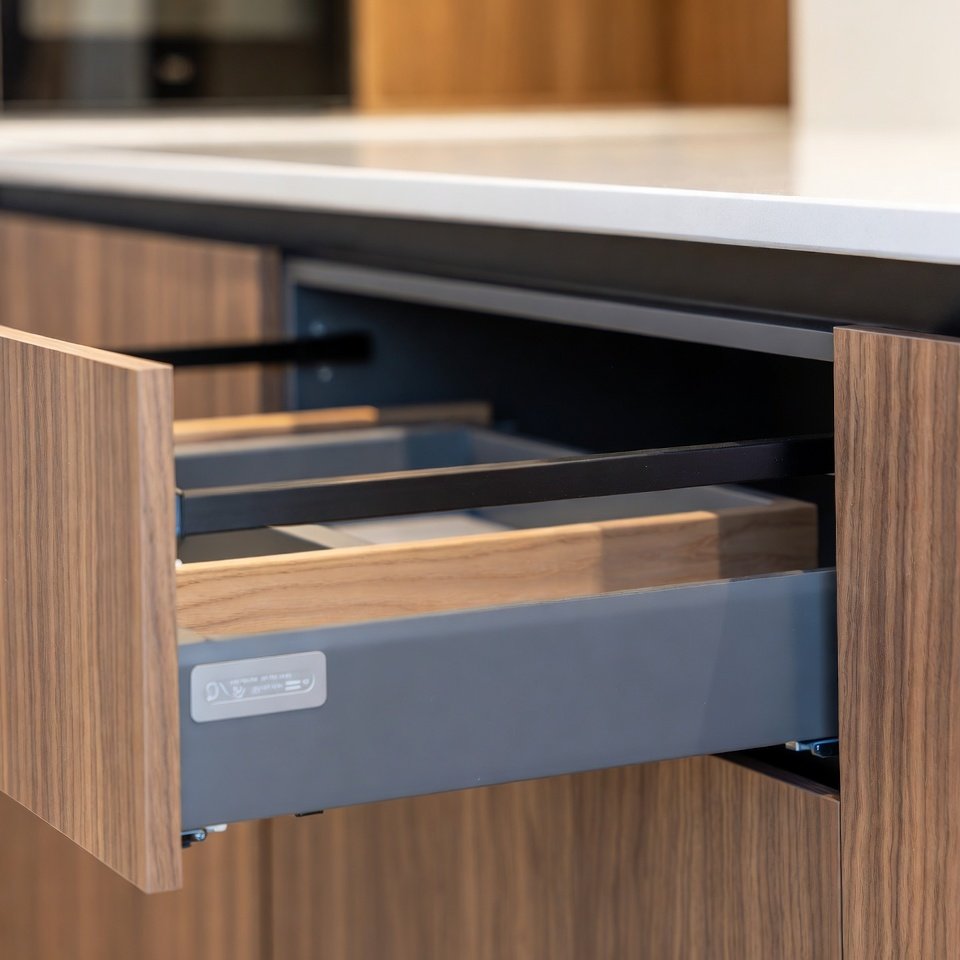
We specified Blum Legrabox on every drawer. Forty-two kilograms of cast iron cookware across three pot drawers. Daily. The Legrabox rated to 70kg per pair without complaint.
For the overhead cabinetry? Hettich Wingline. The kitchen had a low ceiling return on one side that ruled out standard lift systems. Wingline’s folding door mechanism opened fully within the cabinet depth, requiring zero clearance above. Problem solved without redesigning the joinery.
The client’s feedback at the six-week mark: “The drawers feel surgical. The doors feel theatrical.”
That project is why Silk Touch stocks both systems. Not because we cannot choose, but because the right answer depends on the room, the load, the architecture, and the homeowner. And in kitchen renovations Camberwell, the architecture is rarely simple.
Here is the complete technical picture for 2026.
Why Hardware Choice Matters More Than Ever in 2026 Melbourne Joinery
Five years ago, hardware was a finishing conversation—something that happened after the carcass design was locked. That approach produced a generation of kitchens where beautiful cabinetry fronts concealed runner systems that failed within three years.
The shift in 2026 is that hardware is now a structural specification decision, not a cosmetic one.
Three forces are driving this in Melbourne’s Inner East.
First, renovation investment has increased significantly. Kitchens in Toorak, Kew, Hawthorn, and Camberwell are being built to fifteen-year or twenty-year standards. At that horizon, hardware longevity is not a preference—it is a financial requirement. A $350 runner system that performs for twenty years is cheaper than a $120 system replaced twice.
Second, usage intensity has increased. Hybrid and remote work patterns mean kitchens operate across twelve-to-fourteen-hour daily windows. Drawers that were opened four times daily in 2019 are opened twelve times daily in 2026. Cycle ratings matter now in a way they simply did not before.
Third, homeowners are more informed. The specification conversation that once happened only between joiner and designer now involves the homeowner directly. Clients arrive knowing brand names, asking about load ratings, and requesting specific finish options. That is a healthy shift. It is also one that requires a joiner who can answer the question honestly rather than defaulting to whatever system their factory is set up for.
Silk Touch answers that question with data. Here is the data.
Blum at a Glance: Austrian Engineering, Thirty Years of Refinement
Blum is an Austrian manufacturer founded in 1952. Their product range dominates the upper end of the residential joinery market globally, and for specific reasons that are worth understanding technically rather than just accepting as received wisdom.
Legrabox
The Blum Legrabox is the current-generation drawer system and the product Silk Touch specifies most frequently on primary kitchen cabinetry. It replaced the Tandembox line and represents a genuine engineering advance rather than a cosmetic refresh.
Key technical facts:
- Load capacity: 70kg per drawer pair (standard); 40kg (light)
- Extension: Full extension with integrated soft-close on all versions
- Actuation: BLUMOTION soft-close, adjustable in three zones—opening resistance, closing speed, and final position
- Material: Thin-wall steel side profile at 12.8mm, meaning less visual mass in the drawer opening
- Adjustment: Three-dimensional adjustment (height, lateral, depth) without tools after installation
- Cycle rating: 500,000 cycles tested
The Legrabox also accepts AMBIA-LINE internal organisation inserts—a system of longitudinal and cross dividers that transform a standard pot drawer into a configured storage solution without third-party inserts or retrofitting.
Space Corner
Blum Space Corner is the internal corner solution for L-shaped and U-shaped kitchens. It replaces the dead corner with a pull-out system that brings the full corner volume to the front of the cabinet on opening. The mechanical linkage is internally synchronised—both shelves move together without user adjustment.
In heritage homes where the kitchen footprint is constrained and corner cabinets are unavoidable, Space Corner is frequently the specification that converts a frustrating corner into functional storage.
Aventos Lift Systems
Blum Aventos is a range of lift door systems for overhead cabinetry. Four configurations exist:
- Aventos HK — pivot hinge for small overhead doors
- Aventos HL — full lift-up, door opens parallel to ceiling
- Aventos HF — bi-fold, door folds in two
- Aventos HS — swing-up, door swings up at an angle
Each system includes BLUMOTION integrated soft-close and a tension adjustment mechanism calibrated to the door weight. Critically, Aventos systems include a SERVO-DRIVE option—electrically actuated opening via light touch or push sensor—which is increasingly specified in accessibility-conscious or premium-finish projects where hand contact on cabinetry fronts is minimised.
Hettich at a Glance: German Precision, Genuine Innovation
Hettich is a German manufacturer founded in 1888. Their product philosophy is different from Blum’s in a specific way: Hettich tends to innovate at the system level, producing hardware solutions for spatial problems that standard runners and hinges cannot solve.
Actro
Hettich Actro is the primary drawer runner range competing directly with Blum Legrabox. Technical comparison:
- Load capacity: 70kg per pair (Actro 5D) / 30kg (standard Actro)
- Extension: Full extension with integrated soft-close
- Actuation: Silent System soft-close, adjustable
- Adjustment: Five-directional adjustment (height, lateral, depth, tilt, and inclination) — one additional axis over Legrabox
- Profile height: Available in 70mm and 90mm variants
- Cycle rating: 500,000 cycles tested
The five-directional adjustment on the Actro 5D is the technical differentiator. In heritage homes where floors and walls are out of true, the additional adjustment axis means drawer faces can be set perfectly parallel even when the carcass is not. This is a meaningful specification advantage in Edwardian and Federation kitchens where achieving a flush drawer front across six adjacent drawers requires every available adjustment point.
ArciTech
Hettich ArciTech is a drawer system with a distinctive design feature: a curved profile on the inner side panel that creates visual interest in open-plan kitchens where drawers are frequently visible from living areas. The system carries the same 70kg load rating as Actro 5D and accepts Hettich’s innotech internal organisers.
It is worth specifying in drawer-heavy islands where the drawer interior is a design statement as well as a functional element.
Wingline
Hettich Wingline is the product that solves the problem Aventos cannot. Where Aventos HL requires clearance above the cabinet for the door to lift fully, Wingline folds the door into itself within the cabinet depth. The result is a lift system that functions correctly with zero overhead clearance.
In Melbourne’s Inner East, where heritage ceilings often mean overhead cabinetry sits closer to the ceiling than modern construction allows, Wingline is frequently the only viable specification for full-access overhead storage. Silk Touch has installed it in six Hawthorn and Camberwell projects in the past eighteen months where Aventos would have required either a cabinet redesign or a permanent partial obstruction.
Hettich Sensys Hinges
Hettich Sensys is the premium hinge range with integrated soft-close and 165-degree opening angle. The design is frameless-compatible and includes a clip-on system that allows door removal without tools—relevant for kitchen maintenance access and for painted cabinetry where hinge removal for touch-up painting is a periodic requirement.
Side-by-Side Comparison
| Specification | Blum Legrabox | Hettich Actro 5D |
|---|---|---|
| Load capacity | 70kg per pair | 70kg per pair |
| Adjustment axes | 3-directional | 5-directional |
| Soft-close system | BLUMOTION | Silent System |
| Cycle rating | 500,000 | 500,000 |
| Internal organiser | AMBIA-LINE | innotech |
| Side profile width | 12.8mm | 12.8mm |
| Servo-drive option | Yes (SERVO-DRIVE) | Limited |
| Noise level | Extremely low | Extremely low |
| Warranty | Lifetime (residential) | 10 years |
| Price point | Premium | Premium |
| Best application | High-load primary drawers, organised storage | Heritage homes, precision-alignment situations |
| Specification | Blum Aventos | Hettich Wingline |
|---|---|---|
| Door type | Lift-up / bi-fold / swing | Folding (inline) |
| Overhead clearance | Required (HL, HF) | Zero required |
| Soft-close | Integrated (BLUMOTION) | Integrated |
| Electric actuation | SERVO-DRIVE available | Not standard |
| Best application | Standard ceiling heights, contemporary builds | Low ceilings, heritage homes, tight overhead clearance |
| Specification | Blum Clip Top Blumotion | Hettich Sensys |
|---|---|---|
| Opening angle | 110° / 165° | 165° |
| Soft-close | Integrated | Integrated |
| Clip-on system | Yes | Yes |
| Adjustment | 3D | 3D |
| Best application | Standard cabinetry, high volume | Painted cabinetry, frequent door removal |
Blum vs Hettich by Room
Kitchens
For primary kitchen cabinetry—base drawers, pot drawers, cutlery drawers—Silk Touch defaults to Blum Legrabox with AMBIA-LINE inserts. The 70kg rating handles cast iron without degradation. The AMBIA-LINE system organises the internal space from day one. The BLUMOTION soft-close is the quietest in class.
For overhead cabinetry in standard ceiling-height kitchens, Blum Aventos HL is the specification. For heritage homes and tight ceiling returns, Hettich Wingline is correct.
For pantry pull-outs and tall cabinet internal hardware, Blum’s Space Corner and pull-out column systems are preferred for their mechanical simplicity and cycle reliability.
The 2026 Kitchen Island Trends Melbourne post covers how these hardware decisions integrate specifically into island cabinetry—where load ratings and internal organisation are concentrated into a smaller footprint.
Wardrobes
Wardrobe hardware operates at lower load but higher cycle frequency than kitchen hardware. A bedroom wardrobe in active use cycles its doors and drawers more often than any kitchen drawer.
For wardrobe drawers, Silk Touch specifies Hettich Actro in most cases. The five-directional adjustment is valuable in wardrobes where floor levels vary between rooms, and the lower price point relative to Legrabox is justified given the lower loads.
For wardrobe lift systems and folding door hardware, Hettich Wingline is frequently the specification in walk-in wardrobes where the wardrobe occupies a former bedroom and ceiling heights are standard domestic. The luxury walk-in wardrobes Melbourne page covers the full hardware specification process for wardrobe projects.
For soft-close hinges on wardrobe doors, Hettich Sensys is specified where the door is painted—the clip-on system makes repainting manageable. Blum Clip Top Blumotion is specified where the door is timber veneer and hinge removal frequency is low.
Vanities
Bathroom vanity hardware operates in the most challenging environment: high humidity, daily cycle frequency, cleaning chemical exposure.
Both Blum and Hettich produce hardware rated for bathroom environments, but the specification priority shifts. Corrosion resistance of the runner steel and hinge mechanism is the primary consideration.
Silk Touch specifies Blum Legrabox for vanity drawers in all premium bathroom projects. The BLUMOTION mechanism is sealed against moisture ingress to a standard that builder-grade runners are not. In Brighton coastal properties where humidity cycling is aggressive, this specification difference is the margin between hardware that lasts eight years and hardware that lasts three.
Laundries
Laundry joinery carries the heaviest loads in the home relative to cabinet size. Detergent, fabric softener, and linen pull-outs regularly exceed 40kg in a standard family laundry.
Blum Legrabox at the 70kg rating is the correct specification for all primary laundry drawers. The alternative—specifying standard runners to save cost—produces failures within eighteen months under this loading.
Home Offices
Home office joinery operates at light loads but high aesthetic expectations. Clients in Toorak and Kew specifying bespoke study joinery frequently want hardware that is nearly invisible—slim profiles, no visible mechanism, complete silence.
Blum Legrabox in the light variant (40kg, slimmer profile) is the specification for home office drawers where the interior is document or stationery storage. The aesthetic is clean. The mechanism is silent.
For home office overhead cabinetry—bookshelves with lift-up panels, concealed printer compartments—Blum Aventos HK is the specification where the door panel is small and the mechanism must be compact.
Heritage Homes vs Modern New Builds
This is where the specification conversation becomes genuinely interesting—and where a joiner who only stocks one system will run into problems.
Heritage Homes: Federation, Edwardian, Californian Bungalow
Heritage homes in Boroondara and Stonnington present three specific hardware challenges.
Floors are not level. Original Baltic pine floors, tessellated tile, and axed bluestone all present irregular surfaces. The five-directional adjustment on Hettich Actro 5D is a direct solution to this problem. Three-directional adjustment on Legrabox is sufficient in most situations, but in extreme cases—and Camberwell Federation homes regularly produce extreme cases—the additional axes matter.
Ceiling clearances are non-standard. Victorian and Edwardian ceiling heights vary by room, and heritage overlay requirements in Boroondara and Stonnington can prevent ceiling alteration. Hettich Wingline is the correct specification for overhead cabinetry in any heritage room where clearance cannot be guaranteed.
Carcasses must be scribed. This is not a hardware specification—it is an installation requirement. Regardless of which runner system is specified, Silk Touch scribes every cabinet base return and side panel to the actual floor and wall profile on-site. Factory-set dimensions do not account for the reality of heritage plaster and original flooring. On-site scribing does.
For bespoke joinery Toorak projects specifically, the heritage overlay context and the concentration of Federation and Edwardian homes means Hettich Actro 5D appears in our specifications significantly more frequently than in contemporary build suburbs.
Modern New Builds and Contemporary Extensions
Contemporary construction provides level floors, standard ceiling heights, and consistent wall geometry. In this context, the specification tilts toward Blum.
Blum Legrabox performs at its best in a dimensionally consistent environment where the three-directional adjustment is sufficient and the AMBIA-LINE organiser system can be configured precisely. Blum Aventos lift systems work without compromise when ceiling clearance is standard.
The material decisions that accompany contemporary builds also integrate well with Blum’s aesthetic. A Fenix NTM matte cabinet front with a Legrabox drawer system reads as a complete design statement. The 12.8mm steel side profile of the Legrabox is visually appropriate against a matte surface. For a timber veneer decision in that context, the Walnut vs Oak Veneers 2026 Guide covers how species selection interacts with hardware visibility and finish choice.
How Silk Touch Specifies and Installs Both Systems
The hardware specification at Silk Touch is not a catalogue selection. It is an outcome of the design process, confirmed at drawing stage and documented in the fabrication set.
Week 1–2: Free 3D design consultation. Hardware is discussed at the first consultation, not after the design is locked. The room type, usage pattern, ceiling height, floor condition, and homeowner preference all inform the specification. The 3D model shows hardware in context—drawer openings, overhead cabinet clearances, and corner solutions are visible before any commitment is made.
Week 3–5: Factory fitting. Every drawer box leaves the factory with its runner system installed and adjusted to the specified weight range. Hinge plates are mortised to the correct depth. Lift system arm tensions are pre-set to the door weight calculated from the drawing set. Nothing is adjusted blind on-site.
Week 6–7: On-site installation and adjustment. The final adjustment—drawer face alignment, hinge angle, soft-close speed—is set after the cabinet is fixed to the wall and scribed to the floor. This is the step that separates a professional installation from a competent one. Three-dimensional and five-dimensional adjustments are made with the door and drawer face in position, not in the factory.
Week 8: Client handover and adjustment. Silk Touch returns after the benchtop is installed and the kitchen is in use for the first time. Drawers loaded with actual contents settle slightly. Hinge angles shift marginally under door weight with handles fitted. The handover adjustment corrects this. It is not an extra service. It is part of the installation.
Total programme: 6–8 weeks from confirmed design to handover. Hardware specification does not extend this timeline. It is built into it.
Common Costly Hardware Mistakes—and How We Prevent Them
Mistake 1: Specifying hardware by price, not by load
The most common hardware failure pattern in Melbourne kitchens is a pot drawer fitted with 25–30kg runners carrying 50kg of cast iron. The runner fails. The drawer face drops. The carcass is damaged. The rectification cost exceeds the saving on the original runner specification by a factor of four.
Silk Touch calculates the intended load for every drawer at design stage. The runner specification follows the load. Not the budget.
Mistake 2: Specifying one system across an entire project regardless of application
A system that is correct for kitchen base drawers is not necessarily correct for wardrobe doors, vanity drawers, and overhead kitchen cabinetry. Applying one system uniformly is a factory convenience, not a design decision. Silk Touch mixes systems within a project when the application demands it.
Mistake 3: Installing at factory settings and not adjusting on-site
Both Blum and Hettich systems require final adjustment after installation in the actual built environment. A drawer face that is parallel in the factory is not guaranteed to be parallel after the cabinet is fixed to a heritage plaster wall with 8mm of variation across its height. On-site adjustment is not optional. It is the step that determines whether premium hardware performs to specification.
Mistake 4: Overlooking soft-close calibration under load
BLUMOTION and Silent System soft-close mechanisms are calibrated to a door or drawer weight range. A mechanism set for a 600g door face will not soft-close correctly with a 2.2kg door face fitted. Silk Touch calibrates soft-close tension after all hardware—handles, pulls, and any applied decorative elements—is fitted to the door. The mechanism is adjusted to the final weight, not the estimated weight.
Mistake 5: Specifying lift systems without confirming overhead clearance
This is the Aventos vs Wingline decision, and it must be resolved at documentation stage. A homeowner who has specified Aventos HL and discovers during installation that the ceiling prevents the door from opening fully has a problem that cannot be resolved without either replacing the lift system or accepting a permanently restricted door. Silk Touch confirms overhead clearance at survey stage. The lift system is specified accordingly. This conversation never happens at installation.
Real 2026 Inner East Projects
Kew, Federation kitchen, February 2026. Full kitchen rebuild. Blum Legrabox across all twelve base drawers and the pantry pull-out columns. AMBIA-LINE inserts in the cutlery and utensil drawers. Hettich Wingline on the three overhead cabinets adjacent to the original ceiling return—standard Aventos would have required 180mm of clearance that did not exist. The client has not touched a cabinet handle since installation. SERVO-DRIVE on the primary overhead panel.
Camberwell family kitchen, January 2026. Mixed specification. Blum Legrabox on the pot drawers and island drawers—combined load of 85kg across three drawers. Hettich Actro 5D on the vanity-style drawer stack in the butler’s pantry, where the floor level was 6mm lower than the main kitchen. The five-directional adjustment resolved the drawer face alignment without shimming the carcass.
Hawthorn wardrobe, December 2025. Full walk-in wardrobe in an Inter-War clinker brick home. Hettich Actro throughout the drawer section. Hettich Wingline on the overhead compartment. Blum Clip Top Blumotion on the painted MDF door panels. Kitchen renovation Hawthorn covers the material decisions in this style of project—hardware follows the same specification logic.
Toorak study joinery, November 2025. Bespoke home office for a legal practice partner. Blum Legrabox light across all document drawers. Blum Aventos HF on the dual overhead panels concealing a printer and filing zone. Hettich Sensys on the lower cabinetry doors—the client requested the ability to remove doors for annual maintenance without tools.
Brighton coastal kitchen, October 2025. Blum Legrabox specified throughout on humidity resistance grounds. All runners coated with Blum’s nickel-finish option. Hettich Wingline on the overhead gallery cabinets—the kitchen extension had a polycarbonate rooflight that reduced effective ceiling clearance to 210mm above the cabinet top.
The Verdict: Why Silk Touch Stocks Both—and Why That Matters to You
The Blum vs Hettich question does not have a universal answer. Anyone who tells you otherwise is simplifying a technical specification for commercial convenience.
Blum Legrabox is the stronger specification for high-load kitchen drawers, contemporary builds with standard geometry, and projects where integrated organisation systems are a priority.
Hettich Actro 5D is the stronger specification for heritage homes with irregular geometry, projects requiring maximum adjustment range, and wardrobe applications where load requirements are moderate.
Hettich Wingline solves a problem that Blum Aventos cannot—zero overhead clearance lift systems. In Melbourne’s Inner East heritage housing stock, this is not an edge case. It comes up regularly.
Blum SERVO-DRIVE addresses the premium end of kitchen automation—hands-free cabinetry that is not a novelty but a functional specification for households where continuous contact with cabinetry fronts is a maintenance or hygiene concern.
What Silk Touch brings to this decision is the technical knowledge to specify correctly, the factory capability to install both systems to manufacturer specification, and the on-site adjustment process that makes the difference between hardware that performs on paper and hardware that performs in use.
Book your free 3D design consultation today — bring the room, the brief, and the questions. The hardware conversation starts there.
Frequently Asked Questions
Is Blum or Hettich better for kitchen drawers? For high-load primary kitchen drawers—pot drawers, pantry pull-outs, island storage—Blum Legrabox is typically the stronger specification due to its 70kg load rating, AMBIA-LINE integration, and BLUMOTION soft-close precision. For kitchens in heritage homes with irregular floor or wall geometry, Hettich Actro 5D’s five-directional adjustment provides an installation advantage. Silk Touch specifies both, depending on the application.
What is the difference between Blum Legrabox and Hettich Actro? Both are rated to 70kg per drawer pair with 500,000-cycle testing and integrated soft-close. The primary technical difference is adjustment range: Legrabox offers three-directional adjustment; Actro 5D offers five-directional adjustment, adding tilt and inclination axes. Actro 5D’s additional adjustment range is a meaningful advantage in heritage homes where walls and floors are out of true.
Do Blum and Hettich offer the same warranty? Blum offers a lifetime residential warranty on Legrabox runners. Hettich offers a ten-year warranty on Actro systems. For a twenty-year kitchen build programme, Blum’s warranty is the stronger document.
What is Hettich Wingline and when should it be specified? Hettich Wingline is a folding door lift system for overhead cabinetry that requires zero overhead clearance—the door folds into itself within the cabinet depth on opening. It should be specified wherever Blum Aventos HL cannot be used due to ceiling restrictions. In Melbourne’s Inner East heritage homes, this is a frequent situation.
Can Blum SERVO-DRIVE be retrofitted to existing cabinetry? SERVO-DRIVE is a factory-fitted specification requiring a dedicated power circuit integrated into the carcass. It cannot be cleanly retrofitted to existing cabinetry without opening the carcass and running electrical supply. It is a documentation-stage specification, not an upgrade.
How does Silk Touch choose between Blum and Hettich for a given project? The specification decision follows four factors: load requirements, room geometry (particularly floor and ceiling conditions), ceiling clearance for overhead cabinetry, and client requirements for adjustment access and maintenance. Silk Touch documents the hardware specification in the drawing set before fabrication begins. The choice is not made on the factory floor.
Does hardware brand affect the lead time on a Silk Touch project? No. Both Blum and Hettich hardware is held in stock at Silk Touch’s Melbourne factory. Neither brand creates a supply chain delay. The 6–8 week programme from confirmed design to completed installation applies regardless of hardware specification.