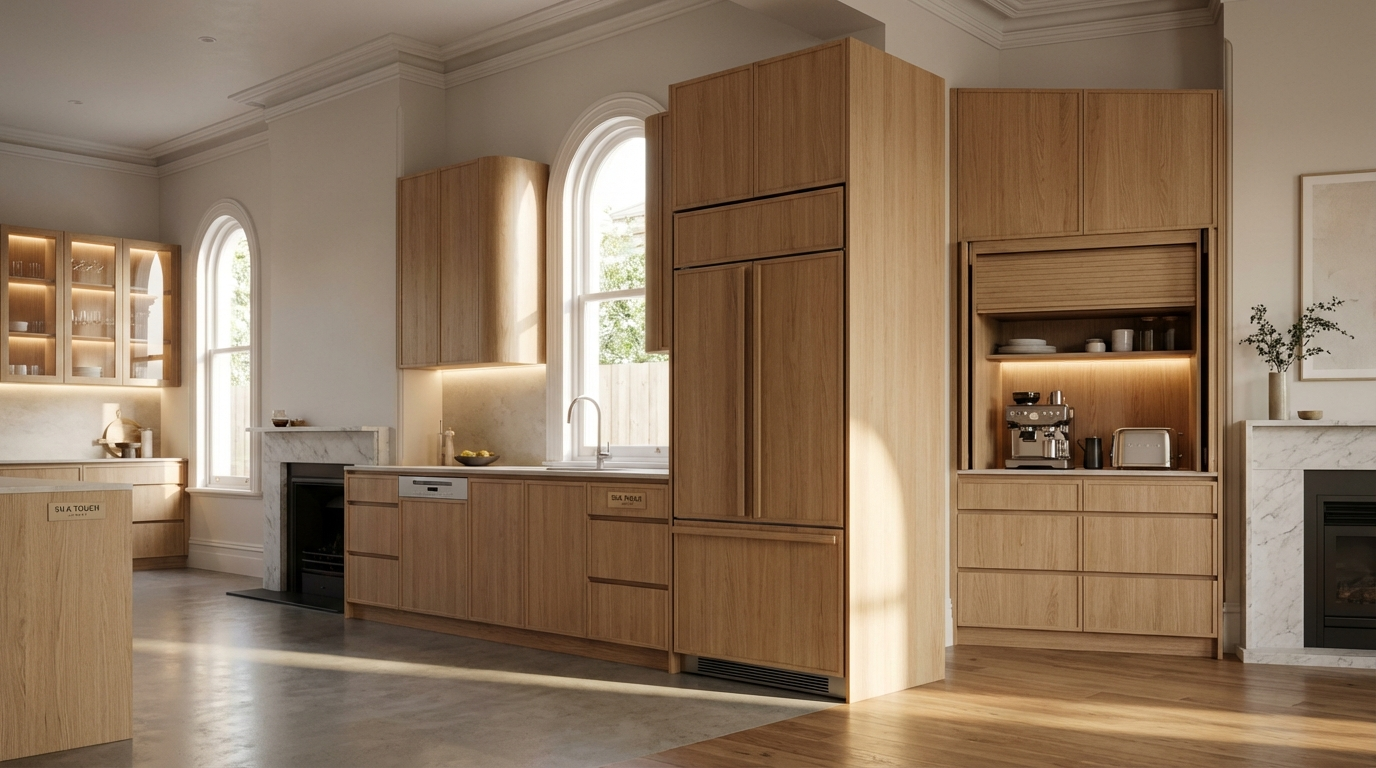
The Kitchen Where the Fridge Disappeared
The Hawthorn brief had one non-negotiable: “I don’t want to see a single appliance when I walk in.”
The kitchen was a rear extension on an Edwardian terrace. Open to the living room. Visible from the front hall through a sightline the architect had deliberately created. Every appliance that read as an appliance would read from the sofa.
What we built was a kitchen where the 900mm French door fridge sat behind two full-height cabinet panels, flush with the surrounding joinery to within 1.5mm. The dishwasher was below the island bench, fronted with the same American oak panel as the adjacent drawers, on a handle-free push-to-open mechanism. The rangehood was a ceiling-recessed canopy concealed within a joinery bulkhead that ran the full width of the kitchen wall — it read as an architectural soffit, not an appliance housing.
The microwave sat in a dedicated tower at 1,350mm centre height — visible, but integrated into a full-height joinery column that contained it within the design language of the room.
The client walked in at handover and said: “It looks like a room, not a kitchen.”
That distinction — room versus kitchen — is what hidden appliance integration delivers when it is executed correctly. And it begins, without exception, with the joinery specification — not the appliance selection.
For how this approach extends beyond the kitchen into whole-home joinery coordination, Whole-Home Joinery Kew 2026 covers the project management approach that keeps appliance integration decisions coherent across multiple rooms in a single renovation.
Why Appliance Integration Is a Joinery Problem First
The appliance integration conversation in most Melbourne kitchen renovations starts with the appliance. The client selects a fridge. Then the kitchen designer works out where to put it and how to panel it. The joinery is designed around the appliance decision.
This sequence produces integration that works technically but rarely reads as seamless. The panel sits slightly proud of the surrounding joinery. The gap at the top of the fridge panel is slightly wider than the reveal on the adjacent doors. The handle alignment is 3mm off because the appliance rebate was not dimensioned precisely enough at the drawing stage.
The sequence Silk Touch uses is the reverse. The integration zone is designed first — the exact cabinet opening, the exact panel reveal, the exact handle height — and the appliance is specified to fit that zone. Where multiple appliance brands are compatible with the design intent, the selection is made based on which unit most precisely matches the integration specification.
This is not a trivial distinction. A 2mm tolerance error in a panel-ready fridge installation is visible every time someone opens the adjacent drawer. The same 2mm error in a non-integrated kitchen is irrelevant because there is no comparison panel to reference against.
In 2026 Inner East Melbourne kitchens — where the open-plan living and kitchen connection means the joinery is read from living spaces as well as within the kitchen — this level of precision is what separates a premium integration outcome from a competent one.
Panel-Ready Fridges: The Tolerance Game
The panel-ready fridge is the appliance integration challenge that requires the most precise joinery coordination. A fridge is the tallest object in the kitchen, the widest individual appliance, and the one that is most visually prominent from outside the room.
How Panel-Ready Integration Works
A panel-ready fridge has no visible appliance finish on its exterior faces — the door fronts are designed to accept a client-specified panel, typically 18–20mm thick, in any material. The panel is fixed to the door via a manufacturer-supplied bracket system, and the integrated handle — if any — is mounted through the panel.
The joinery requirement: the surrounding cabinet opening must be sized to within ±2mm of the appliance’s panel-ready dimensions. The panel itself must be fabricated to the appliance manufacturer’s template — not to a general dimension — because the bracket system has fixed mounting positions that do not accommodate panel size variation.
This is the step where most integration failures originate. The panel is fabricated to a general dimension. The bracket positions are not confirmed against the manufacturer’s template. The panel sits with a 4mm gap on one side and flush on the other. From the sofa, this is visible.
Silk Touch requests the appliance manufacturer’s panel template at the design stage — before any cabinet opening is dimensioned. The template drives the joinery, not the other way around.
Brand Compatibility: What Matters in 2026
Not all panel-ready fridges are equal in their integration precision. Three brands dominate the specification in Silk Touch’s Inner East kitchen projects at the premium end:
Miele produces the tightest panel-to-rebate tolerances in class. The MasterCool and KFN series panel specifications are dimensionally consistent across the range — the template for one 900mm unit is reliable for another. Miele’s integrated handle system (the recessed rail behind the panel top) produces a completely flush face with no visible handle hardware. The premium integration choice where budget permits.
Fisher & Paykel ActiveSmart panel-ready units are the most commonly specified mid-premium option in Silk Touch’s Camberwell and Hawthorn projects. The panel template is reliable. The installation system is straightforward. The 900mm French door configuration is the specification for Inner East family kitchens where the storage requirement matches the appliance footprint.
AEG and Electrolux panel-ready units offer a broader configuration range — bottom-mount, French door, single door — at a cost position below Miele. The panel template requires careful confirmation against the specific model number: AEG’s panel specifications have varied within product generations in a way that Miele’s have not.
The Heritage Complication: Fridge Depth in Original Floor Plans
Federation and Edwardian kitchen floor plans were not designed for 600mm deep European integrated fridges. The perimeter wall adjacent to the original kitchen area — frequently a load-bearing masonry wall — may not allow the 650–700mm of total depth required for a panel-ready fridge with its door swing clearance.
Silk Touch resolves this at the laser measure stage: total available depth is confirmed before any appliance is specified. Where the wall depth is insufficient, the options are a counter-depth panel-ready unit (typically 550mm deep), a recessed alcove with structural consultation, or a repositioning of the fridge zone to a wall with adequate depth. This is a documentation-stage decision — confirming it at installation is too late.
Panel-Ready Dishwashers: The Reveal Question
The panel-ready dishwasher is technically simpler than the fridge integration — the unit is fixed in position, there is no moving panel, and the dimensional tolerance requirement is less critical than for a fridge. What matters for the dishwasher is the reveal.
The reveal is the visible gap between the dishwasher panel face and the adjacent cabinet door faces when all panels are in the closed position. In a correctly integrated kitchen, the reveal between the dishwasher panel and the adjacent drawer stack is identical to the reveal between any two adjacent cabinet doors in the same run — typically 2–3mm. A dishwasher with a 5mm reveal when adjacent drawers have a 2mm reveal reads as integrated but not seamless.
Achieving consistent reveal across a mixed appliance and joinery run requires that the dishwasher rebate — the space in the cabinet carcass that the appliance sits within — is dimensioned to the same precision as every other cabinet opening. The dishwasher panel is then fabricated with the same thickness and finish as the adjacent door panels.
Handle Alignment
The most visible integration detail on a panel-ready dishwasher is handle alignment — whether the dishwasher handle sits at exactly the same height as the handles on adjacent drawers and doors.
For handle-free kitchens — increasingly the specification in 2026 Inner East projects — the dishwasher uses a push-to-open mechanism (Miele’s EasyOpen or equivalent) and no handle is required. The panel face is flush and handleless in the same way as the surrounding joinery. This is the cleanest integration outcome and is the specification Silk Touch recommends first for kitchens where full visual integration is the brief.
For kitchened with bar handles, the handle position on the dishwasher panel must be set to match the centre height of the adjacent drawer handles. This is a panel fabrication instruction — the handle bore position is drilled to a specified measurement from the top of the panel. It requires the adjacent drawer handle height to be confirmed before the dishwasher panel is drilled.
Appliance Garages and Retractable Stations
The appliance garage — a dedicated above-bench or below-bench cabinet zone with a concealing door mechanism — is the solution for bench-top appliances that are used daily but should not be visible when the kitchen is at rest.
The HAWA Folding Concepta System
Silk Touch specifies the HAWA Folding Concepta bi-fold mechanism for appliance garages as the primary solution. The mechanism folds a two-panel door into the cabinet interior on opening, presenting full-width access to the cabinet interior and leaving no door projection beyond the cabinet face. When closed, the face reads as two standard cabinet panels within the kitchen’s door grid.
The technical requirement: minimum cabinet interior width of 400mm for a single-appliance garage, 700mm for a dual-appliance configuration. Interior height minimum 500mm for most benchtop appliances — confirm against the tallest appliance at design stage. The HAWA mechanism is rated to 6kg per door panel — a 18mm MDF panel in a standard finish is typically 4–5kg, within rating.
The LED specification for appliance garages: a Hafele Loox 5 door-activated strip at the top interior face of the cabinet, activating on door open. At 2700K the interior reads warm and the appliances are visible without requiring the overhead kitchen lighting to angle into the space. This is the same door-activated specification used in wardrobe applications — covered in the LED Lighting Innovations 2026 guide.
What Fits and What Does Not
An appliance garage is not a solution for every benchtop appliance. Before specifying the cabinet dimensions, Silk Touch confirms the appliance list with the client and checks three things: footprint dimensions (width × depth), height to top of appliance with lid open where relevant, and cable exit position.
Fits reliably: Nespresso and pod coffee machines (typically 280–320mm wide), toasters with top-exit slots (not side-exit), hand mixers and stick blenders in vertical storage, small food processors.
Requires custom dimensioning: Full-size espresso machines (typically 350–420mm wide, 400mm+ height clearance required for portafilter operation), stand mixers (KitchenAid: 370mm wide, 400mm high, but requires a lift mechanism for heavy use — a Häfele or Sugatsune spring-assisted shelf is the specification).
Does not fit: Toasters with side-exit bread slots — the slot direction requires clear side access that a bi-fold door cannot provide cleanly. Wide-format coffee machines with side water reservoir access. Appliances with rear-exit cables that conflict with the cable management channel.
Cable management is the detail most frequently overlooked. Every appliance garage requires a cable exit — typically a 40mm circular grommet in the rear or base panel, with a cable management channel running to the nearest GPO. The GPO position is confirmed with the electrician at documentation stage.
Rangehood and Ventilation Integration
The rangehood is the appliance integration challenge unique to the kitchen — there is no equivalent in any other room, and the joinery solution depends entirely on the ceiling condition above the cooktop.
Contemporary Kitchens: Ceiling-Recessed Canopy
In contemporary rear extensions and new builds, the rangehood is specified as a ceiling-recessed canopy — a ventilation unit that sits within a joinery bulkhead, with only the extraction grille visible at the ceiling plane. The bulkhead itself is joinery: a full-width soffit above the cooking zone, finished in the same material as the surrounding cabinetry, that reads as an architectural element rather than an appliance housing.
The duct routing from a ceiling-recessed rangehood runs horizontally within the ceiling cavity to an exterior wall penetration. In a new build or contemporary extension where the ceiling cavity is accessible, this is a straightforward installation. The duct diameter — typically 150mm or 200mm depending on extraction volume — is confirmed at documentation stage and the ceiling framing is designed around it.
Heritage Kitchens: The Bulkhead Solution
Federation and Edwardian homes present a specific rangehood challenge: the original ceiling is plaster-on-lath, often decorated with a cornice, and cannot be penetrated for duct routing without permanent heritage damage.
The Silk Touch solution for heritage kitchens is a surface-mounted joinery bulkhead — a full-width cabinet soffit above the cooking zone that conceals a horizontal duct run within its depth, routing to a penetration point that is outside the heritage-significant ceiling zone. The bulkhead is designed as a deliberate architectural element: the same height as any overhead cabinetry in the kitchen, finished in the same material, with a profile that references the cornice above it without competing with it.
In Boroondara and Stonnington heritage overlay properties, external wall penetrations for ventilation ducts may require notification or approval depending on the property’s specific overlay provisions. Silk Touch coordinates this confirmation at design stage — the Heritage Overlay Approvals Boroondara 2026 guide covers the permit framework that applies.
Microwave and Oven Tower Integration
The oven tower — a full-height joinery column housing the oven, microwave, and steam oven in a vertical stack — is the integration solution that converts multiple individual appliances into a single designed element.
The Ergonomic Height Argument
The single most important specification decision in an oven tower is the height of the microwave centre. The correct specification: microwave door handle at 1,350mm from finished floor level — roughly elbow height for a person of average stature. This means the interior of the microwave is visible when standing in front of it without bending, and hot dishes can be removed at a safe height without reaching over the head.
The specification that Silk Touch encounters most frequently in renovations of existing kitchens is the microwave positioned below the benchtop — in a base cabinet, accessible by opening a door and crouching. This is the ergonomic failure that a tower integration corrects. It is also a safety failure: removing a hot container at knee height is a scalding risk.
The tower carcass specification: 650mm deep minimum for most combination oven and microwave units — 50mm deeper than a standard base cabinet. This depth requirement must be confirmed at the design stage, as a tower that reads as flush with surrounding 600mm cabinetry but is actually 650mm deep will project 50mm from the cabinet face plane — visible and incorrect.
Concealed Microwave Options
For kitchens where even the oven tower is considered too visible, a concealed microwave drawer — installed below the benchtop in a standard base cabinet position with a downward-opening door — is the integration specification. Miele and Sharp produce drawer microwave units in 600mm widths that integrate into a base cabinet run without any visual distinction from the adjacent drawers. The door handle aligns with the drawer handles at the same height.
The limitation: a microwave drawer at benchtop-minus-one position is at approximately 700mm height. This is acceptable for a secondary microwave in a butler’s pantry context but is the same ergonomic problem as an underbench microwave in the main kitchen — bending to access the interior, heat exposure toward the face on opening. For the primary kitchen microwave, the tower position at 1,350mm remains the correct ergonomic specification.
The Heritage Kitchen: Integration Without Compromise
The appliance integration conversation in heritage kitchens has one additional constraint that contemporary builds do not: the design must read as consistent with the period character of the home without requiring appliances that do not exist.
The approach Silk Touch takes is material continuity rather than stylistic pastiche. A Federation kitchen with American oak cabinetry and Caesarstone benchtops does not need Victorian-style appliance hardware. It needs appliances that are invisible within the material language — panel-ready units that disappear behind the oak veneer, a rangehood that becomes a joinery bulkhead, an appliance garage that reads as a cabinet.
The appliance integration that reads as period-appropriate is the integration where the appliances cannot be identified from across the room. The material does the heritage work. The appliances simply disappear.
This is the same material logic that governs timber veneer specification in heritage rooms — covered in detail in the Tasmanian Oak Veneers 2026 guide, where the argument for domestic timber in domestic heritage rooms is made at length.
For the kitchen benchtop decisions that complete this picture — specifically the surface continuity around integrated appliances, where benchtop material meets panel-ready unit without a visible transition — the 2026 Kitchen Benchtop Trends Melbourne post covers the material and edge profile decisions that make appliance integration read as seamless rather than assembled.
The island context — where integrated appliances including dishwashers, underbench fridges, and warming drawers are increasingly specified — is covered in 2026 Kitchen Island Trends for Melbourne’s Inner East Homes.
How Silk Touch Manages Appliance Integration
Documentation stage. Every appliance in the kitchen is listed at the design stage with its exact model number. Silk Touch requests the manufacturer’s panel template, integration manual, and cutout dimensions for every panel-ready unit before any cabinet opening is dimensioned. The joinery drawing set references the appliance template — not a general dimension.
Electrical coordination. GPO positions for all integrated appliances are confirmed with the electrical trade before the joinery is fabricated. A GPO in the wrong position relative to the appliance cabinet is a site problem that produces visible cable management compromises. A GPO confirmed at documentation stage is invisible in the finished kitchen.
Reveal consistency. The reveal — the gap between adjacent panels — is set as a single dimension across the entire kitchen at design stage. Every panel-ready appliance panel, every drawer face, and every door is fabricated to produce this reveal. Silk Touch’s factory quality check includes a reveal measurement across the full panel run before the joinery leaves the workshop.
On-site adjustment. Panel-ready appliance integration is adjusted after the appliance is delivered and set in position — not before. The panel is fixed to the appliance bracket system with the appliance in its final position, the surrounding joinery installed, and the reveal confirmed in situ. Adjustments made at this stage are within the bracket system’s tolerance range. They are not corrections — they are the final calibration that produces a precise outcome.
Heritage coordination. In heritage overlay properties, any external penetration for rangehood ducting is confirmed with the relevant council before the joinery installation proceeds. Boroondara and Stonnington planning departments are contacted at documentation stage, not during installation.
Total programme: 6–8 weeks from confirmed design to commissioned appliances.
2026 Cost Guide
Panel-ready fridge integration (joinery surround, custom panel fabrication, bracket installation, reveal calibration): $2,800–$5,500 over the base fridge cost, depending on panel material and surround complexity.
Panel-ready dishwasher (panel fabrication, push-to-open mechanism, reveal calibration): $900–$2,200 over the base dishwasher cost.
Appliance garage (HAWA Folding Concepta bi-fold, carcass, LED, cable management): $3,200–$5,800 installed depending on width and internal configuration.
Oven and microwave tower (full-height joinery column, 650mm deep carcass, integrated ventilation, appliance panels): $5,500–$12,000 installed depending on appliance count and column height.
Rangehood bulkhead (ceiling-recessed canopy housing, duct routing, joinery soffit finish): $4,500–$9,000 installed depending on bulkhead width and duct routing complexity. Heritage homes with non-standard duct routing add $1,500–$3,500.
Full kitchen appliance integration package (fridge, dishwasher, rangehood, appliance garage, oven tower): $18,000–$38,000 in joinery and installation costs over appliance purchase prices, depending on specification level and heritage complexity.
Frequently Asked Questions
What does panel-ready mean for a fridge or dishwasher? A panel-ready appliance has no visible exterior finish on its door faces — the door is designed to accept a client-specified panel in any material. The panel is fixed to the appliance door via a manufacturer-supplied bracket system. The result is an appliance that reads as a cabinet door within the surrounding joinery, indistinguishable from adjacent drawers or doors when closed.
Which fridge brands offer the best panel-ready integration in 2026? Miele produces the tightest panel-to-rebate tolerances and the most dimensionally consistent panel templates across its range. Fisher & Paykel ActiveSmart panel-ready units are the most commonly specified mid-premium option in Inner East Melbourne kitchens. AEG panel-ready units offer broader configuration options at a lower cost position but require model-specific template confirmation before cabinet dimensioning.
What is an appliance garage and what fits inside one? An appliance garage is a dedicated above-bench or below-bench cabinet zone with a bi-fold or tambour door mechanism that conceals benchtop appliances when not in use. The HAWA Folding Concepta bi-fold is the standard specification. Typical appliances that fit: pod coffee machines, top-exit toasters, hand mixers, small food processors. Appliances that require custom dimensioning: full-size espresso machines, stand mixers. Side-exit toasters and appliances with side reservoir access do not integrate cleanly into a standard garage configuration.
How is a rangehood hidden in a heritage kitchen with an original ceiling? Where the original plaster-on-lath ceiling cannot be penetrated for duct routing, Silk Touch designs a surface-mounted joinery bulkhead — a full-width soffit above the cooking zone that contains a horizontal duct run within its depth, routing to an external wall penetration outside the heritage-significant ceiling area. The bulkhead is finished in the same material as the surrounding cabinetry and reads as an architectural soffit rather than an appliance housing.
What height should a microwave be installed at in a kitchen tower? The microwave door handle should be at 1,350mm from finished floor level — approximately elbow height for average stature. This height allows the interior to be seen without bending and hot dishes to be removed safely. Microwaves installed below the benchtop are an ergonomic and safety failure that an oven tower at the correct height corrects.
Does appliance integration affect the 6–8 week Silk Touch programme? No — appliance integration is built into the standard programme. Appliance model confirmation, panel template acquisition, electrical coordination, and reveal specification are all documentation-stage activities completed in weeks one and two. The joinery fabrication proceeds from confirmed drawings. The final panel installation and calibration occurs at the end of the installation stage after the appliance is set in its final position.
Can panel-ready integration be specified in a heritage overlay property in Boroondara or Stonnington? Yes — internal appliance integration does not involve the exterior fabric of the building and does not require a planning permit in most heritage overlay contexts. The exception is rangehood duct routing that requires an external wall penetration, which may require notification to the relevant council. Silk Touch confirms the permit position at documentation stage for all heritage overlay properties in Boroondara and Stonnington.