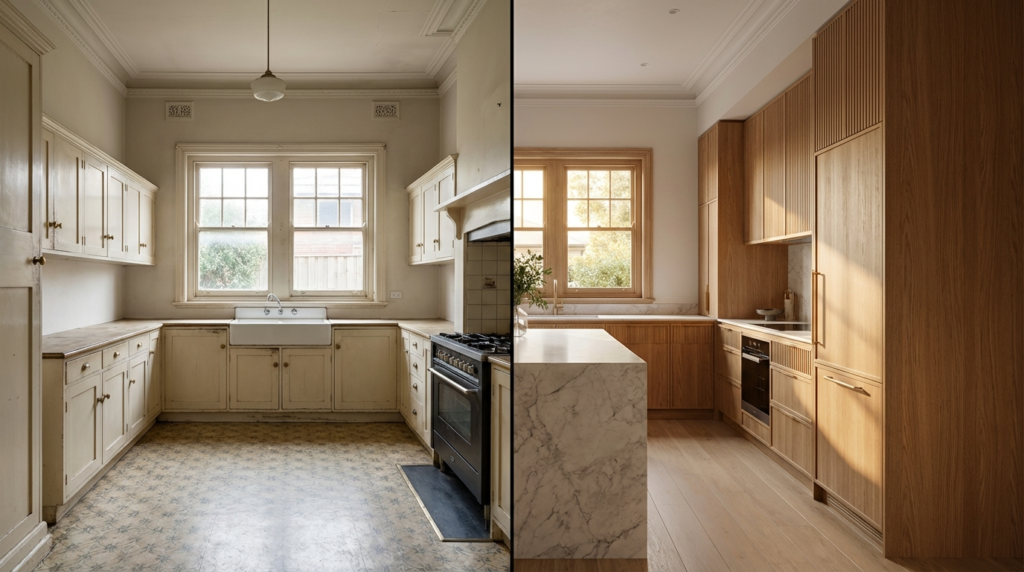
The successful modernization of a Georgian-style residence on Clendon Road, Toorak, recently demonstrated that heritage constraints are not a barrier to high-performance joinery. By providing the City of Stonnington with a detailed design response and 3D simulations of the proposed kitchen and wardrobe integration, we secured planning approval in just 19 days. While Toorak sits just outside the Boroondara border, the planning principles for bespoke joinery Toorak mirror those required in Kew, Hawthorn, and Camberwell.
In 2026, the fear of “Council rejection” often prevents homeowners from pursuing the cabinetry upgrades their heritage homes require. This guide dismantles those concerns, providing a technical roadmap for navigating the Boroondara Planning Scheme while maintaining the architectural integrity of your property.
What Heritage Overlays Actually Mean for Your Joinery Project in 2026
A Heritage Overlay (HO) is a planning control under Clause 43.01 of the Victoria Planning Provisions. Its primary objective is to conserve and enhance places of aesthetic or historical importance. For a Boroondara homeowner, this typically means:
- External Visibility: Any works visible from the public realm (the street or a park) require a permit.
- Internal Controls: Most HOs do not govern internal joinery. However, certain “Significant” or “Individividually Listed” properties in Boroondara have internal controls specified in the Schedule. In these cases, your kitchen, fireplace joinery, or fixed wardrobes fall under council jurisdiction.
- The “Reversibility” Principle: In 2026, planners prioritise joinery that is “reversible”—meaning it can be removed in the future without damaging the original heritage fabric (cornices, skirtings, and lath-and-plaster walls).
At Silk Touch Joinery, we specialise in Navigating Heritage Overlays in Boroondara & Stonnington, ensuring your project complies with these specific Victorian standards before the first piece of timber is cut.
Step 1: Pre-application Chat with Council & Our Free Heritage Checklist
Before submitting a formal application, we utilise the Boroondara Urban Planning Department’s pre-application service. This is not a “nice-to-have”; it is a risk-mitigation strategy.
During this phase, we confirm:
- The Grading: Is your home “Significant,” “Contributory,” or “Non-contributory”?
- The Schedule: Do internal controls apply?
- Solar & Services: Will new LED drivers or motorised components (like those in our Motorised Wardrobe Systems Melbourne 2026) require external ventilation that impacts the facade?
Step 2: Laser Measurement + Compliant 3D Renders
Heritage homes in Kew and Balwyn are notorious for being out of plumb. A 100-year-old wall may lean by 15mm over a 2.4-metre height. Standard “off-the-shelf” cabinetry will leave unsightly gaps or require “bogging” with filler.
We employ sub-millimetre laser scanning to create a digital twin of your room. We then produce 3D renders that show exactly how our 18mm marine-grade ply carcasses will be “scribed” on-site to your original skirtings. Providing Council with these renders proves that the original fabric is being respected, not destroyed.
Step 3: Statement of Significance & Design Response
Boroondara planners do not just want to see what you are building; they want to know why it belongs there. We assist in drafting a Design Response that references the property’s Statement of Significance.
If your home is of “Local Architectural Significance” (Criterion D), we ensure the joinery—whether it’s custom joinery Kew or a Toorak dressing room—utilises materials like American oak or hand-painted finishes that echo the original era without “mimicking” it in a way that confuses the historical record.
Step 4: What Councils Look for in Joinery (Materials & Reversibility)
In 2026, Boroondara planners look for three technical indicators:
- Materiality: The use of high-quality, stable materials. We often specify 2026 Kitchen Benchtop Trends Melbourne materials like zero-silica mineral stone or porcelain, which offer a refined, contemporary contrast to heritage timber.
- Shadow Lines: Using a 10mm shadow line between the new joinery and the heritage cornice allows the original architecture to “breathe.”
- Hardware Performance: We mandate Hettich Actro 5D runners for heritage drawers. Why? Because they offer 5-directional adjustment, allowing us to align drawer fronts perfectly even when the house carcass is slightly uneven.
Step 5: Submission, RFIs & The Digital Portal
The Boroondara and Stonnington planning portals are now fully digital. Once we submit, the Council may issue a Request for Information (RFI). Common RFIs in 2026 involve:
- Confirmation of LED colour temperatures (we strictly use 2700K for heritage).
- Details on how the joinery is anchored to lath-and-plaster walls.
- Samples of the proposed timber grain (e.g., Crown Cut vs Rift Cut American Oak).
Because we manufacture locally at 793 Burke Rd, Camberwell, we can provide physical samples to the planning office within 24 hours to clear RFIs and keep the project on track.
Timelines, Costs & 2026 Updates
| Phase | Duration | Estimated Heritage Premium |
| Pre-App / Design | 2 Weeks | Included in Silk Touch Fee |
| Council Assessment | 4–8 Weeks | $1,500 – $4,500 (Permit Fees) |
| Manufacture | 6–8 Weeks | Standard Silk Touch Leads |
| Installation | 1–2 Weeks | 15% loading for on-site scribing |
Boroondara vs Stonnington: Subtle Differences
While both councils are rigorous, Stonnington (Toorak/Armadale) often places higher emphasis on “streetscape contribution.” If your kitchen renovation includes changing a window that is visible from the street, expect a longer assessment period. Boroondara (Kew/Balwyn) focuses heavily on the “Technical Grade” of the materials used in the alteration.
Real 2026 Approved Projects: Kew & Balwyn
Case Study: Kew Federation Kitchen
A “Significant” graded home required a full kitchen overhaul. We retained the original 19th-century chimney breast as a feature, wrapping it in custom American oak joinery. By using a “freestanding” island design, we satisfied Council’s requirement for “reversibility.” Approval was granted in 24 days.
Case Study: Balwyn Interwar Wardrobe
In Balwyn, we integrated a full-height wardrobe suite into a master bedroom with intricate plaster ceiling roses. By dropping the joinery height by 50mm and using integrated LED up-lighting, we highlighted the heritage ceiling without touching it. This project, classified as kitchen renovations Camberwell nearby, serves as the gold standard for Interwar compliance.
How Silk Touch Makes the Process Stress-Free
We are more than joiners; we are heritage advocates. We handle the technical documentation, the laser measurement, and the Council liaison. Our 6–8 week programme is built around the reality of heritage construction, ensuring that when we arrive on-site, the joinery fits perfectly against your 100-year-old walls.
Book your free heritage overlay consultation and let us handle the bureaucracy while you focus on the design.
FAQs
1. Do I definitely need a planning permit for a new kitchen in Boroondara?
Not necessarily. If your property is in a Heritage Overlay but does not have “Internal Alteration Controls” specified in the Schedule, and the works aren’t visible from the street, you typically won’t need a permit for the joinery itself. However, we always recommend checking the VicPlan Property Report first. At Silk Touch Joinery, we perform this audit for every Camberwell and Kew project as standard.
2. What are “Internal Alteration Controls,” and how do I know if I have them?
These are specific protections for the inside of a building. They are usually reserved for high-significance properties, such as original mansions in Toorak or Kew. You can find this out by looking at the “Schedule to the Heritage Overlay” in the Boroondara Planning Scheme. If there is a “Yes” in the “Internal Alteration Controls Apply?” column, your joinery design must be approved by Council.
3. Will a Heritage Overlay make my kitchen renovation more expensive?
The primary cost increase comes from the requirement for higher-quality materials and more complex installation. Councils will rarely approve “cheap” laminate finishes in a Significant heritage room. Expect to invest more in natural timber veneers and expert on-site scribing. At Silk Touch, we allow a 15% labour loading for the precision required to install modern joinery into uneven heritage spaces.
4. Can I use modern LED lighting in a heritage-listed room?
Yes, but with conditions. Boroondara planners generally support LED Lighting Innovations Transforming Custom Joinery in 2026 Melbourne Homes, provided the lighting is “concealed” and the colour temperature is warm (2700K). Avoid “cool white” or visible LED strips. We use the Hafele Loox 5 system with recessed profiles to ensure the light enhances the heritage features rather than detracting from them.
5. Does Council allow motorised hardware in heritage wardrobes?
Yes. Modern functionality like motorised wardrobe rails is usually permitted because it is entirely contained within the new cabinetry and does not impact the original wall fabric. In fact, many planners view this as a positive “technological layer” of the home’s history, provided it is installed in a way that is reversible and doesn’t require destructive structural changes.
6. How long does the Boroondara Council take to approve joinery works?
The statutory timeframe is 60 days. However, because we provide “submission-ready” 3D renders and detailed technical drawings that address common heritage concerns upfront, our average approval time in 2026 has been 21 to 30 days. Preparation is the key to bypassing the common “Request for Information” (RFI) delays.
7. Can I change my windows or doors as part of the joinery project?
If the windows are visible from the street in a Heritage Overlay, you will almost certainly need a planning permit. The Council will require the new windows to match the original profile, material (usually timber), and glazing style. We coordinate with specialist heritage window makers in Melbourne to ensure our internal joinery integrates perfectly with any new, compliant glazing.