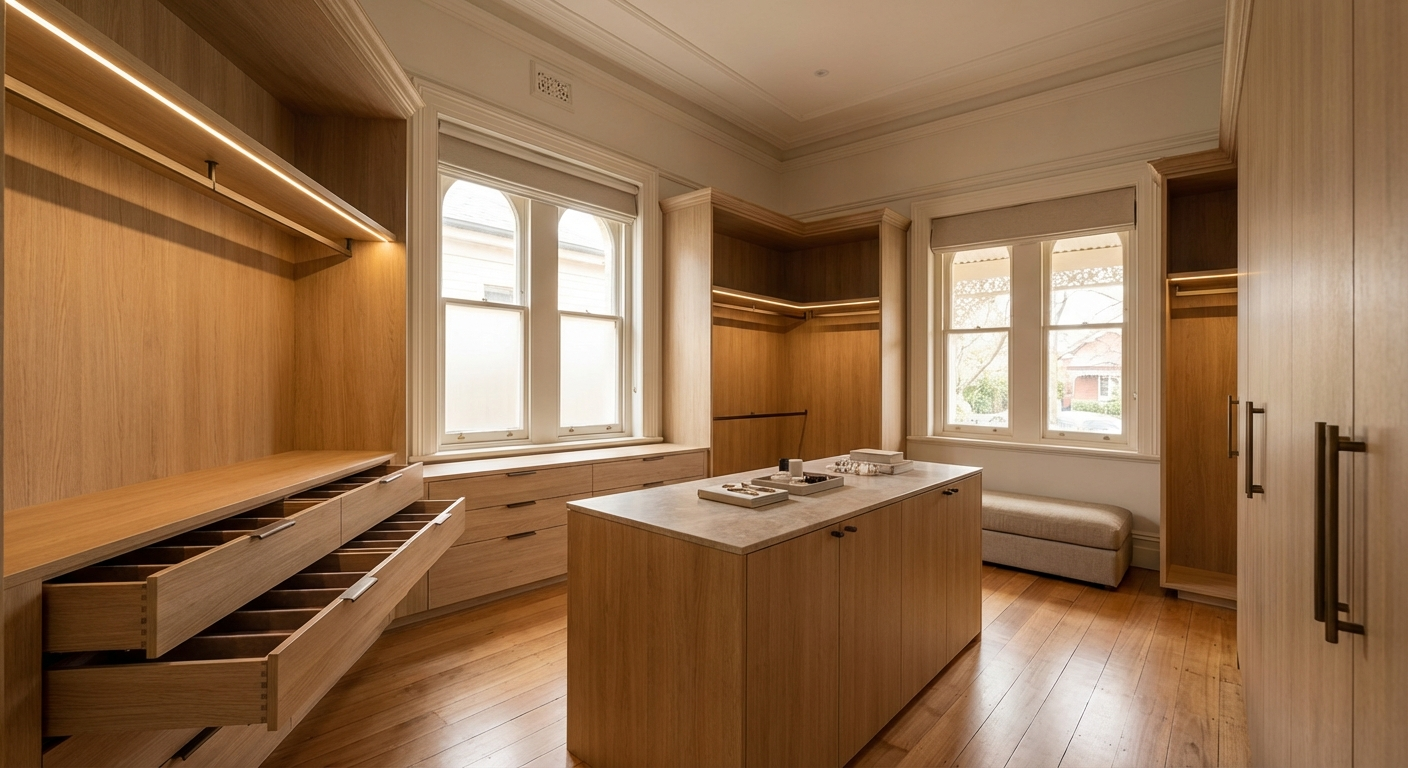
The Wardrobe That Refused to Be American Oak
The brief for the Kew Federation home was clear on almost everything. Full walk-in wardrobe. Blum Legrabox throughout. Hafele Loox 5 at 2700K. Heritage scribing throughout — the walls were 18mm out of plumb across the 3.6-metre run and nobody was pretending otherwise.
The timber was the open question. The client had seen the American oak wardrobes on the website and liked them. But she had also grown up in this house. The floors were original Baltic pine. The skirtings were original Baltic pine. The window reveals were original Baltic pine, painted over four times but unmistakably there underneath.
“I want something that looks like it grew up in the same forest.”
American oak did not. Tasmanian oak did.
What we built was a full walk-in wardrobe in Crown Cut Tasmanian oak veneer, finished in natural oil at 10% gloss — the finish that let the pink-straw tone of the timber breathe rather than deepen it. The grain referenced the Baltic pine floors without replicating them. The wardrobe looked like a room that had always been there.
This is the Tasmanian oak argument in 2026. Not that it is better than American oak. Not that it is cheaper, though it often is. But that in certain rooms — specifically Federation and Edwardian interiors in Melbourne’s Inner East — it is the species that makes architectural sense in a way that no imported alternative can.
For the full context on whole-home joinery in this postcode and how timber specification connects across multiple rooms in a single renovation, the Whole-Home Joinery Kew 2026 guide covers the project coordination approach that keeps material decisions coherent across kitchen, wardrobe, and vanity.
Why Tasmanian Oak Is Having a Considered Moment in 2026
Tasmanian oak never went away. It was the dominant residential joinery timber in Victoria for the better part of the twentieth century — Baltic pine for floors, Tasmanian oak for cabinetry and furniture. The shift to imported species (American oak, European oak, American walnut) happened gradually across the 2000s and 2010s, driven partly by consistency, partly by fashion, and partly by the import pipeline that made international veneer more reliably available than domestic supply.
In 2026, three forces are bringing Tasmanian oak back into specification conversations.
Sustainability. Tasmanian oak — the commercial name for a group of eucalyptus species including Eucalyptus regnans, E. obliqua, and E. delegatensis — is available from FSC-certified Victorian and Tasmanian forests under managed harvest programmes. For clients who have asked about the environmental provenance of their joinery timber, the domestic supply chain argument is straightforward. The tree grew in Australia. It did not travel from Austria or the American northeast.
Heritage authenticity. The Inner East renovation wave is producing a generation of homeowners who are researching the original material language of their homes before specifying replacements. A Federation home built in 1910 used Australian timbers. Specifying Australian timber in a 2026 renovation of that home has a logic that American oak, however beautiful, does not.
Cost position. Tasmanian oak veneer sits 15–25% below American oak veneer in material cost at equivalent quality grades. At the scale of a full walk-in wardrobe — 20–30 square metres of panel area in a significant project — the saving is material. In projects where the budget is being allocated across kitchen, wardrobe, laundry, and vanity simultaneously, the saving on the wardrobe timber creates capacity elsewhere.
None of this makes Tasmanian oak the automatic specification. It has genuine limitations that must be understood before committing. The article that follows covers both sides.
The Timber: What Tasmanian Oak Actually Is
The first thing to understand about Tasmanian oak is that it is not a single species. It is a commercial grouping of three closely related eucalyptus species that are harvested, processed, and sold together because their timber characteristics overlap sufficiently for most applications.
This matters for specification because the three species differ in subtle but visible ways — most notably in the pink undertone that is more pronounced in E. regnans (mountain ash) than in the other two. In a high-visibility veneer application like a wardrobe door face, the variation within a Tasmanian oak lot can be wider than within an American oak lot from a consistent growth region.
This is the variable that requires the most management in a professional specification. It is not a reason to avoid the species — it is a reason to specify it carefully and to work with a fabricator who understands lot selection.
Grain Profile
Tasmanian oak in Crown Cut produces a moderate cathedral grain figure — less pronounced than American oak’s bold cathedraling, more dynamic than European oak’s tight linear profile. The figure is energetic without being dramatic. In a wardrobe panel at 2.4 metres, it reads as timber — present, warm, natural — without the visual assertiveness of a heavily figured American oak book-match.
Quarter Cut Tasmanian oak produces a linear grain with occasional interlocked figure — a slightly irregular linearity that some designers find more characterful than American oak’s cleaner quarter-sawn profile. It is less commonly specified in premium wardrobe applications but is the correct choice where the visual goal is restraint.
The pink-straw tone is the species’ signature — a warm base colour with pink undertones that reference the original Baltic pine and Tasmanian oak joinery found throughout Melbourne’s Federation and Edwardian housing stock. At 2700K LED illumination, this tone deepens and warms in a way that American oak’s honey-cream does not. The two species respond differently to the same light source — a specification detail worth understanding before the wardrobe and the lighting are locked simultaneously.
The Colour Variation Reality
Here is the honest assessment that some specifications skip: Tasmanian oak is more colour-variable than American oak at equivalent grades.
The cause is the multi-species commercial grouping. A bundle of American oak veneer from a single growth region will have a narrower colour range than a Tasmanian oak bundle that may contain leaves from two or three eucalyptus species. The variation is not dramatic — it is a shift between warmer pink-straw and cooler pale-cream within the same panel run — but in a book-matched wardrobe where adjacent panels are directly compared, it is visible.
Silk Touch manages this through lot selection and colour review before purchase. Every Tasmanian oak project begins with a visual review of the specific lot, not an order based on species and grade alone. Panels destined for book-matched door faces are selected from the same sequenced bundle. The warm-pink leaves and the cooler-cream leaves are sorted and allocated to applications where the variation is least visible — typically the interior wardrobe walls and secondary storage panels rather than the primary door faces.
This process takes time. It is not a step that a factory working to a commodity schedule performs. It is the step that determines whether a Tasmanian oak wardrobe reads as a designed object or as a variable one.
Tasmanian Oak vs American Oak vs European Oak: The 2026 Comparison
| Specification | Tasmanian Oak | American Oak | European Oak |
|---|---|---|---|
| Origin | Victoria / Tasmania, Australia | Eastern USA | Europe (France, Germany) |
| Colour | Pink-straw, warm, variable | Honey-cream, neutral consistent | Medium honey-gold, consistent |
| Grain (Crown Cut) | Moderate cathedral, energetic | Bold cathedral, prominent | Tight, linear with ray flecks |
| Colour consistency | Moderate — lot selection critical | High | High |
| Book-match quality | Good — requires careful lot management | Excellent | Excellent |
| Heritage suitability (Melbourne) | Excellent — domestic species reference | Good — colour-neutral | Moderate — reads as European |
| Contemporary suitability | Moderate | Good | Excellent |
| Finishing versatility | High — oil finish excellent; 2-Pac acceptable | Very high | High |
| Humidity resistance (sealed) | Moderate — more movement than American oak | High | High |
| Sustainability | FSC-certified domestic supply | FSC-certified imported | FSC-certified imported |
| Relative veneer cost | Mid — 15–25% below American oak | Mid-premium | Premium |
| Best application | Federation/Edwardian heritage joinery, wardrobes, study joinery | All heritage and contemporary contexts | European-style interiors, contemporary |
The American Oak Veneers In Depth guide covers the American oak specification in full — including book-matching technique, cut direction, and finishing options. The two articles read as a pair for any client or designer comparing the species directly.
For the walnut side of the comparison — which is the other species that regularly enters the same specification conversation — the Walnut vs Oak Veneers 2026 Guide covers the three-way comparison including grain, colour, and heritage suitability at length.
Best Applications: Where Tasmanian Oak Performs
Walk-In Wardrobes in Federation and Edwardian Homes
The primary application for Tasmanian oak veneer in Silk Touch’s 2026 Inner East projects is the walk-in wardrobe in a Federation or Edwardian home — specifically where the bedroom retains original Baltic pine floors and where American oak’s stronger honey-cream tone creates a material contrast that reads as imported rather than integrated.
The specification logic: Baltic pine floors in Melbourne’s Inner East have been absorbing foot traffic for 110 years. Their colour has shifted toward a warm, slightly pink-cream that no longer resembles new Baltic pine. Tasmanian oak veneer in Crown Cut profile at natural oil finish occupies the same tonal register — warm, slightly pink, organic. The wardrobe reads as if it grew from the same material tradition as the floor, even though it was manufactured in Camberwell in 2026.
This is the specification argument that American oak cannot make in these rooms.
Built-In Robes and Alcove Wardrobes
Heritage bedrooms in Camberwell and Hawthorn frequently have chimney breast alcoves or purpose-built recesses that were originally fitted with basic joinery. In 2026, these are being rebuilt as full-height fitted wardrobes with proper internal configuration.
Tasmanian oak in these applications reads as original joinery reinstated rather than new joinery inserted — which is precisely the aesthetic goal in a heritage overlay property where the visual continuity of the room matters to the owners. The Heritage Overlay Approvals Boroondara 2026 guide covers the planning context for internal joinery works in these properties — in most cases, fitted wardrobes in existing recesses do not require a planning permit, but understanding the overlay’s scope is a documentation-stage step that Silk Touch confirms before any design commitment is made.
Study and Home Office Joinery
Tasmanian oak in a home study context — bookshelves, desk surround, filing storage — is an underspecified application in 2026. The species’ moderate grain figure and warm tone are well-suited to a room that is used for sustained concentration, where the timber should be present but not demanding attention. American oak’s bold cathedraling can read as slightly restless in a study context. Tasmanian oak’s more moderate figure reads as settled.
Quarter Cut Tasmanian oak is the specification for study joinery — the linear grain is quieter than Crown Cut and appropriate for continuous horizontal shelf panels where the grain runs across the full width.
Kitchen Cabinetry: The Qualified Application
Tasmanian oak as a kitchen cabinet veneer is a qualified recommendation — qualified specifically by the humidity environment of the kitchen and the moisture-resistance requirements it imposes on the veneer substrate.
Tasmanian oak has higher moisture movement rates than American oak. On a correctly specified 18mm moisture-resistant MDF substrate with a two-pack polyurethane seal on all faces, it performs acceptably in a kitchen environment. On particleboard, or with an unsealed rear panel, it will telegraph moisture movement as surface checking or edge lifting within three to five years. The substrate and sealing specification is non-negotiable for Tasmanian oak in a kitchen context.
The application where Tasmanian oak works best in a kitchen is the perimeter cabinetry in a Federation or Edwardian home — where the heritage colour reference it provides is the specification argument, and where the cabinet faces are not directly adjacent to the cooktop or sink. For island applications where heat and steam exposure is more direct, American oak or a Fenix NTM finish on MDF is the more conservative specification.
What Tasmanian Oak Is Not Suitable For
Bathroom vanities. The humidity cycling in a bathroom — steam shower, cold ventilation, repeated condensation — exceeds what Tasmanian oak veneer on MDF handles reliably over a ten-to-fifteen-year horizon. American oak with a fully sealed specification is the correct species for bathroom vanity applications. The 2026 Bathroom Vanity Trends Melbourne post covers the moisture-resistance specification requirements for vanity joinery in full.
Laundry cabinetry. Same reasoning, higher stakes. The laundry operates in Melbourne’s most humidity-variable domestic environment. Tasmanian oak’s movement rates make it a risk that American oak or a Fenix NTM finish does not present.
Brighton coastal homes. The additional humidity cycling from coastal proximity pushes the risk profile of Tasmanian oak in exposed applications beyond what Silk Touch recommends. American oak with nickel-finish hardware and a 2-Pac sealed specification is the correct approach in coastal contexts.
Finishing Tasmanian Oak: What Works and What Doesn’t
Finishing Tasmanian oak is where the species requires the most care — and where the difference between a successful outcome and a disappointing one is determined at the specification stage, not the application stage.
Natural Oil Finish
Natural oil is the strongest specification for Tasmanian oak in a wardrobe or study context. The oil penetrates the timber surface rather than filming it, leaving the pink-straw tone and the grain texture fully expressed. The tactile quality under the hand — the slight softness of an oiled timber surface versus the hard film of a lacquer — is the detail that makes oiled Tasmanian oak read as furniture rather than cabinetry.
The maintenance requirement is real: re-oiling every two to three years with the same oil product used in the original application. In a wardrobe context where the client understands and accepts this, the outcome over a fifteen-year horizon is superior to any film finish — the timber deepens and warms with age rather than yellowing as film finishes eventually do.
Colour temperature interaction: Oiled Tasmanian oak at 2700K LED illumination — the correct specification for a wardrobe — reads as a deep, warm straw with visible pink. At 3500K the same panel reads cooler and the pink undertone is less apparent. The oil finish amplifies the 2700K response more than 2-Pac does, which is a specification argument for using natural oil and 2700K together in heritage wardrobe applications.
Two-Pack Polyurethane
2-Pac on Tasmanian oak produces a durable, consistent film finish that performs well in high-contact applications. The colour effect is different from oil: 2-Pac adds a slight amber cast that warms the pink-straw base but reduces the surface texture contrast. At 10–15% gloss level, the result reads as a considered timber finish — not as plasticky as higher gloss levels, not as raw as oil.
The specification limitation: Tasmanian oak’s grain interlocking — where the grain direction reverses across growth rings — can produce grain raising under 2-Pac application if the timber surface preparation is not thorough. Silk Touch’s factory preparation process for 2-Pac on Tasmanian oak involves an additional sanding stage at 240 grit before the sealer coat — a step that adds time but eliminates the risk of visible grain raising in the finished panel.
Matte Clear Lacquer
Lacquer on Tasmanian oak at 5–10% gloss is the finish that sits between oil and 2-Pac in both durability and appearance. The colour effect is closer to oil than 2-Pac — the surface reads as more natural, the grain texture is more apparent. Durability is lower than 2-Pac but higher than oil. In a wardrobe context where the client wants the oil aesthetic without the maintenance requirement, lacquer is the compromise specification.
What Does Not Work
High-gloss 2-Pac on Tasmanian oak amplifies the grain variation and the colour inconsistency within a panel run. Any lot variation that is acceptable at matte finishes becomes visible at 40%+ gloss. Do not specify high-gloss on Tasmanian oak veneer in visible applications.
Water-based polyurethane raises the grain of Tasmanian oak unpredictably and produces a slightly grey cast on the pink-straw base. It is not a specification Silk Touch uses on this species.
Durability, Sustainability, and the Provenance Argument
Durability
Tasmanian oak veneer on a correctly specified substrate — 18mm moisture-resistant MDF, full-contact adhesive bond, sealed all faces — is a durable assembly that performs within its application range for twenty-plus years. The durability qualification is environmental: keep it out of high-humidity rooms, specify sealed substrates without exception, and the timber will outlast the renovation cycle.
The species’ Janka hardness (hardness rating) sits at approximately 5.5 kN — comparable to American oak at 5.9 kN and meaningfully softer than European white oak at 6.0 kN. In a wardrobe context where the timber faces are touched rather than worked, this difference is academic. In a high-use kitchen benchtop application — which is outside Silk Touch’s veneer specification anyway — the hardness difference would matter.
Sustainability: The Domestic Supply Chain Argument
Tasmanian oak is available from FSC-certified and PEFC-certified Victorian and Tasmanian forestry operations under managed harvest programmes. The supply chain from forest to Melbourne workshop is domestic — no international freight, no port delays, no currency exposure on material costs.
For clients who are asking the right questions about their renovation’s environmental footprint — and in Toorak and Kew in 2026, more clients are — the provenance argument for Tasmanian oak is the strongest in the domestic veneer market. The species is managed, the certification is verifiable, and the supply chain is transparent in a way that imported species supply chains are not always able to demonstrate.
Silk Touch can provide chain-of-custody documentation for Tasmanian oak lots on request. This is occasionally requested for heritage overlay planning submissions and for clients documenting the sustainability credentials of a whole-home renovation.
Property Value Consideration
The property value argument for Tasmanian oak is more nuanced than for American oak or walnut. In Toorak — where buyers at the upper end of the market have been exposed to American oak wardrobes extensively — Tasmanian oak may read as a less prestigious specification to buyers unfamiliar with the heritage argument. In Kew and Camberwell — where the Federation and Edwardian heritage context is more prevalent and better understood by buyers at this price point — a Tasmanian oak wardrobe that clearly references the home’s original material language is a specification that informed buyers recognise and value.
The specification argument is strongest where the provenance story can be told — either in the property marketing or in a specification document left with the property. Silk Touch provides a material specification summary for all projects on request.
How Silk Touch Specifies and Installs Tasmanian Oak
Lot selection and colour review. Before any Tasmanian oak project proceeds to fabrication, Silk Touch reviews the specific veneer lot for colour consistency and book-match viability. This is a factory-stage step performed before purchase is confirmed, not after. Lots with unacceptable colour range within the bundle are rejected. The correct lot is held for the project.
Sequenced bundle management. Consecutive veneer leaves are retained in bundle sequence from purchase through to panel pressing. The sequence is not broken during storage or handling. Book-match quality depends entirely on this discipline — a shuffled bundle cannot be reliably book-matched regardless of the species.
Substrate specification. Always 18mm moisture-resistant MDF for Tasmanian oak veneer, regardless of the application room. The moisture-resistant substrate is not a premium option — it is the minimum correct specification for this species.
Factory finishing. All Tasmanian oak panels are finished in Silk Touch’s Melbourne workshop — not on-site. Factory finishing under controlled temperature and humidity produces consistent results that site finishing cannot match. For oil finishes, the factory environment also allows the correct drying time between coats without the site schedule pressures that produce under-cured finishes.
On-site scribing. Heritage homes — which are the primary Tasmanian oak application context — require on-site scribing for all panels adjacent to original walls and floors. The Kew project referenced above had 18mm of wall variation across the wardrobe run. Every panel base return was scribed to the actual floor profile. The wardrobe sits flush to the Baltic pine floor at every point without a visible gap.
LED specification. Tasmanian oak wardrobe projects are always specified with 2700K Hafele Loox 5 LED at the door-activated strip position. The 2700K temperature is non-negotiable for this species — it is the light that makes the pink-straw tone perform as designed. A 3000K or 3500K specification on Tasmanian oak reads as clinical in a heritage wardrobe context.
Total programme: 6–8 weeks from confirmed design to completed installation.
2026 Pricing Guide
Entry-level built-in robe, Tasmanian oak Crown Cut, natural oil, Blum hinges, no LED: $9,000–$14,000 installed.
Mid-specification walk-in wardrobe, book-matched Crown Cut, 2-Pac finish at 15% gloss, Blum Legrabox drawers, Hafele Loox 5 door-activated LED: $18,000–$32,000 installed.
Full bespoke dressing room, Tasmanian oak throughout, natural oil finish, Blum Legrabox with custom inserts, central island with stone top, 2700K LED throughout, heritage scribing: $35,000–$60,000 installed.
The cost saving versus American oak at equivalent specification is 15–25% on the veneer material cost — which at the mid-specification level represents $2,500–$5,000 across a full walk-in wardrobe project. This saving narrows if the Tasmanian oak lot selection process requires multiple reviews before a suitable lot is confirmed.
Variables that move price most significantly:
Book-matching complexity — as with American oak, sequential book-matching across 10+ door panels adds 20–30% over slip-matched panels. The visual outcome at this scale is the difference between a timber wall and a designed object.
Heritage installation — on-site scribing in non-plumb rooms adds $2,000–$4,500 depending on severity of wall variation. Standard in Kew and Camberwell Federation homes.
Finishing — natural oil adds approximately 15% over 2-Pac at the labour stage due to multiple coat application and drying intervals. The material cost of oil is lower than 2-Pac; the labour cost is higher.
For the comprehensive wardrobe cost breakdown across specification levels and species, the custom wardrobe costs guide covers the full pricing structure.
Real 2026 Inner East Projects
Kew, Federation walk-in wardrobe, February 2026. The project referenced in the introduction. Crown Cut Tasmanian oak, natural oil, 2700K door-activated LED. Heritage scribing to 18mm floor variation. The timber referenced the Baltic pine floors directly. The Whole-Home Joinery Kew 2026 article covers how this wardrobe connected to the kitchen and study joinery specified in the same project.
Camberwell, Edwardian bedroom alcove wardrobe, January 2026. Built-in robe in a chimney breast recess, 1800mm wide, full height to cornice. Tasmanian oak slip-matched at the two door panels — the alcove width did not permit a true book-match without fabricating panels from unusually wide leaves. 2-Pac at 12% gloss. The robe sits within the original cornice geometry as if always there. Planning context confirmed under Heritage Overlay Approvals Boroondara 2026 — internal joinery in an existing recess did not require a permit.
Hawthorn, Inter-War home study, December 2025. Quarter Cut Tasmanian oak throughout — bookshelves, desk surround, filing column. Natural oil. No LED — the study had an original pendant fitting that the client retained. The Quarter Cut grain in horizontal shelf panels reads as settled and linear. American oak Crown Cut was the client’s original specification; the switch happened when a sample panel was placed against the existing skirtings. The match was immediate.
Toorak, Federation home full wardrobe suite, November 2025. This project used American oak in the main dressing room and Tasmanian oak in the secondary bedroom wardrobes — a deliberate hierarchy where the primary room received the premium specification and the secondary rooms received a species that was still appropriate to the heritage context but at a cost position that freed budget for the kitchen renovation running simultaneously. The Motorised Wardrobe Systems Melbourne 2026 post covers the automated lift and rail systems specified in the Toorak dressing room — a specification that sits above the Tasmanian oak secondary wardrobe scope but within the same project.
The Verdict: Tasmanian Oak Is Not the Budget Option. It Is the Correct Option for Specific Rooms.
The framing of Tasmanian oak as a cost-saving alternative to American oak is not wrong — the 15–25% material cost saving is real. But it is the wrong framing for the Inner East heritage market in 2026.
The correct framing is specificity. Tasmanian oak is the correct species for Federation and Edwardian wardrobes, study joinery, and built-in alcove installations where the room’s existing material language — Baltic pine floors, original skirtings, period cornices — calls for a domestic timber that references that heritage without replicating it. American oak is the correct specification for Toorak Georgian contexts and contemporary extensions where the palette is broader and the heritage reference is less specific.
Getting this right requires understanding both species — their grain profiles, their finishing behaviour, their response to the light specification you have already committed to, and their movement rates in the room environment where they will spend the next twenty years.
Silk Touch holds both species in current stock, manages lot selection for both, and has installed both in Inner East heritage homes across the past fifteen years. The recommendation that comes out of the free 3D design consultation is based on the actual room, the actual floors, and the actual material language of the home — not on which species is easier to source that month.
Book your free 3D wardrobe design consultation — bring a photograph of the bedroom floor and the skirtings. The timber decision usually resolves itself in the first five minutes.
Frequently Asked Questions
What is Tasmanian oak and is it actually from Tasmania? Tasmanian oak is a commercial name for a grouping of three related eucalyptus species — Eucalyptus regnans, E. obliqua, and E. delegatensis — harvested from managed forests in both Victoria and Tasmania. Not all Tasmanian oak veneer originates from Tasmania, but all is Australian-grown. FSC and PEFC certification is available from responsible suppliers. Silk Touch sources certified lots and can provide chain-of-custody documentation on request.
How does Tasmanian oak compare to American oak for a wardrobe in a Federation home? Tasmanian oak’s pink-straw colour tone references the original Baltic pine joinery found throughout Melbourne’s Federation housing stock in a way that American oak’s honey-cream does not. In rooms with original Baltic pine floors or skirtings, Tasmanian oak reads as architecturally consistent. American oak reads as a neutral introduction. Neither is wrong — the choice is determined by the specific room’s existing material character.
Is Tasmanian oak veneer colour-consistent enough for a book-matched wardrobe? It requires more careful management than American oak but is achievable with correct lot selection. Silk Touch reviews each specific veneer lot for colour consistency before purchase and retains sequential bundle order throughout fabrication. Panels destined for primary book-matched door faces are selected from the most consistent portion of the bundle. Projects where colour consistency across a large panel run is critical are discussed at design stage — lot selection is confirmed before fabrication begins.
What is the best finish for Tasmanian oak in a heritage wardrobe? Natural oil at 10% gloss is the specification that lets Tasmanian oak perform at its best — the pink-straw tone is fully expressed, the grain texture is present under the hand, and the timber reads as furniture rather than cabinetry. Combined with 2700K LED, it produces the warm, settled aesthetic that heritage bedroom wardrobes call for. Two-pack polyurethane at 12–15% gloss is the correct specification where durability is the priority over tactile quality.
Can Tasmanian oak veneer be used in a bathroom vanity or laundry? Not as a primary specification. Tasmanian oak has higher moisture movement rates than American oak and is not recommended for high-humidity environments without exceptional substrate and sealing specification. American oak veneer on 18mm moisture-resistant MDF with full two-pack polyurethane seal on all faces is the correct species for vanity and laundry joinery. Tasmanian oak is best confined to bedrooms, studies, and kitchen cabinetry where the humidity environment is controlled.
Does Tasmanian oak require a heritage overlay planning permit for a Boroondara wardrobe installation? In most cases, no. Fitted wardrobes in existing recesses or built against internal walls in Boroondara properties do not require a planning permit under the heritage overlay provisions, provided the work does not affect the external fabric of the building. The Heritage Overlay Approvals Boroondara 2026 guide covers the specific permit thresholds for internal joinery works in Boroondara heritage overlay properties. Silk Touch confirms permit requirements at the design stage before any commitment is made.
How much does a Tasmanian oak walk-in wardrobe cost in Melbourne in 2026? Mid-specification walk-in wardrobes in book-matched Tasmanian oak with 2-Pac finish, Blum Legrabox drawers, and Hafele Loox 5 LED run $18,000–$32,000 installed. Full bespoke dressing rooms with natural oil finish, custom inserts, a central island, and heritage scribing run $35,000–$60,000 installed. Entry-level built-in robes start at $9,000–$14,000 installed. Material cost savings versus American oak at equivalent specification are typically 15–25% on the veneer component.