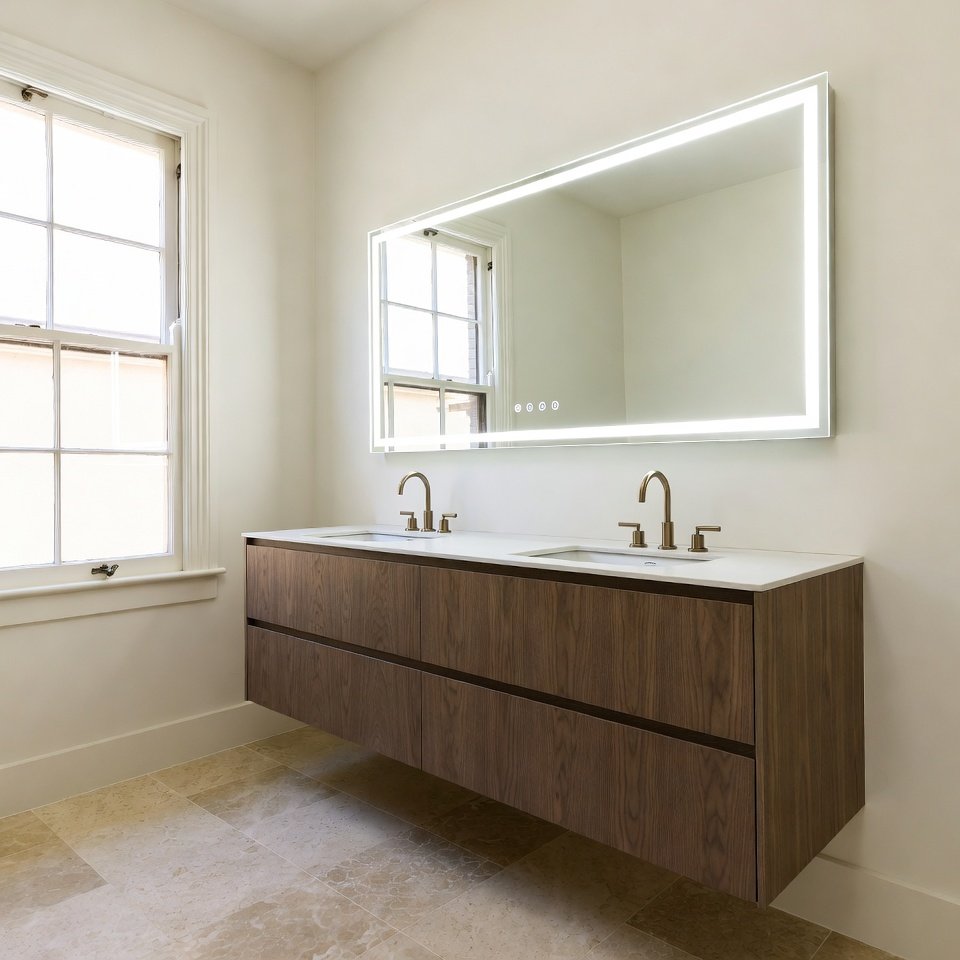
The Ensuite That Stopped the Renovation in Its Tracks
The Hawthorn Victorian terrace had been renovated thoughtfully. New kitchen. Restored Baltic pine floors. A laundry that finally worked. Everything except the ensuite, which remained exactly as 1987 had left it — a pedestal basin, a builder-grade vanity unit in laminate that had buckled at the toe-kick, and a mirror with a plastic frame that caught the morning light badly.
The brief was a single sentence: “Make it feel like it belongs to the same house as the kitchen.”
What we built: a floating American oak vanity at 850mm height, wall-mounted on a hidden steel bracket frame, with a Fenix NTM Grigio Londra base cabinet and a 12mm Neolith benchtop in soft white. Two slim drawers on Blum Legrabox runners, organised internally with a bespoke insert. A backlit LED mirror with touch dimming. And a concealed LED strip beneath the floating base — the light that made the room feel twice its actual size.
The client’s response at handover was not about the vanity. It was about the floor. “I can finally see the whole floor.”
That is what a floating vanity does. And in Hawthorn’s heritage homes — where bathrooms are frequently small, dark, and complicated by original tiles, dado rails, and cornices — it is the specification that resolves the room rather than filling it.
For context on how Silk Touch approaches heritage homes in this postcode, kitchen renovation Hawthorn covers the same specification logic applied to the adjacent room.
Why Wall-Mounted Vanities Are Dominating Melbourne Bathrooms in 2026
The freestanding vanity had a good decade. It solved the problem of exposed plumbing without requiring structural wall work. It offered storage without commitment. And it photographed well in the mid-range renovation market.
In 2026, the specification has shifted — and the reasons are functional rather than fashionable.
Floor continuity. A wall-mounted vanity allows the floor tile to run uninterrupted beneath the cabinet. In a bathroom where the floor is the primary material interest — marble, large-format porcelain, original tessellated tile — the floating base preserves the visual field. A freestanding vanity divides it.
Cleaning access. The floor beneath a freestanding vanity accumulates. It is inaccessible to a standard mop and inconvenient for manual cleaning. The floating base eliminates the problem entirely.
Visual space. In bathrooms under 4 square metres — which describes most ensuites in Melbourne’s Inner East heritage housing stock — the wall-mounted vanity creates a floor plane that reads as larger than the room’s actual dimensions. This is not an optical illusion. It is spatial psychology, and it works.
Plumbing integration. Contemporary tapware and basin combinations are increasingly designed for wall-mounted vanity contexts. The back-to-wall basin, the wall-set tap, the integrated overflow — these are specification decisions that assume a floating base. Retrofitting them to a freestanding vanity always involves a compromise.
Trend 1: Floating and Wall-Mounted Designs
The structural requirement for a wall-mounted vanity is a steel bracket frame, concealed within the wall cavity or surface-mounted and subsequently tiled over. This frame carries the full load of the cabinet, benchtop, and contents — typically 80–120kg for a complete vanity installation.
In heritage homes with original lathe-and-plaster walls, the bracket frame must be fixed to the structural stud or masonry behind the plaster, not to the plaster face itself. This is a survey-stage determination — Silk Touch confirms wall construction at the laser measure appointment, not during installation.
The height specification for a wall-mounted vanity is not the standard 850mm used in contemporary bathrooms. In heritage homes with owners over 1.75m, Silk Touch frequently specifies at 900mm — the same ergonomic logic applied to kitchen benchtop heights. This is a detail that a catalogue product cannot accommodate. A bespoke unit can.
The visual depth of the floating base matters as much as the height. A vanity that projects 550mm from the wall in a 1.2m wide bathroom leaves 650mm of clear floor — functional but tight. Reducing the cabinet depth to 450mm while maintaining internal drawer capacity through a redesigned internal configuration is a fabrication decision that requires factory capability. Silk Touch holds this capability as standard.
Trend 2: Warm Timber and Matte Finishes
The all-white bathroom has not disappeared — but it has been joined by a palette that references material warmth rather than clinical neutrality.
American oak veneer in a Quarter Cut profile is the timber specification for heritage bathrooms in 2026. The tight, linear grain reads as considered rather than rustic. It references the original joinery language of Victorian and Edwardian interiors — the skirtings, the door architraves, the window reveals — without replicating it directly.
The critical specification in a bathroom context: the oak veneer substrate must be 18mm moisture-resistant MDF with a two-pack polyurethane seal on all faces, including the rear panel and the internal faces of any drawers. An unsealed rear panel in a bathroom environment absorbs moisture from condensation cycling and delaminates within three years. This is a factory specification, not a site instruction.
Fenix NTM in the bathroom context performs differently from the kitchen context — and better, in some respects. The oleophobic surface that resists fingerprints in kitchens also resists soap residue and toothpaste splatter in bathrooms. The thermal self-healing property addresses the micro-abrasion from jewellery, taps placed on the vanity face, and hairdryer heat. For matte finish specification in 2026, Silk Touch is specifying three Fenix tones with particular frequency in Hawthorn heritage bathrooms: Grigio Londra (a warm mid-grey), Verde Comodoro (a deep olive that references period joinery), and Bianco Kos (a matte white that reads warmer than 2-Pac white).
The combination of oak veneer on the cabinet face with a Fenix NTM door insert — or vice versa — is the specification that appears most consistently in Silk Touch’s 2026 Inner East bathroom projects. The material contrast reads as designed. The tonal relationship between warm oak and a cool grey Fenix is a decision that works in both period and contemporary contexts.
The same finish palette logic applied to bathroom vanities extends across Custom Laundry Solutions Melbourne 2026 — where the case for matching the vanity tone to the laundry joinery is made in full.
Trend 3: Integrated LED Mirrors and Touchless Taps
The mirror is no longer a reflective surface on a wall. In 2026 bathroom specification, it is a functional element with lighting, storage, and control integration.
Backlit LED mirrors with touch dimming and colour temperature adjustment are the standard specification for Silk Touch bathroom projects. The technical specification:
- Lighting: Hafele Loox 5 integrated strip at 2700K–3000K — warm enough to render skin tones accurately, cool enough to function as task lighting for grooming
- Dimming: Touch-sensitive edge control, 10–100% range
- Demisting: Rear heating element, 12V, activated by the same touch control
- Size: Mirror face to extend 50mm beyond the vanity width on each side, and 300mm above the top of the cabinet — the proportional rule that prevents the mirror from reading as undersized
The concealed LED strip beneath the floating vanity base is not a mirror specification — it is a vanity specification, and it warrants its own discussion. A 3000K LED strip recessed into the underside of the cabinet base, directed downward, creates the floating effect that is the signature of a well-executed wall-mounted vanity. The strip must be dimmable and connected to the vanity circuit, not a separate switch. The effect at full brightness is task lighting for the floor area. At 20% brightness, it is the ambient light that makes a bathroom feel considered at 11pm.
Touchless taps in the bathroom context are increasingly specified in Hawthorn and Toorak projects where hygiene and the absence of visible fingerprints on brushed brass or matte black tapware are client priorities. The specification requires a power supply to the tap body — a rough-in decision that must be made before tiling. Silk Touch coordinates this at documentation stage.
Trend 4: Hidden Storage and Slimline Drawers
The bathroom vanity that looks minimal and stores everything is the 2026 brief. Achieving it requires thinking about internal configuration before the external dimensions are confirmed.
Slimline drawer stacks — two drawers at 150mm height and one at 200mm height in a 600mm high vanity base — provide more usable storage than one large cupboard with a shelf. The reason is accessibility: a drawer presents its full contents at eye level when open. A cupboard requires bending to access the rear. In a bathroom context where the vanity height is 850–900mm, the drawer stack is functionally superior in every daily-use scenario.
Internal organisation within bathroom drawers is specified differently from kitchen drawers. The primary storage requirement is not utensils but personal care products — irregular heights, varying widths, unstable when drawers open. A custom-moulded insert in a matte finish, sized to the specific product inventory the homeowner maintains, converts a standard drawer into a functioning system. Silk Touch produces these inserts from the same material as the vanity carcass — they are not aftermarket additions but designed components.
For the hardware specification governing these drawer systems, the Blum vs Hettich Hardware Melbourne 2026 guide covers the load, adjustment, and moisture-resistance considerations that make the hardware decision different in a bathroom than in a kitchen.
Concealed shaving cabinets — recessed into the wall between studs, with a flush door that reads as a wall panel when closed — are a related specification increasingly requested in heritage bathrooms where wall depth permits. A standard 90mm stud cavity accommodates a 70mm deep shaving cabinet. Silk Touch builds these as part of the vanity scope, finished to match the vanity doors.
Wall-Mounted vs Freestanding: Which Suits Heritage Homes Best?
The honest answer is that both can be correct — but the default for Hawthorn heritage bathrooms should be wall-mounted, with freestanding considered only where structural constraints make bracket installation genuinely impractical.
Wall-mounted is correct when:
- The wall has accessible structural fixing points (stud or masonry)
- The floor tile or original tessellated tile is worth preserving in full view
- The bathroom is under 5 square metres
- The renovation budget permits the additional structural work
Freestanding is considered when:
- The wall is a heritage partition that cannot be penetrated (rare in internal bathrooms)
- The floor covering is compromised beneath where the bracket would sit
- The client specifically requests a furniture-style piece that reads as a freestanding object
In either case, the specification decisions — material, hardware, internal configuration, finish — are identical. The fixing method changes. The design quality does not.
For bespoke joinery Toorak projects where the heritage context is most demanding, Silk Touch documents the wall construction at survey stage and provides a structural specification recommendation before the client commits to either approach.
Shop Vanities vs Full Bespoke: Speed, Price, and Customisation
Silk Touch operates two parallel pathways for vanity projects, and the right one depends on three variables: timeline, budget, and the degree of customisation required.
Shop vanities are pre-designed units manufactured in standard sizes (600mm, 750mm, 900mm, 1200mm wide) in a curated range of finishes. They are produced in batches, held in stock, and available for delivery within 2–3 weeks of order. The specification is fixed — finish, hardware, and internal configuration are as designed. Price point: $3,500–$8,500 depending on size and finish.
Shop vanities are the correct specification when the bathroom dimensions match a standard size, the finish range includes the required tone, and the timeline does not permit a full bespoke programme. For a Hawthorn bathroom renovation where the structural and tiling work is complete and the client needs a vanity within a three-week window, the Shop pathway delivers a premium outcome without the full bespoke timeline.
Full bespoke vanities are designed to the actual room dimensions, specified to the client’s exact material and configuration requirements, and manufactured at Silk Touch’s Melbourne workshop. Every dimension, every finish, every internal detail is client-specified. Price point: $8,000–$22,000 depending on size, material, and complexity. Timeline: 6–8 weeks from confirmed design.
Bespoke is the correct pathway when the bathroom is non-standard in dimension, the wall-mounted bracket requires integration with the cabinet design, the finish is not in the standard Shop range, or the internal configuration requires custom organisation inserts. For heritage bathrooms — which are almost universally non-standard — bespoke is usually the correct specification.
The aesthetic continuity argument also favours bespoke. A vanity that matches the kitchen’s Fenix tone, the laundry’s oak veneer specification, and the wardrobe’s hardware brand is a designed outcome. It requires a fabricator who can hold all of those specifications in a single project. The luxury walk-in wardrobes Melbourne page covers how Silk Touch manages material continuity across multiple joinery scopes within a single home.
How Silk Touch Delivers: The Vanity Programme
Week 1: Free 3D design consultation and laser measure. The bathroom is measured to ±1mm. Wall construction is confirmed. Structural fixing points are located. The 3D model is built from the actual room — not from the floor plan dimensions, which are routinely inaccurate in heritage homes by 15–40mm across a 1.5-metre wall.
Week 2: Design presentation and material confirmation. The 3D model is presented with material options in context — Fenix tones rendered against the existing floor tile, oak veneer shown at the correct grain direction, mirror proportion confirmed relative to the wall height. Changes are made in the model. Nothing is ordered until the design is signed off.
Weeks 3–5: Local Melbourne manufacture. The vanity is built at Silk Touch’s Melbourne workshop. The carcass is marine-grade ply. The door faces are finished to specification. Hardware is installed and adjusted. The bracket frame is fabricated to the structural fixing specification confirmed at survey.
Weeks 6–7: Installation. The bracket frame is fixed to the confirmed structural points. The cabinet is mounted, levelled, and checked for plumb. On-site scribing addresses any wall irregularity at the cabinet sides. The plumber connects the basin and tapware after the vanity is set — not before. Drawer adjustment is finalised after basin weight is on the benchtop.
Week 8: Mirror installation and client handover. The LED mirror is installed and connected. Dimming and demisting functions are tested. The LED strip beneath the cabinet is calibrated. Final adjustment of all soft-close mechanisms is completed with the drawers loaded.
2026 Cost Guide
Shop vanity, standard size, stock finish: $3,500–$8,500 supplied. Installation additional — typically $800–$1,500 depending on wall construction and plumbing configuration.
Bespoke vanity, Fenix NTM or 2-Pac finish, Blum hardware, standard wall mounting: $8,000–$14,000 installed.
Bespoke vanity, American oak veneer, Neolith or Caesarstone benchtop, Blum Legrabox, integrated LED strip: $14,000–$22,000 installed.
Full ensuite joinery package (vanity, shaving cabinet, wall unit, mirror): $22,000–$38,000 installed.
The variables that move price most significantly in bathroom vanity projects:
Benchtop material — Neolith at 12mm profile adds $2,000–$4,500 over a laminate benchtop. The visual and durability case for sintered stone in a bathroom context is the same as in a kitchen.
Heritage wall installation — bracket frame engineering for lathe-and-plaster walls adds $1,200–$2,500 over a standard stud-wall installation. This is not optional in a heritage home. It is the structural foundation of the entire installation.
LED mirror specification — a quality backlit mirror with demisting and touch dimming adds $1,800–$3,500 to the scope depending on size. The builder-grade alternative costs $400 and reads as such.
The 2026 Kitchen Island Trends for Melbourne’s Inner East Homes post discusses a comparable cost logic in the kitchen context — the same principle applies here. The saving on a specification component rarely justifies the visual or functional outcome it produces.
The Verdict: The Bathroom Vanity Is Worth Getting Right
The bathroom vanity is used more consistently than any other piece of joinery in the home. Twice daily, every day, by every household member. The specification decision — floating or freestanding, Fenix or timber, bespoke or shop — has a daily consequence that kitchen joinery does not match for frequency.
In Hawthorn’s heritage homes, the vanity is also a statement about the renovation’s ambition. A floating oak vanity with a Fenix drawer face, a Neolith benchtop, and a backlit LED mirror tells a story about the standard of the work throughout the house. It is the detail that confirms the renovation was designed rather than assembled.
Silk Touch builds bathroom vanities with the same technical rigour applied to kitchens and laundries — marine-grade ply carcasses, moisture-resistant specifications, premium hardware, and a 3D design process that resolves every heritage complication before manufacture begins.
Browse our ready-made luxury vanities or book a free 3D consultation — the Shop range delivers in 2–3 weeks, the bespoke programme in 6–8. Both are built in Melbourne. Neither is a compromise.
Frequently Asked Questions
How much does a custom bathroom vanity cost in Melbourne in 2026? Bespoke bathroom vanities from Silk Touch range from $8,000–$14,000 installed for a standard Fenix or 2-Pac finish with Blum hardware, to $14,000–$22,000 for an American oak veneer with Neolith benchtop and integrated LED strip. Full ensuite joinery packages including shaving cabinet, wall unit, and mirror run $22,000–$38,000 installed. Shop vanities in standard sizes are available from $3,500 supplied.
Are wall-mounted vanities suitable for heritage homes in Hawthorn and Camberwell? Yes — provided the wall construction permits structural bracket fixing, which Silk Touch confirms at the laser measure appointment. Heritage lathe-and-plaster walls require bracket frames fixed to the structural stud or masonry behind the plaster face. This is a standard installation approach for Silk Touch and does not compromise the heritage fabric of the room.
What is the best finish for a bathroom vanity in a heritage home? Fenix NTM in warm grey tones — Grigio Londra, Verde Comodoro — works correctly in heritage bathroom contexts by referencing period colour without replicating period material. American oak veneer in Quarter Cut profile with a low-sheen polyurethane seal is the timber specification for heritage interiors. Both require marine-grade ply carcasses with fully sealed internal faces in the bathroom environment.
How long does a bespoke bathroom vanity take to build and install? Silk Touch’s standard bespoke programme is 6–8 weeks from confirmed design to completed installation. Shop vanities in standard sizes are available for delivery within 2–3 weeks of order.
What is the floating LED strip effect under a wall-mounted vanity? A dimmable LED strip recessed into the underside of the cabinet base, directed downward at 3000K, creates a light plane between the vanity base and the floor. At full brightness it functions as task lighting. At low brightness it is the ambient detail that makes the bathroom feel considered. The strip is connected to the vanity circuit and controlled by the same touch dimmer as the mirror.
Can Silk Touch match the vanity finish to an existing kitchen or laundry? Yes. Material and colour matching across kitchen, laundry, and bathroom joinery is a standard service. Silk Touch holds current Fenix NTM and Polytec sample ranges and can match existing specifications precisely. Where the kitchen uses a custom 2-Pac colour, the same colour reference is applied to the vanity finish.
What is the difference between a Shop vanity and a fully bespoke vanity from Silk Touch? Shop vanities are pre-designed units in standard sizes (600mm–1200mm wide) in a curated finish range, available within 2–3 weeks. Bespoke vanities are designed to the actual room dimensions in any material, finish, and configuration, with a 6–8 week programme. Shop vanities are the correct specification when dimensions and timeline align. Bespoke is correct for non-standard rooms, heritage installations, or when full material continuity across the home is a design requirement.