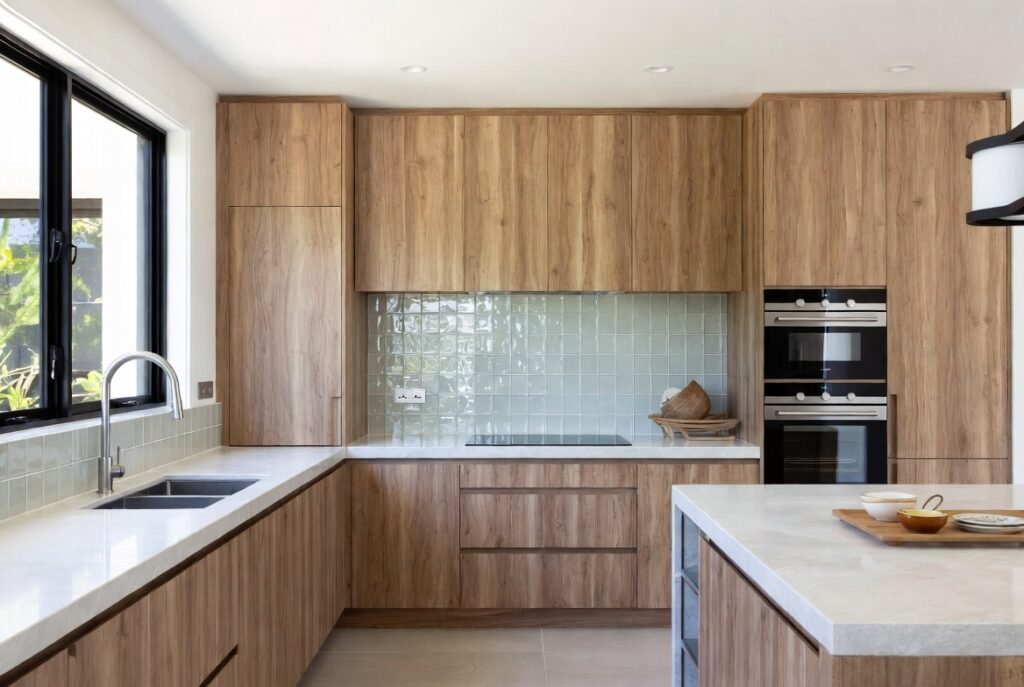
The Kitchen That Made the Carbon Argument Unnecessary
The Kew brief arrived with a sustainability specification document attached. The clients — both architects — had spent three months researching embodied carbon in building materials and had a clear position: the joinery would be FSC-certified throughout, the finishes would be low-VOC, and the benchtop would be recycled-content where a performance-equivalent option existed.
They expected to compromise somewhere. Every other supplier had told them that the sustainability requirements would limit the material palette, extend the timeline, or add a cost premium that made the brief unviable.
Silk Touch’s response was to go through their specification document line by line. FSC-certified American oak veneer: standard stock. Low-VOC 2-pack polyurethane with aliphatic hardener: standard specification. Recycled-content Caesarstone Mineral range: the product already being recommended first for its zero-silica properties. Local Melbourne manufacture: the only way Silk Touch builds.
The compromise list was empty. The kitchen went ahead without modification to the sustainability brief and without a cost premium above a comparable non-sustainability-specified project.
That conversation — the one where the sustainability requirements turn out to already be the standard specification — is becoming more common in bespoke joinery Toorak and Inner East projects in 2026. Not because the market is forcing it, but because the products that perform best in premium residential joinery are increasingly the products that also perform best on environmental metrics.
Why Sustainability Is a Different Conversation in 2026
The sustainability conversation in residential joinery has matured significantly in the past three years. It is no longer primarily a values conversation — “I want to do the right thing.” It is increasingly a specification conversation — “I want to understand what my joinery is made of and how it was produced.”
Three forces are driving this shift in Melbourne’s Inner East in 2026.
Embodied carbon awareness. The construction and renovation sector is the largest contributor to embodied carbon in the built environment — the carbon emitted in the manufacture and transport of building materials before a building is even occupied. Inner East homeowners who have engaged with this issue — particularly those who have completed or are planning whole-home renovations — are asking the same questions about their joinery that they have been asking about their insulation and glazing for a decade.
Certification literacy. FSC (Forest Stewardship Council) and PEFC (Programme for the Endorsement of Forest Certification) certification were niche knowledge five years ago. In 2026, a significant proportion of Silk Touch’s client consultations involve clients who have already researched these certifications and are asking for confirmation that the specific timber lot being specified carries the relevant chain-of-custody documentation. The clients know what to ask for.
Long-term value alignment. Sustainable specification and premium specification are increasingly the same specification. An FSC-certified American oak veneer from a managed forest in the eastern United States is also the most dimensionally stable, most colour-consistent American oak available — because managed forests produce timber under controlled harvest cycles that wild-cut timber cannot match. The environmental and performance arguments point to the same products.
Timber: FSC-Certified American Oak, Walnut, and Tasmanian Oak
Silk Touch sources FSC and PEFC-certified timber veneer for all projects where the certification is available in the required species and grade. In 2026, this covers the three primary species in the Inner East specification palette.
American oak (the most frequently specified veneer in Silk Touch’s kitchen and wardrobe projects) is available from FSC-certified forests in the eastern United States under managed selective harvest programmes. The certification chain runs from the forest through the veneer mill to the Melbourne importer to the Silk Touch workshop. Chain-of-custody documentation is available for all American oak lots on request. The American Oak Veneers In Depth guide covers the species’ specification in full — the FSC certification is additive to the performance and aesthetic arguments made there.
American walnut is similarly available from FSC-certified eastern US sources. The same chain-of-custody documentation applies. Walnut’s darker tone and stronger grain figure make it the specification for clients seeking a more dramatic material statement — the sustainability credentials are equivalent to American oak.
Tasmanian oak carries the strongest domestic provenance argument in the Silk Touch timber palette. FSC and PEFC-certified Victorian and Tasmanian forestry operations manage the species under Australian regulatory oversight — a supply chain that is shorter, more transparent, and more verifiable than any imported alternative. The full sustainability and specification case for Tasmanian oak in heritage contexts is covered in the Tasmanian Oak Veneers 2026 guide on the Silk Touch blog.
The Veneer Efficiency Argument
The sustainability case for veneer over solid timber is significant and underappreciated. A single log sliced into veneer yields approximately 40 times the usable surface area compared to the same log sawn into solid timber boards. The embodied carbon per square metre of finished surface is a fraction of the solid timber equivalent. For a full walk-in wardrobe with 30+ square metres of panel surface, the veneer specification represents a substantial reduction in timber resource consumption relative to a solid timber alternative — without any reduction in the visual quality of the finished product.
This is the argument that makes high-quality veneer joinery the environmentally correct specification, not a compromise position.
Finishes: Low-VOC 2-Pack and the Aliphatic Hardener Standard
The finish category is where sustainability claims in joinery most frequently lack specificity. “Low-VOC” is a marketing term that covers a wide range of actual VOC emissions — from genuinely low-emission water-based systems to solvent-heavy products that just barely meet a regulatory threshold.
Silk Touch’s position is specific: all 2-pack polyurethane applied in the Camberwell workshop uses aliphatic hardener formulations from suppliers with documented low-VOC compliance. The VOC content of the products used falls below the threshold set by the Australian Architectural and Decorative Surface Coatings Standard — not simply meets it, falls below it.
The aliphatic hardener choice is made for performance reasons first — as established in the 2-Pack Polyurethane Finishes: The Gold Standard guide, aliphatic hardeners produce UV-stable finishes that do not yellow over the fifteen-year performance horizon. The low-VOC benefit is additive to the performance argument.
Workshop Ventilation and Emission Management
The Silk Touch spray booth is equipped with activated carbon filtration on the exhaust stream — a system that captures solvent vapour before it reaches the external air. This is above the regulatory requirement for a booth of this size and is the specification that allows Silk Touch to operate the booth adjacent to the broader workshop and office environment without odour or air quality issues.
For clients requesting full transparency on finish emissions, Silk Touch can provide the product Safety Data Sheets for all finishes specified in a project — a level of documentation that most joinery suppliers do not offer because the information is not flattering for lower-specification products.
Water-Based Adhesives
The adhesive systems used in Silk Touch’s veneer pressing and carcass assembly are water-based PVA and polyurethane formulations — not solvent-based contact adhesives. The shift away from solvent-based contact adhesives in the workshop environment reduces workshop VOC emissions during production and produces a bond that performs equivalently to solvent-based alternatives in residential joinery applications.
The one application where solvent-based adhesive remains the specification is edge banding adhesion on complex curved profiles — water-based systems do not produce sufficient open time for precise positioning on compound curves. This is a narrow exception, not the standard.
Benchtops and Panels: Recycled Content and Environmental Performance
Caesarstone Mineral Range
The Caesarstone Mineral range — already the standard first recommendation for its zero-silica formulation — incorporates recycled industrial minerals and post-consumer glass content in its aggregate composition. The recycled content proportion varies by colour, but the Mineral range consistently outperforms standard quartz-aggregate engineered stone on recycled content metrics.
The 2026 Kitchen Benchtop Trends Melbourne guide covers the full Caesarstone Mineral specification — the recycled content is additive to the silica-free and performance arguments made there.
Fenix NTM
Fenix NTM panels are manufactured in Italy using a thermosetting resin process that does not require solvent-based manufacturing chemicals. The panel production process operates under the Italian IPPC environmental permit framework — one of the more stringent manufacturing environment regulatory systems in the world. The panels themselves are formaldehyde-free, which is relevant in the context of off-gassing in sealed residential environments over the years following installation.
Fenix is also one of the few panel products in the premium joinery specification range that documents its environmental credentials to the level of a full Environmental Product Declaration (EPD) — a third-party verified assessment of the product’s environmental impact across its full lifecycle. EPD documentation is available on request for clients who require it for green building certification purposes.
Porcelain Benchtops
Porcelain is the benchtop specification with the lowest ongoing maintenance environmental footprint: no sealing products required, no specialist cleaning chemicals, and a lifespan that extends to fifty years or more in protected interior applications. The production process is energy-intensive — fired at 1200°C — but the raw materials (clay, feldspar, quartz) are abundant, non-toxic, and sourced domestically in the European production facilities that supply the Australian market.
For Brighton and other coastal applications where UV exposure and humidity cycling are material specification factors, porcelain’s durability profile also means no replacement within a twenty-year renovation horizon — a significant embodied carbon advantage over materials requiring replacement at ten to twelve years.
Substrate: E0-Rated MDF
All MDF used in Silk Touch’s carcass production is E0-rated — the lowest formaldehyde emission classification available for composite wood panels. Standard MDF is E1-rated; E0 product emits formaldehyde at levels below detection threshold in normal residential environments. In sealed cabinetry with limited air exchange — wardrobe interiors, integrated appliance housings — the difference between E0 and E1 substrate is material for indoor air quality over the years following installation.
Hardware: Blum, Hettich, and Häfele Environmental Programmes
The three primary hardware suppliers in Silk Touch’s specification range all operate documented environmental management programmes.
Blum (Austria) operates its manufacturing facilities on 100% renewable electricity and publishes an annual sustainability report documenting progress against emissions, water use, and waste targets. The BLUMOTION soft-close mechanism’s 500,000-cycle rating translates to a hardware lifespan that exceeds the joinery it is installed in — the hardware does not require replacement within the renovation’s useful life.
Hettich (Germany) operates under ISO 14001 environmental management certification across its manufacturing facilities. The Actro 5D runner’s 500,000-cycle rating and 10-year warranty make the same hardware longevity argument as Blum’s offering.
Häfele (Germany) — whose Loox 5 LED system is specified across Silk Touch’s kitchen, wardrobe, and vanity projects — manufactures the Loox 5 strips with a 50,000-hour rated lifespan and publishes environmental product information for its LED range. A Loox 5 strip at 4 hours daily use has a 34-year operating lifespan before replacement — hardware that outlasts the renovation it serves.
The hardware longevity argument is an underappreciated sustainability point. Premium hardware that lasts the life of the joinery eliminates the embodied carbon of replacement hardware at year eight, year twelve, and year fifteen — a real environmental cost that builder-grade hardware with a three to five year lifespan produces repeatedly.
Workshop Practices: Local Manufacturing and Zero-Waste Production
Local Melbourne Manufacturing
The most significant single sustainability advantage in Silk Touch’s production model is geographic: all joinery is manufactured in the Camberwell workshop and delivered within Melbourne’s Inner East. There is no international freight. There is no interstate transport. The timber arrives at the workshop from Australian or internationally certified sources; the finished joinery departs to a suburb within 15 kilometres.
The embodied carbon of international freight in imported flat-pack and pre-manufactured joinery is substantial and rarely documented in the product’s environmental claims. A kitchen cabinet imported from a European or Asian factory and shipped to Melbourne carries freight emissions that a locally manufactured equivalent does not. For clients building a whole-home renovation with an embodied carbon budget, local manufacture is the single most effective joinery specification decision available.
Offcut and Waste Management
Silk Touch’s workshop generates timber veneer offcuts, MDF panel offcuts, and finishing product waste as production byproducts. The current waste management approach:
Timber veneer offcuts from the sequenced bundle selection process are retained and used for sample panels, material testing, and finishing trials — not discarded. Offcuts below usable size are collected for timber recycling rather than general waste disposal.
MDF panel offcuts above 300mm in any dimension are retained for use in smaller joinery components — drawer dividers, pelmet backing panels, and internal carcass components that do not require full sheet dimensions. The offcut retention programme reduces sheet waste by approximately 15% per project compared to a full-cut-from-new approach.
Finish waste from the spray booth — including catalysed 2-pack that has exceeded its pot life — is collected as chemical waste and disposed of through a licensed chemical waste contractor, not through general waste streams.
Energy
Silk Touch’s Camberwell workshop operates with rooftop solar generation covering the base load electrical requirement of the workshop during daylight hours. Spray booth operation, CNC equipment, and compressed air systems draw from the solar generation during production hours. The workshop is not carbon-neutral — the solar system covers the base load, not the peak demand of full production operations. The claim Silk Touch makes is accurate: solar generation reduces the workshop’s grid electricity consumption materially. The claim Silk Touch does not make is carbon neutrality, because the documentation does not support it.
Does Sustainable Joinery Cost More in 2026?
The honest answer is: minimally, and in most cases not at all.
FSC-certified timber veneer carries a cost premium of approximately 5–12% over uncertified timber of equivalent grade — a figure that represents $400–$1,200 on a full kitchen veneer component. This is real but modest relative to total project cost.
E0-rated MDF carries a 10–18% cost premium over standard E1 MDF — approximately $300–$800 on a full kitchen carcass. Again, real but not material at the project level.
Low-VOC 2-pack with aliphatic hardener is the standard Silk Touch specification. There is no premium for requesting it because there is no lower-specification alternative in the Silk Touch product range. The cost is the baseline.
Recycled-content Caesarstone Mineral is the same cost as standard Caesarstone at equivalent grade. There is no premium.
Local manufacture is the Silk Touch standard. The comparison cost of imported joinery is lower — but the comparison product is not equivalent in quality, fit precision, or heritage scribing capability.
The total sustainability premium across a full kitchen project using FSC timber, E0 substrate, and low-VOC finishes is typically $800–$2,500 over a hypothetical equivalent project using uncertified materials — less than 5% of the total project cost in most cases.
For kitchen renovations Camberwell projects at the mid-to-premium specification level, this premium is within the normal cost variation between equivalent quotes from different suppliers. It is not a significant budget item.
Real Inner East Eco-Luxury Projects
Kew, Federation kitchen and wardrobe, January 2026. The project referenced in the introduction. FSC American oak throughout kitchen and walk-in wardrobe. E0 MDF carcasses. Low-VOC 2-pack at 12% gloss. Caesarstone Mineral Fior di Bosco perimeter benchtop. The clients received chain-of-custody documentation for the timber lot and the Fenix NTM panel used in the laundry. Total sustainability premium over non-certified equivalent: $1,850 on a $145,000 project — 1.3%.
Camberwell, Edwardian full home joinery, 2024. Client requested a sustainability briefing before any specification was confirmed. Silk Touch provided product Environmental Data Sheets for all primary materials — veneer, MDF, 2-pack finish, benchtop. The briefing took forty minutes. The project proceeded on standard specification because the standard specification already met every criterion on the client’s list.
Toorak, Georgian kitchen, 2025. FSC American walnut veneer on the island base — a species the client had initially ruled out on environmental grounds before confirming that FSC-certified walnut from managed forests is available and was the specification being used. The sustainability confirmation converted a client hesitation into a project commitment.
Malvern, walk-in wardrobe, 2025. FSC Tasmanian oak throughout — the domestic timber argument was the primary driver. The client wanted to understand exactly where the timber came from. Silk Touch provided the specific forestry certification reference for the lot. The Luxury Walk-In Wardrobe Islands & Seating: 2026 Must-Haves for Malvern guide covers the full wardrobe specification for this project — the Calacatta marble island top is the one component where an environmental alternative does not exist, and Silk Touch communicated this clearly.
Hawthorn, Inter-War kitchen, 2024. Low-VOC 2-pack and E0 MDF driven by the client’s sensitivity to indoor air quality following a family member’s respiratory diagnosis. The E0 MDF substrate and low-VOC finish specification reduced post-installation off-gassing to below detection threshold at the three-day mark. Standard E1 MDF and solvent-heavy finishes would have produced measurable off-gassing for two to four weeks.
How to Request a Sustainable Brief
Every Silk Touch free 3D design consultation can be structured as a sustainability-first brief. The process:
At the consultation booking, note that sustainability certification and low-emission materials are a specification priority. Silk Touch will prepare a materials schedule for the proposed project that documents FSC certification availability, E0 or E1 substrate options, VOC emission levels for proposed finishes, and recycled content data for proposed benchtop materials — before the design conversation begins.
The consultation then proceeds with this documentation on the table. Every specification decision is made with full environmental information available. No decision is made on environmental grounds alone — performance and aesthetic criteria apply equally. But the environmental data is present and accurate, not estimated or marketed.
For projects where formal environmental documentation is required — green building certification, heritage overlay planning submissions, or whole-home embodied carbon assessments — Silk Touch can provide product EPD data, chain-of-custody certificates, and VOC compliance documentation in a format suitable for third-party verification.
Book your free sustainable 3D design consultation — request the sustainability briefing at booking and the materials documentation will be ready at the first meeting.
Frequently Asked Questions
What does FSC certification mean for my joinery timber? FSC (Forest Stewardship Council) certification means the timber was harvested from a forest managed under standards that protect biodiversity, worker rights, and long-term forest health. Chain-of-custody certification tracks the timber from the certified forest through every production step to the finished product. Silk Touch can provide chain-of-custody documentation for all FSC-certified timber lots on request — the certification reference is traceable to the specific forest and harvest region.
Is 2-pack polyurethane a low-VOC finish? The 2-pack polyurethane used in Silk Touch’s Camberwell spray booth uses aliphatic hardener formulations with VOC content below the Australian Architectural and Decorative Surface Coatings Standard threshold. The workshop spray booth is equipped with activated carbon filtration on the exhaust stream. Silk Touch can provide Safety Data Sheets documenting VOC content for all finishes used in a project. The off-gassing period after installation is typically two to four days, after which the cured film is inert.
Does sustainable joinery cost significantly more in 2026? In most cases, the total sustainability premium across a full kitchen project — FSC timber, E0 substrate, low-VOC finishes — is $800–$2,500, representing less than 5% of total project cost at the mid-to-premium specification level. Recycled-content Caesarstone Mineral benchtops and low-VOC 2-pack finishes carry no premium over standard specification because they are the standard Silk Touch specification. Local Melbourne manufacture eliminates international freight costs that imported joinery carries.
What is E0-rated MDF and why does it matter? E0 is the lowest formaldehyde emission classification for composite wood panels — below detection threshold in normal residential environments. Standard MDF is E1-rated, which emits formaldehyde at measurable levels for two to four weeks after installation in sealed cabinetry environments. In enclosed wardrobes, integrated appliance housings, and bedroom joinery, E0 substrate is the specification that produces the lowest post-installation air quality impact. Silk Touch uses E0-rated MDF throughout its carcass production.
How does local Melbourne manufacturing reduce environmental impact? Joinery manufactured in Melbourne and delivered within the Inner East carries no international freight emissions and minimal domestic transport emissions. Imported joinery — even from high-quality European manufacturers — carries the embodied carbon of sea freight from Europe or Asia, which is substantial at the per-unit level. For clients building a whole-home renovation with an embodied carbon budget, local manufacture is the single most effective specification decision available within the joinery scope.
Can Silk Touch provide environmental documentation for green building certification? Yes. Silk Touch can provide FSC chain-of-custody certificates for certified timber lots, Environmental Product Declaration data for Fenix NTM panels, VOC compliance documentation for 2-pack finishes, and recycled content data for Caesarstone Mineral benchtops in a format suitable for third-party verification. This documentation is prepared on request at the design consultation stage for projects requiring formal environmental certification.
Does sustainable specification compromise the aesthetic or durability of the joinery? No — in the Silk Touch specification range, sustainable and premium are the same specification. FSC-certified American oak veneer is dimensionally stable, colour-consistent, and book-matchable at the same level as uncertified timber. Low-VOC 2-pack polyurethane with aliphatic hardener produces the same fifteen-year performance horizon as higher-VOC alternatives. E0 MDF performs identically to E1 MDF in structural and finishing applications. The environmental credentials are additive to the performance credentials, not traded against them.