Buying a period home in Melbourne is not just a purchase; it is an act of custodianship. You secure the keys to a Victorian terrace in Hawthorn or an Edwardian villa in Malvern, and the romance is immediate.
But then you read the Section 32 and see the words that strike fear into the heart of every renovator: Heritage Overlay.
It can be paralyzing. Clients often come to our Camberwell studio worried that they are trapped in a museum, legally bound to live with draughty halls and 19th-century plumbing.
The reality is different. At Silk Touch Joinery, we believe in “Sympathetic Evolution.” You can have a high-performance, architectural kitchen in a heritage home. It simply requires a nuanced approach to design and a joiner who understands the rules of the game.
Understanding the Rules: What is actually protected?
There is a common misconception we call the “Facade Fallacy.” Many homeowners believe the entire property is frozen in time.
In 90% of cases in suburbs like Hawthorn, Armadale, and Kew, the Heritage Overlay (HO) is designed to protect the streetscape. The council cares about what the public can see. They want to preserve the rhythm of the chimneys, the intricate ironwork of the verandahs, and the consistency of the fence lines.
What happens at the rear of the property—the private realm—is often open for interpretation. This gives rise to the architectural typology known as the “Mullet” renovation: strictly heritage at the front, and unapologetically modern at the back.
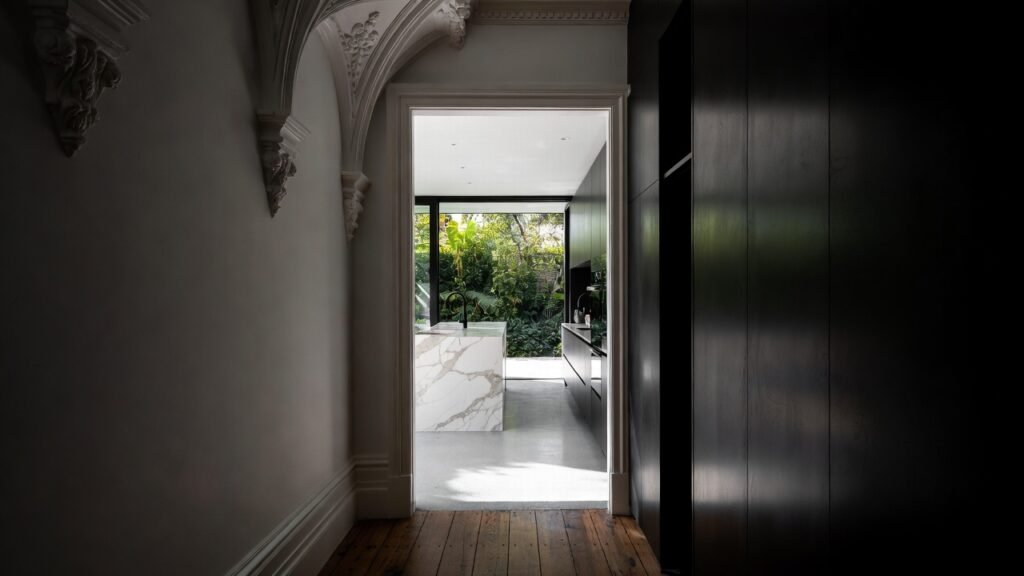
While architects handle the shell, we handle the flow. Our joinery is the connective tissue. We design cabinetry that respects the heritage weight of the front rooms without mimicking it, creating a seamless transition into the light-filled extension.
Council Specifics: Boroondara vs. Stonnington
We work across both municipalities daily. While the goals are similar, the architectural nuances differ.
Boroondara (Kew, Hawthorn, Camberwell)
Boroondara relies heavily on a grading system (Significant, Contributory, Non-Contributory). The focus here is the preservation of the “Garden City” character—leafy streets and grand setbacks.
- The Joinery Implication: In Heritage Kitchens in Camberwell, we often find that while the exterior colour palette is strictly controlled (muted greys and creams), the interiors allow for Transitional Design. We might use a slim-shaker profile that nods to the past but finish it in a contemporary, matte 2-pack polyurethane rather than a traditional gloss.
Stonnington (Toorak, Malvern, Armadale)
Stonnington is obsessed with “Street Rhythm” and setbacks. The focus is on maintaining the prestige and scale of the frontage.
- The Joinery Implication: In Toorak Restoration Projects, the stakes are higher. The joinery needs to feel substantial. Thin, modern porcelain benchtops often look out of place here. We use thick natural stone (Marble or Dolomite) and solid timber framing to match the grandeur and “heaviness” of the original architecture.
The “Link” Architecture: Connecting Old and New
The hardest part of a heritage renovation is not the kitchen itself; it is the Transition Zone. This is the point where the original 1890s hallway (with its plaster arches and Baltic Pine floors) meets the new 2026 open-plan living space (with its polished concrete and glass).
If you get this wrong, the house feels like two separate buildings glued together.
The Solution is Material Continuity.
We use joinery to bridge the gap:
- Timber Tones: We might take the warm honey tone from the original floorboards and replicate it in a modern, flat-panel veneer for the kitchen cabinetry.
- Stone as a Neutralizer: Natural stone is timeless. It existed in 1890 and it exists now. Using a classic Calacatta or Super White Dolomite effectively bridges the gap between eras.
See how we achieved this balance of materials in our Modern Minimalist Renovations in Brighton
Why “Off-the-Shelf” Kitchens Fail in Heritage Homes
This is the technical reality that most kitchen brochures won’t tell you. Heritage homes—especially Hawthorn Warehouse Conversions or brick Victorians—are never square.
- Undulating Walls: A 130-year-old brick wall moves. It breathes. It settles. If you attempt to install a standard modular kitchen (IKEA or Kaboodle) against these walls, you will end up with unsightly gaps or cabinets that don’t close properly.
- The Ceiling Height Issue: A standard kitchen cabinet is 2400mm high. A Victorian home often has 3.6m (12ft) ceilings. If you put a standard height kitchen in a room with 3.6m ceilings, it looks dwarfed, temporary, and cheap.
The Silk Touch Standard: We build “monolithic” cabinetry that extends up to the ceiling or a datum line, utilizing that vertical space for storage and respecting the scale of the room.
The Art of Scribing
We utilise a technique called “scribing.” This involves oversized filler panels that are hand-planed on-site by our installers to perfectly follow the undulating profile of your ornate cornices, skirtings, and out-of-plumb walls. It is the difference between a “fitted” kitchen and a “built-in” architectural feature.
Checklist for Your Heritage Renovation
- Check your Schedule: Look at your Section 32. Is your HO Schedule number listed?
- Consult the Experts: Hire an architect and a joiner who know the local council. The Boroondara planning counter is not a place for amateurs.
- Plan Early: In heritage homes, modern services (HVAC, plumbing, electricals) often need to be routed through solid brick walls. Planning your joinery early allows us to create service voids to hide these ugly necessities behind beautiful timber panels.
Don’t let the paperwork scare you.
We build kitchens that respect the past and embrace the future. Whether you are in a Heritage Overlay in Toorak or a character precinct in Camberwell, we know how to navigate the rules to deliver luxury.
Living in a Heritage Overlay?