The Room That Took Three Years to Get Right
The Malvern client had renovated everything else first. The kitchen. The bathrooms. The laundry. Each time, the master bedroom suite was next — and each time, something more urgent moved ahead of it.
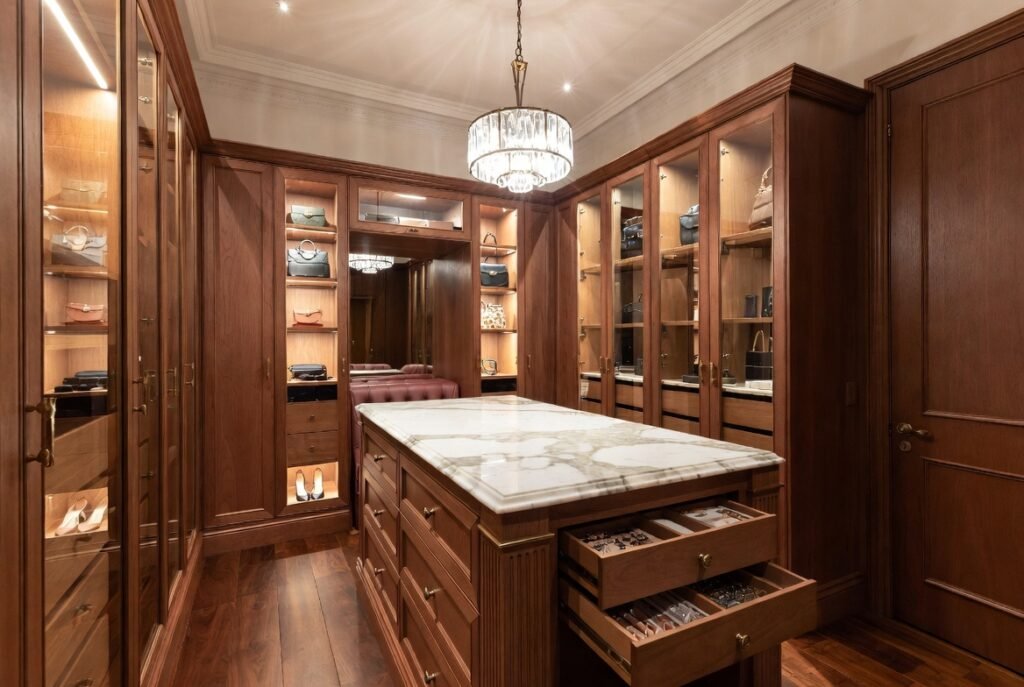
When the dressing room finally came, the brief had three years of thinking behind it. A wardrobe island with a Calacatta marble top and velvet-lined jewellery drawers. A built-in upholstered bench along the window wall with storage beneath. A dressing table with the right mirror height and the right light — not the bathroom vanity lighting she had been using for three years. Open display niches for the handbags, because she was tired of knowing they were in boxes but not knowing which box.
What we built took six weeks. The three years of thinking meant every decision was made before the laser measure was complete.
This is the dressing room brief in Malvern in 2026: considered, specific, and built on an understanding that this room is not a large wardrobe. It is a room designed around a daily ritual that deserves the same precision as the kitchen it took three years to perfect.
For the full luxury walk-in wardrobe specification approach — including internal configuration, hanging ratios, and the Blum hardware specification that governs every drawer — the luxury walk-in wardrobes Melbourne pillar covers the complete scope. The island, the seating, the dressing table, and the display system are the elements that convert a wardrobe into a dressing room. This article covers all four.
Why the Island Is the Centrepiece — and Why It Must Be Joinery
The walk-in wardrobe island is frequently specified as a piece of furniture — a chest of drawers positioned in the centre of the room with a stone top placed on it. This approach produces a result that looks like a chest of drawers in the centre of a room. It does not produce a dressing room.
The joinery island is a built element. It is fixed in position, dimensioned to the actual room, finished in the same material as the surrounding wardrobe, and fitted with the same hardware as every other drawer in the space. It reads as the centre of a designed room — not as a piece of furniture that arrived from somewhere else.
The structural argument is also real. A furniture island in a walk-in wardrobe is not fixed to the floor. In a heritage Edwardian home in Malvern with Baltic pine floors that move seasonally, an unfixed piece of furniture with a heavy stone top develops a lean within eighteen months. A joinery island is fixed to the floor structure at the base, levelled precisely, and the stone top is templated to the actual island dimensions after it is set in position.
The Island: Dimensions, Drawers, and Stone
Clearance First
The single most important island specification decision is not the material or the drawer configuration. It is the clearance — the distance between the island face and the surrounding wardrobe panels on all sides.
The rule: 1,000mm minimum clearance on all operational sides — the sides where wardrobe doors open or where the user stands to dress. On a non-operational side adjacent to a wall, 600mm is acceptable. Less than 1,000mm on an operational side produces a room where the user cannot fully open a wardrobe door while standing at the island. This is the error that makes an expensive dressing room feel cramped.
In a standard Malvern master bedroom dressing room of 3.6 × 3.0 metres — a common configuration in Edwardian homes where two bedrooms have been combined — a 1,200mm wide × 550mm deep island leaves 1,200mm of clearance on the long sides and 900mm at each end. This is the maximum island size for this room before the clearance rule is compromised. Silk Touch confirms clearance dimensions in the 3D model before the island carcass is drawn.
Dimensions
Width: 900mm minimum for functional use — less than this and the island reads as a bedside table rather than a centrepiece. 1,200mm is the standard specification for Malvern dressing rooms. 1,500mm at the upper end where the room permits.
Depth: 550mm for island-only configuration. 600mm where the top overhang is used as a seating surface at one end — the additional 50mm provides knee clearance for a stool.
Height: 850mm for standard use matching kitchen ergonomics. 900mm where the primary user is over 1.8 metres — the same ergonomic logic applied to kitchen benchtop height specification.
Drawer Configuration
The island drawer stack is the most detailed specification in the dressing room. Silk Touch approaches it with a function-first hierarchy: what is stored here, in what quantity, and at what access frequency?
Primary drawers (upper two rows): 150mm height — the correct dimension for folded knitwear, accessories, and folded shirts. Each drawer fitted with a custom velvet insert in a client-selected colour — charcoal, dove grey, and champagne are the most frequently specified in Malvern projects. The velvet insert is fabricated from the drawer interior dimensions after the carcass is complete, not estimated from a standard size.
Jewellery drawer: A dedicated 80mm height drawer with a two-tier pull-out tray system — the upper tray slides forward on integrated runners to reveal a second tray beneath. Ring rolls, earring foam, watch cushions, and necklace hooks are all specified from the client’s actual jewellery inventory at the design consultation. This is not a catalogue insert. It is a bespoke configured tray built to the contents.
Watch winder integration: Where clients have automatic watches requiring winding, a Buben & Zörweg or Wolf watch winder module can be integrated into a dedicated island drawer bay — a 200mm high, 300mm wide drawer with a power supply run into the island carcass during factory build. The winder module sits within the drawer bay and plugs into the internal GPO. This is a documentation-stage specification: the power supply cannot be added after the island is installed.
Deep base drawer: One 250mm height base drawer for large items — folded jumpers, handbag dust bags, rolled belts. Blum Legrabox at 70kg rating — the base drawer in an island accumulates the heaviest loads.
The American Oak Veneers In Depth guide covers the timber specification that governs the island exterior faces — Crown Cut American oak is the standard Malvern dressing room specification, with the island finished in the same veneer and the same lot as the surrounding wardrobe panels.
The Island Top
The island benchtop is the one location in a joinery project where Calacatta marble is the specification Silk Touch recommends without the maintenance caveats that apply in kitchens.
The reasoning: a dressing room island top is not a food preparation surface. It does not see acidic liquids, red wine, or lemon juice in normal use. The surfaces placed on it are fabric, jewellery, and personal care products — none of which etch calcium carbonate. The maintenance risk that makes marble a considered specification in a kitchen is largely absent in a dressing room context.
The aesthetic argument is also stronger here than anywhere else in the home. A Calacatta Gold or Calacatta Viola slab — selected at the Melbourne slab yard for its specific movement and colour — on an American oak island in a 3.0-metre ceiling Edwardian dressing room is the specification that reads as a designed room rather than a configured storage system. The material’s drama is appropriate to the space in a way it is not in a family kitchen.
Thickness: 20mm for the island top — thicker than a standard benchtop at 20mm reads as furniture rather than infrastructure, which is the correct register for a dressing room. A 30mm thickness is occasionally specified where the client wants a more substantial profile; this adds approximately $800–$1,500 to the stone fabrication cost.
Built-In Seating: The Bench and the Ottoman
The Built-In Bench
A built-in upholstered bench along a non-wardrobe wall — typically the window wall or the entry wall — is the seating specification that reads as architectural rather than furnished. It is fixed, scribed to the wall, and upholstered in a fabric that is selected as part of the joinery finish package.
The structural specification: the bench carcass is 18mm marine-grade ply throughout — not MDF, because the dynamic load of a person sitting and standing repeatedly over twenty years exceeds what MDF joints handle reliably. The seat panel is 25mm ply with a 75mm high-density foam topper, fabric-wrapped and staple-fixed to the underside. The foam density specification: 35kg/m³ minimum — below this density, the seat compresses noticeably within two years of regular use.
Storage beneath: two or three full-extension drawers on Blum Legrabox at 70kg rating — the bench drawer is used for shoes, bags, and seasonal items that are heavy in aggregate. A drawer that cannot be fully opened when loaded defeats the purpose of the storage entirely.
The bench height: 480mm from finished floor — the ergonomic standard for seated dressing. Lower than a standard chair at 450mm to allow shoe-putting-on without leaning forward. The seat surface at 480mm with a 75mm cushion presents at 555mm, which is within the ergonomic range for comfortable sitting and standing.
The Ottoman Alternative
Where the dressing room floor plan does not accommodate a fixed bench — typically where the room width is under 2.8 metres and a fixed bench would compromise clearance — a custom upholstered ottoman with a joinery base and a removable lid is the alternative. The joinery base is built as a fixed floor element in the same material as the surrounding wardrobe. The upholstered lid is removable for access to the storage chamber beneath.
This is not a furniture piece. The base is levelled and fixed to the floor. The material is matched to the wardrobe carcass. It reads as a joinery element with an upholstered top, not as a piece of furniture that arrived independently.
Integrated Dressing Table: Mirror, Light, and the 3000K Exception
The integrated dressing table — a dedicated makeup and grooming station built into the wardrobe wall — is the specification that most dramatically changes how the dressing room functions as a daily ritual space.
Mirror Height
The mirror height calculation that Silk Touch uses: bottom of glass at seated eye level minus 200mm, top of glass at standing eye level plus 150mm. For a client of average stature (1.65–1.70m), this produces a mirror that runs from approximately 900mm to 1,850mm from finished floor — a 950mm tall glass. This height allows both seated makeup application and standing full-face assessment in the same mirror without repositioning.
The mirror is full-surface silvered glass rather than a framed bathroom-style mirror — the edge is polished and the glass sits flush to the joinery surface on a concealed bracket system. No frame is visible. The glass reads as part of the wall.
LED Specification for Makeup: The 3000K Exception
This is the one room in a Silk Touch project where the standard 2700K wardrobe LED specification is incorrect.
Makeup application requires accurate colour rendering at a colour temperature that approximates natural daylight. 2700K is too warm — it produces a flattering amber cast that reads as good in the dressing room and incorrect in natural light outside. 4000K is too cool — it reads as clinical and unflattering.
The correct specification for a dressing table LED mirror is 3000K at CRI ≥ 95. CRI 95 — higher than the standard CRI 90 minimum for general joinery LED — is the threshold at which skin tone rendering is accurate enough for makeup application to translate correctly to daylight. The Hafele Loox 5 range includes 3000K CRI 95 options. This is the only location in the joinery specification where Silk Touch departs from the standard 2700K wardrobe specification.
The strip position: both sides of the mirror at 100mm from the glass edge, plus the mirror top — three-sided illumination that eliminates the shadow cast by single-direction lighting. A single strip above the mirror produces shadow under the chin and nose. Three-sided illumination produces even light across the face.
For the full LED specification approach across all joinery rooms including the colour temperature decisions that govern kitchens, wardrobes, and vanities, LED Lighting Innovations 2026 covers the complete framework.
The dressing table bench height: 720mm from finished floor — standard desk height, which is correct for seated makeup application. The knee clearance beneath the dressing table surface: minimum 650mm width, 650mm height — enough for a standard upholstered stool to sit fully under the surface when not in use.
The dressing table connects directly to the bathroom vanity specification in adjoining ensuites. For bespoke joinery Toorak and Malvern projects where the ensuite and dressing room are adjacent, Silk Touch specifies the dressing table finish to match the vanity — same Fenix tone or same veneer lot, same hardware. The 2026 Bathroom Vanity Trends Melbourne post covers how the vanity specification is made in this context.
Display and Open Shelving: Handbags, Shoes, and Accessories
Handbag Display Niches
The handbag niche — a dedicated open shelf compartment with LED illumination — is the specification that converts a wardrobe into a display. Each niche is dimensioned to accommodate a specific handbag size category: 400mm wide × 350mm deep × 320mm high for standard structured bags, 500mm wide × 400mm deep × 400mm high for oversized totes and weekend bags.
The illumination specification: a Hafele Loox 5 strip at the rear of each niche, directed forward onto the bag. At 2700K, warm leather reads as rich and dimensional. The strip is concealed behind a narrow pelmet at the niche top — the light source is not visible from a standing position. Only the illuminated bag is seen.
The niche back panel material: mirror is the standard specification — it reflects the bag and visually doubles the niche depth. Lacquered back panels in a contrasting colour are the alternative for clients who want a stronger colour statement behind the display.
Shoe Display
The shoe display wall — open shelving with adjustable shelf pitch — requires a specific shelf depth specification that builder-grade adjustable shelving never achieves: 300mm for standard shoes and heels, 350mm for boots stored horizontally. Shelves shallower than 300mm require shoes to overhang the front edge, which reads as under-specified. Shelves deeper than 350mm push shoes to the rear and make retrieval difficult.
The acrylic shelf option — a 10mm thick clear acrylic shelf on concealed metal brackets — is the specification for clients who want the floating display effect: shoes appear to sit on air, with no shelf material visible from the front. The acrylic must be cast acrylic rather than extruded — cast acrylic has better optical clarity and does not yellow over time. The shelf is limited to 600mm maximum unsupported span at 10mm thickness; longer runs require a central bracket.
Shelf spacing: 160mm vertical centres for standard heeled shoes. 220mm for boots and platform shoes. 120mm for flat shoes stored with the sole facing outward on display. Silk Touch confirms the shoe inventory at the design consultation and sets the shelf configuration from the actual collection rather than from a standard grid.
Belt, Tie, and Accessory Pull-Outs
The accessory pull-out — a shallow drawer at 60–80mm height with a horizontal bar or hook system on the interior — is the joinery solution for belts, ties, and scarves that standard drawers handle poorly. Items stored loose in a standard drawer tangle. Items on hooks in a dedicated pull-out are individually accessible without disturbing adjacent items.
The hook specification: brushed brass or brushed nickel rods at 80mm centres, mounted at 45mm from the rear of the drawer. The rod height within the drawer: 40mm from the base — enough clearance for belt buckles and tie knots without the item dragging on the drawer base.
The pull-out mechanism: Blum Legrabox light at the 40kg rating — the load is minimal, but the Legrabox soft-close action means the drawer closes without impact even when the hooks are loaded unevenly.
Heritage Considerations: Malvern Edwardian Dressing Rooms
Malvern’s Edwardian and Inter-War housing stock presents the same on-site scribing requirements as Camberwell and Kew heritage homes — non-plumb walls, non-level floors, and ceiling heights that vary by 15–25mm across a room. In a dressing room context, these variations have a specific consequence: the island, if it is not precisely levelled and the surrounding wardrobe panels are not scribed to the actual wall profile, will read as slightly off-plumb in a room where the eye is drawn to fine detail.
Silk Touch levels the island carcass to within 1mm of true horizontal across its full length before the stone top is templated. The stone is templated after the island is set — not before. The wardrobe panels are scribed to the actual floor and wall profiles. The result is a room where everything reads as plumb and level regardless of what the heritage structure underneath is doing.
For Malvern properties within Stonnington’s heritage overlay, the dressing room works described in this guide are internal works that do not require a planning permit in most cases. Where a structural opening between two bedrooms has been created to form the dressing room footprint, that structural work requires a building permit — confirmed with the relevant building surveyor before any joinery is designed.
2026 Cost Guide
Island, American oak Crown Cut, velvet-lined drawers, Blum Legrabox, Calacatta marble top (20mm): $18,000–$32,000 installed depending on width and drawer configuration.
Jewellery tray system (two-tier pull-out): $2,800–$4,500 additional.
Watch winder integration (bay + GPO, winder module separate): $1,800–$3,200 for joinery preparation; winder module $800–$8,000 depending on brand and capacity.
Built-in upholstered bench, Blum Legrabox drawers beneath, 1,800mm wide: $6,500–$10,500 installed, excluding fabric.
Integrated dressing table, mirror, three-sided LED at 3000K CRI 95: $7,500–$13,000 installed.
Handbag display niches with illumination, set of 6: $4,500–$7,500 installed.
Acrylic shoe display shelving, 2,400mm run: $3,200–$5,500 installed.
Full dressing room package (island, bench, dressing table, display niches, shoe wall, accessory pull-outs): $55,000–$120,000+ installed depending on room size, material specification, and island stone selection.
Frequently Asked Questions
What is the correct island size for a walk-in wardrobe in a Malvern home? The island dimensions follow the clearance rule first: 1,000mm of clear floor on all operational sides. In a 3.6 × 3.0-metre dressing room — a common Malvern Edwardian configuration — a 1,200mm wide × 550mm deep island is the maximum size that maintains adequate clearance. Width minimum is 900mm for functional use; depth is 550mm for standard configuration, 600mm where the end is used as a seating surface.
Is marble appropriate for a walk-in wardrobe island top? Yes — and it is the specification Silk Touch recommends in a dressing room context without the kitchen caveats. A dressing room island top does not encounter the acidic liquids that cause marble to etch. Calacatta Gold and Calacatta Viola are the most frequently specified stones for Malvern dressing room islands in 2026 — the movement and warmth reference the room’s Edwardian heritage without replicating it.
What LED colour temperature is correct for a dressing table mirror? 3000K at CRI ≥ 95 — the only location in a Silk Touch joinery project where the standard 2700K wardrobe specification is departed from. Makeup application requires accurate colour rendering at a temperature close to natural daylight. 2700K produces a flattering amber cast that does not translate correctly to daylight conditions. The strip is positioned on three sides of the mirror — both vertical edges and the top — to eliminate shadow from single-direction lighting.
How is a built-in wardrobe bench constructed to handle long-term seated use? The bench carcass is 18mm marine-grade ply throughout — not MDF — because the dynamic load of sitting and standing repeatedly exceeds what MDF joints handle over twenty years. The seat panel is 25mm ply with a 75mm high-density foam topper at minimum 35kg/m³ density. Below this density the seat compresses noticeably within two years. The bench height is 480mm from finished floor — slightly lower than a standard chair to allow comfortable shoe-putting-on.
What is the correct shelf depth for a shoe display wall? 300mm for standard shoes and heels; 350mm for boots stored horizontally. Shallower than 300mm causes shoes to overhang the front edge. Deeper than 350mm pushes shoes to the rear and makes retrieval uncomfortable. Vertical spacing is 160mm for standard heels, 220mm for boots and platforms, 120mm for flat shoes displayed with the sole facing outward. Silk Touch sets the shelf configuration from the client’s actual shoe collection at the design consultation.
Can a watch winder be integrated into a joinery island? Yes — a dedicated drawer bay with an internal GPO accommodates a watch winder module from brands including Wolf and Buben & Zörweg. The power supply is run into the island carcass during factory build — it cannot be added after installation without reopening the carcass. The drawer bay dimensions and GPO position are specified from the winder manufacturer’s installation dimensions at the design stage.
How long does a full dressing room project take to design and install? Silk Touch’s standard programme is 6–8 weeks from confirmed design to completed installation. Full dressing room projects — island, seating, dressing table, display niches, shoe wall — are within this timeline when material selections and appliance specifications (watch winder, LED colour temperature, mirror dimensions) are confirmed in weeks one and two. Stone templating for the island top occurs after the island carcass is set and levelled, typically in week six.