The Wardrobe That Referenced the House
The Toorak Georgian home had been carefully stewarded. Original plaster cornices intact. Ceiling roses uncovered and restored. Oregon pine floors stripped and re-oiled. The owners had spent three years returning the house to its architectural intention before they called Silk Touch about the main bedroom wardrobe.
The brief was precise: “It needs to look like the house commissioned it, not like we bought it.”
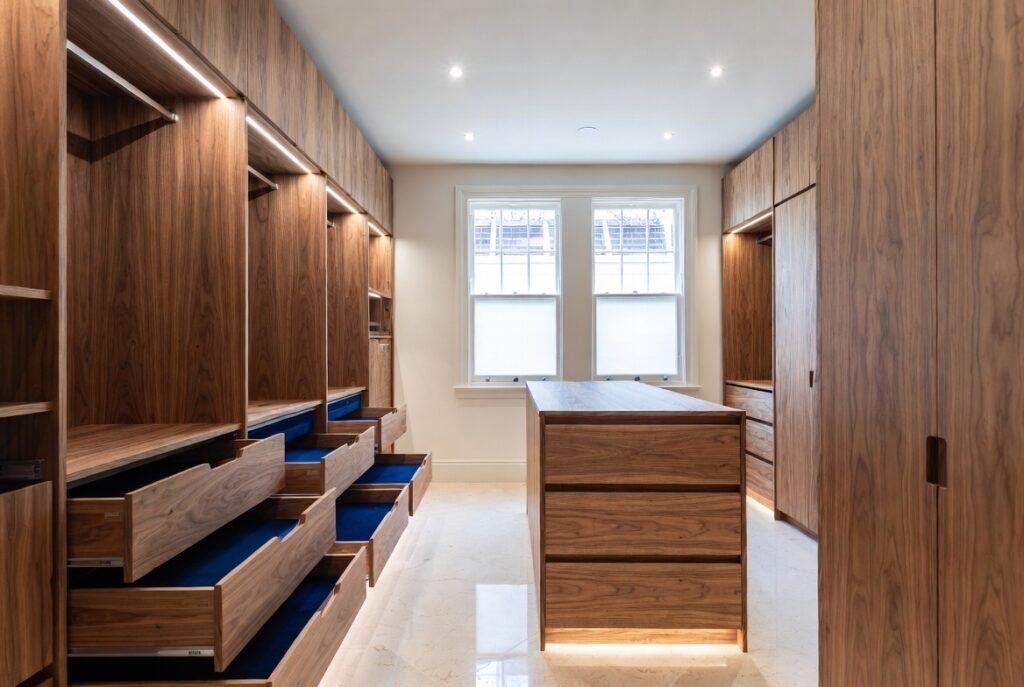
What we built was a full walk-in wardrobe — 4.2 metres across, 2.8 metres high, floor to cornice — in book-matched American oak veneer. Crown Cut profile. The grain cathedraling symmetrically across each door pair. A finish of low-sheen two-pack polyurethane at 15% gloss that let the timber read as furniture rather than cabinetry. A central island with an oak veneer top, Blum Legrabox drawers in velvet-lined silk grey, and Hafele Loox 5 LED strips at 2700K warming the interior from behind the hanging rail.
The cornices framed the wardrobe. The wardrobe referenced the cornices. The house read as a single designed object.
That is the argument for American oak in Toorak’s heritage homes. And in 2026, it remains the strongest argument in the timber veneer conversation.
For the full context on bespoke joinery Toorak and how Silk Touch approaches heritage-context projects in this postcode, the framework is the same across every room — wardrobe, kitchen, bathroom, and laundry.
Why American Oak Remains Melbourne’s Inner East Timeless Favourite in 2026
Timber veneer trends cycle. Walnut had its decade. Blackbutt appeared briefly as a local favourite before its colour inconsistency at scale became apparent. European oak arrived with considerable momentum and remains a strong specification in specific contexts.
American oak has not trended. It has simply persisted — and the reason is architectural rather than fashionable.
Colour neutrality. American oak sits in the warm-neutral range: a creamy honey tone with pink undertones in some cuts, cooler beige in others, depending on the growth region. This range means American oak does not fight the existing palette of a heritage interior the way that walnut’s dark chocolate tones or blackbutt’s yellow warmth can. It occupies a position that reads as neither contemporary nor period — and that ambiguity is precisely what a wardrobe in a heritage home needs.
Grain legibility. American oak grain is prominent enough to read as a natural material at distance, consistent enough to book-match predictably, and fine enough to avoid the coarseness that some clients associate with Australian hardwoods. In a wardrobe panel at 2.4 metres height, the grain scale is correct for the visual context.
Finishing versatility. American oak accepts more finish options than any other veneer species in regular use. Two-pack polyurethane, natural oil, matte clear lacquer, limed wash — all produce distinct, successful outcomes. The timber does not resist the finish. It responds to it.
Stability. American oak’s tangential and radial movement rates are well-documented and manageable with correct substrate and bonding specification. On an 18mm moisture-resistant MDF substrate with a full-contact adhesive bond, American oak veneer maintains dimensional stability across Melbourne’s seasonal humidity range without the telegraphing or edge-lifting that characterises poorly specified veneer work.
Grain Patterns, Colour, and Book-Matching Explained
Understanding the veneer specification conversation requires three technical concepts: cut direction, book-matching, and colour consistency. These are not aesthetic preferences — they are fabrication decisions with direct visual consequences.
Cut Direction
American oak veneer is available in two primary cut profiles, and the choice governs the entire visual character of the finished joinery.
Crown Cut (also called flat-cut or plain-sawn) produces the characteristic arching, cathedraling grain figure. The growth rings are sliced tangentially, producing wide, flowing patterns that are visually dynamic and strongly associated with traditional furniture and heritage joinery. Crown Cut is the correct specification for heritage interiors — Federation, Edwardian, Georgian — where the wardrobe is intended to reference the original material language of the home.
Quarter Cut (also called quarter-sawn) slices the log radially, producing a tighter, more linear grain with occasional ray flecks — small, bright reflective marks perpendicular to the grain direction. Quarter Cut reads as more contemporary and more restrained. It is the correct specification for transitional interiors where the architecture is heritage but the renovation language is modern, or for applications where the grain should recede rather than feature — drawer faces, side panels, interior wardrobe walls.
Silk Touch specifies cut direction at the design stage, not the factory stage. It is a design decision that affects every panel and door face in the project — changing it after fabrication begins requires reordering all veneer stock.
Book-Matching
Book-matching is the technique of opening consecutive veneer leaves like book pages, producing mirror-image grain patterns across adjacent panels. The result is bilateral symmetry in the grain figure — architecturally composed rather than randomly distributed.
The technical requirement for book-matching is that consecutive veneer leaves must be retained in sequence from the log slicing. Veneer stock that has been warehouse-shuffled loses this sequence and cannot be reliably book-matched. Silk Touch sources American oak veneer in sequenced bundles and retains sequence through the entire fabrication process — from the material store through to panel pressing and finishing.
Book-matching is the specification that converts a timber veneer wardrobe from “nice material” to “designed object.” It is also the specification detail that is most frequently omitted in mid-range joinery to reduce material handling complexity. The visual difference is immediately apparent to anyone comparing the two approaches side by side.
Slip-matching — where consecutive leaves are placed in the same orientation rather than mirrored — produces a repeating directional pattern without symmetry. It is used where book-matching is not achievable due to veneer width constraints or where the designer specifically wants a non-symmetrical outcome.
Colour Consistency
American oak varies in colour across growth regions, log positions, and seasonal harvest timing. A wardrobe project requiring 12 door panels must be cut from veneer stock with sufficient colour consistency that the panels read as a single material at completion.
Silk Touch purchases American oak veneer in lot quantities sufficient for the full project scope, confirmed by colour review before purchase. Panels from different lots — even the same species and cut profile — will show colour variation that becomes visible after finishing. This is the material specification detail that separates a professional fabrication outcome from an amateur one.
American Oak vs Walnut, Tasmanian Oak, and European Oak
| Property | American Oak | Walnut | Tasmanian Oak | European Oak |
|---|---|---|---|---|
| Colour | Warm honey-cream | Dark chocolate-brown | Pale straw-pink | Medium honey-gold |
| Grain | Prominent, even | Fine, flowing | Variable, pronounced | Tight, ray flecked |
| Book-match quality | Excellent | Excellent | Moderate | Excellent |
| Colour consistency | High | High | Variable | High |
| Heritage suitability | Excellent | Good (darker rooms) | Moderate | Good |
| Contemporary suitability | Good | Excellent | Good | Excellent |
| Finishing versatility | Very high | High | Moderate | High |
| Relative cost (veneer) | Mid-premium | Premium | Mid | Premium |
| Stability | High | High | Moderate | High |
| Best application | Heritage & transitional joinery | Contemporary, dark-palette rooms | Budget-tier veneer work | European-style interiors |
The Walnut vs Oak Veneers 2026 Guide provides the extended version of this comparison — including specific finish recommendations for each species and the project contexts where each performs at its best.
Best Applications: Where American Oak Performs
Walk-In Wardrobes
The walk-in wardrobe is the primary application for American oak veneer in Toorak and the broader Inner East in 2026. The reasons are spatial: a walk-in wardrobe is an enclosed room where the timber is experienced at close range, in deliberate light, over an extended daily engagement. The material needs to reward proximity.
American oak at close range reveals the depth of its grain figure, the subtle colour variation within individual panels, and the precision of the book-matching joint. These are details that a photographed image does not fully convey but that a person standing inside the wardrobe experiences immediately. Luxury walk-in wardrobes Melbourne covers the full specification approach for this room type — including internal configuration, lighting, and island design.
Built-In Robes
Built-in robes in heritage bedrooms — where the wardrobe occupies a former chimney breast alcove or a purpose-built recess — benefit from American oak’s ability to read as original joinery rather than a modern insertion. A Crown Cut oak door with a period-appropriate profile moulding can be specified to sit within the same visual register as an original bedroom fireplace surround or window seat.
Dressing Rooms
Dressing rooms at the premium end of Toorak renovation projects are increasingly designed as rooms rather than large wardrobes — with seating, island storage, and dedicated lighting. In this context, American oak is often used as a feature material on the island top and the primary door faces, with a contrasting tone — a Fenix NTM matte — on secondary storage. The material hierarchy reads correctly: timber as the primary visual material, matte laminate as the supporting element.
The material logic that governs the dressing room island decision connects directly to the 2026 Kitchen Island Trends for Melbourne’s Inner East Homes approach — the island specification in both contexts follows the same structural and material principles.
Bathroom Vanities and Coordinating Joinery
American oak specified in the wardrobe and carried through to the bathroom vanity is the material decision that reads as a designed home rather than a renovated one. The same Crown Cut or Quarter Cut profile, the same finish specification, the same hardware tone — applied across both rooms — creates a visual continuity that buyers and valuers in Toorak’s upper market register immediately. The 2026 Bathroom Vanity Trends Melbourne post covers the specific moisture-resistance specifications required when American oak transitions from wardrobe to bathroom context.
Finishing Options: What Changes and What It Means
The finish on American oak veneer is not a protective coating applied after the design decisions are made. It is a design decision in its own right — one that determines the colour, the sheen, the tactile quality, and the maintenance requirements of the finished surface.
Two-pack polyurethane (2-Pac) is the most durable finish option for American oak in wardrobe applications. Applied in a spray booth and oven-cured, it produces a hard, consistent film over the veneer surface. At 10–20% gloss level, the finish reads as a natural sheen rather than a plastic coating. The timber colour is slightly deepened and enriched. Durability is excellent — 2-Pac on American oak in a wardrobe context will not require refinishing within a fifteen-year period under normal use.
Natural oil finish penetrates the veneer rather than filming it, leaving the timber surface open and tactile. The grain texture is felt under the hand. The colour is the most natural representation of the unfinished timber — lighter, with less amber than 2-Pac. The maintenance requirement is higher: natural oil requires re-oiling every two to three years to maintain protection. In a wardrobe context, this is acceptable. In a kitchen or bathroom context, it requires a more disciplined maintenance commitment.
Matte clear lacquer sits between the two — a film finish with a lower build than 2-Pac, producing a slightly softer sheen (typically 5–10% gloss) and a more hand-crafted appearance. It is the finish most associated with bespoke furniture in the European tradition. Durability is lower than 2-Pac but higher than oil. It is the correct specification for clients who want the matte quality of an oil finish with the film protection of a spray coating.
Limed or white-washed finish opens the grain of American oak and fills it with a white or light grey pigment, producing a pale, bleached appearance that is increasingly specified in Toorak master bedrooms where the palette is white, stone, and light timber. This finish requires the oak to be wire-brushed before application — a factory process that removes the soft grain cells and creates the channels for the pigment to fill. Not all veneer substrates survive wire-brushing; solid substrate panels are preferred for this finish.
Durability, Sustainability, and Property Value
Durability in a veneer context is determined by two things: the substrate specification and the bonding method. American oak veneer on an 18mm moisture-resistant MDF substrate, bonded with a full-contact adhesive under controlled pressure, is a durable assembly that will not delaminate under normal residential conditions within a twenty-year horizon. The critical failure modes — edge lifting, surface bubbling, joint telegraphing — are all substrate and bonding failures, not veneer failures.
Sustainability of American oak veneer is materially superior to solid timber alternatives. A single log of American oak, sliced into 0.6mm veneer, yields approximately forty times the usable material that the same log would produce in solid timber form. The environmental efficiency of veneer over solid is significant — and it is a specification argument worth making to clients who raise sustainability as a design priority.
American oak is harvested primarily from managed forests in the eastern United States under FSC or PEFC certification. Silk Touch sources veneer from certified suppliers and can provide chain-of-custody documentation on request.
Property value impact of American oak joinery in Toorak is difficult to quantify precisely, but the qualitative evidence from the Inner East market is consistent: timber veneer wardrobes — specifically book-matched American oak — register as a premium specification signal to buyers and valuers. The wardrobe is inspected in detail during property inspections in this price bracket. The quality of the veneer match, the finish, the hardware, and the internal configuration are all read as evidence of the renovation’s overall standard.
How Silk Touch Sources, Matches, and Installs American Oak
Sourcing. American oak veneer is purchased in sequenced bundles — typically 24 to 48 leaves per bundle — from a consistent supplier. Silk Touch reviews colour samples from each lot before purchase and retains lot numbers for every project. If additional panels are required during a project — a design change, a damaged panel — the replacement veneer is sourced from the same lot wherever possible.
Factory book-matching. Consecutive veneer leaves are laid out on a flat table and reviewed for grain figure, colour, and defect-free surface area before pressing. The book-match joint is marked and the layout is photographed for client approval where requested. Panels are pressed in a vacuum bag system with contact adhesive under controlled temperature — the adhesive bond is as important as the veneer itself.
On-site scribing. In Toorak’s heritage homes — Georgian, Federation, Edwardian — walls are rarely plumb and corners are rarely square. A wardrobe panel that is cut to a right-angle in the factory will gap at one end against a wall that is 8mm out of plumb over 2.4 metres. On-site scribing — where a profile gauge is run along the actual wall surface and the panel edge is cut to match — eliminates this gap. It is a time-consuming step that adds to installation cost. It is not optional in a heritage home if the outcome is to read as designed.
Timeline. From confirmed design to completed installation: 6–8 weeks. American oak veneer sourcing does not extend this timeline when Silk Touch holds adequate stock for the project scope, which is confirmed at the design stage.
Care and Maintenance for Decades of Beauty
American oak veneer joinery in a wardrobe context requires minimal maintenance — but the maintenance it does require is specific.
Cleaning: A dry microfibre cloth for dust. A lightly dampened cloth for marks. Never an abrasive cloth, a spray cleaner applied directly to the surface, or an oil-based product on a 2-Pac or lacquer finish. On an oil finish, a small amount of the same oil used in the original finish application can be applied sparingly to the surface and buffed in — this is the maintenance step that keeps an oil-finished surface performing correctly over time.
Humidity: American oak veneer on MDF substrate is stable within Melbourne’s residential humidity range — typically 40–65% relative humidity. Extended periods below 30% (unusual in Melbourne) can cause surface checking on oil-finished panels. A humidifier in the bedroom during prolonged dry periods is the preventive measure, not a product application.
Scratches: Minor scratches in a 2-Pac or lacquer finish can be addressed by a specialist furniture restorer using a colour-matched fill. On an oil finish, a light re-oiling of the affected area followed by buffing will reduce scratch visibility without full refinishing. Deep scratches that penetrate the veneer are not field-repairable — they require a panel replacement, which is why the original veneer lot reference is retained in the project documentation.
Hardware: Blum and Hettich hardware in the wardrobe requires a periodic alignment check — once every two to three years under normal use. The three-directional (Legrabox) or five-directional (Actro 5D) adjustment means that any seasonal timber movement that affects drawer face alignment can be corrected without tools in under ten minutes.
2026 Pricing Transparency Guide
American oak veneer wardrobe pricing in Toorak and the Inner East reflects the material cost, the fabrication complexity, and the installation requirements of heritage homes.
Entry-level American oak built-in robe (standard layout, Crown Cut veneer, 2-Pac finish, Blum hinges, no internal lighting): $12,000–$18,000 installed.
Mid-specification walk-in wardrobe (book-matched Crown Cut, 2-Pac finish, Blum Legrabox drawers, Hafele Loox 5 LED strip, internal island): $22,000–$38,000 installed.
Full bespoke dressing room (book-matched American oak throughout, oil or matte lacquer finish, Blum Legrabox with velvet-lined inserts, central island with stone or oak top, integrated LED system, heritage scribing throughout): $40,000–$75,000 installed.
The variables that move price most significantly:
Book-matching complexity — a four-door wardrobe with straightforward book-matching adds 15–20% over slip-matched panels. A twelve-door walk-in with sequential book-matching across all panels adds 25–35%. The visual outcome justifies the cost in a Toorak context.
Heritage installation — on-site scribing for non-plumb walls and non-square corners adds $2,500–$5,000 to the installation cost depending on the severity of the geometry. In Georgian and Edwardian homes in Toorak, this is a near-universal requirement.
Internal specification — velvet-lined drawer inserts, pull-out tie and accessory organisers, and bespoke shoe storage add $3,000–$8,000 to the internal fit-out cost depending on scope.
For a comprehensive breakdown of custom wardrobe pricing across specification levels, custom wardrobe costs Melbourne 2026 covers the full cost structure in detail.
The Verdict: American Oak Is Not a Trend. It Is a Standard.
Trends in joinery materials come and go on roughly five-year cycles. American oak has been the correct specification for Inner East heritage wardrobes across four of those cycles and shows no signs of displacement in 2026.
The reason is architectural. Toorak’s Georgian, Federation, and Edwardian homes were built with timber joinery as the primary interior material. A wardrobe that uses American oak — correctly cut, correctly book-matched, correctly finished — does not compete with that heritage. It participates in it.
The specification decisions that make the difference — Crown Cut versus Quarter Cut, book-matched versus slip-matched, 2-Pac versus oil, Blum Legrabox versus Hettich Actro — are design decisions that require technical knowledge and fabrication capability to execute. Silk Touch holds both, confirmed across fifteen years of Inner East wardrobe projects.
Book your free 3D wardrobe design consultation — bring the room dimensions, the heritage context, and the brief. The veneer conversation starts there, and the wardrobe that belongs to the house follows from it.
For further reading on the bespoke joinery Toorak context and how material decisions are made across multiple rooms in a single heritage renovation, the pillar page covers the full project approach.
Frequently Asked Questions
What is book-matched American oak veneer and why does it matter? Book-matching is the technique of opening consecutive veneer leaves like book pages to produce mirror-image grain patterns across adjacent panels. It creates bilateral grain symmetry that reads as architecturally composed rather than randomly distributed. It is the specification detail that distinguishes a designed wardrobe from a well-made one — and it requires sequenced veneer stock and factory discipline to execute correctly.
What is the difference between Crown Cut and Quarter Cut American oak? Crown Cut (flat-cut) produces arching, cathedraling grain patterns — visually dynamic and strongly associated with traditional and heritage joinery. Quarter Cut produces tighter, more linear grain with occasional ray flecks — more contemporary and restrained. Crown Cut is the correct specification for heritage interiors. Quarter Cut is preferred for transitional or contemporary contexts where the grain should recede rather than feature.
How does American oak compare to walnut for a Toorak wardrobe? American oak is the stronger specification for Toorak heritage interiors due to its colour neutrality, grain legibility at scale, and ability to read as period-appropriate without replicating period material. Walnut is the stronger specification for contemporary or dark-palette rooms where the deeper colour tone is a deliberate design choice. The full comparison is covered in the Walnut vs Oak Veneers 2026 Guide.
What finish should I specify for American oak in a wardrobe? Two-pack polyurethane at 10–20% gloss level is the most durable specification for wardrobe applications — it will not require refinishing within a fifteen-year period under normal use. Natural oil finish produces the most tactile, furniture-like result but requires re-oiling every two to three years. Matte clear lacquer sits between the two in both durability and appearance.
How long does an American oak walk-in wardrobe take to build and install? Silk Touch’s standard programme is 6–8 weeks from confirmed design to completed installation. Veneer sourcing, book-matching, and factory fabrication are within this timeline when veneer stock is confirmed at the design stage.
Does American oak veneer work in Toorak heritage homes with uneven walls? Yes — on-site scribing is the installation technique that resolves non-plumb walls and non-square corners in heritage homes. Silk Touch scribes all wardrobe panels to the actual wall profile at installation, eliminating gaps that would be visible with factory-cut right-angle panels. This is a standard installation requirement for Inner East heritage projects.
What does an American oak walk-in wardrobe cost in Melbourne in 2026? Mid-specification walk-in wardrobes with book-matched Crown Cut American oak, 2-Pac finish, Blum Legrabox drawers, LED lighting, and a central island run $22,000–$38,000 installed. Full bespoke dressing rooms with oil or lacquer finish, velvet-lined inserts, and heritage scribing throughout run $40,000–$75,000 installed. Entry-level built-in robes start at $12,000–$18,000 installed.