The Corners That Were Holding the Kitchen Back
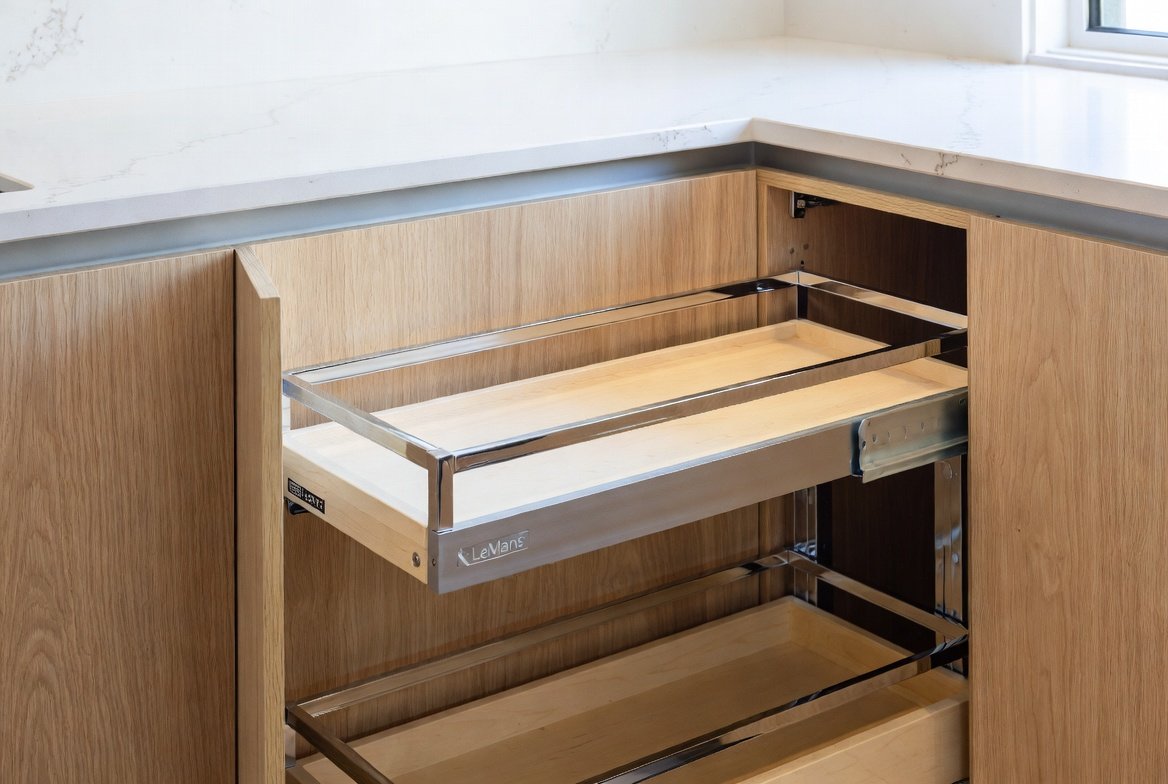
The Camberwell kitchen had 3.8 metres of perimeter cabinetry on each side. On paper, it was a well-sized kitchen. In practice, two of its four base cabinet corners were essentially unusable — a fixed shelf accessible only by crouching and reaching blind into 600mm of darkness. The client had stopped using them entirely. Pots lived on the benchtop because reaching into the corner meant a 40-second excavation for something that might not even be there.
The corner cabinets represented approximately 1.1 square metres of floor area. They contained, in practical terms, about 0.15 square metres of usable storage.
When Silk Touch rebuilt those two corners — one with a LeMans swing-out system, one with a custom blind-corner pull-out drawer stack — the accessible storage volume in those positions increased by a factor of six. Items that had lived on the benchtop had somewhere to go. The benchtop gained 800mm of clear run.
The kitchen did not get bigger. It started working.
For kitchen renovations Camberwell projects in the suburb’s semi-detached and terrace housing stock — where the kitchen floor area is fixed by the heritage floor plan and cannot expand — the corner is the most significant untapped storage resource in the room. This guide covers every solution available in 2026, with honest assessments of what each one delivers.
Why Blind Corners Are the Biggest Space-Waster in Melbourne Kitchens
A blind corner occurs where two runs of cabinetry meet at 90 degrees and one run extends past the junction, creating a cabinet zone that is only accessible from one side — the blind side — where the door opening does not align with the full cabinet interior.
In a standard kitchen layout, a blind corner base cabinet has an interior volume of 0.6–0.9 cubic metres. Of that volume, a fixed-shelf configuration typically makes 15–25% practically accessible — the zone within arm’s reach of the door opening. The remaining 75–85% is technically present but functionally absent.
At a $25,000–$45,000 kitchen renovation investment, paying for storage that cannot be used is not a minor inefficiency. It is a specification failure that no amount of premium material or hardware quality elsewhere in the kitchen compensates for.
The good news: every blind corner in a 2026 kitchen has a hardware solution that converts it from dead space to functional storage. The solutions differ in cost, in the volume they recover, in how easy they are to use, and in whether they work within the constraints of a heritage floor plan. Selecting the right one requires understanding all five.
The Five Best 2026 Blind Corner Solutions
Solution 1: The LeMans System
The LeMans is a swing-out pull-out system where two kidney-shaped shelves pivot out of the corner cabinet on a single-point pivot arm, presenting their full surface area in front of the door opening. The user opens the door and pulls — the shelves rotate out and forward, completely clearing the interior and presenting every item in the cabinet at standing height.
Storage recovery: 70–80% of the theoretical cabinet interior. The kidney shape maximises the accessible surface area within the pivot geometry.
Ease of use: High. One motion — pull — presents the full cabinet contents. No crouching, no reaching blind, no excavation.
Load rating: The standard LeMans specification handles 25kg total across both shelves. A premium version rates to 35kg. For pots, pans, and kitchen equipment, the 25kg rating is adequate for most households.
Soft-close integration: The LeMans system does not have integrated soft-close on the swing-out motion itself — the shelves reach their extended position and stop without damping. The door, however, runs on a standard Blum or Hettich hinge with BLUMOTION or Silent System soft-close. The two motions — door and shelves — are mechanically separate.
Heritage fit: The LeMans requires a minimum cabinet interior width of 900mm at the corner to function correctly — the pivot geometry needs this clearance to complete the rotation without the shelves contacting the interior walls. In heritage kitchens where the corner cabinet is narrower, the LeMans is not always viable without a carcass modification.
Correct for: Medium-to-high turnover storage — pots, pans, mixing bowls, large kitchen equipment used several times weekly. Not the correct specification for occasional-use items where the swing-out mechanism is more than the access frequency warrants.
Solution 2: The Magic Corner (Hettich)
The Magic Corner is a two-tier linked shelf system where the interior shelves pull forward and out in a sequential motion — the front shelf moves to the door opening first, then the rear shelf follows to the vacated interior position. The full cabinet contents are accessible from the door opening in two pull motions.
Storage recovery: 75–85% of the theoretical cabinet interior — slightly higher than the LeMans because the two-tier system accesses the full cabinet depth.
Ease of use: Medium-high. Two sequential pull motions rather than one. The linkage mechanism is reliable but requires the user to understand the sequence — pull the front unit, then pull the rear unit. First-time users occasionally try to pull both simultaneously.
Load rating: Hettich Magic Corner at 30kg per tier — 60kg total system capacity. The highest load rating in the swing-out category. Correct for heavy pot and pan storage in a family kitchen.
Soft-close integration: The Hettich Magic Corner incorporates Silent System damping on the retraction motion — the shelves close with controlled deceleration rather than slamming. This is the soft-close integration the LeMans lacks, and it is the specification detail that distinguishes the Magic Corner in a premium kitchen context.
Heritage fit: Minimum 800mm interior width — slightly less demanding than the LeMans. More viable in heritage kitchens with narrower corner cabinets.
Correct for: Heavy kitchen equipment, high-frequency access, premium specification context where soft-close on the storage system (not just the door) is required.
Solution 3: The Carousel (Lazy Susan)
The carousel — a rotating turntable system on a central pole within the corner cabinet interior — is the oldest blind corner solution and the most commonly specified in builder-grade kitchens. Two or three circular shelves rotate around the central pole, bringing any position on the shelves to the door opening.
Storage recovery: 55–65% of the theoretical cabinet interior. The circular shelf geometry wastes the corner zones — the area at the extreme positions of each shelf that never aligns with the door opening.
Ease of use: Low-medium. Items at the rear of the circular shelf must be rotated to the front. The rotation arc means adjacent items on the shelf are temporarily blocked. Tall items fall over during rotation.
Load rating: 20–25kg per tier — lowest in class. Not suitable for heavy cast-iron cookware.
Soft-close integration: None. Carousels spin freely and require the user to stop the rotation at the correct position. Over time, the pole bearing wears and the rotation becomes uneven.
Heritage fit: The carousel works in any corner cabinet interior dimension above 700mm — the most dimensionally flexible solution. It is also the easiest to retrofit in an existing carcass without modification.
Correct for: Light storage, occasional access, budget-constrained specifications. Silk Touch does not specify carousels in premium kitchen projects — the storage efficiency and ease-of-use shortfalls do not meet the standard that the surrounding joinery specification demands.
Solution 4: The Blind Corner Pull-Out
The blind corner pull-out is a drawer or shelf unit mounted within the blind corner cabinet that slides horizontally toward the door opening on a telescoping runner system. The unit begins in the recessed corner position and extends fully through the door opening when pulled.
Storage recovery: 80–90% of the theoretical cabinet interior — the highest recovery in class. The pull-out extends the full cabinet depth on a telescoping runner, presenting every item in the cabinet at the door opening.
Ease of use: High — single horizontal pull, full extension, complete visibility of all contents. No rotation, no sequential motions.
Load rating: On Blum Legrabox runners at 70kg — the highest load rating available in any corner solution. Correct for the heaviest kitchen equipment including cast-iron, appliances, and bottle storage.
Soft-close integration: Full Blum BLUMOTION on the pull-out motion — the unit closes with the same controlled deceleration as every other Legrabox drawer in the kitchen. This is the only corner solution with soft-close integrated into the storage motion itself at the Blum standard.
Heritage fit: The pull-out requires a minimum 100mm clearance between the door frame and the blind corner cabinet face — the telescoping runner needs this space to extend past the adjacent cabinet face. In heritage kitchens where this clearance is not available, the runner system must be modified or the adjacent carcass reconfigured.
Correct for: High-load storage, high-frequency access, premium specification context. The correct specification for cast-iron cookware, appliance storage, and bottle storage in a premium kitchen.
Solution 5: The Diagonal Corner Drawer
The diagonal corner drawer — a square or trapezoidal drawer cabinet positioned at 45 degrees to both cabinet runs, replacing the standard 90-degree corner junction — eliminates the blind corner entirely by making the corner itself accessible from a 45-degree door face.
Storage recovery: 60–70% of the theoretical corner volume — lower than pull-outs, but 100% of the recovered volume is directly accessible without a mechanism.
Ease of use: Very high — open a door, pull a drawer. No mechanism, no sequence, no rotation.
Load rating: On Blum or Hettich standard runners at 40–70kg depending on specification.
Soft-close integration: Full soft-close on both the door hinge and the drawer runner.
Heritage fit: The diagonal corner requires a design modification to the kitchen plan — the 45-degree cabinet face replaces two cabinet doors at the corner, which affects the door rhythm of the perimeter run. In heritage kitchens where the door rhythm is architecturally significant, this modification may read as a disruption to the overall joinery composition. Silk Touch assesses this in the 3D model before specifying.
Correct for: Contemporary kitchens where the plan modification is acceptable, high-frequency access requirements, clients who prefer mechanical simplicity over maximum storage recovery.
2026 Performance Comparison Table
| Solution | Storage recovery | Ease of use | Load rating | Soft-close | Minimum cabinet width | Relative cost |
|---|---|---|---|---|---|---|
| LeMans swing-out | 70–80% | High | 25–35kg | Door only | 900mm | Mid |
| Magic Corner (Hettich) | 75–85% | Medium-high | 60kg | Door + retraction | 800mm | Mid-premium |
| Carousel | 55–65% | Medium | 20–25kg | None | 700mm | Low |
| Blind corner pull-out (Blum) | 80–90% | High | 70kg | Full BLUMOTION | 100mm clearance req. | Premium |
| Diagonal corner drawer | 60–70% | Very high | 40–70kg | Full | Plan modification req. | Mid-premium |
Best Solution by Context
Heritage kitchens (Camberwell, Hawthorn, Kew Federation and Edwardian): The Hettich Magic Corner is the standard recommendation — the 800mm minimum interior width fits most heritage corner cabinet dimensions, the 60kg load rating handles family kitchen use, and the Silent System soft-close retraction meets the premium specification standard. Where the pull-out clearance requirement is achievable, the Blum blind corner pull-out is the upgrade specification.
Contemporary kitchens and rear extensions: The Blum blind corner pull-out on Legrabox runners is the specification — maximum storage recovery, maximum load rating, full BLUMOTION soft-close. The clearance requirement is designed into the plan at documentation stage.
Apartment kitchens with narrow corner dimensions: The Magic Corner at 800mm minimum width is the most dimensionally flexible premium solution. Where the interior is below 800mm — which occurs in some inner-city apartment configurations — a custom pull-out on reduced-projection runners is the specification.
Budget-constrained secondary kitchens or laundry areas: The LeMans is the step below the Magic Corner — adequate performance at a lower cost point. The carousel is not a Silk Touch specification at any price point.
The Curved Joinery Trends 2026: Softening Traditional Toorak Interiors post covers how curved corner cabinet treatments — radius doors, soft corner junctions — interact with the corner storage solution below. The curved door face does not constrain the hardware choice, but it must be confirmed against the specific mechanism’s door-opening arc before the curve radius is finalised.
Hardware Integration: Blum and Hettich at the Corner
The corner cabinet is the position in the kitchen where hardware quality is most consequential. A corner mechanism that is used twice daily — 700 times per year — over a fifteen-year kitchen lifespan operates 10,500 cycles. At the low end of the load spectrum with builder-grade hardware, this cycle count produces mechanism degradation that is visible and audible within five years.
Blum and Hettich rate their corner systems at 500,000 cycles — fifty times the fifteen-year residential cycle count. This rating is not marketing language. It is a tested mechanical threshold that the manufacturer guarantees. Specifying Blum or Hettich in the corner position is the decision that determines whether the mechanism performs at day one standard at year fifteen.
The door hinge on a corner cabinet operates with the same frequency as the corner mechanism — and requires the same hardware quality argument. Blum Clip Top Blumotion or Hettich Sensys hinges at the corner positions are the standard Silk Touch specification. A premium corner mechanism behind a builder-grade hinge that fails at year five defeats the mechanism investment.
The 2-Pack Polyurethane Finishes: The Gold Standard guide covers the finish specification that protects the corner cabinet interior from the moisture and grease accumulation that accelerates mechanism wear in poorly finished cabinets. A sealed 2-pack interior on the corner cabinet carcass is the finishing specification that protects both the substrate and the mechanism mounting hardware over the fifteen-year horizon.
On-Site Scribing: The Heritage Corner Problem
Heritage kitchens in Camberwell and Hawthorn present a specific corner challenge that contemporary builds do not: the corner junction between two wall runs is rarely 90 degrees. Victorian and Edwardian masonry construction produces corner angles that vary from 87 to 93 degrees — 3 degrees off-square across the corner produces a 30mm gap at the far end of a 600mm cabinet depth.
A corner mechanism installed in a carcass that is not correctly aligned to the actual wall angle will not function at its rated performance. The swing-out arc of a LeMans or Magic Corner assumes a specific geometric relationship between the cabinet interior and the adjacent wall. If the carcass is positioned to the nominal 90 degrees rather than the actual wall angle, the mechanism arc is compromised.
Silk Touch resolves this at the laser measure stage — the actual corner angle is recorded and the carcass opening is dimensioned to the actual geometry. On-site scribing at the carcass base and rear panels closes the gap to the heritage wall surfaces at every contact point. The mechanism is installed in a correctly aligned carcass and operates at its rated performance.
For kitchen renovation Hawthorn projects specifically — where the Inter-War clinker brick construction produces some of the most non-square internal corners in the Inner East — this measurement and scribing discipline is the difference between a mechanism that works and one that binds within eighteen months.
Common Mistakes and How Silk Touch Prevents Them
Specifying the mechanism after the carcass is built. The single most common blind corner failure in Melbourne kitchen renovations. The mechanism is an afterthought — selected after the carcass is built to a nominal dimension. The minimum width requirement is not met, the clearance for the pull-out runner is not provided, and the mechanism is either forced into a space it cannot operate correctly in or replaced with a carousel because nothing else fits. Silk Touch specifies the mechanism at the design stage and builds the carcass around the mechanism’s requirements.
Ignoring the door-opening arc. Every swing-out mechanism requires the cabinet door to open to a minimum angle before the mechanism can be extracted. The LeMans requires approximately 95 degrees of door opening. If an adjacent appliance, wall, or island limits the door opening to less than this, the mechanism cannot be used. The door-opening arc is confirmed in the 3D model before the kitchen plan is finalised.
Under-specifying load capacity. A 20kg carousel in a cabinet that stores cast-iron cookware, a 5-litre KitchenAid bowl, and a stack of baking trays. The mechanism degrades within two years, the shelves tilt, and the cabinet reverts to unusability. Load capacity is specified against the actual anticipated contents at the design consultation — not against a generic assumption.
Skipping the interior finish. An unfinished MDF interior in a corner cabinet accumulates moisture, grease vapour, and cleaning product residue that the door-sealed environment concentrates. Mechanism mounting hardware corrodes. The substrate checks and swells. A 2-pack sealed interior — or at minimum a moisture-resistant laminate — is the specification that prevents this failure mode.
Matching mechanism to door style without checking compatibility. A curved corner door on a radius-face cabinet requires hinge adjustment for the curve angle — as established in the curved joinery guide. A LeMans behind a curved door must be confirmed against the door’s specific curve radius and the resulting change in the door-opening arc. This confirmation happens at the design stage, not at installation.
For the full island context — where the corner storage solutions in a kitchen often interact with the island’s storage configuration and the flow between the two — 2026 Kitchen Island Trends for Melbourne’s Inner East Homes covers the island storage specification that complements the corner solutions covered here.
Real 2026 Inner East Projects
Camberwell, Edwardian kitchen, January 2026. The project referenced in the introduction. Two corners, two solutions. The cooking-zone corner received a Blum blind corner pull-out on Legrabox 70kg runners — cast-iron cookware, heavy mixing bowls. The pantry-zone corner received a Hettich Magic Corner — lighter pantry items, frequent access. The wall angle at the cooking corner was 88.5 degrees — recorded at the laser measure stage and used to set the carcass opening. Both mechanisms operate at rated performance.
Toorak, Georgian kitchen, November 2025. Corner dimension below 900mm — the LeMans minimum interior width requirement was not met. The specification moved to a Magic Corner at 800mm minimum, which was achievable. The 60kg load rating handled the client’s cookware requirement. Silent System retraction on the Magic Corner was the detail that aligned with the premium specification of the surrounding kitchen.
Hawthorn, Edwardian semi kitchen, October 2025. Corner angle at 91.5 degrees — 1.5 degrees off-square. At 600mm cabinet depth, this produced a 16mm gap at the rear of the cabinet against the adjacent wall. Scribed rear panel closed the gap. Diagonal corner drawer specified rather than swing-out — the client’s priority was mechanical simplicity, and the plan modification read as a natural element of the contemporary extension context. The door rhythm modification was modelled in 3D and approved before fabrication.
Kew, Federation kitchen, September 2025. Both corners treated with Magic Corner — consistent specification across the two corner positions, consistent mechanism motion, consistent training for the household. The Kew floor plan had 870mm interior width at both corners — within the Magic Corner minimum, not within the LeMans minimum. The hardware solution followed the dimensional constraint, not the other way around.
2026 Cost Guide
Hettich Magic Corner, supply and install, standard kitchen corner: $1,800–$3,200 including carcass modification if required.
Blum blind corner pull-out on Legrabox, supply and install: $2,400–$4,200 including runner system and carcass modification.
LeMans swing-out system, supply and install: $1,400–$2,600.
Diagonal corner drawer set, supply and install, Blum or Hettich hardware: $2,800–$4,800 including plan modification cost.
Carousel replacement with Magic Corner or pull-out (retrofit): $2,200–$3,800 including carcass modification and door rehang.
Both kitchen corners, full premium specification (Magic Corner + pull-out or two pull-outs): $4,500–$8,000 installed. On a $35,000 kitchen, this represents 13–23% of the total budget for storage that returns 80–90% of the two corner volumes to usable space.
Frequently Asked Questions
What is the best blind corner solution for a heritage kitchen in Inner East Melbourne? The Hettich Magic Corner is the standard recommendation for heritage kitchens in Camberwell, Hawthorn, and Kew — the 800mm minimum interior width fits most heritage corner cabinet dimensions, the 60kg load rating handles family kitchen use, and Silent System soft-close retraction meets the premium specification standard. Where the Blum blind corner pull-out clearance requirement is achievable within the heritage floor plan, the pull-out is the upgrade specification for maximum storage recovery and full BLUMOTION soft-close.
What is the difference between a LeMans and a Magic Corner? Both are swing-out systems that bring the corner cabinet contents to the door opening. The LeMans uses two kidney-shaped shelves on a single pivot arm — one pull motion, 25–35kg load rating, no soft-close on the swing motion. The Magic Corner uses two linked tiers that extend sequentially — two pull motions, 60kg load rating, Silent System soft-close on retraction. The Magic Corner outperforms the LeMans on every specification metric except cost. Silk Touch specifies the Magic Corner over the LeMans in premium kitchen contexts.
How much storage does a blind corner pull-out recover compared to a fixed shelf? A Blum blind corner pull-out on Legrabox runners recovers 80–90% of the theoretical cabinet interior volume — compared to 15–25% for a fixed shelf configuration. In a standard 900mm corner cabinet with 0.6 cubic metres of interior volume, the pull-out provides approximately 0.5 cubic metres of accessible storage versus 0.1 cubic metres for a fixed shelf. The difference is not marginal — it is the difference between a functional storage zone and a dead zone.
Why does the corner cabinet dimension matter for mechanism selection? Every swing-out mechanism requires a minimum interior width to complete its rotation without contacting the cabinet walls. The LeMans requires 900mm interior width. The Magic Corner requires 800mm. Below these dimensions, the mechanism arc is compromised and the system cannot be fully extended. Silk Touch records the actual interior dimension at the laser measure stage — before any mechanism is specified — and selects the correct solution for the available space.
Can a carousel be replaced with a better system in an existing kitchen? Yes — in most cases. The Hettich Magic Corner retrofit requires the existing carcass interior to be at least 800mm wide and the mounting positions to be accessible for the new mechanism hardware. The existing door is retained in most retrofits — the mechanism mounts to the interior carcass walls, not to the door. A retrofit Magic Corner installation typically takes half a day on-site including the carcass modification. Cost: $2,200–$3,800.
Do curved corner cabinet doors affect the mechanism choice? The curve radius of the door affects the door-opening arc — a curved door on a radius-face cabinet opens to a slightly different angle than a flat door of the same width. The minimum opening angle required by the mechanism must be confirmed against the actual opening arc of the curved door. This confirmation happens in the 3D model at the design stage. In most cases, the mechanism choice is unaffected — the opening arc difference from a typical 100mm radius door is within the mechanism’s functional range.
How long does a blind corner mechanism last with premium hardware? Blum and Hettich rate their corner mechanisms at 500,000 cycles — the equivalent of twice-daily use for 685 years, or fifty times the fifteen-year residential kitchen lifespan. In practice, mechanism degradation in a correctly specified and installed Blum or Hettich system is not a realistic planning horizon for a residential kitchen. The limiting factor is not the mechanism — it is the door hinge, the carcass substrate, and the finish quality of the interior. Silk Touch specifies these to the same standard as the mechanism.