The Kitchen That Stopped Feeling Like a Museum
The Toorak Georgian had everything a heritage kitchen should have. Original ceiling rose. Original cornice. 3.4-metre ceilings. Sash windows on two walls. An axial floor plan that the architect had designed to impress.
It also had right angles everywhere. The island was a rectangle. The perimeter cabinets were rectangles. The breakfast bar was a rectangle. The room was architecturally correct and absolutely uninviting — a formal space that the family used because it was the kitchen, not because they wanted to be there.
The brief that came to Silk Touch was not about function. The kitchen functioned. It was about feeling. “We want it to feel like ours, not like a period piece.”
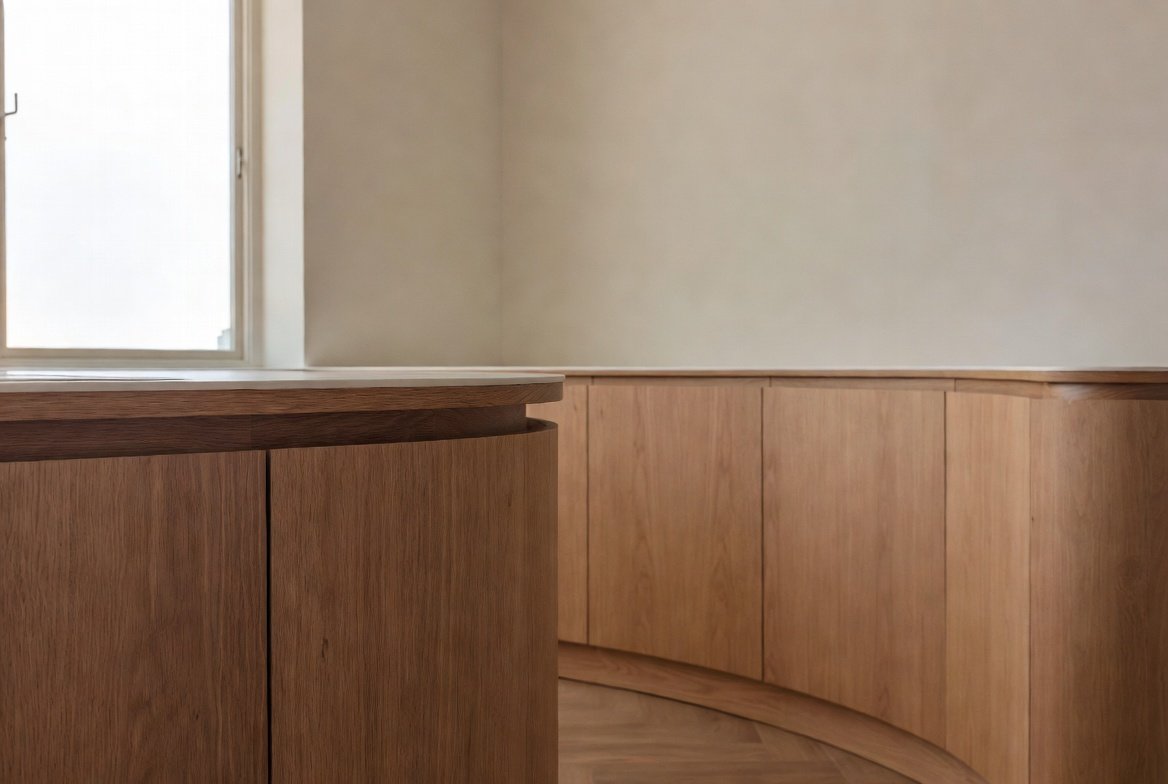
What we built was a curved island — a 2,800mm run with a continuous 400mm radius curve at the family end, facing the living room. The perimeter cabinets received radius doors at the corner returns. The breakfast bar became a sculpted arc that invited people to sit along its length rather than at designated positions.
Nothing structural changed. The ceiling rose is still there. The cornice is still there. The sash windows are still there.
The kitchen is now used because people want to be in it.
This is the curved joinery argument in Toorak in 2026 — not a rejection of the heritage character, but a softening of the geometry that makes a grand room feel inhabited rather than curated.
For the full bespoke joinery Toorak approach across kitchens, wardrobes, and whole-home specifications in the suburb’s Georgian and Federation stock, the pillar page covers the complete scope. This article covers curves specifically — what they are, how they are built, where they work, and what they cost.
Why Curved Joinery Is the Defining Trend of 2026 in Traditional Melbourne Homes
The design shift toward organic, sculptural forms in residential interiors has been building for three years. In 2026, it has reached the specification stage — clients are not just referencing curves in mood boards. They are commissioning them.
Three forces are converging in Toorak specifically.
The reaction to rectilinear excess. The decade of handleless, flat-panel, strictly rectilinear joinery that defined premium kitchen design from 2012 to 2022 produced beautiful rooms that aged into uniformity. In Toorak and Malvern, where the architectural backdrop is already formal and symmetrical, adding another layer of rigidity to the interior produced rooms that felt correct but cold. Curves break this without requiring a complete design language change.
The heritage compatibility discovery. The assumption that curves conflict with heritage architecture — that a curved island is a contemporary intrusion into a period room — has been tested and found incorrect by a growing number of Inner East projects. Heritage cornices are curved. Heritage ceiling roses are circular. Heritage sash window arches are curved. The rectilinear kitchen was always the architectural interloper. A curved island is the element that restores the room’s original organic quality.
Fabrication accessibility. CNC routing technology has made curved joinery panels available at a cost premium that is meaningful but not prohibitive. A curved island end panel that required hand shaping by a specialist joiner in 2015 is now CNC-routed to precise geometry in the Silk Touch workshop in 2026. The curve is repeatable, dimensionally accurate, and achievable within the standard 6–8 week programme.
Trend 1: Curved Kitchen Islands and Waterfall Benchtops
The curved island is the single most impactful curved joinery element available in a kitchen — it is the element that changes how the room reads from every approach angle.
Island Curve Geometry
Two distinct approaches:
The radius end curve — a single curved face at one or both ends of an otherwise rectangular island. The curve radius is typically 300–600mm depending on the island width. A 900mm wide island with a 400mm radius end produces a curve that reads as generous and flowing without requiring the island to be rebuilt from a non-standard footprint. This is the most frequently specified curved island element in Silk Touch’s 2026 Toorak projects — it softens the island without changing its functional organisation.
The fully organic island — a continuous curved perimeter with no straight face. The plan shape is an ellipse, a kidney form, or a free-form curve developed in the 3D model. This approach produces a more dramatic design statement and requires the benchtop to be correspondingly curved — a fabrication challenge that adds significant cost. Fully organic islands are specified at the premium end of the Toorak market where the design statement is the primary brief.
Curved Waterfall Benchtops
The waterfall benchtop on a curved island end presents a specific fabrication challenge: the vertical drop must follow the curve of the island face, which means the stone or porcelain panel is not a flat rectangle but a curved surface. Porcelain and sintered stone can be cold-bent to gentle curves — typically a minimum radius of 1,200mm for standard 12mm thickness. Tighter radii require steam bending or a specialist cold-forming process that adds $2,500–$5,000 to the stone fabrication cost.
Caesarstone and engineered quartz cannot be curved — they are brittle and fracture rather than bend. For a curved waterfall edge, porcelain or sintered stone is the only specification. This is one of the few contexts where the benchtop material is partially determined by the joinery form rather than by the client’s independent material preference.
The 2026 Kitchen Island Trends for Melbourne’s Inner East Homes covers the waterfall edge specification in full in a standard rectilinear context — the curved waterfall adds fabrication complexity on top of the standard specification.
Trend 2: Radius Cabinet Doors and Curved Drawers
Radius cabinet doors — doors with a curved profile on one or both vertical edges — are the specification that introduces the curved language to the perimeter cabinetry without requiring a curved carcass.
Corner Radius Doors
The most common application: a convex radius on the outer vertical edge of a corner return cabinet door. The radius — typically 50–150mm — softens the 90-degree corner that is the most visually aggressive element in a rectilinear kitchen. At 100mm radius, the corner reads as flowing rather than hard-edged. Adjacent doors remain flat-panel — the curve appears only at the room’s corner positions.
This is the accessible entry point to curved joinery. It requires CNC-routed door panels and a matching edge profile on the cabinet face frame, but the carcass remains standard. The cost premium over flat-panel doors at the same corner positions is approximately 25–40% on the door components only — not on the full kitchen.
Curved Drawer Faces
Curved drawer faces — a continuous horizontal curve across the face of a drawer stack — require that both the drawer face panel and the internal drawer structure accommodate the curve. The Blum Legrabox runner system is compatible with curved drawer face applications: the runner itself remains straight, the drawer body remains rectangular, and the curved face is attached to the front of the drawer body on adjustable mounting plates that allow the curve to be set accurately.
The critical specification: the curve must be consistent across all drawer faces in a stack. A 150mm radius on the top drawer, 145mm on the middle, and 152mm on the bottom reads as inconsistent. CNC routing from a single geometry file ensures every face is cut to the same radius. This is a documentation-stage quality check — confirming that the CNC programme uses a single radius value for all faces in a stack.
Trend 3: Arched Wardrobe Entries and Rounded Dressing Room Islands
The curved joinery language in Toorak’s master bedroom suites has taken two distinct forms in 2026 projects.
Arched Wardrobe Entry Frames
The arched entry — a full-height wardrobe opening with a curved head — is the most architecturally coherent curved element in a heritage Toorak bedroom. Heritage doorways in Georgian and Federation homes frequently have arched heads. A wardrobe entry that mirrors this geometry reads as an intentional architectural response to the room rather than a contemporary insertion.
The arch is formed within the wardrobe face frame — the structural opening remains rectangular, and the arch is created by a curved pelmet element that reduces the opening head to the desired arch profile. For a standard 900mm wide wardrobe opening, a 200mm rise semi-ellipse produces an arch that reads as architecturally deliberate without reducing the practical opening height below 2,100mm.
The door that sits within the arch: either a flat-panel door with a curved head that follows the arch profile exactly, or a full-height door that sits behind the arch frame and is revealed by it. The behind-frame approach is simpler to fabricate and allows standard door hardware. The curved-head door requires a custom door profile and a Hettich Sensys hinge with a specific mounting adjustment to accommodate the head geometry.
Rounded Dressing Room Islands
The dressing room island with rounded corners — replacing the standard rectangular island with an island where all four corners are softened to a 100–200mm radius — is the curved element that reads most subtly in a dressing room context. The island function is unchanged. The four rounded corners eliminate the sharp edges at elbow height that are a practical irritant in a room used while dressing.
The stone top follows the rounded corners — a fabrication step that requires the stone to be templated after the island carcass is set, not from the carcass drawings alone. The corner radius in the stone must match the corner radius in the carcass exactly. A 2mm discrepancy between the two reads as an error in the finished installation.
For the full dressing room island specification including dimensions, drawer configuration, and jewellery insert options, Luxury Walk-In Wardrobe Islands & Seating: 2026 Must-Haves for Malvern covers the complete specification. The curved corner addition is a modification of the standard island specification rather than a separate product category.
Trend 4: Curved Wall Units, Vanities, and Home Office Desks
The curved language is extending beyond kitchens and wardrobes into every joinery room in Toorak’s premium residential market in 2026.
Curved Vanity Fronts
A bathroom vanity with a gently convex front face — the drawer fronts curving outward at 50–100mm over the full width — softens the bathroom in a way that flat-panel joinery cannot. In a Toorak ensuite with hard stone surfaces on every other plane, a curved timber veneer vanity front introduces the organic quality that makes the room feel resolved rather than assembled.
The fabrication requirement: the drawer faces must be curved MDF panels, bent over a former and laminated with veneer in the Silk Touch workshop under vacuum bag pressure. This is a factory process — the curved face cannot be applied on-site. The curve radius and the veneer grain direction must be specified before fabrication, as the grain direction on a convex curved face reads differently depending on whether the grain runs horizontally or vertically across the curve.
Curved Home Office Desks
The curved desk return — a desk surface with a curved junction between the main run and the return — eliminates the 90-degree internal corner that is the ergonomic irritant of most L-shaped desk configurations. At the desk return junction, a 600mm radius curve produces a corner that is comfortable to work around and visually fluid. Papers and equipment can be positioned across the curve rather than stopping at the internal corner.
This specification connects directly to the Custom Home Office Joinery: Elegant & Productive Spaces for Hawthorn 2026 guide — the curved desk return is a direct evolution of the standard built-in desk specification covered there, applied to the L-shaped configuration that most dedicated home offices require.
How Curves Work with Heritage Features
The concern most frequently raised in the Toorak curved joinery consultation is that curves will conflict with the strict geometry of the heritage architecture. The ceiling rose is circular. The cornice is a continuous horizontal line. The sash windows are rectangular with arched heads. Will a curved island look out of place?
The answer, consistently, is the opposite.
The Ceiling Rose Relationship
A curved island below a circular ceiling rose resolves a visual tension that a rectangular island creates. The rectangle below the circle reads as an unresolved relationship between two different geometric languages. The curve below the circle reads as a family — the same organic vocabulary at different scales.
Silk Touch models this relationship explicitly in the 3D design. The ceiling rose position is recorded at the laser measure stage and is visible in the 3D model. The island geometry is developed in direct relationship to the rose position. Where the island curve is centred on the rose, the relationship reads as designed.
The Cornice and Picture Rail
Curved joinery below a continuous horizontal cornice and picture rail does not conflict — the horizontal lines continue across the top of the room regardless of what is below them. The cornice reads as the room’s boundary. The curved island or cabinet reads as the room’s contents. These are different elements at different scales and the eye processes them independently.
The one relationship that requires management: the curved base of a joinery element adjacent to an original skirting board. The skirting is straight. The carcass base is curved. The junction between the curved carcass base and the straight skirting requires a scribed return piece — a curved filler element that closes the gap between the two profiles. This is an on-site fabrication step, performed after the carcass is set and before the skirting junction is finalised.
Fabrication: CNC, Hand-Finishing, and the Silk Touch Process
Curved joinery panels are fabricated at the Silk Touch Camberwell workshop using a combination of CNC routing and hand-finishing processes.
CNC routing produces curved panel profiles from flat sheet material to dimensional accuracy of ±0.5mm. The CNC programme is developed from the 3D model geometry — the curve in the physical panel is the curve in the digital model, not an approximation of it. This is the precision that makes curved joinery repeatable and dimensionally consistent across a full island run.
Veneer application on curved faces uses vacuum bag pressing — the veneer is applied over the curved substrate under controlled vacuum pressure that distributes adhesive contact evenly across the curve. The same process used for flat veneer panels, adapted for the curved geometry. Veneer grain direction on curved faces is confirmed against the 3D model before pressing — the grain direction affects how the curve reads in the finished installation.
Hand-finishing completes the curved edges — the junction between the curved face and the adjacent flat face panels requires a hand-finished profile that CNC cannot produce in the same pass as the face itself. The transition reads as continuous when it is hand-finished correctly. It reads as a joint when it is not.
2-pack application on curved surfaces follows the same process as flat panel finishing — the spray booth application produces an even film across the curved geometry without the runs or sags that brush or roller application would produce on a convex surface. The 2-Pack Polyurethane Finishes: The Gold Standard guide covers the full application standard — the curved surface application adds no process complexity to what is described there.
For clients who want the curved specification to incorporate sustainable material choices, the FSC-certified timber and E0 substrate options described in the Sustainable Bespoke Joinery in Melbourne guide are fully compatible with curved fabrication. The sustainability specification does not constrain the form.
Total programme: 6–8 weeks from confirmed design to completed installation — curved joinery is within the standard Silk Touch timeline when the design is confirmed and the geometry is resolved in the 3D model before fabrication begins.
Common Challenges and How Silk Touch Resolves Them
Hardware on curved doors. Standard hinge systems are designed for flat doors. Curved doors require hinge mounting plates that accommodate the door face angle at the hinge position — typically 5–15 degrees from vertical on a radius door. Hettich Sensys hinges with adjustable mounting plates handle this geometry within their adjustment range. The hinge position is confirmed in the 3D model before fabrication — a hinge that does not align correctly on a curved door cannot be corrected on-site.
LED on curved surfaces. LED strips on curved surfaces require flexible strip rather than rigid PCB segments. Hafele Loox 5 flexible strip in the same 2700K/CRI 90 specification as the standard rigid strip is the product used. The strip is adhered to the curved surface using the manufacturer’s adhesive backing — confirmed as sufficient for the curve radius. At radii below 150mm, a mechanical clip system supplements the adhesive backing.
Scribing curved bases to heritage floors. A curved carcass base against an uneven heritage floor requires a curved scribe — a contoured base panel cut to the actual floor profile across the full length of the curve. This is more complex than a straight scribe and requires the floor profile to be recorded at multiple points along the curve. Silk Touch records floor levels at 300mm intervals along the curved run and fabricates the scribe panel from this data on-site.
Colour consistency across curved and flat panels in the same run. Where curved panels are adjacent to flat panels in the same joinery run, the 2-pack colour must be consistent between the two. Curved panels are sprayed in the same batch as the adjacent flat panels — the same mixed product, the same application day, the same curing conditions. Panels sprayed in different batches on different days produce visible colour variation under certain light angles even from the same colour reference.
2026 Cost Guide
Curved island end (400mm radius, one end), CNC-routed, matched to standard island specification: $3,500–$6,500 additional to standard island cost.
Fully organic curved island (continuous perimeter curve, CNC and hand-finished): $12,000–$25,000 additional to standard island cost depending on plan complexity and benchtop fabrication requirements.
Curved waterfall benchtop end (cold-bent porcelain or sintered stone): $4,500–$9,000 additional to standard waterfall specification.
Corner radius cabinet doors, 4 doors at 100mm radius, CNC-routed: $2,800–$4,500 additional to standard door cost.
Arched wardrobe entry frame, 900mm wide, 200mm rise semi-ellipse: $3,200–$5,500 installed.
Rounded dressing room island corners (all four, 150mm radius, stone top matched): $2,500–$4,000 additional to standard island cost.
Full curved kitchen package (curved island ends, corner radius doors, curved breakfast bar): $18,000–$42,000 additional to standard kitchen cost, depending on curve complexity and benchtop specification.
Real 2026 Toorak and Inner East Projects
Toorak, Georgian kitchen, January 2026. The project referenced in the introduction. 2,800mm island with 400mm radius at the family end. Perimeter corner return doors at 100mm radius. Breakfast bar arc at 800mm radius. American oak veneer on the island curved faces, 2-pac on perimeter cabinetry at 12% gloss. Curved porcelain waterfall at the island family end, cold-bent at 600mm radius. The ceiling rose centred above the island arc — the relationship was modelled in 3D and confirmed before any fabrication began.
Toorak, Edwardian master bedroom dressing room, November 2025. Arched wardrobe entry at 900mm wide, 180mm rise. The arch profile referenced the room’s original doorway arch — same rise, same span proportion. The wardrobe doors behind the arch frame in matching American oak. Hettich Sensys hinges at adjusted mounting angle. Dressing room island with 150mm radius corners, Calacatta marble top with matched corner radius.
Kew, Federation kitchen extension, October 2025. Curved island end at the living room side — 300mm radius at 900mm island width. The curve was the only concession to the organic language; all perimeter cabinetry remained flat-panel. The single curved element at the island’s living-room face was sufficient to change the kitchen’s character without requiring a full design language shift. For kitchen renovations Camberwell and adjacent Kew projects, this restrained application of a single curved element is the specification Silk Touch recommends most frequently — the full effect without the full cost.
Toorak, Georgian home office, September 2025. Curved desk return at the L-junction — 600mm radius connecting the main desk run to the return. The curve eliminated the 90-degree internal corner. The ceiling rose above the desk was circular; the curve below referenced it without replicating it. American oak veneer throughout, 2-pac at 12% gloss on the painted bookcase panels adjacent.
Conclusion: The Geometry That Makes a House a Home
Traditional Toorak homes are architecturally correct. The proportions are right. The heritage features are intact. The geometry is exactly as the original architect specified.
And in 2026, many of the families who live in these homes want a room that feels like theirs — not a curated heritage interior, but a place that is lived in, welcoming, and organic.
The curved joinery specification is the intervention that achieves this without touching the architecture. The cornice stays. The ceiling rose stays. The sash windows stay. The geometry of the joinery below softens — and the room changes character.
This is the work Silk Touch is most frequently asked to do in Toorak in 2026. And it is the work the CNC capabilities and on-site scribing discipline make possible at a precision level that the heritage context demands.
Book your free 3D curved joinery consultation — bring photographs of the room and a reference image of the geometry you have in mind. The 3D model will show you exactly how the curve reads in your specific room before a single panel is cut.
Frequently Asked Questions
What is the most common curved joinery specification in Toorak kitchens in 2026? The curved island end — a continuous radius curve at one or both ends of an otherwise rectangular island — is the most frequently specified curved element in Silk Touch’s 2026 Toorak kitchen projects. At 300–400mm radius on a 900mm wide island, the curve softens the island’s most visible face without changing the functional organisation of the kitchen or requiring non-standard benchtop fabrication. It is the accessible entry point to the curved joinery language.
Do curved cabinets work with heritage cornices and ceiling roses? Yes — and frequently better than rectilinear joinery does. Heritage ceiling roses are circular; heritage cornices incorporate curved moulding profiles. A curved island below a circular ceiling rose reads as a family of organic forms at different scales. The rectangular island is the element that creates visual tension with a circular ceiling rose — the curve resolves it. Silk Touch models the ceiling rose position and the proposed joinery geometry together in the 3D model before any commitment is made.
What benchtop materials can be curved for a waterfall island end? Porcelain and sintered stone (Neolith, Dekton) can be cold-bent to gentle curves — minimum radius approximately 1,200mm for standard 12mm thickness, tighter radii requiring specialist forming. Caesarstone and engineered quartz are brittle and cannot be curved — they fracture rather than bend. For a curved waterfall edge, porcelain or sintered stone is the only specification. The specific curve radius must be confirmed with the stone fabricator before the island geometry is finalised.
How are curved panels fabricated at the Silk Touch workshop? CNC routing produces curved panel profiles from flat sheet material to ±0.5mm dimensional accuracy. The CNC programme is developed from the 3D model geometry — the physical panel matches the digital model exactly. Veneer application on curved faces uses vacuum bag pressing. Hand-finishing completes the junction between curved and flat faces. 2-pack polyurethane is applied in the spray booth using the same process as flat panel finishing — curved surfaces produce no additional application complexity.
What hardware is used for curved cabinet doors? Hettich Sensys hinges with adjustable mounting plates accommodate the door face angle at the hinge position — typically 5–15 degrees from vertical on a radius door. Standard hinge systems are designed for flat doors and do not accommodate this geometry within their adjustment range. The hinge mounting position is confirmed in the 3D model before fabrication — a hinge that does not align correctly on a curved door cannot be corrected on-site without remaking the door.
How much does a curved island end add to a standard kitchen cost? A single curved island end at 400mm radius, CNC-routed and matched to the standard island specification, adds $3,500–$6,500 to the standard island cost. A fully organic curved island with a continuous curved perimeter adds $12,000–$25,000 depending on plan complexity. A curved cold-bent porcelain waterfall end adds $4,500–$9,000 to the standard waterfall specification. The total curved kitchen package — curved island ends, corner radius doors, curved breakfast bar — typically adds $18,000–$42,000 to the standard kitchen cost.
Does curved joinery take longer than standard joinery to design and build? No — curved joinery is within the standard Silk Touch 6–8 week programme when the design is confirmed and the geometry is resolved in the 3D model before fabrication begins. The additional time in curved projects is at the design stage — resolving the curve geometry, confirming the heritage relationship, and validating the benchtop fabrication requirements with the stone supplier. Once the design is confirmed, the CNC routing and vacuum bag pressing processes add minimal time relative to standard flat-panel fabrication.