The Room That Was Never Used
The formal dining room at the Hawthorn Victorian terrace had not been used for dining in eleven years. The owners ate at the kitchen island. The formal dining room held a table that was too large to move easily, eight chairs that were never sat in, and a sideboard from a previous life.
It faced north. It had the original ceiling rose, the original cornice, the original picture rail. It had a sash window looking onto a side garden that nobody ever looked at because nobody ever sat in the room.
The brief was simple: make it a room we actually use.
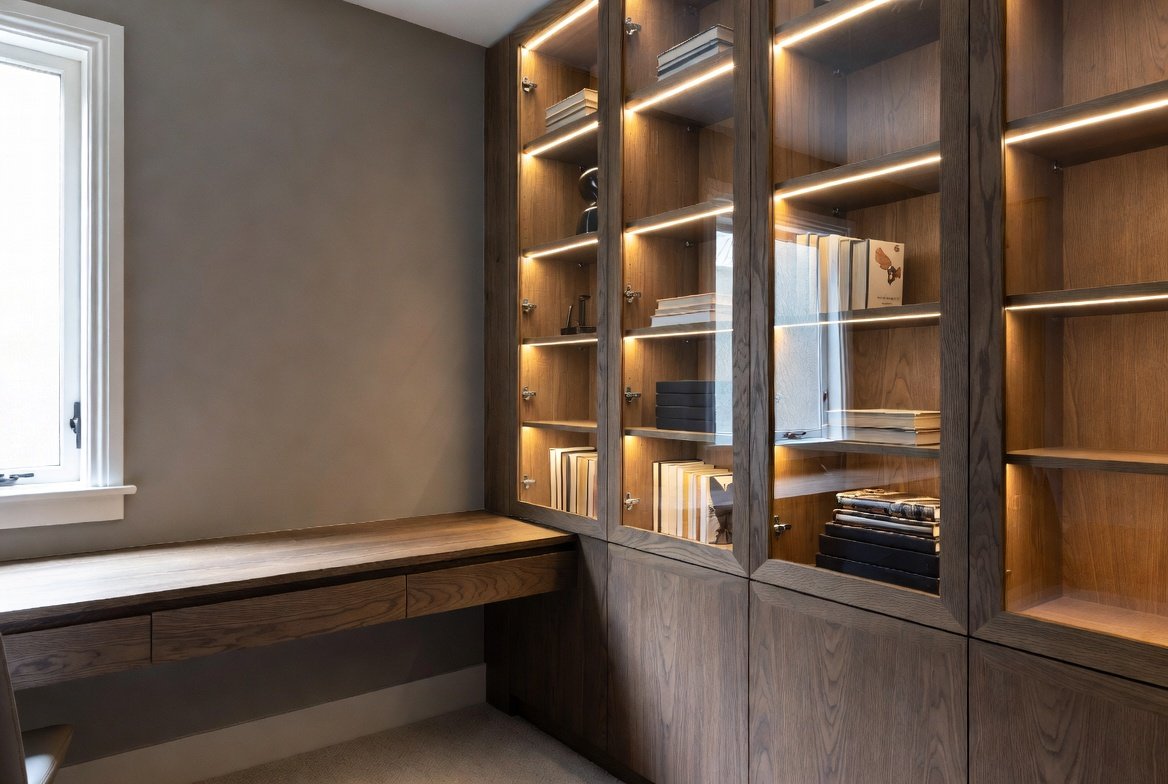
What Silk Touch built was a full home office — a 3.2-metre built-in American oak desk on the window wall with integrated cable management and a power station concealed within the desk body, floor-to-ceiling bookcases on both flanking walls with Hafele Loox 5 at 2700K behind each shelf tier, a concealed printer and filing cabinet behind a full-height door that matched the bookcase panelling exactly, and a motorised monitor arm mounted through the desk surface on a concealed base plate.
The ceiling rose is still there. The cornice is still there. The picture rail is still there.
The room is used every day.
For kitchen renovation Hawthorn projects, the question of what happens to the formal dining room — increasingly redundant in open-plan Inner East living — is one Silk Touch is asked regularly. The home office conversion is the most common answer in 2026.
Why a Custom Home Office Is One of the Smartest Upgrades in 2026 Hawthorn
Hawthorn’s housing stock — Victorian terraces, Inter-War clinker brick, Edwardian semis — was not designed for remote work. Original floor plans have formal rooms that no longer serve their original function, studies that are too small to work in properly, and spare bedrooms that are neither spare nor bedrooms in any meaningful sense.
In 2026, three converging forces have made the custom home office conversion the most actively requested non-kitchen joinery project in Silk Touch’s Hawthorn project pipeline.
The hybrid work settlement. The three-to-five day office week that characterised Inner East professional life before 2020 has not returned. Two to three days at home is the working pattern for most of Silk Touch’s client base. A room that serves this pattern properly — with a desk that functions as a professional workspace, storage that accommodates a working day’s worth of materials, and lighting that does not produce eye strain by 3pm — is not a luxury. It is infrastructure.
The property value argument. A purpose-built home office is a documented feature in property valuations for Inner East homes in 2026. Real estate agents in Hawthorn, Kew, and Camberwell report that a well-executed joinery home office adds to the property’s presented value in a way that a spare bedroom with a desk in it does not. The distinction is the quality of the execution — a built-in desk that reads as designed, not assembled.
The heritage room problem. Hawthorn’s period homes have rooms that are beautiful to look at and difficult to furnish. A formal dining room with 3.2-metre ceiling height, picture rail, and original cornice does not accommodate standard office furniture at any price point. Purpose-built joinery that is designed for the specific room, scribed to the actual walls, and finished to complement the heritage features is the only solution that makes the room functional without damaging what makes it worth having.
Trend 1: Built-In Desks with Cable Management and Power Integration
The built-in desk — a continuous work surface fixed to the wall, supported by the bookcase structure on either side — is the specification that separates a home office from a room with a desk in it.
Desk Dimensions
Depth: 700mm for a single-monitor setup with adequate forearm support. 750mm for a dual-monitor setup or where drawing and physical document work supplements screen work. Less than 650mm and the monitor sits within 500mm of the face — too close for extended work sessions at standard screen size.
Height: 720mm fixed-height standard — the ergonomic desk height for seated keyboard work for a person of average stature. Where the desk accommodates multiple users of different heights, or where the client has specified a sit-stand mechanism, the height is determined by the mechanism’s range rather than by a fixed dimension.
Width: Determined by the room. The desk runs wall to wall in most Hawthorn terrace study rooms — typically 2.8 to 3.6 metres. The full-width specification uses the room’s horizontal dimension without waste and provides the continuous work surface that makes a built-in desk functionally superior to any freestanding alternative.
Cable Management
The cable management system is the detail that most distinguishes a professional built-in desk from a competent one. Silk Touch’s standard approach:
A 60mm circular cable grommet at each monitor position in the desk surface — brushed nickel or matte black depending on the overall finish specification. A cable channel routed within the desk body from the grommet positions to a concealed cable exit at the rear of the desk, where cables drop vertically to the floor-level cable management channel that runs to the nearest GPO cluster.
The GPO cluster is positioned within the desk body — not on the wall behind the desk — accessed via a flush-mounted power station with three to four GPOs, two USB-A, and one USB-C. The power station sits flush with the desk surface, opens on a spring-loaded press mechanism, and closes to a completely flat face when not in use.
The electrical trade positions the sub-board GPO for the desk power station at documentation stage. This is a coordination step that cannot be resolved after the desk is installed — the cable channel within the desk body has fixed routing that connects to a fixed exit point. Silk Touch confirms the GPO position with the electrician before the desk carcass is fabricated.
Trend 2: Floor-to-Ceiling Bookcases with Integrated LED
The bookcase wall — full-height shelving that reads as architecture rather than furniture — is the element that converts a home office from a functional room into a room people want to be in.
Shelf Specification
Depth: 280mm for standard book storage — sufficient for A4 landscape and most hardcover formats without the dead zone at the rear that a 350mm shelf produces. 350mm for display zones where objects of varying depth are shown — the additional depth allows items to be positioned at different distances from the front edge.
Shelf thickness: 25mm MDF or 25mm ply for spans over 800mm — the thickness that prevents visible sag over a ten-year loaded shelf life. Standard 18mm shelf panels at 900mm span will deflect 3–5mm under full book load within two years. The deflection is not structural — but it is visible and reads as an under-specified installation.
Adjustable vs fixed: Lower shelves fixed — the reference books and archive material that do not move. Upper shelves adjustable on a 32mm system with concealed shelf pins — the display and active reference zone where height requirements change. The visual discipline: all adjustable shelves set at a consistent height relationship to the fixed shelves below. Random shelf heights read as unresolved.
LED Specification
Hafele Loox 5 strips at 2700K at the rear of each shelf tier, directed forward and downward onto the shelf surface. The effect: books and objects are lit from behind and above, producing a warm glow that reads as display lighting rather than task lighting. The bookcases are illuminated; the room is not lit by the bookcase LED. Overhead lighting handles the task requirement.
The LED circuit connects to a dedicated dimmer switch — separate from the desk task lighting circuit. At 20% output, the bookcase LED produces the ambient evening atmosphere that makes the home office a room someone chooses to be in after 6pm, not just during work hours.
This is the same LED specification approach established in the LED Lighting Innovations 2026 guide — the bookcase application follows the same 2700K/Hafele Loox 5 standard as the wardrobe and kitchen applications covered there.
Trend 3: Hidden Storage — Printer Cupboards, Filing Drawers, and the Visual Rest Zone
The home office that reads as calm and productive is the one where everything not currently in use has somewhere to go. The printer, the paper stock, the filing system, the cords for devices that are charged rather than used — all of it disappears into the joinery.
Printer and Equipment Cupboard
A full-height door panel within the bookcase run — finished identically to the adjacent bookcase panels, on the same hinge specification, with the same reveal — that opens to reveal a ventilated equipment zone: printer shelf at the correct height for the specific printer model, paper stock shelf below, and a cable management channel at the rear connecting to the power station.
The ventilation requirement: a 30mm gap at the top and bottom of the cabinet interior, concealed by the door panel overlap, that allows passive air circulation around heat-generating equipment. Printers and routers in sealed unventilated cabinets overheat and fail faster than their rated lifespan. Silk Touch confirms the ventilation requirement against the specific equipment at the design stage.
Filing Drawers
Two drawers at 200mm height under the desk run, on Blum Legrabox at 40kg rating — the light specification is correct for filing drawer loads in a residential context. Suspension file rails at 350mm depth. The drawer face matches the desk kicker panel exactly — the filing drawers are not visible from a seated position. They are accessed by opening a panel that reads as the desk base.
The Visual Rest Principle
The home office that produces sustained focus is the one where the visual field is managed. A wall of mismatched objects — equipment, cables, paper stacks, charging devices — produces the cognitive load of disorder that undermines concentration. The hidden storage specification is not about tidiness. It is about visual rest — the condition where the room contains only what is needed to do the work, and everything else is behind a door.
Trend 4: Motorised and Ergonomic Features
Sit-Stand Desk Mechanisms
The sit-stand desk — a desk surface that raises and lowers electrically between sitting and standing height — is increasingly specified in Silk Touch’s Inner East home office projects for clients who spend six or more hours at the desk daily.
The integration challenge with a built-in joinery desk: the mechanism must be concealed within the desk carcass without affecting the visual outcome of the installation. Silk Touch uses Häfele or Linak column mechanisms with a steel sub-frame fixed to the floor, concealed within the desk body, connected to a flush-mounted handset at the desk edge. The desk surface raises from 720mm (seated) to 1,150mm (standing) and holds any position within this range.
The structural requirement: the floor beneath the mechanism base must be confirmed as structurally adequate for the dynamic load of the desk at full extension with equipment on the surface. In heritage Baltic pine floors, the base plate spans two joists — confirmed at the laser measure stage.
Motorised Monitor Arms
A motorised monitor arm mounted through the desk surface on a concealed base plate allows the monitor to be repositioned between landscape and portrait orientations, raised to standing height when the desk is elevated, and retracted to a stored position below the desk surface edge when not in use. The arm is powered from the desk power station. The base plate is flush with the desk surface when the arm is retracted — no hardware visible.
For the connection between home office joinery and the broader motorised joinery specification range — including motorised wardrobe lift systems and automated storage — Motorised Wardrobe Systems Melbourne 2026 covers the automation systems that operate across the full Silk Touch project scope.
Heritage Homes: The Cornices, Skirtings, and Scale Problem
Hawthorn’s Victorian and Edwardian rooms present the same on-site scribing requirements as every other Inner East heritage context — with one additional consideration unique to the home office application: scale.
A home office bookcase in a 3.2-metre ceiling heritage room must be proportioned to the room. A 2.4-metre bookcase in a 3.2-metre ceiling room leaves 800mm of wall above it that reads as unresolved. The joinery must go to the cornice — or be designed with a deliberate relationship to the cornice that reads as considered rather than incomplete.
Silk Touch’s standard approach for Hawthorn home office bookcases: built-to-cornice with a scribed pelmet, as established in the space-saving joinery guide covering the same technique in a wardrobe context. The bookcase runs to within 20mm of the cornice underside, the pelmet panel closes the gap with a scribed profile, and the total height of the installation uses the full wall plane without touching the heritage plaster.
Skirtings present a different problem at the base: the bookcase base must either sit on top of the existing skirting (readable as a gap between the carcass base and the floor) or the skirting must be scribed around — a return piece at each side that closes the gap between the carcass base and the existing skirting profile. Silk Touch’s standard: scribe around the skirting, not on top of it. The bookcase reads as part of the room, not as furniture placed in front of it.
Picture rails in rooms where the bookcase runs to full height: the rail is retained, and the bookcase is designed to read as installed behind it — a 15mm reveal between the bookcase face and the picture rail face produces the reading that the joinery belongs to the room’s heritage register.
For heritage joinery expertise at the premium end of the Hawthorn and Inner East market, bespoke joinery Toorak and custom joinery Kew cover the same on-site scribing approach applied to kitchen and wardrobe contexts in adjacent suburbs.
Materials: Sustainable, Durable, and Heritage-Appropriate
The home office material specification in Hawthorn’s heritage homes follows the same logic as every other room in Silk Touch’s Inner East project portfolio.
American oak veneer at Crown Cut is the primary timber specification — the grain figure is appropriate for a heritage room where the joinery should read as considered without being assertive. FSC-certified lots available and documented. For clients who have specified sustainable materials across their renovation, the Sustainable Bespoke Joinery in Melbourne guide covers the full environmental documentation available.
2-pack polyurethane at 12% gloss on painted surfaces — the same finish standard established in the 2-Pack Polyurethane Finishes: The Gold Standard guide. In a home office context where the desk surface receives daily use and the bookcase shelves accumulate years of minor surface contact, the hardness and chemical resistance of 2-pack is the specification that protects the finish investment over the room’s useful life.
E0-rated MDF substrate throughout — the low formaldehyde emission standard that is particularly relevant in a room where a person spends six or more hours daily. The off-gassing implications of standard E1 substrate in a sealed study environment are an indoor air quality consideration that E0 specification resolves at a minimal cost premium.
For the full wardrobe and dressing room timber specification that frequently accompanies a Hawthorn home office project in the same renovation scope, Luxury Walk-In Wardrobe Islands & Seating: 2026 Must-Haves for Malvern covers the coordinated timber approach across rooms.
How Silk Touch Designs and Builds Home Office Joinery
Free 3D consultation. The home office consultation begins with the room — its actual dimensions, actual wall conditions, actual window positions, and actual heritage features. The 3D model is built from laser measure data, not from floor plan drawings. The client sees the proposed bookcase, desk, and storage configuration in the context of the actual room before any commitment is made. Cornices, picture rails, and skirting profiles are modelled — the client can see exactly how the joinery meets the heritage fabric.
Cable and power coordination. The electrical trade is briefed at documentation stage — GPO positions, USB outlet positions, and any data cabling requirements are confirmed before the joinery is fabricated. A home office with a desk power station positioned incorrectly is a frustration that cannot be resolved without reopening the desk body.
Factory build. All joinery is fabricated in the Camberwell workshop. The 2-pack finish is applied in the spray booth. The LED drivers are installed in the bookcase carcass before the unit leaves the workshop. The sit-stand mechanism sub-frame is pre-assembled and test-operated before delivery.
On-site scribing. Heritage Hawthorn rooms — Victorian terraces, Edwardian semis — have walls that are out of plumb, floors that are not level, and cornices that vary in projection across their length. Every panel adjacent to a heritage surface is scribed to the actual profile in situ. The bookcase sits flush against the heritage plaster at every point without a visible gap.
Handover and configuration. At handover, Silk Touch configures the cable management with the client’s specific equipment, programs the sit-stand mechanism to the client’s preferred heights, and confirms the LED dimming levels. The room is operational on the day of handover — not provisionally installed pending the client’s own setup.
Total programme: 6–8 weeks from confirmed design to commissioned home office.
2026 Cost Guide
Built-in desk, 3.0m wide, American oak veneer or 2-pac, cable management and flush power station, no sit-stand: $8,500–$14,000 installed.
Add sit-stand mechanism (Häfele or Linak column, handset, structural base): $3,500–$6,500 additional.
Floor-to-ceiling bookcase, single wall, 3.0m wide, scribed pelmet to cornice, Hafele Loox 5 LED, adjustable shelving: $12,000–$20,000 installed.
Hidden printer and equipment cupboard, ventilated, within bookcase run: $2,800–$4,500 additional.
Filing drawer set, two drawers, Blum Legrabox, suspension file rails: $2,200–$3,800 additional.
Full home office package (desk with cable management, both bookcase walls, printer cupboard, filing drawers, LED throughout): $28,000–$52,000 installed depending on room size, material specification, and sit-stand requirement.
What moves price most significantly: sit-stand mechanisms add $3,500–$6,500; veneer specification over 2-pac adds $2,500–$5,000; heritage scribing complexity adds $1,500–$3,500; motorised monitor arms add $1,800–$3,200 per arm.
Real 2026 Hawthorn and Inner East Projects
Hawthorn, Victorian terrace formal dining room conversion, January 2026. The project referenced in the introduction. 3.2-metre desk, floor-to-ceiling bookcases to cornice, hidden printer cupboard, Blum filing drawers, Hafele Loox 5 at 2700K throughout, sit-stand mechanism. American oak veneer desk and bookcase faces. The ceiling rose, cornice, and picture rail retained and incorporated. The room has been used every working day since installation.
Hawthorn, Edwardian semi study expansion, November 2025. An existing 2.4-metre square study — too small to function as a proper workspace — was extended visually through floor-to-ceiling joinery that used every wall plane. The bookcase wrapped three walls; the desk occupied the fourth. The 12% gloss 2-pack on the painted panels reflected enough light from the single north-facing window to eliminate the need for additional overhead lighting during daylight hours.
Kew, Federation home library conversion, October 2025. A formal sitting room converted to a combined library and home office. Quarter Cut American oak veneer on all joinery — the linear grain was appropriate for a room with a more restrained character than the Hawthorn project. Rolling library ladder on a brass track — a joinery element that required a structural wall confirmation before the track was fixed. The ladder adds 30–40mm of projection from the bookcase face — confirmed against the room’s door swing before specification.
Camberwell, Edwardian home office from scratch, September 2025. New extension with no heritage constraints — the home office was a 4.2 × 3.6-metre dedicated room. Floor-to-ceiling joinery on three walls. Dual-station desk on the window wall for two occupants working simultaneously. Individual cable management zones. The room was documented as a dedicated home office in the property’s building records — a detail the clients’ estate agent confirmed as relevant to the property’s presented value.
Conclusion: The Room That Earns Its Square Metres
The unused formal dining room, the study that is too small, the spare bedroom that is neither spare nor a bedroom — these are the rooms in Hawthorn’s heritage homes that are waiting for a joinery solution.
The custom home office is not a luxury addition to a completed renovation. It is the room that makes the house function for the way people actually live and work in 2026. Built into the heritage fabric without disturbing it. Finished to the same standard as the kitchen and the wardrobe. Operational on handover day.
The three-year conversation that preceded the Malvern dressing room in Day 14 does not happen with home offices. Clients know they need one. The question is whether the room gets furniture or joinery.
The answer determines whether the room is used.
Book your free 3D home office design consultation — bring the room dimensions and a list of what needs to go in it. The rest is a forty-minute conversation.
Frequently Asked Questions
What is the correct desk depth for a built-in home office desk in a heritage Hawthorn room? 700mm for a single-monitor setup with adequate forearm support. 750mm for a dual-monitor configuration or where physical document work supplements screen work. Less than 650mm positions the monitor within 500mm of the face — too close for extended work sessions at standard screen sizes. The desk depth is confirmed against the client’s specific monitor size and working pattern at the design consultation.
How does cable management work in a built-in joinery desk? A 60mm circular cable grommet at each monitor position routes cables into a channel within the desk body, connecting to a concealed exit point at the desk rear. Cables run from the exit to a flush-mounted power station within the desk surface — three to four GPOs, USB-A, and USB-C, accessible on a spring-loaded press mechanism. GPO positions are confirmed with the electrical trade at documentation stage before the desk carcass is fabricated.
Can floor-to-ceiling bookcases be installed in a Hawthorn Victorian room without damaging the cornice? Yes — through a scribed pelmet. The bookcase carcass terminates 20mm below the cornice underside. A horizontal pelmet panel is cut to the actual cornice profile using a profile gauge at the specific wall position, closing the gap without contact pressure on the heritage plaster. The result reads as flush from a standing position. Silk Touch performs this scribing on-site after the carcass is set — the cornice profile cannot be resolved from a measurement alone.
Is a sit-stand desk mechanism suitable for a heritage home joinery installation? Yes — Häfele and Linak column mechanisms are integrated within the desk body on a steel sub-frame fixed to the floor, concealed by the desk carcass panels. The handset mounts flush at the desk edge. In heritage Baltic pine floors, the base plate is engineered to span two joists — confirmed at the laser measure stage. The mechanism raises the desk from 720mm to 1,150mm and holds any intermediate position.
What materials are specified for a Hawthorn home office joinery project? American oak Crown Cut veneer for timber-faced components — FSC-certified lots available. 2-pack polyurethane at 12% gloss on painted surfaces. E0-rated MDF substrate throughout — the low formaldehyde emission standard is particularly relevant in a room where a person spends six or more hours daily. Hafele Loox 5 at 2700K for bookcase LED. All specifications available with full environmental documentation on request.
How long does a custom home office joinery project take from design to installation? 6–8 weeks from confirmed design to commissioned home office — the standard Silk Touch programme. The timeline includes 3D design and client approval in weeks one and two, factory fabrication and 2-pack finishing in weeks three through five, and on-site installation and LED commissioning in weeks six and seven. Sit-stand mechanism sub-frames are pre-assembled and test-operated at the workshop before delivery.
Does a built-in home office add value to a Hawthorn heritage property? Yes — a purpose-built joinery home office is a documented feature in Inner East property valuations in 2026. Real estate agents in Hawthorn report that a well-executed built-in office reads as a designed room rather than a furnished spare bedroom, and is presented as a property feature rather than a furniture inventory item. The value addition is most pronounced where the joinery incorporates heritage-sensitive scribing, full-height bookcase walls, and a professional-grade cable management and power system.