Four Years of Family Use. Still Looks Like Day One.
The Malvern kitchen was installed in early 2022. American oak veneer below, Caesarstone Mineral above, matte 2-pack polyurethane on every painted surface. Two adults, three children under twelve, a dog, and a household that uses the kitchen the way a kitchen is supposed to be used.
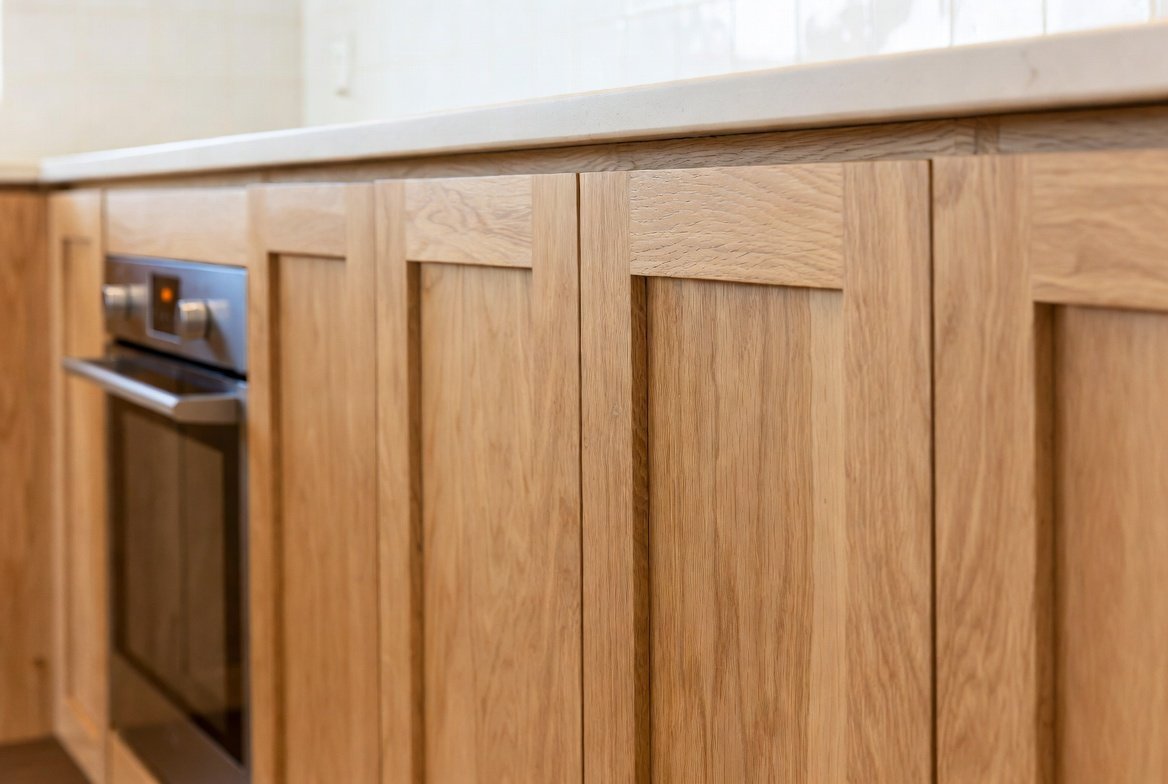
At the four-year mark, the client sent through photographs for a project feature. The cabinets in those photographs are indistinguishable from the handover images taken in March 2022.
No yellowing. No surface checking. No scratched edges where school bags have made contact with the corner cabinet. The finish that went on in the Silk Touch spray booth in Camberwell in 2022 is the finish that is on the kitchen today.
That is the 2-pack polyurethane argument. Not that it looks good on installation day — every finish looks good on installation day. That it looks the same four, eight, and fifteen years later, in a household that does not treat a kitchen like a showroom.
For the full picture of how 2-pack finish interacts with the kitchen renovation specification at every stage, kitchen renovations Camberwell covers the complete project approach. This article covers the finish itself: what it is, why it performs, how it is applied, and what it costs in 2026 Melbourne.
What 2-Pack Polyurethane Actually Is
The name causes confusion. “2-pack” refers to the two-component nature of the product — a resin base and a hardener catalyst that are mixed immediately before application and undergo a chemical cross-linking reaction as they cure. The resulting film is not a surface coating in the way a paint is a surface coating. It is a cross-linked polymer network that bonds to the substrate at a molecular level.
This is the technical foundation of every performance claim made about 2-pack polyurethane. The hardness, the scratch resistance, the chemical resistance, the UV stability — all are consequences of the cross-linked polymer structure that no single-component finish can replicate.
The working life of a mixed 2-pack batch — the pot life — is typically two to four hours depending on temperature and the specific product formulation. After this window, the catalysed mixture has cross-linked to the point where it can no longer be applied. This is why 2-pack polyurethane is a professional trade application. It cannot be touch-up painted from a tin the way a standard paint can. It requires a spray booth environment, a calibrated spray gun, and a painter who understands the pot life constraints.
Silk Touch applies 2-pack in its own spray booth at the Camberwell workshop — not through a subcontracted spray painter. The finish is part of the joinery production process, not an external finishing step.
Matte, Satin, or Gloss: Which Finish Is Correct
The gloss level of a 2-pack finish is specified on a scale from 5% (near-dead flat) to 100% (full mirror gloss). The correct specification depends on the room, the material it sits adjacent to, and the heritage context of the home.
Matte (5–20% Gloss)
Matte 2-pack is the specification for 90% of Silk Touch’s Inner East kitchen and wardrobe projects in 2026. At 10–15% gloss, the surface reads as silky and considered — present enough to show the quality of the finish, understated enough to not compete with the benchtop material or the veneer grain.
The practical advantage of matte over gloss: fingerprints, smudge marks, and minor surface contact marks are significantly less visible on a matte surface. In a family kitchen, this is not an aesthetic preference — it is a specification decision that determines how the kitchen reads between cleaning sessions.
Matte 2-pack is the correct specification for heritage homes in Camberwell, Kew, and Hawthorn where a high-gloss finish would conflict with the period character of the architecture. The surface reads as crafted rather than industrial.
Satin (25–40% Gloss)
Satin 2-pack sits between matte and gloss — it reflects enough light to read as polished without the mirror quality of full gloss. It is the specification for contemporary extensions and new builds where a slightly more reflective surface is the design intent, and for rooms with lower natural light levels where additional surface reflectivity improves the ambient light quality.
Satin is less commonly specified in Silk Touch’s heritage Inner East projects but is the standard specification for butler’s pantries and laundry joinery where the surface is viewed at close range and the higher gloss reads as a deliberate material quality.
Gloss (60–100%)
High-gloss 2-pack is the specification for specific design contexts — a statement kitchen in a contemporary Toorak or Brighton home where the reflective surface is a deliberate design choice. It is not the default. High-gloss surfaces show every fingerprint, every water mark, and every minor surface contact mark in a way that matte surfaces do not. In a family kitchen, high-gloss 2-pack requires a cleaning discipline that most households cannot sustain.
Where high-gloss is specified, Silk Touch applies an additional finishing stage — a final cutting and buffing of the cured film — to eliminate any residual texture in the surface. The result is the mirror-quality finish that the gloss specification promises. Without this stage, even a high-gloss 2-pack application shows slight texture variation under raking light.
Technical Performance: Why 2-Pack Outperforms Everything Else
Hardness
2-pack polyurethane cures to a pencil hardness of 2H–3H — a standard measure of surface film hardness where H values indicate increasing hardness. For comparison, a standard acrylic paint cures to approximately HB–B. The 2-pack surface is two to three times harder than a standard painted surface.
In practical terms: a set of keys dragged across a 2-pack surface at moderate pressure will not scratch it. The same action on a standard lacquered or painted surface produces a visible mark. This is the hardness argument that makes 2-pack the specification for joinery in rooms with daily contact use — kitchen cabinets, wardrobe doors, laundry cabinetry.
Scratch and Abrasion Resistance
The cross-linked polymer structure of cured 2-pack polyurethane resists abrasion at a level that no other spray finish in the residential joinery specification range approaches. The film does not micro-scratch from cleaning — a common failure mode for softer lacquer finishes where repeated wiping with a damp cloth produces a dull surface texture within two to three years.
Chemical and Stain Resistance
2-pack polyurethane is resistant to the full range of household chemicals encountered in a kitchen or bathroom context: cooking oils, cleaning products, mild acids, alcohols, and surface disinfectants. A 2-pack surface does not absorb these chemicals — they sit on the film surface until wiped. There is no staining mechanism.
The exception is sustained contact with strong solvents — acetone, paint stripper, concentrated bleach. These will soften and damage the cured film with prolonged exposure. Standard household use does not produce this exposure.
UV Stability
2-pack polyurethane resists yellowing under UV exposure significantly better than oil-based single-component finishes and conventional lacquers. In a kitchen with north-facing windows — common in Inner East heritage homes where the rear extension faces north — the finish on the window-adjacent cabinets is exposed to sustained UV. After four years, the colour difference between the UV-exposed faces and the protected faces on a well-specified 2-pack finish is within the range of natural colour variation in the substrate. It is not visible.
2-Pack vs Alternatives: The 2026 Comparison
| Finish | Hardness | Scratch resistance | UV stability | Repairability | Cost relative to 2-pac | Lifespan (residential) |
|---|---|---|---|---|---|---|
| 2-Pack polyurethane | 2H–3H | Excellent | Excellent | Specialist touch-up | Baseline | 15–20+ years |
| 2K lacquer | H–2H | Good | Good | Specialist touch-up | 10–20% below | 8–12 years |
| Vinyl wrap | N/A (film) | Moderate | Poor | Replace panel | 25–35% below | 5–8 years |
| Single-component lacquer | HB–H | Moderate | Moderate | DIY possible | 20–30% below | 5–8 years |
| Natural oil | Soft | Low | Moderate | DIY re-oil | 15–25% below | 20+ years with maintenance |
| Powder coat | 3H–4H | Excellent | Excellent | Replace panel | 10–20% above | 20+ years |
Vinyl wrap is the specification Silk Touch declines to offer. The PVC film delaminates at edges and heat-adjacent surfaces within three to five years in a kitchen environment. It is a short-term cost saving that produces a visible failure within a renovation’s useful life. Clients who have experienced vinyl wrap failure in a previous kitchen do not require explanation of why 2-pack is the correct specification.
2K lacquer is a legitimate alternative at a lower cost point — it uses a similar two-component chemistry but with different resin systems that produce a slightly softer film. For laundry and secondary storage joinery where the hardness specification of full 2-pack is more than the application requires, 2K lacquer is an acceptable downward specification step.
Natural oil is the correct specification for exposed timber veneer surfaces where the tactile and visual character of the timber is the priority — covered in detail in the American Oak Veneers In Depth guide. Oil and 2-pack are not competing specifications — they occupy different positions in the material palette and are frequently used in the same project.
Powder coat outperforms 2-pack on hardness but is only applicable to metal substrates. It is not a joinery finish.
How Silk Touch Applies 2-Pack: The In-House Process
The quality of a 2-pack polyurethane finish is determined primarily by the application environment and process — not by the product specification alone. A premium 2-pack product applied in inadequate conditions produces an inferior result. The same product applied correctly produces the fifteen-year finish the specification promises.
The spray booth. Silk Touch applies all 2-pack finishes in its enclosed spray booth at the Camberwell workshop. The booth maintains a filtered, positive-pressure air environment that eliminates dust contamination during application and curing. Dust inclusions in the wet film — the most common failure in non-booth 2-pack application — are not present in a correctly operated spray booth environment. Under raking light at handover, the surface is uniform. This is the detail that distinguishes a spray booth finish from a site-applied or garage-applied finish.
Surface preparation. Every panel destined for 2-pack receives a sanding sequence to 240 grit before the first coat, followed by a light 320-grit cut between sealer and topcoat. For MDF substrates — the standard carcass material for 2-pack painted panels — the end grain is sealed with a dedicated MDF primer before the 2-pack sealer coat. Unsealed MDF end grain absorbs the 2-pack sealer unevenly and produces a finish with visible porosity at edges. This is a preparation step that is not visible in the finished product when done correctly and is highly visible when omitted.
Coat sequence. Silk Touch applies a minimum of three coats: a sealer coat, a build coat, and a topcoat. For gloss finishes, a fourth buffing stage follows the cured topcoat. The build coat is applied the day after the sealer — not the same day. Applying multiple coats within the same day traps solvent in the film and produces a finish that outgasses over subsequent weeks, creating surface texture variation that is visible under certain light angles. The intercoat drying schedule is a production discipline, not a shortcut opportunity.
Colour matching. Silk Touch colour-matches all 2-pack specifications to the client’s selected colour reference — typically a Dulux, Resene, or international paint brand reference. The colour is mixed to the target and confirmed against a physical sample before the full panel run is sprayed. Colour matching is confirmed under the LED colour temperature that will be used in the installed room — a colour that matches at 4000K may read differently at the 2700K specification used in heritage wardrobe and kitchen environments.
Best Applications by Room
Kitchens. 2-pack at 10–15% gloss on painted cabinet doors and drawer faces is the standard Silk Touch specification. Matte surfaces resist daily fingerprint accumulation. The hardness specification handles the contact use of a family kitchen. Applied to MDF carcass faces and profiled door edges, the finish reads as seamless — no grain, no texture variation, a single continuous surface. For bespoke joinery Toorak kitchens at the upper end of the market, 2-pack on profiled shaker doors in heritage kitchens is the specification that reads as period-appropriate without the maintenance burden of a painted timber door.
Wardrobes. 2-pack at 12–18% gloss on wardrobe door faces — particularly in combination with American oak veneer panels in the same run — is the specification that reads as coherent. The painted 2-pack faces and the oiled timber faces occupy adjacent positions in the same material palette without one dominating the other. As covered in the Luxury Walk-In Wardrobe Islands & Seating: 2026 Must-Haves for Malvern, island drawer faces in 2-pack match the surrounding wardrobe doors exactly — same batch, same application date, same colour reference.
Vanities. 2-pack on bathroom vanity bases is the finish that handles the humidity cycling of a bathroom environment better than any alternative except Fenix NTM. The fully sealed film on all faces — front, rear, internal, edges — prevents moisture ingress at every surface. The 2026 Bathroom Vanity Trends Melbourne post covers how 2-pack and Fenix NTM compare in the vanity context and which applications favour each.
Laundries. 2-pack in the laundry is the specification that produces a surface that can be wiped down with cleaning products without surface degradation. In a room where bleach, washing powder, and general household cleaning chemicals make regular contact with the cabinetry, the chemical resistance of 2-pack is the specification argument that no other finish meets.
Heritage homes. Matte 2-pack on profiled door styles in Camberwell and Hawthorn Federation kitchens reads as period-appropriate in a way that high-gloss or vinyl-wrapped alternatives do not. The surface has depth — light catches the profile edges and recesses in a way that a flat film finish cannot replicate. With the correct colour specification — a heritage white or warm putty rather than a stark contemporary white — the kitchen reads as consistent with the architecture.
Maintenance and Long-Term Performance
The maintenance protocol for 2-pack polyurethane is the simplest of any joinery finish: wipe with a damp cloth. For stubborn marks, a mild household cleaner. No specialist products, no periodic re-coating, no sealing.
What 2-pack does not tolerate is abrasive cleaning. A scourer or abrasive cream cleaner will dull the cured film surface — not by scratching through the film but by micro-abrading the surface texture in a way that changes how light reflects from it. Clean with a soft cloth only.
Repairability. 2-pack polyurethane is not a DIY-repairable finish. A significant impact chip or a deep scratch requires a colour-matched touch-up from a professional spray finisher. The touch-up is blended into the surrounding finish rather than applied as a discrete patch. In most cases, the repair is not detectable in normal lighting conditions. Silk Touch retains colour reference records for all projects — a touch-up specification from five years after installation is reproducible.
The fifteen-year horizon. Silk Touch’s standard performance expectation for a 2-pack polyurethane finish in a residential kitchen or wardrobe context is fifteen to twenty years without refinishing. This is not a warranty claim — it is an observation from completed projects. The 2022 Malvern kitchen in the introduction is one data point. There are others from 2015, 2017, and 2019 that perform consistently with this expectation.
2026 Cost Guide
2-pack polyurethane adds a cost premium over unlacquered or vinyl-wrapped alternatives. The premium is real and it is justified by the performance difference — but it is worth understanding what drives it.
The cost variables: substrate preparation (MDF end grain sealing is mandatory and time-consuming), number of coats (three minimum, four for gloss), pot life management (mixed product must be used or discarded — waste is a cost), and booth operation (energy, filtration, maintenance).
Cost premium over vinyl wrap: 30–45% on the finish component of the project cost. On a full kitchen, this typically represents $3,500–$7,000 over the vinyl alternative — for a finish that lasts three times as long and performs at a categorically different level.
Cost premium over single-component lacquer: 15–25% on the finish component. On a full kitchen, $1,500–$3,500 over lacquer — for hardness and UV stability that lacquer does not match.
2-pack finish as a component of full project cost (2026 Melbourne):
- Kitchen (15 doors + 20 drawer faces, matte 2-pack, standard colour): $4,500–$7,500 for the finish component
- Wardrobe (10 doors, matte 2-pack, standard colour): $2,800–$4,500
- Vanity (4 doors + 2 drawer faces): $1,800–$3,200
- Full home (kitchen, two wardrobes, laundry, vanity): $12,000–$22,000 for finish component across all joinery
These figures are for the finish application only — substrate, carcass, hardware, and installation are separate line items in the project cost.
Real Inner East Projects
Toorak, Georgian kitchen, 2024. Shaker profile doors in matte 2-pack at 12% gloss, heritage white (Dulux Lexicon Quarter). American oak veneer island base in natural oil. The 2-pack on the perimeter cabinetry and the oiled oak on the island occupy the same material palette without competing. Two years in, the white is the same white.
Kew, Federation kitchen extension, 2023. Matte 2-pack in warm putty (Dulux Antique White USA) on flat-panel doors, 15% gloss. The colour was selected against the original Baltic pine floor under the installed LED specification — 2700K. The same colour under a 4000K colour reference read noticeably cooler. Colour confirmation under the installed light source prevented a specification error.
Camberwell, Edwardian full home joinery, 2022. Kitchen, laundry, and study joinery in matte 2-pack at 10% gloss throughout, single colour across all three rooms. The consistency of 2-pack colour matching across rooms finished in the same spray run means the three rooms read as a single joinery project. Different paint applications across separate rooms — even from the same tin — produce variation that is visible in rooms adjacent to each other.
Malvern, walk-in wardrobe, 2025. 2-pack on the wardrobe door faces at 15% gloss, American oak veneer panels in the same run in natural oil. The pairing — referenced in the 2026 Kitchen Benchtop Trends Melbourne guide as a material palette decision — produces a wardrobe where the painted and timber faces read as designed together.
Hawthorn, Victorian terrace laundry, 2024. 2K lacquer (not full 2-pack) on the laundry cabinet faces — a considered downward specification where the performance requirement of the laundry was met by the lacquer specification and the cost saving was allocated to the Fenix NTM benchtop. The lacquer faces read identically to 2-pack at installation. Performance over five years will produce a visible difference; the client was briefed on this and accepted the specification.
Conclusion: The Finish That Earns Its Cost
The 2-pack polyurethane premium is real. It is not the cheapest finish available, and the application process that produces a fifteen-year result is not the fastest.
What it delivers is a surface that performs at the level the rest of a premium joinery specification demands. A kitchen with Blum Legrabox hardware, Caesarstone Mineral benchtops, and American oak veneers deserves a painted finish that holds its quality for the same duration as those components. 2-pack polyurethane is that finish.
Vinyl wrap is not. Lacquer is not. Single-component paint is not.
The clients who return to Silk Touch after four, six, and eight years with photographs of their original installation — not to report a problem, but to show what the finish looks like after sustained family use — are the clients who specified 2-pack when the alternative was cheaper and more convenient.
Book your free 3D design with 2-pack finish samples — the colour confirmation happens under the LED specification for your room, against your veneer selection, before a single panel is sprayed.
Frequently Asked Questions
What is 2-pack polyurethane and why is it better than regular paint? 2-pack polyurethane is a two-component finish — a resin base mixed with a hardener catalyst immediately before application. The chemical cross-linking reaction produces a polymer film that is significantly harder, more scratch-resistant, and more chemically stable than any single-component paint or lacquer. It cures to 2H–3H pencil hardness, compared to HB–B for standard paint. The cross-linked structure is what produces the fifteen-year residential lifespan — standard finishes do not have an equivalent mechanism for achieving this durability.
What gloss level should I specify for a heritage kitchen in Inner East Melbourne? Matte at 10–15% gloss is the standard specification for heritage kitchens in Camberwell, Kew, and Hawthorn. This level reads as silky and considered — present enough to show the quality of the finish without the industrial character of higher gloss levels. High-gloss 2-pack conflicts with the period character of heritage architecture and is not a specification Silk Touch recommends for Federation, Edwardian, or Victorian kitchen contexts.
How does 2-pack polyurethane compare to Fenix NTM? Both are premium surface specifications for painted joinery faces. 2-pack polyurethane is a spray-applied film finish — it can be applied to any substrate in any colour, including custom colour-matched specifications. Fenix NTM is a manufactured panel product — it comes in fixed dimensions and a defined colour range, but its oleophobic surface and thermal self-healing properties perform at a level 2-pack does not match for fingerprint resistance. Silk Touch specifies 2-pack where custom colour is required and Fenix where the specific tonal range and oleophobic performance are the priority.
Can 2-pack polyurethane be repaired if a door is chipped or scratched? Yes — a professional colour-matched touch-up from a spray finisher blends into the surrounding film in most cases. The repair is not a DIY process — 2-pack cannot be applied from a brush or roller and requires the same spray equipment used for the original application. Silk Touch retains colour reference records for all projects, so a touch-up specification from years after installation is reproducible. For significant damage, a panel replacement finished in the same colour batch is the cleanest outcome.
Does 2-pack polyurethane yellow over time? Correctly specified 2-pack polyurethane using a UV-stable aliphatic hardener does not yellow measurably over a fifteen-year residential lifespan. Early-generation 2-pack products using aromatic hardeners did yellow under UV exposure — this is the origin of the yellowing concern that some clients raise. Aliphatic hardener formulations, standard in premium 2-pack products since the mid-2010s, resolve this issue. Silk Touch specifies aliphatic hardener 2-pack only — the colour reference at handover is the colour reference fifteen years later.
What is the correct maintenance routine for 2-pack polyurethane joinery? Wipe with a soft damp cloth for daily cleaning. Mild household cleaner for stubborn marks. Never use abrasive cleaners, scourers, or solvent-based cleaning products — these will dull or damage the cured film surface. The 2-pack surface requires no periodic re-sealing, no oiling, and no specialist maintenance products. It is the lowest-maintenance premium joinery finish available.
How much does 2-pack polyurethane add to a kitchen renovation cost in Melbourne in 2026? The finish component for a standard kitchen (15 doors, 20 drawer faces, matte 2-pack, standard colour) runs $4,500–$7,500. This represents a premium of 30–45% over vinyl wrap and 15–25% over single-component lacquer on the finish component alone. Across the full kitchen project cost, the 2-pack premium typically represents 8–15% of the total budget. For a finish that lasts fifteen-plus years versus five to eight years for vinyl alternatives, the cost-per-year argument favours 2-pack across the renovation’s full life.