The House That Got Three Rooms From Two
The Camberwell semi-detached had been on the market twice. Both times the feedback was the same: “Beautiful bones, not enough storage.” The second bedroom was being used as a dumping room because the first bedroom had nowhere to put anything. The study was a desk shoved against the laundry wall.
The clients bought it on the third listing, when the price reflected the problem.
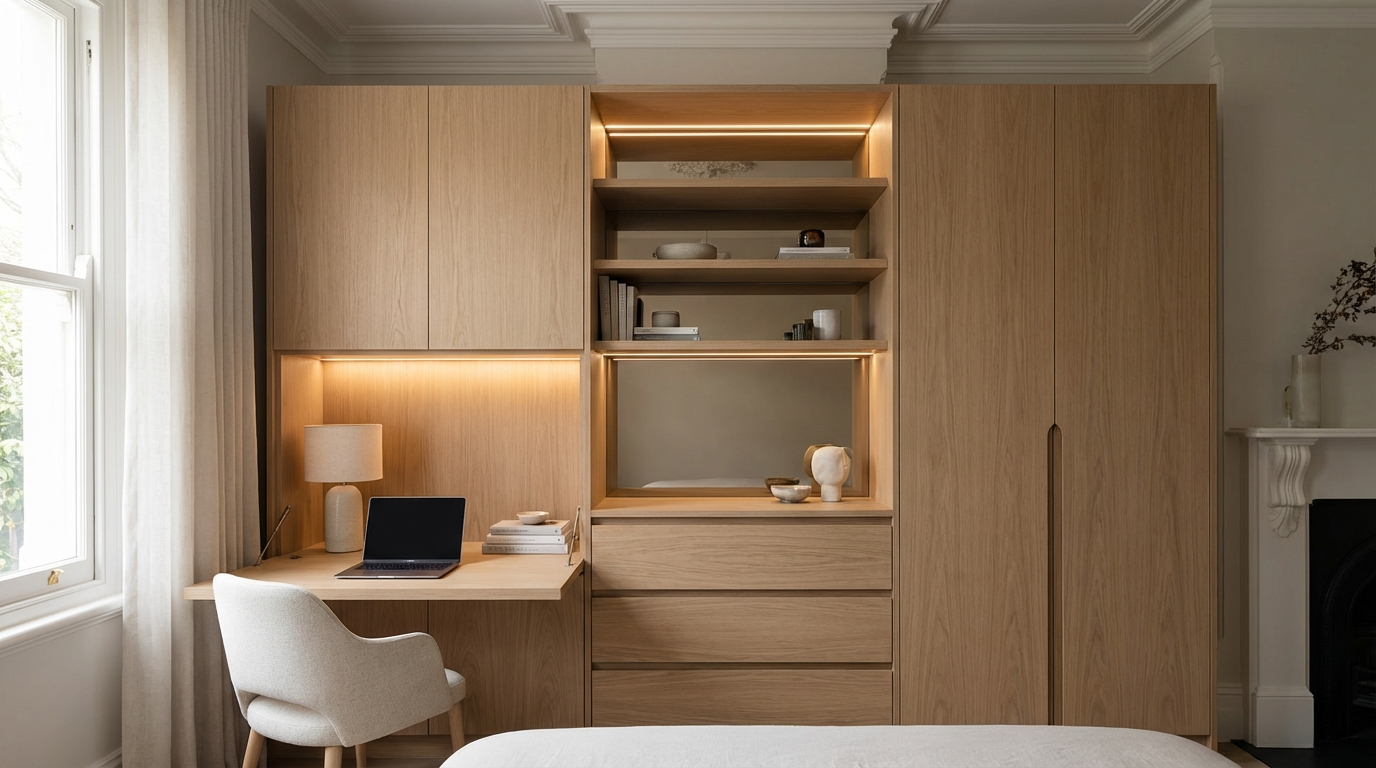
What Silk Touch built was not an extension. No walls moved. No permits beyond what the standard building regulations required. We built a floor-to-ceiling storage wall in the second bedroom that contained a full wardrobe, a fold-down double bed, and a fold-down desk — all within a 350mm projection from the wall. We rebuilt the laundry as a full-height joinery column with integrated hamper, drying cabinet, and cleaning storage in 600mm of floor width. We converted the under-stair void into a pull-out drawer system with a wine rack column that the clients had not thought to ask for.
The dumping room became a guest bedroom. The study became a study. The house had the same footprint and a completely different set of possibilities.
That is the compact joinery argument. Not clever tricks. Not furniture hacks. Purpose-built joinery that makes a constrained floor plan function at the level the owners deserve.
For kitchen renovations Camberwell projects specifically, the compact floor plan is the starting condition for most semi-detached and terrace renovations in this suburb — and the joinery is where the renovation either delivers or falls short.
Why Compact Inner East Properties Need a Different Joinery Approach
A compact property in Melbourne’s Inner East is not simply a smaller version of a Toorak Georgian. It is a different architectural problem with different constraints.
Heritage fabric cannot move. A Victorian terrace in Hawthorn or Camberwell has load-bearing masonry party walls, an original stair configuration that is heritage-significant, and ceiling heights that vary by room in ways that defy a single joinery solution. Removing a wall to gain floor area requires structural engineering, council notification in heritage overlay areas, and — frequently — a planning permit that takes three to four months to obtain. The joinery solution that works within the existing fabric is almost always faster, cheaper, and less disruptive than the structural solution.
Vertical space is underused. The average Inner East terrace has 3.0–3.3 metre ceiling heights — a direct consequence of Victorian and Edwardian construction standards. This vertical space is the resource that most builder-grade fit-outs ignore completely. Joinery that reaches the ceiling, or reaches to within a scribed 20mm of the cornice, converts a 3.0-metre wall into 50–80% more usable storage than a standard 2.4-metre carcass.
Every centimetre is a design decision. A 450mm deep kitchen cabinet in a 2.1-metre wide galley kitchen is not a compromise specification — it is the specification that makes the kitchen functional without sacrificing the 150mm of floor clearance that determines whether two people can pass each other in the space. These are decisions that require a fabricator who can build to non-standard dimensions without a price premium, not one who offers three depth options from a catalogue.
Strategy 1: Floor-to-Ceiling Joinery
The most impactful single space intervention in a compact Inner East room is raising the joinery to the ceiling. The storage gain is not marginal — a standard 2.1-metre wardrobe carcass in a 3.0-metre ceiling room leaves 900mm of dead space above. At 600mm depth, that is 0.54 cubic metres of unusable volume per metre of wall length.
The Cornice Question
Heritage rooms have cornices. A joinery carcass cannot butt directly against a projecting cornice without either damaging the plaster or leaving a visible gap on one face.
The correct approach is a scribed pelmet — a horizontal panel at the top of the joinery run, cut to the actual cornice profile using a profile gauge, that closes the gap between the joinery top and the cornice underside without contact pressure on the plaster. The pelmet sits 5mm below the cornice at its closest point, bridging the gap with a tight visual close that reads as flush from a standing position.
This is an on-site fabrication step. The profile gauge is run along the actual cornice at the specific wall position. The pelmet is cut and fitted in situ. It is not a dimension that can be resolved in the factory from a measurement — cornices in Federation and Edwardian homes vary in projection across their length in ways that a single measurement does not capture.
Built-to-Ceiling vs Built-to-Cornice
Two distinct approaches:
Built-to-cornice — the joinery carcass terminates at a horizontal pelmet that fills the space between the carcass top and the cornice underside. The pelmet face is flush with the door faces. The space above the carcass is closed. This approach preserves the cornice as a visible room feature and is the preferred specification in heritage rooms where the cornice is architecturally significant.
Built-to-ceiling — the joinery carcass runs to the ceiling plane, above the cornice line, in a room where the cornice has been removed or was never present. Common in contemporary extensions and Californian Bungalow bedrooms where the ceiling is flat and undecorated. Produces the maximum storage volume and the cleanest visual outcome. Not applicable where the cornice is retained.
For bespoke joinery Toorak projects where heritage cornices are the most architecturally significant, built-to-cornice with a scribed pelmet is the standard specification.
Strategy 2: Under-Stair Storage
The under-stair void in an Inner East terrace or semi-detached is typically between 2.5 and 4.0 cubic metres of floor area — frequently used for vacuum cleaners, sports equipment, and things that belong elsewhere. Converted to purpose-built joinery, it becomes the most efficient storage volume in the house.
Pull-Out Drawer Systems
The under-stair zone has a raking ceiling that makes fixed shelving inefficient — the shelf closest to the stair structure is the narrowest and hardest to access. Pull-out drawer systems on Blum Legrabox runners convert this constraint into a feature: each drawer is sized to the available height at its specific position under the stair rake, pulling out fully to present its entire contents at standing height.
A standard under-stair configuration for a Melbourne terrace with a 900mm stair width and a 2.4-metre rise produces four to six drawers of varying heights, plus a full-height column at the tallest point adjacent to the wall. The column handles hanging storage, wine racks, or cleaning equipment depending on the household’s priority.
The structural requirement: confirmation that the stair structure above is self-supporting and that the under-stair void is not a load path for the stair itself. Silk Touch confirms this at the laser measure stage — under-stair joinery that is installed against a structural stair soffit without clearance confirmation creates a load transfer risk. This is a building surveyor confirmation, not a joinery estimation.
Wine and Pantry Integration
The under-stair column at the tall end of the void — typically 2.0–2.2 metres high in a standard terrace — is the natural location for a wine rack column or a pantry pull-out. A full-extension pull-out pantry on Hettich Actro 5D runners, 300mm wide and 500mm deep, extends fully from the column to present three shelves of pantry storage simultaneously. In a Camberwell semi-detached without a butler’s pantry, this column is frequently the most used storage element in the house.
Strategy 3: Multi-Function Joinery Walls
The multi-function joinery wall — a single built-in unit that serves two or three distinct purposes within the same wall depth — is the specification that produces the most dramatic floor plan transformation in compact properties.
Fold-Down Bed and Wardrobe Combination
A Murphy bed (wall-mounted fold-down bed) integrated into a joinery wall with flanking wardrobe columns is the specification that converts a second bedroom into a multi-use room without sacrificing sleeping capacity.
The technical specification for a double Murphy bed: 350mm of wall projection for the bed cabinet in the stored position. The flanking wardrobe columns are 600mm deep — 250mm deeper than the bed cabinet — and project forward of the bed face in a way that conceals the stored bed from direct sightlines without requiring a door. The bed deploys on a gas-piston mechanism to the horizontal position, resting on fold-down legs that prevent floor contact from taking the load.
Silk Touch does not manufacture the bed mechanism itself — this is a proprietary component from suppliers including Häfele and Resource Furniture. The joinery carcass is designed around the mechanism’s specific dimensions, which are confirmed before any fabrication begins. The door panels of the bed cabinet are matched in material and finish to the flanking wardrobe doors — the bed reads as a cabinet when stored.
The ceiling height requirement: minimum 2.4 metres for a standard double bed length (1,980mm) with mechanism clearance. In heritage rooms with 3.0–3.3 metre ceilings, this is not a constraint. In contemporary apartments with 2.4 metre ceilings, the mechanism must be confirmed against the actual ceiling height before specification.
For motorised wardrobe and lift systems that operate in the same wall zone, Motorised Wardrobe Systems Melbourne 2026 covers the automated alternatives that are increasingly specified alongside Murphy bed joinery in premium compact renovations.
Fold-Down Desk and Wardrobe Combination
The fold-down desk — a 600mm × 900mm desk surface on a piano hinge, stored vertically against the wardrobe face and deploying horizontally to a fixed bracket position — is the home office solution for rooms where a permanent desk cannot be accommodated without consuming the floor area required for the bed.
The specification detail that is most frequently wrong: the desk surface depth in the deployed position must clear the wardrobe door swing. A desk that deploys into the path of the adjacent wardrobe door produces a room where either the desk or the wardrobe is inaccessible when both are in use. Silk Touch resolves this at the design stage by confirming all door swing arcs before the desk position is fixed.
The desk surface material: 18mm MDF in a 2-Pac finish that matches the wardrobe door faces. The underside is finished in the same specification — the desk face when stored is the visible cabinet face, and it must read as part of the joinery wall, not as the underside of a surface.
Strategy 4: Compact Kitchen Joinery
The compact kitchen in an Inner East terrace or apartment is a specific design challenge — the floor area cannot expand, the benchtop run is short, and the storage requirement is identical to a kitchen twice the size.
The 450mm Cabinet
Standard kitchen base cabinets are 600mm deep. In a galley kitchen corridor narrower than 2.4 metres, 600mm base cabinets on both sides leave less than 1.2 metres of clearance — insufficient for two people to work in the kitchen simultaneously.
The 450mm deep base cabinet reduces the benchtop depth but restores the corridor width to a functional minimum. The storage loss (150mm of depth across the base run) is partially recovered by specifying full-extension pull-out drawers rather than fixed shelves — a full-extension drawer in a 450mm deep cabinet presents its full depth at the front of the cabinet, whereas a fixed shelf in a 600mm deep cabinet has a 200mm inaccessible rear zone that accumulates forgotten items.
The benchtop over a 450mm deep base cabinet is custom-fabricated to 500mm depth — a 50mm overhang that references standard benchtop ergonomics without the full 600mm depth. Caesarstone and porcelain can both be fabricated to this dimension without structural compromise.
Integrated Pantry Towers
The full-height pantry tower — a 600mm wide, 600mm deep column from floor to ceiling, with internal pull-out shelving on Hettich Actro runners — converts 0.36 square metres of floor area into the pantry storage equivalent of a 1.2-metre wide base cabinet run. In a compact kitchen where the base cabinet run is 2.4 metres or less, the pantry tower provides the storage depth that the short run cannot.
For kitchen renovation Hawthorn projects in Inter-War terraces where the original kitchen is a narrow rear room, the pantry tower is the specification that makes a compact kitchen function for a family household without structural alteration.
For concealed appliance integration within these compact kitchen configurations — specifically how panel-ready fridges and appliance garages are specified where floor area is limited — Hidden Appliance Integration: Creating Seamless Kitchens in Inner East Homes covers the technical approach in full.
Strategy 5: Compact Laundry Joinery
The compact laundry is the room most improved by joinery relative to its floor area. A 1.5 × 1.8-metre laundry with purpose-built joinery functions better than a 2.0 × 2.5-metre laundry with builder-grade shelving.
The 600mm full-height joinery column is the specification that converts a narrow laundry wall into a complete laundry system. A single 600mm wide, 2.1-metre high column on a standard laundry wall contains, from top to bottom: a HAWA pocket door concealed drying cabinet with internal LED and rail, a mid-height shelf zone for cleaning products, a pull-out ironing board at bench height, and a three-sorted pull-out hamper at the base on Blum Legrabox runners.
The full operational capacity of a family laundry — drying, sorting, ironing, storage — within 600mm of wall width and 350mm of floor depth projection. The Custom Laundry Solutions Melbourne 2026 guide covers the full specification for each of these elements including HAWA mechanism ratings, LED specification, and runner load requirements.
For kitchen renovations Brighton projects where the laundry is adjacent to the kitchen in a compact rear layout, the laundry joinery is specified in the same material and finish as the kitchen — Fenix NTM or 2-Pac — so the two rooms read as a single designed zone rather than two separate projects.
Heritage Homes: Working Within the Overlay
Compact heritage properties in Boroondara and Stonnington present an additional constraint that non-heritage compact properties do not: structural and external alterations require planning permits that internal joinery does not.
This distinction is the argument for investing in joinery solutions rather than structural solutions in heritage compact properties. A Murphy bed wall, a full-height storage system, a compact kitchen rebuild — none of these require a planning permit under the heritage overlay provisions in most Boroondara and Stonnington properties, because they do not affect the external fabric of the building.
A rear extension that adds 15 square metres — the structural alternative to the same storage problem — requires a planning permit, a heritage assessment, architectural drawings, a building surveyor, and a construction programme measured in months. The joinery solution is designed in two weeks and installed in one.
This is not an argument against extensions — extensions are the right answer in some situations. It is an argument for exhausting the joinery solution first, before committing to the structural path.
For custom joinery Kew projects specifically — where the heritage overlay is prevalent and the Federation housing stock is dense — the joinery-first approach to compact living has produced outcomes that structural alteration would have taken twice as long and cost twice as much to deliver.
How Silk Touch Designs Compact Joinery
Laser measure first. Compact rooms do not forgive approximation. Every wall, ceiling height, cornice projection, door swing, window reveal, and structural element is recorded to ±1mm. The 3D model is built from the actual room — not from floor plan drawings that are routinely 20–40mm inaccurate in heritage properties.
Function hierarchy before aesthetics. The compact joinery design conversation starts with a function list: what must this room do, in order of priority. The Murphy bed, the desk, the wardrobe, the charging station — each function is allocated its volume before the aesthetic decisions are made. This prevents the outcome where the room looks designed but does not work.
Mechanism confirmation before fabrication. For fold-down beds, fold-down desks, pull-out hampers, and HAWA pocket doors, the mechanism manufacturer’s installation manual is confirmed before the carcass dimensions are finalised. Mechanisms have fixed mounting points, clearance requirements, and load ratings that the carcass must accommodate. Designing the carcass without the mechanism specification produces conflicts discovered at installation.
On-site scribing. Heritage compact rooms — Victorian terraces, Edwardian semis, Californian Bungalows — have non-plumb walls, non-level floors, and non-square corners as standard conditions. Every carcass panel adjacent to an original surface is scribed to the actual profile. The joinery sits flush against the heritage fabric at every contact point.
Total programme: 6–8 weeks from confirmed design to completed installation.
2026 Cost Guide
Floor-to-ceiling wardrobe with scribed pelmet, Blum hardware, standard finish, 2.4m wide: $8,500–$14,000 installed.
Under-stair pull-out drawer system, 4–6 drawers, Blum Legrabox, matching finish: $7,000–$12,000 installed.
Murphy bed with flanking wardrobe columns, Häfele mechanism, full joinery carcass: $14,000–$24,000 installed.
Fold-down desk integrated into wardrobe wall: $2,500–$4,500 additional to wardrobe cost.
Compact kitchen rebuild, 450mm deep base cabinets, pantry tower, Blum hardware, Caesarstone benchtop: $18,000–$32,000 installed.
Full-height laundry column, 600mm wide, HAWA drying cabinet, pull-out hamper, LED: $6,500–$10,500 installed.
Frequently Asked Questions
What is the most effective joinery upgrade for a compact Inner East terrace? Floor-to-ceiling joinery in the bedroom or living zone delivers the greatest storage gain per square metre of floor area. In a 3.0-metre ceiling heritage room, extending joinery from a standard 2.1-metre carcass height to the ceiling adds 40–50% more usable storage volume without increasing the floor footprint. The scribed pelmet detail closes the gap to the cornice cleanly in heritage rooms.
Can a Murphy bed be specified in a heritage overlay property without a planning permit? Yes — in most Boroondara and Stonnington heritage overlay properties, internal joinery including Murphy beds, floor-to-ceiling storage walls, and fold-down desk systems does not require a planning permit, as it does not affect the external fabric of the building. Silk Touch confirms the permit position at the design stage before any commitment is made.
What is the minimum corridor width for a galley kitchen to function with two people? 1,200mm is the practical minimum for a galley kitchen corridor — enough for one person to work at the bench while another passes. 450mm deep base cabinets on one or both sides restores this clearance in corridors that standard 600mm cabinets would reduce to 900mm or less. Full-extension pull-out drawers recover most of the storage lost to the shallower depth.
How does under-stair storage work structurally in a heritage terrace? Silk Touch confirms at the laser measure stage that the stair structure above the under-stair void is self-supporting and that the void is not a structural load path. This confirmation is a building surveyor assessment, not a joinery estimation. Once confirmed, the void is dimensioned precisely and the pull-out drawer system is fabricated to the raking ceiling profile with each drawer height sized to the available clearance at its specific position.
What is a scribed pelmet and why does it matter in heritage rooms? A scribed pelmet is a horizontal panel at the top of a joinery run, cut to the exact profile of the cornice above using a profile gauge at the specific wall position. It closes the gap between the joinery carcass top and the cornice underside without contact pressure on the heritage plaster. Without a scribed pelmet, floor-to-ceiling joinery in a heritage room either damages the cornice or leaves a visible gap that reads as an unfinished installation.
Can compact laundry joinery match the kitchen finish in an open-plan layout? Yes — matching laundry and kitchen joinery in the same Fenix NTM tone or 2-Pac colour is a standard Silk Touch service. Where the laundry is visible from the kitchen in a compact open-plan layout, material continuity across both rooms is the specification that makes the combined space read as designed. The same hardware brand, the same reveal dimension, and the same finish produce a result that reads as a single joinery project rather than two separate rooms.
How long does compact joinery take to design and install? Silk Touch’s standard programme is 6–8 weeks from confirmed design to completed installation — identical to full-scale kitchen and wardrobe projects. Compact joinery projects do not have shorter timelines: the design complexity, mechanism confirmation, and on-site scribing requirements are equivalent to larger projects, and the laser measure and 3D design stages are equally important.