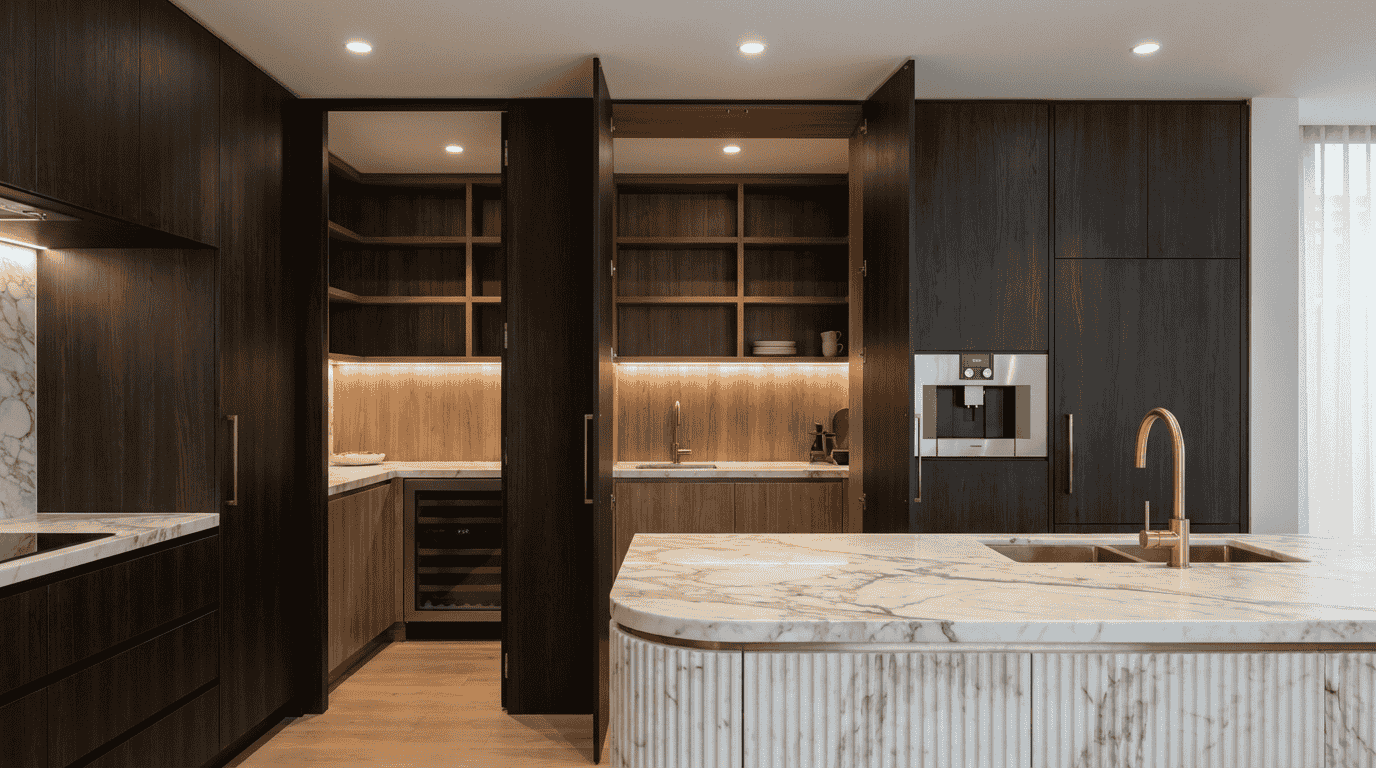
Butler’s pantry ideas have become the new status symbol in Melbourne homes, replacing formal dining rooms as the must-have luxury kitchen feature. This functional space is much more than just extra storage—it’s the workhorse that keeps your main kitchen pristine and organised.
No longer just a shelf and a sink, modern butler’s pantry designs have evolved significantly. Many now include dishwashers, second fridges, ovens, and generous bench space, effectively turning them into working prep kitchens. For a smooth workflow, especially when entertaining, a second sink and mixer is essential. When planning your butler’s pantry layout, consider that functional designs require a minimum width of 1500mm, though 1800mm+ is ideal, with 600mm benches on both sides.
Throughout this guide, you’ll discover the latest butler’s pantry design ideas for Melbourne homes in 2026. We’ll explore the differences between butler’s pantries and walk-in pantries, showcase trending designs, provide smart layout solutions for spaces of all sizes, and help you make informed decisions about materials and appliances that truly make a difference.
Butler’s Pantry vs Walk-In Pantry: What’s the Difference?
When planning your kitchen renovation, understanding the fundamental differences between a butler’s pantry and a walk-in pantry will help you make the right choice for your Melbourne home. These two spaces serve distinct purposes despite often being confused with one another.
Purpose and function of each
A walk-in pantry primarily functions as a storage space for food items, small appliances, and kitchen essentials. It’s essentially a closet for your kitchen goods—practical and straightforward. Generally, walk-in pantries feature shelving on multiple walls and occasionally a small benchtop, but rarely include plumbing or electrical outlets for major appliances.
In contrast, a butler’s pantry acts as a secondary workspace and storage area combined. More sophisticated in function, butler’s pantries typically include:
- A sink with running water
- Power points for appliances
- Benchtop space for food preparation
- Storage for both everyday items and special occasion dinnerware
- Often, a secondary dishwasher or refrigerator
The butler’s pantry serves as a preparation zone and staging area, particularly valuable during entertaining, whereas the walk-in pantry focuses almost exclusively on storage.
Why Melbourne homes prefer a butler’s pantry
Melbourne homeowners increasingly favour butler’s pantries because they perfectly complement our social lifestyle and entertaining culture. Furthermore, modern open-plan kitchen designs have eliminated walls where cabinets once stood, creating a need for additional storage and workspace.
The butler’s pantry allows you to maintain a pristine main kitchen area while containing meal prep mess out of sight. Additionally, Melbourne’s property market recognises the value-add of this feature—homes with well-designed butler’s pantries often command higher resale prices and attract more potential buyers.
How both can work together in modern kitchen designs
Surprisingly, these two spaces aren’t mutually exclusive. In fact, many thoughtfully designed Melbourne homes incorporate both for maximum functionality. For instance, a butler’s pantry might connect directly to a walk-in pantry, creating a workflow that makes perfect sense:
- Store bulk ingredients and appliances in the walk-in pantry
- Prepare foods and drinks in the butler’s pantry
- Serve and entertain in the main kitchen and dining areas
This arrangement creates distinct zones for storage, preparation, and presentation—a truly sophisticated approach to modern kitchen design. Consequently, homeowners enjoy both the organisational benefits of a walk-in pantry and the functional advantages of a butler’s pantry, making the entire kitchen area more efficient and enjoyable to use.
Top 3 Butler’s Pantry Design Trends for 2026
As 2026 approaches, cutting-edge butler’s pantry trends are redefining Melbourne’s luxury homes with innovative design solutions that blend form and function. These modern spaces have evolved from simple storage areas to sophisticated extensions of the main kitchen, offering both practicality and style. Let’s explore the top three butler’s pantry design trends that are setting new standards in Melbourne homes this year.
1. Hidden joinery doors that blend into cabinetry
The invisible transition between kitchen and butler’s pantry has become a hallmark of sophisticated design. Hidden joinery doors that seamlessly blend into surrounding cabinetry create a clean, uninterrupted aesthetic throughout your kitchen space. Moreover, these concealed entrances maintain the streamlined look of your main kitchen while hiding the functional workspace behind.
To achieve this effect, opt for push-to-open mechanisms rather than traditional handles. Cabinet fronts with matching finishes and consistent panel heights ensure the door appears as just another part of your kitchen cabinetry. This approach works particularly well in open-plan living spaces where visual continuity is paramount.
The beauty of hidden joinery lies in the surprise element—guests won’t even realise there’s an entire second kitchen tucked away until you reveal it. This design choice ultimately preserves the clean lines of your main kitchen while providing all the functionality of a dedicated prep space.
2. Open timber shelving for display and function
Open timber shelving has emerged as a standout feature in modern butler’s pantry designs across Melbourne. Unlike closed cabinetry, these shelves create visual interest and warmth through natural timber tones, simultaneously offering practical accessibility to frequently used items.
Victorian ash, American oak, and blackbutt are currently popular timber choices, each bringing unique character to the space. The contrast between timber shelving and other materials—such as stone benchtops or tiled splashbacks—adds dimension and texture to what might otherwise be a purely utilitarian area.
Indeed, the key to successful open shelving lies in thoughtful curation. Display decorative items and beautiful servingware on upper shelves, reserving lower shelves for everyday essentials. This balances aesthetics with practicality, transforming your butler’s pantry into both a functional workspace and a design feature.
3. The second dishwasher for seamless entertaining
The inclusion of a second dishwasher has become almost standard in high-end butler’s pantry designs throughout Melbourne. This addition revolutionises entertaining by allowing you to hide dirty dishes away from your main kitchen, keeping your primary entertaining space immaculate throughout an event.
Compact dishwasher drawers are ideal when space is limited, whereas full-sized models suit larger butler’s pantries. Positioning the dishwasher near the sink creates an efficient cleaning zone that minimises movement between tasks. This thoughtful layout maximises efficiency during busy entertaining periods.
The second dishwasher certainly represents the butler’s pantry’s evolution from simple storage to true working kitchen. It embodies the space’s fundamental purpose—keeping your main kitchen pristine while the real work happens behind the scenes, exactly what makes a butler’s pantry the new status symbol in Melbourne homes.
Smart Layout Ideas for Every Home
Designing the perfect butler’s pantry requires careful planning to maximise functionality, regardless of your home’s size. The key measurements to remember include a minimum walkway width of 1000mm plus 600mm for benchtops [1].
Galley-style pantry: best for narrow spaces
For terraces and townhomes with limited space, a galley-style layout offers the most efficient solution. This straight-line configuration works perfectly in areas as compact as 1.6m, featuring parallel runs with a comfortable 900-1000mm walkway between [2]. Ideally, position tall pantry storage at one end with benchtop and overhead cabinets running along both sides.
L-shaped pantry: ideal for corner integration
L-shaped designs brilliantly utilise corner spaces, requiring a minimum area of 1.6m × 2.2m [1]. This configuration wraps around a corner adjacent to the main kitchen, often including a short return that can cleverly incorporate integrated bins near the sink [2]. L-shaped layouts work exceptionally well when incorporating a fridge or additional appliances [3].
Small butler’s pantry layout tips
Even modest spaces can deliver impressive functionality. For visibility and accessibility, implement shallow shelves (approximately 200mm wide for smaller items like herbs) [1]. Floor-to-ceiling storage maximises capacity, whilst under-bench wire baskets effectively utilise tricky corners [3]. Alternatively, consider a pocket-door cupboard or “appliance garage” to create a mini scullery within your main kitchen [2].
Walk-in pantry design for larger homes
Spacious homes benefit from comprehensive walk-in designs requiring upwards of 2.4m × 2.8m [1]. These larger layouts accommodate double sinks, dishwashers, microwaves, and generous bench space. Outward-swinging doors prevent blocking stored items [4], whilst U-shaped shelving prevents losing items at the back [1].
Material and Appliance Choices That Make a Difference
Savvy material selection in your butler’s pantry not only maximises your budget but also enhances functionality. The right choices can transform this space into the hardworking backbone of your luxury Melbourne kitchen.
Use laminate in pantry, save stone for main kitchen
The butler’s pantry presents a prime opportunity to make practical budget choices without compromising style. Since this area remains largely hidden from guests, opting for laminate benchtops instead of premium stone makes financial sense [5]. You’ll still achieve a cohesive look by colour-matching these surfaces to your main kitchen counters [1]. This strategic approach allows you to allocate more of your renovation budget to visible areas.
Best benchtop materials for high-use zones
Durability should be your primary consideration for butler’s pantry surfaces [6]. This workhouse area endures significant activity, making stain and scratch resistance essential. For high-traffic prep zones, consider:
- Stainless steel near heavy preparation areas
- Hardwearing laminates throughout
- Engineered stone for an upscale feel at moderate cost
- Porcelain/sintered stone for heat resistance [2]
Notably, ultra-compact porcelain surfaces like Dekton and Neolith offer exceptional durability plus the luxurious appearance of natural stone [6].
Appliance integration: what to include and what to skip
Your butler’s pantry should house appliances that support its primary function—keeping your main kitchen pristine. Firstly, a second dishwasher makes practical sense, eliminating the need to transfer dirty dishes back to the main kitchen [6]. Additionally, a microwave fits perfectly here, installed at a comfortable height without aesthetic concerns [6].
Power point placement deserves careful consideration—position at least two double outlets just above benchtop level, either in back or side panels for convenience [1]. Nonetheless, be cautious about installing cooktops, as they necessitate extraction hoods, potentially increasing costs [6].
Hidden pantry joinery tips for a seamless look
A truly sophisticated butler’s pantry blends invisibly into your kitchen design. For an integrated appearance, ensure door alignment matches surrounding cabinetry perfectly [7]. Sliding pocket doors create a clean aesthetic and prevent obstruction issues common with hinged options [6]. Alternatively, a full-height false cabinet wall can cleverly conceal the entry without requiring doors [6].
Conclusion
Butler’s pantries have certainly evolved from simple storage spaces to sophisticated extensions of the modern Melbourne kitchen. This transition reflects changing lifestyles and entertaining preferences across Australian homes. A well-designed butler’s pantry undoubtedly adds both functional value and prestige to your property.
Your butler’s pantry design should align with your specific needs and available space. Whether you opt for a space-efficient galley layout in a terrace home or a comprehensive walk-in design in a larger residence, thoughtful planning makes all the difference. The minimum requirements of 1500mm width with 600mm benches provide a starting point, though wider spaces offer greater functionality.
Design trends for 2026 emphasise seamless integration through hidden joinery, warmth via timber shelving, and practical luxury with second dishwashers. These elements combine to create a space that works efficiently while maintaining aesthetic appeal. Additionally, strategic material choices like laminate benchtops in the pantry can help balance your renovation budget without compromising on quality where it matters most.
Perhaps most importantly, your butler’s pantry serves as the behind-the-scenes hero that keeps your main kitchen spotless during entertaining. This practical benefit explains why butler’s pantries have replaced formal dining rooms as the must-have luxury feature in Melbourne homes. After all, a clean, uncluttered main kitchen creates the perfect impression for guests while the real work happens discreetly in your well-equipped butler’s pantry.
Smart homeowners recognise that butler’s pantries offer both practical advantages and significant resale value. Therefore, investing in this feature represents a worthwhile addition to your home renovation plans. With proper planning and implementation of the ideas discussed, your butler’s pantry will become not just a functional workspace but a true status symbol that elevates your entire home.
Key Takeaways
Modern butler’s pantries have evolved beyond simple storage to become sophisticated working kitchens that maintain your main kitchen’s pristine appearance whilst providing essential prep space.
• Butler’s pantries require minimum 1500mm width with 600mm benches, though 1800mm+ is ideal for optimal functionality • Hidden joinery doors, open timber shelving, and second dishwashers are the top 2026 design trends transforming Melbourne homes • Use laminate benchtops in pantries to save budget for stone in main kitchens without compromising style or durability • Galley layouts work brilliantly for narrow spaces, whilst L-shaped designs maximise corner areas effectively • Strategic appliance placement including dishwashers and microwaves keeps mess hidden whilst supporting seamless entertaining
A well-designed butler’s pantry serves as the behind-the-scenes hero of modern entertaining, allowing you to maintain an immaculate main kitchen whilst handling all the real work discreetly. This practical luxury feature has become Melbourne’s new status symbol, offering both immediate functional benefits and significant resale value for discerning homeowners.
FAQs
Q1. What is the minimum width required for a functional butler’s pantry? A functional butler’s pantry requires a minimum width of 1500mm, though 1800mm or more is ideal for optimal functionality. This allows for 600mm benches on both sides with adequate walkway space.
Q2. How does a butler’s pantry differ from a walk-in pantry? A butler’s pantry serves as a secondary workspace and storage area, often including a sink, power points, and appliances. In contrast, a walk-in pantry primarily functions as a storage space for food items and kitchen essentials, typically without plumbing or major appliances.
Q3. What are the top design trends for butler’s pantries in 2026? The top design trends for butler’s pantries in 2026 include hidden joinery doors that blend into cabinetry, open timber shelving for display and function, and the inclusion of a second dishwasher for seamless entertaining.
Q4. Should I use stone or laminate for my butler’s pantry benchtop? It’s recommended to use laminate benchtops in the butler’s pantry to save on costs, while reserving stone for the main kitchen. Laminate offers durability and can be colour-matched to maintain a cohesive look with the main kitchen counters.
Q5. How can I maximise space in a small butler’s pantry? To maximise space in a small butler’s pantry, consider implementing shallow shelves (about 200mm wide) for smaller items, using floor-to-ceiling storage, and incorporating under-bench wire baskets for tricky corners. A galley-style layout can also be efficient for narrow spaces.
References
[1] – https://www.homebeautiful.com.au/kitchen-ideas/how-to-design-the-perfect-butlers-pantry/
[2] – https://eco2.com.au/articles/butlers-pantry-ideas-australia-layouts-storage-appliances-for-effortless-entertaining
[3] – https://www.carlislehomes.com.au/blog/home-ideas/plan-your-perfect-butlers-pantry/
[4] – https://www.rawsonhomes.com.au/blog/walk-in-pantry
[5] – https://www.kookaburrahomes.com.au/tips-tricks/tips-for-creating-the-perfect-butlers-pantry/
[6] – https://www.houzz.com.au/magazine/kitchen-upgrade-10-must-have-inclusions-for-a-butler-s-pantry-stsetivw-vs~105686729
[7] – https://carolinashomestone.com/hidden-pantry-design-kitchen/