The Decision That Changed the Whole Kitchen
The Camberwell brief was straightforward until it was not. A 1920s California Bungalow, full kitchen rebuild, book-matched American oak cabinets already specified and approved. The open question was the benchtop — and the client had been holding it open for six weeks because every material she researched contradicted the last.
Caesarstone: reliable but she had seen it everywhere. Natural marble: wanted it, feared it. Porcelain: intriguing, but uncertain.
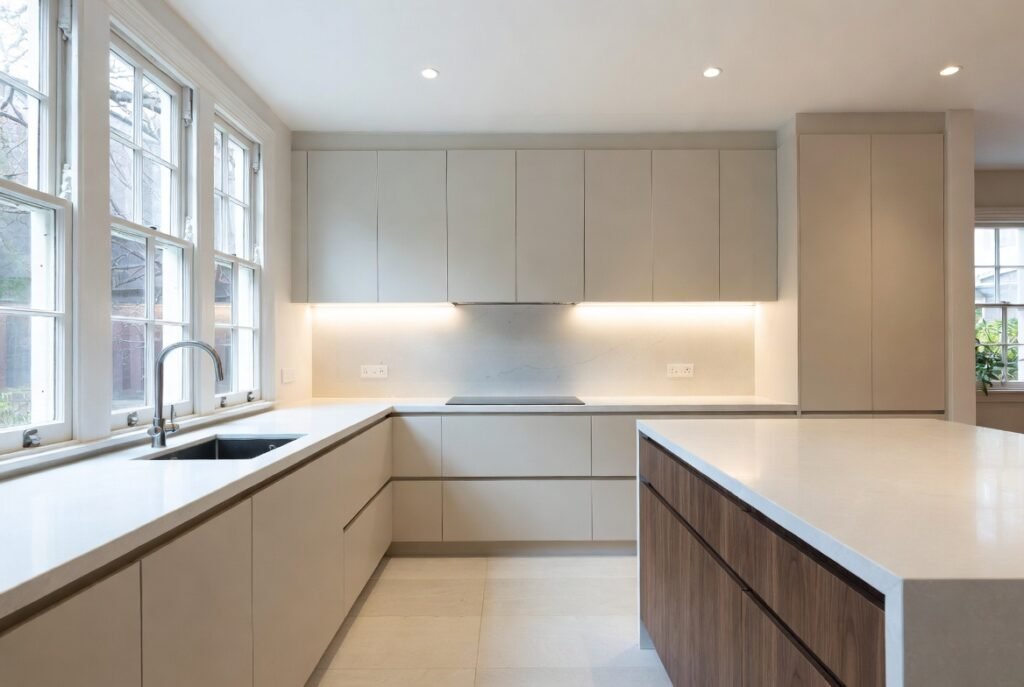
We templated the island and specified a 1200 x 2800mm porcelain waterfall in a white vein-on-cream base, 12mm profile, seamless mitre at the vertical edge. The perimeter counters went in Caesarstone Fior di Bosco — a warm greige with subtle veining that read as stone without competing with the island’s stronger statement.
The oak below. The porcelain above. The Caesarstone perimeter providing the visual rest the room needed.
At handover the client said: “I cannot believe I almost chose marble.”
That decision process — held too long, resolved only when the materials were seen together in context — is the most common benchtop story in Inner East Melbourne kitchens in 2026. This guide is the decision framework that resolves it faster.
For the full context on kitchen renovations Camberwell and how Silk Touch approaches the material specification process, the pillar page covers the complete project scope.
Why the Benchtop Is the Single Biggest Decision in 2026 Melbourne Kitchens
The benchtop is not the most expensive line item in a kitchen renovation. The joinery carcasses, the hardware, the appliances — all cost more individually. But the benchtop is the material that determines how the room reads, because it occupies the horizontal plane at the height where eyes rest.
Every other material choice in the kitchen — veneer, hardware finish, splashback, flooring — is read against the benchtop. Get the benchtop right and the rest of the room falls into coherence. Get it wrong and no amount of quality in the surrounding joinery rescues the visual outcome.
Three forces are shaping benchtop decisions in Melbourne’s Inner East in 2026.
Zero-silica awareness. The engineered stone industry’s connection to silicosis in fabrication workers has changed the specification conversation materially. Caesarstone, Silestone, and several other engineered quartz brands have launched silica-free or low-silica ranges in response. For homeowners who want engineered stone without the associated occupational health concerns, these ranges now exist — and they are the specification Silk Touch recommends first in the Caesarstone category.
Matte surface demand. The polished stone kitchen benchtop is giving ground to honed and matte finishes. A matte Caesarstone or honed quartzite does not show fingerprints in the same way a polished surface does. In high-traffic Inner East family kitchens, this is a practical argument as well as an aesthetic one.
Porcelain’s technical maturation. Large-format porcelain benchtops at 12mm and 6mm profiles have been technically available for a decade. In 2026, the fabrication capability to execute a seamless waterfall mitre in porcelain without visible joins — a detail that defeated many Melbourne fabricators as recently as 2023 — is now reliable. The material’s moment has arrived.
2026 Trend Overview: What Is Actually Selling in Inner East Melbourne
Three aesthetic directions are dominant in Silk Touch’s specification conversations across Toorak, Kew, Camberwell, and Hawthorn in early 2026.
Warmer neutrals over stark white. The all-white kitchen with bright white benchtops had a long run and is not disappearing, but it is being supplemented by warm creams, warm greiges, and stone tones that reference the original material palette of Melbourne’s heritage housing stock. Caesarstone’s Mineral range leads this direction.
Matte and honed over polished. Polished stone reads as formal and shows use quickly. Matte and honed surfaces read as considered — they age with the kitchen rather than against it. In heritage homes where the patina of age is an asset rather than a liability, this is the correct material logic.
Waterfall edges and seamless profiles. The benchtop-as-object has replaced the benchtop-as-surface. Waterfall edges on islands — where the material drops vertically to the floor on one or both ends — are the specification that most frequently appears in Silk Touch’s 2026 kitchen projects. The 2026 Kitchen Island Trends for Melbourne’s Inner East Homes covers how waterfall edges integrate with island design in detail.
Caesarstone in 2026: The Reliable Evolution
Caesarstone is the engineered quartz brand that has dominated the mid-to-premium residential kitchen specification in Melbourne for fifteen years. In 2026 it remains the most commonly specified benchtop material in Silk Touch’s kitchen projects — but the specific products within the range have shifted.
The Mineral Range: Zero-Silica Specification
Caesarstone’s Mineral series is the silica-free range launched in response to the Australian engineered stone regulatory environment. It uses mineral and non-silica materials to produce engineered stone with the same surface characteristics as quartz — consistent colour, high hardness, low porosity — without the silica content that creates fabrication health risks.
For clients who want engineered stone and have heard about silicosis concerns, the Mineral range is the specification answer. The surface performs identically to standard Caesarstone in domestic use. The fabrication risk is the manufacturer’s responsibility, not the homeowner’s concern, but specifying a zero-silica product removes the connection to the issue entirely.
Key Mineral range tones relevant to Inner East Melbourne kitchens in 2026: Empira White (warm white with subtle movement), Fior di Bosco (warm greige with soft veining), Alpine Mist (cool grey with linear patterning).
Caesarstone Performance Profile
- Hardness: 7 on the Mohs scale — harder than most natural stones except granite and quartzite
- Porosity: Non-porous. No sealing required.
- Heat resistance: Moderate. Thermal shock can cause cracking — use a trivet. Do not place hot pans directly.
- Scratch resistance: High. Standard kitchen use will not scratch engineered quartz.
- Maintenance: Wipe clean with warm soapy water. No acid cleaners.
- Warranty: 25-year residential warranty (Caesarstone international)
- Installed cost range (Melbourne 2026): $800–$1,400 per square metre installed, depending on edge profile and colour selection.
Caesarstone is the correct specification when consistency and low maintenance are the primary criteria. The surface reads the same in five years as it does on the day of installation. For families with young children, high daily use, and no appetite for maintenance protocols, this predictability is a specification advantage.
Porcelain Benchtops: The Technical Argument
Porcelain benchtops are the specification that requires the most explanation — because the material’s limitations sound alarming until the context is applied.
Porcelain is brittle. Drop a heavy cast iron pan on its edge and the surface can chip. This is true, and it matters at the fabrication and installation stage, which is why the fabricator’s capability matters more for porcelain than for any other benchtop material.
In use, the brittleness concern is largely theoretical. A standard domestic kitchen does not produce the impact events that damage porcelain. The material’s actual performance profile is exceptional.
Porcelain Performance Profile
- Heat resistance: Full — a hot pan directly from the cooktop will not damage porcelain. No trivet required.
- Scratch resistance: Exceptionally high — fired at 1200°C, the surface is harder than steel
- Stain resistance: Zero porosity. Nothing penetrates. Red wine, oil, coffee — wipe clean.
- UV resistance: Porcelain colour does not fade. Relevant in kitchens with significant north-facing window exposure.
- Thickness: 12mm standard (most benchtop applications); 6mm available for worktop-only applications where weight is a constraint
- Edge profile: The waterfall mitre is the technically demanding specification. A 45-degree mitre on a 12mm slab, matched for vein direction across the vertical drop, is the detail that separates a premium installation from a competent one.
- Maintenance: None. Clean with any household product. No sealing. No oiling.
- Installed cost range (Melbourne 2026): $1,000–$2,000 per square metre installed for standard profiles; waterfall edges add $400–$800 per vertical metre depending on mitre complexity.
Porcelain is the correct specification when heat exposure, zero maintenance, and visual drama are all priorities simultaneously. In a kitchen with an induction cooktop that gets significant direct use, porcelain removes every thermal concern that Caesarstone carries.
The material’s moment in Inner East Melbourne corresponds with the availability of fabricators who can execute the waterfall mitre correctly. Silk Touch coordinates directly with its Melbourne stone fabrication partners — the 2026 Bathroom Vanity Trends Melbourne post covers the same fabricator relationship in the vanity context.
Natural Stone: Marble, Quartzite, and Granite
Natural stone in kitchen benchtop applications is the specification that demands honesty about maintenance before the aesthetics conversation begins. Clients who commit to natural stone with accurate maintenance expectations end up with the most satisfied outcome in the long run. Clients who specify marble based on appearance alone and discover the reality at six months are the renovation regret story Silk Touch works hardest to prevent.
Marble
The honest assessment: Marble is calcium carbonate. Acids etch it — lemon juice, wine, coffee, vinegar-based cleaners. This is not a maintenance failure. It is the material’s chemistry, and no sealing product prevents it permanently. Etching produces a dull mark on the polished surface that is visible on light marbles and less visible on veined or darker alternatives.
Where marble is the correct specification: Heritage homes where the aesthetic is the unambiguous priority and the client has been explicitly briefed on maintenance. A Toorak Georgian home with marble benchtops has a visual and material logic that cannot be replicated with any engineered alternative. The client must want the material, not just the look.
Best marble specifications for Inner East Melbourne: Bianco Carrara (classic white with grey veining), Calacatta (bolder veining, higher contrast), Statuario (dramatic movement, premium pricing). All should be specified in a honed finish — polished marble shows etching immediately, honed marble ages with the kitchen.
Installed cost range (2026): $1,200–$3,000+ per square metre installed, depending on origin, movement, and slab selection.
Quartzite
Quartzite is the natural stone specification that delivers marble’s aesthetic without marble’s acid vulnerability — with the important caveat that quartzite hardness varies significantly by origin.
True quartzite (metamorphic rock, primarily quartz) is harder than marble and more acid-resistant. Soft quartzites sold under similar marketing language are sometimes dolomite or calcium-rich stone that performs more like marble than quartzite. Slab testing matters.
Specification standard: Silk Touch recommends requesting an acid test on any quartzite slab before committing. Drop a small amount of lemon juice on the back of the slab. If it fizzes, the stone contains calcium carbonate and will etch. If it does not react, the stone is true quartzite and will perform accordingly.
Popular quartzite specifications in Melbourne’s Inner East in 2026: Taj Mahal (warm cream with subtle gold movement), Sea Pearl (grey-green with pronounced movement), White Macaubas (bright white with linear veining — often mistaken for Carrara marble at distance, performs significantly better).
Installed cost range (2026): $1,400–$3,500+ per square metre installed.
Granite
Granite is the natural stone that performs best in a kitchen context — hardest, most acid-resistant, highest heat tolerance — and is the most under-specified in Inner East Melbourne because its aesthetic is associated with an earlier renovation generation.
In 2026, leathered and honed granite finishes have partially rehabilitated the material for clients who have ruled it out based on memories of polished black granite from the early 2000s. A leathered absolute black granite or a honed Bianco Antico reads as contemporary in a way that polished granite does not.
Installed cost range (2026): $900–$2,000 per square metre installed.
Head-to-Head Comparison
| Specification | Caesarstone (Mineral) | Porcelain | Marble | Quartzite | Granite |
|---|---|---|---|---|---|
| Heat resistance | Moderate — use trivet | Full — direct heat OK | Moderate | High | Full |
| Scratch resistance | High | Very high | Low–moderate | High | Very high |
| Stain resistance | Very high | Full | Low (sealing required) | Moderate–high | High (sealed) |
| Acid resistance | High | Full | None | High (if true quartzite) | High |
| Maintenance | Minimal | None | High | Low–moderate | Low |
| Sealing required | No | No | Yes — annually | Varies | Yes — every 2–3 years |
| Waterfall edge | Good | Excellent | Good | Good | Moderate |
| Heritage suitability | Good | Good | Excellent | Excellent | Moderate |
| Contemporary suitability | Excellent | Excellent | Good | Good | Good |
| Colour consistency | Full | Full | Variable | Variable | Variable |
| Warranty | 25-year residential | Varies by brand | None | None | None |
| Cost per m² installed | $800–$1,400 | $1,000–$2,000 | $1,200–$3,000+ | $1,400–$3,500+ | $900–$2,000 |
Best Benchtop by Home Style and Room
Heritage Inner East Kitchens: Federation, Edwardian, Californian Bungalow
Heritage kitchens in Camberwell, Kew, and Hawthorn typically have smaller footprints, more complex geometry, and an existing material language that the benchtop must reference without replicating.
For the perimeter benchtop in a heritage kitchen — where the material is at lower visual prominence and the joinery carries the design statement — Caesarstone Mineral is the correct specification. Warm greige tones in the Mineral range reference original stone without the maintenance commitment.
For the island benchtop where it exists — and in many heritage extensions, a modest island is the spatial centrepiece — quartzite or porcelain is the specification that rewards the prominence. The kitchen renovation Hawthorn context is the most common scenario: a heritage rear extension with a modest island where the stone selection is the room’s most visible design decision.
Marble in heritage kitchens is the correct specification when the client has both the aesthetic intention and the maintenance commitment. A Toorak Georgian kitchen with Calacatta marble benchtops is a coherent design statement. The same specification in a Camberwell family kitchen with primary-age children is a problem deferred.
Contemporary Extensions and New Builds
Contemporary kitchen extensions — rear additions, basement kitchens, dual-level open plans — have different material requirements. The geometry is consistent. The footprint is generous. The design language is not heritage-constrained.
In these contexts, porcelain is the specification that contemporary clients respond to most strongly in 2026. The zero-maintenance profile, the heat resistance, and the capacity for a dramatic large-format slab with pronounced movement are all arguments that resonate with homeowners who are specifying for a twenty-year horizon.
Caesarstone remains the correct specification for budget-conscious contemporary builds or where colour consistency across a long run of perimeter benchtop is a priority.
For Brighton coastal homes specifically — where the outdoor kitchen connection is common and UV exposure is material — porcelain is the only specification that does not fade or degrade at the indoor-outdoor junction. Kitchen renovations Brighton covers the coastal context in detail.
Islands vs Perimeter
The island and the perimeter benchtop do not need to be the same material — and in 2026 Melbourne, they frequently are not.
The mixed-material specification — porcelain island, Caesarstone perimeter, or quartzite island, Caesarstone perimeter — allows the island to function as the design statement while the perimeter provides the visual rest the room needs. The material contrast must be tonal neighbours, not opposites: a warm-cream porcelain island against a warm-greige Caesarstone perimeter. Not a white island against a dark perimeter.
The American Oak Veneers In Depth guide covers how the cabinet timber below informs the benchtop tone selection above — the two decisions are not independent.
How Silk Touch Sources, Fabricates and Installs Benchtops
Survey and laser measure. Every benchtop starts with a laser measure accurate to ±1mm. Heritage kitchen geometry — non-parallel walls, out-of-square corners, irregular window reveals — is captured precisely. The template drives the fabrication. If the template is wrong, the stone is wrong, and stone cannot be unfabricated.
Slab selection. For natural stone and porcelain, Silk Touch accompanies clients to the Melbourne slab yard for selection. A sample photograph does not represent what a full slab looks like in the space. The slab that will be installed is selected, photographed, and tagged before any cutting begins.
Fabrication coordination. Silk Touch coordinates directly with its Melbourne stone fabrication partners. The benchtop fabrication is scheduled to align with the joinery installation programme — the stone arrives after the cabinets are set and level, not before. An early stone delivery creates site damage risk. A late delivery extends the overall programme.
Installation and scribing. The benchtop is installed after the cabinet carcasses are fixed, levelled, and adjusted. Wall-adjacent edges are scribed to the actual wall profile — a critical step in heritage homes where walls are rarely plumb. A benchtop cut square to the template and installed against a wall with 12mm of variation will show a gap. A scribed benchtop will not.
Waterfall mitre. The vertical drop of a waterfall edge requires a 45-degree mitre where the horizontal and vertical slabs meet. The vein direction must be continuous across the mitre — a bookmatched or directional join. This is a fabrication decision made at the slab yard, not at installation. Silk Touch confirms the mitre direction with the client and the fabricator before the slab is cut.
Total programme from confirmed design to benchtop installation: 6–8 weeks. Stone fabrication is within this timeline when the slab is selected and the template is complete within the first two weeks.
Real 2026 Inner East Case Studies
Camberwell, California Bungalow, January 2026. Porcelain waterfall island in a white-vein cream base, 1200mm wide, 12mm profile. Perimeter in Caesarstone Fior di Bosco. American oak veneer below on island, 2-Pac Fenix Grigio Efeso on perimeter cabinets. The material contrast — warm stone against warm grey — resolved the room.
Kew, Edwardian, December 2025. Taj Mahal quartzite across both island and perimeter — continuous material, differentiated by the waterfall edge on the island end. Honed finish. The client had initially specified Calacatta marble; the acid test at the slab yard produced a strong reaction. The switch to Taj Mahal preserved the aesthetic intention without the maintenance commitment.
Hawthorn, Inter-War kitchen extension, November 2025. Caesarstone Empira White on a modest 1000mm island, matching perimeter. The kitchen had three primary-age children and a high-use daily schedule. The specification was correct for the brief. Porcelain was considered and declined on impact-risk grounds — the children’s use pattern included direct cabinet-to-benchtop contact with sporting equipment.
Toorak, Georgian renovation, October 2025. Honed Calacatta marble on the island, Caesarstone Mineral Alpine Mist on the perimeter. The marble was the client’s non-negotiable — a deliberate heritage reference. Maintenance protocol was discussed and documented. At six months, the island shows the patina of use that the client expected and accepts. The perimeter Caesarstone is unchanged.
Brighton, contemporary rear extension, September 2025. Porcelain throughout — island and perimeter — in a large-format light grey with subtle movement. The kitchen opened directly to an outdoor entertaining area. The indoor-outdoor continuity, combined with the full sun exposure on the exterior-adjacent benchtop, made porcelain the only viable specification.
Transparent 2026 Pricing Guide
Benchtop pricing in Melbourne’s Inner East in 2026 is determined by five variables: material, surface area, edge profile complexity, slab selection (for natural stone and porcelain), and installation complexity.
Budget range — Caesarstone standard colours, simple edge profiles, under 6m² of benchtop: $4,800–$8,400 installed.
Mid range — Caesarstone Mineral or porcelain in a standard profile, 6–10m² of benchtop: $8,000–$16,000 installed.
Premium range — porcelain with waterfall edge, or quartzite/marble with complex profiles, 8–14m²: $14,000–$28,000 installed.
Full specification — natural stone or large-format porcelain with bookmatched waterfall edges, integrated sink cutouts, and heritage scribing: $22,000–$40,000+ installed.
What moves price most significantly:
Waterfall edges — the mitre fabrication, the additional slab area for the vertical drop, and the installation complexity add $2,500–$6,000 per waterfall end.
Integrated sink cutout — an undermount sink requires a reinforced cutout with a polished or honed edge on the underside. This adds $800–$1,800 depending on the material and edge profile.
Heritage scribing — benchtop edges adjacent to heritage plaster walls require scribed profiles cut to the actual wall contour. This adds $400–$1,200 to the installation cost.
Natural stone slab premium — book-matched quartzite or marble at the premium end of the slab market adds $800–$2,500 over standard stock pricing before any fabrication cost.
The Verdict: One Decision That Does Not Need to Be Difficult
The benchtop decision is only difficult when it is made without a framework. With the framework, it is a four-question process.
What is the primary use pattern? High-heat cooking with direct pan contact → porcelain. Standard domestic use → Caesarstone or quartzite. Aesthetic priority over performance → marble.
What is the maintenance commitment? Zero tolerance → porcelain or Caesarstone. Willing to seal annually → quartzite or granite. Willing to accept patina and etch → marble.
What is the home style? Heritage → quartzite or marble. Contemporary → porcelain or Caesarstone Mineral. Coastal → porcelain throughout.
What is the budget horizon? Twenty-year build → invest in the correct material regardless of cost. Five-year hold before sale → Caesarstone Mineral is the most universally appealing specification to the broadest buyer pool.
Silk Touch walks through this framework at the free 3D design consultation — with material samples in hand, in the context of the actual joinery specification.
Book your free 3D kitchen design consultation — the benchtop conversation takes twenty minutes when the framework is clear.
Frequently Asked Questions
What is the most popular kitchen benchtop in Melbourne in 2026? Caesarstone Mineral range is the most frequently specified engineered stone in Silk Touch’s 2026 Inner East kitchen projects, driven by the zero-silica specification and the warmer tone palette. Porcelain is the fastest-growing specification, particularly for island waterfall applications. Natural quartzite is the premium natural stone specification in Toorak and Kew heritage kitchens.
Is porcelain better than Caesarstone for a kitchen benchtop? Porcelain outperforms Caesarstone on heat resistance — direct pan contact will not damage porcelain — and on long-term stain resistance. Caesarstone outperforms porcelain on impact resistance and is the more forgiving specification in households with young children or heavy daily kitchen use. Both are correct specifications; the choice follows the use pattern.
Can I use marble in an Inner East Melbourne kitchen? Yes — with accurate expectations. Marble will etch when exposed to acidic liquids (wine, lemon, vinegar). A honed finish shows etching less than a polished finish. Silk Touch recommends marble only after explicitly discussing the maintenance reality and confirming the client has accepted it as part of the material’s character. It is the most beautiful specification; it is not the most practical one.
What is the difference between quartzite and engineered quartz? Quartzite is a natural metamorphic rock formed from sandstone — it is mined, cut, and honed or polished. Engineered quartz (Caesarstone, Silestone) is manufactured from quartz aggregate and resin binders. Quartzite has natural variation and requires sealing. Engineered quartz is consistent and non-porous. Quartzite performs better aesthetically in heritage contexts; engineered quartz performs better in high-maintenance-averse households.
How much does a kitchen benchtop cost installed in Melbourne in 2026? Standard Caesarstone in simple profiles runs $4,800–$8,400 installed for a typical Inner East kitchen. Porcelain or Caesarstone Mineral in mid-specification runs $8,000–$16,000. Premium natural stone or porcelain with waterfall edges runs $14,000–$28,000. Full specification with bookmatched waterfall edges and heritage scribing can reach $22,000–$40,000+.
What benchtop works best in a heritage home kitchen? Quartzite is the strongest specification for heritage kitchens — the natural variation and warmth reference original stone without the acid vulnerability of marble. Caesarstone Mineral in warm greige tones is the correct specification where budget or maintenance concern rules out natural stone. Marble is correct where the aesthetic is the unambiguous priority and the maintenance commitment is genuine.
Do I need to seal a porcelain or Caesarstone benchtop? No. Both porcelain and engineered stone (Caesarstone) are non-porous and require no sealing. Natural stone — marble, quartzite, granite — requires periodic sealing: marble annually, quartzite and granite every two to three years. Sealing reduces stain absorption but does not prevent acid etching on marble.